
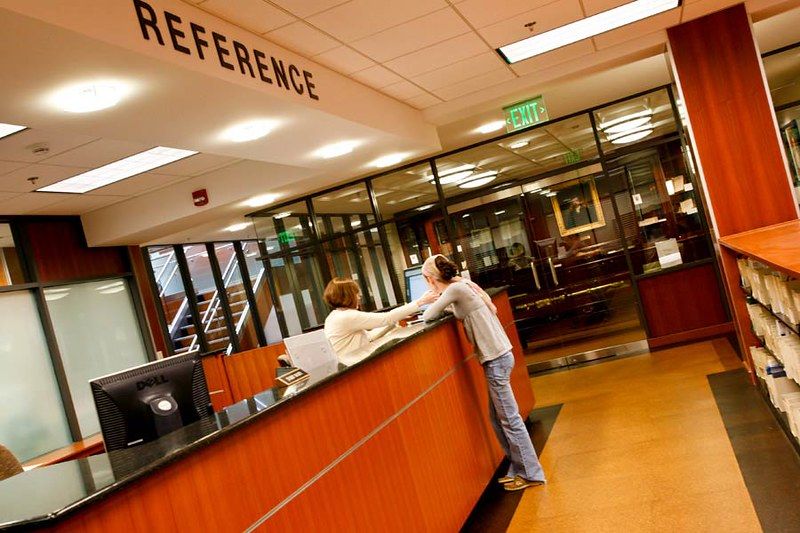
CC Image courtesy of The Wolf Law Library on Flickr
reference services: assistance provided by a librarian to meet the information needs of patrons; may include answering questions, instructing of information-finding techniques, conducting searches, directing patrons to resources, and assisting in evaluation of information
This definition adapted from Reitz (2013) may seem simplistic but there is a lot at play in the words “meet the information needs of patrons”. In an ever-changing digital landscape, this is becoming an increasingly complex task. In order to avoid feeling overwhelmed, I have tried to keep in mind the following characterization from Riedling:
The reference process is comprised of five steps:
- A need for information
- A question
- The search for information
- An answer or response
- An evaluation
Despite the explosion of information that continues to assault us, it is comforting to know that the general reference process remains the same. I have begun to think about how I can provide effective reference services as a teacher-librarian. Knowledge of the library learning commons collection is not limited or even foundational to knowing the books on the shelves. Extensive knowledge of the online databases subscribed to by the district will help me be better prepared to assist my students in their search. Finding the balance between selecting, acquiring and evaluating resources to meet students’ needs and guiding them to do this on their own will also be an area of concern. I feel like my strength in providing reference services will be modelling patience with the frustrations that often accompany reference services and an ability to stay positive despite these.
Another foundational aspect of reference services today is the debate between print vs. non-print reference sources. While I do think it is important to expose students to both sources in order to foster multiliteracies, I recognize students’ preference for electronic resources. In my experience, most libraries in my district lack sufficient electronic resources while keeping out-of-date print resources on their shelves. Ensuring that my collection only houses updated, engaging print resources and turning the reference section into a gathering spot will encourage the use of print resources. While I acknowledge that my own preference is for electronic and digital resources, I know there is value in a balanced collection. This article about St. Catherine’s School portrays the kind of balance that I envision in my own library.
Finally, the key to a robust reference section is collection evaluation. I look forward to putting into practice the learning material in Lesson 3 in Assignment 1: Evaluation of a Reference Work.
Works Cited
Katley, K. (2016, December 16). For future reference. Kim Catley. http://www.kimcatley.com/portfolio/2017/1/30/for-future-reference
Reitz, J. (2013, January 10). Online dictionary for library and information science. ABC-CLIO. https://products.abc-clio.com/ODLIS/odlis_about.aspx
Riedling A., & Houston, C. (2019). Reference skills for the school librarian: Tools and tips. Libraries Unlimited.
Hi Kerri! I love your description “ explosion of information that continues to assault me” I can totally relate to you! Our jobs and what is expected of us is a lot! I also relate to you in regards to print vs non print. My library is also lacking in terms of digital resources with a lot of in print outdated, reference books. The digital resources we do have often go unused because students are unsure how to use them or don’t know they even exist! I think storing and promoting digital resources can be very tricky. I hope to learn new strategies in promoting them!
Hi Kerri! I really relate to your point about modelling patience with the frustrations caused by reference resources, particularly digital ones. I find that many of us are still trying to play catch-up with our digital references because we lack the appropriate technology (and capability) to access them. I hope this is something that will change in the future, particularly as the term teacher librarian becomes synonymous with media and technology specialist. Maintaining a positive attitude through it all is challenging, but important when it comes to building those meaningful connections with our students 🙂