Categories
Comm 486F Blogs

Reply: Comparing Social Smoking to Public Farting – Kathy Lin

https://www.youtube.com/watch?feature=player_embedded&v=fb5q2eie4ko

YouTube Preview Image

After reading Kathy’s blog, I started to think about her question, “do you think this campaign will last/make an impact”? From my experiences, Government advertisements usually run on TV longer than regular ads. However, this Ontario Ministry of Health advertisement has become a hit on Youtube, which offers free publicity and the ability to watch it on demand. So, do I think this campaign will last? Unfortunately, I do not. Although I thoroughly enjoyed viewing the advertisement, in general, most ads just don’t last. Aside from parents and educators showing the clip for educational purposes, I don’t think most viewers will re-watch this advertisement. However, I do think this ad will be popular for at least another 3 – 6 months, giving a chance for first time viewers to watch it. Additionally, I think Ontario should drop the “nibbling” and “ear wax” ads, and focus exclusively on the farting ad, as it has the most Youtube hype (over 810,000 hits). I think it would also be a good idea for other provincial governments to pick up the campaign, and advertise this social cause. If they make it a centralized campaign, I believe the chance of viewership and behaviour change will rise greatly.

However, I do believe the advertisement will leave a lasting impact for those who view it. Many of my friends do exactly what the ad is trying to prevent – social smoking. They believe it makes them part of the “cool” circle, and that it’s an easy way to meet new people. Unfortunately, the reality is that this is the way many people view smoking, and I believe it’s nothing short of ridiculous. However, I believe that for the most part, they smoke without truly thinking about why, or about the potential health ramifications of their actions. This ad will hopefully snap them out of this unconscious state, and make them realize that their actions are as unreasonable as smoking, picking earwax, or nibbling in public. Thus, although I do not believe the ad will be a hit forever, I do think it will make an impact on the viewers who are currently “social smoking”, and even on ones considering it.

YouTube Preview Image

Source: https://blogs.ubc.ca/kathylin/

Categories
Comm 486F Blogs

Final Blog Post Question Response

It is safe to say that before I took this course, I knew close to nothing about sustainability. Now, not only do I know a ton of buzzwords, but I also have a true understanding of several key concepts, and I’m considering doing a minor in sustainability!

Has sustainability marketing changed how you think about how you live your life as a consumer?

Short answer – yes. Although I’ve heard the word before, this course put “consumerism” into perspective for me. In order for us to be “happy” we must purchase, and purchase, and then purchase a little more. This is what most people in our society are trained to think, and it appears as though it’s a necessary phenomenon in order for our world to go round. I was definitely trained to think this way. However, this course snapped me out of the trance, and taught me numerous methods, and companies to help change my behaviour. Now, I’m aware of companies like Patagonia and their “footprint chronicles”. I can even proudly say that I helped encourage my mom buy a Patagonia jacket instead of one from Adidas. Also, I’m now aware of true obsolescence and planned obsolescence. Now, I try to avoid buying products from companies who plan obsolescence, such as Apple, as much as possible (thus far, it has not been an easy task, but I’m keeping strong).

Has sustainability marketing changed how you think about business?

Again, short answer – yes. I think it would be hard for anyone who took this course to disagree. Not only do companies who truly value sustainability do good for the environment, but they also have the potential to boost their profit margins and their brand image. To me, being a sustainable business is an easy, and necessary solution. The Ted talk video of Ray Anderson taught me that even in an industry where it is the norm to be a polluter, there is an opportunity for change. Most CEOs are close-minded about investing in innovative solutions. To all of them, I suggest they watch the Ray Anderson Ted talk. Going green gives most companies an advantage of being ahead of pressing government regulations, and of course, cost savings. However, this course taught me that once a business is set up, it’s extremely hard to make changes. Although the long term gains will usually outweigh the short term costs, most companies are not willing to make the large initial capital investment and potentially lose their competitive advantage. Thus, I have a whole new respect for the companies that have embodied green values.

Has sustainability marketing changed what you think a sustainable society might look like?

Yet again, short answer – yes. However, now that I’m more aware of what a sustainable society could look like, I’m less optimistic that our society will ever truly be sustainable. By this, I mean there will always polluters, as certain industries (and countries) are reliant on the existing way they do business. Even with innovation, I believe certain things will never change, or at least not in my lifetime. In today’s era, I think Vancouver is pretty close to what a sustainable society will ever look like. With the implementation and fulfillment of a few policies (such as banning plastic bags), Vancouver, relative to most cities, is sustainable. Just as we saw in class, there is a learning curve before sustainable initiatives become understood and accepted. When the city of Calgary first introduced blue recycling bins, it took a lot of research, and time before there was a change in consumer conservation behaviour. Thus, this course showed me that our society has the potential to be sustainable; we just have to introduce it in the right way, with the right initiative, at the right time.


Categories
Comm 486F Blogs

Reply: What is Recycling? – Laurel Jay

Reading Laurel’s blog post, which mainly concentrated on poor recycling practices in the U.S. was both eye opening, and made me extremely frustrated. How could a university, or city (via mandates) not ensure sports facilities have nearby recycling bins?

Sure, it would be ideal to have everyone use a re-usable bottle. However, we do not live in an ideal world. The majority of athlete’s still use plastic bottles, but at least have the resources to recycle. One question is, why do these athletes use plastic bottles? Perhaps its because while watching professional sports games (especially soccer), almost every team uses plastic bottles. Likely, there are nearby recycling bins to dispose these bottles, however, is that really enough? These teams have the potential to truly make a difference, and be the driving force behind change. If one major team started using re-usable bottles, would there be a domino effect? I believe so.

This leads me to my next point, government intervention. Why is there no mandate for sporting facilities to have recycling bins within a, say 200-meter radius of each facility? Secondly, when will they fully ban plastic bottles? My belief is that the first part of the question would be easier to enforce. It truly doesn’t make sense to me how these facilities could not have recycling bins nearby. How many plastic bottles per day/year are going to landfills because of politician’s lackadaisical behaviour? As for the second part, re-usable bottles save consumers money, are better for the environment, and are healthier (plastics = bad). Do governments care solely about tax earning from bottle sales? Likely, yes. However, I think now is the time for change. Filtration systems are widely available, so a plastic bottle ban likely wouldn’t be too hard to implement. From my point of view, this change only benefits the general public. What do you think?

The last point I wanted to touch on was the $0.05 recycling fee. Do stores charging this fee truly create an incentive for consumers to recycle their beverages? I think it can go either way. My feeling is that cities currently charging a recycling fee are more focused on being green, and thus, would have more “Return-It Depot’s”, or other recycling resources available. However, as Laurel mentioned, a place like Austin Texas, who offers few to zero recycling bins, doesn’t charge a recycling fee. Likely, the reasoning is the population’s inadequate knowledge about the benefits of recycling. Thus, even with more bins, or a fee, I truly believe that without a major social recycling program, behavioural change would not occur.

Blog Post: https://blogs.ubc.ca/laureljay/

Categories
Comm 486F Blogs

Reply: “Seriously Good” Ice Cream – Oliver Bernardino

After reading Oliver’s post on Earnest Ice Cream – a Vancouver company that in my mind, has flown under the radar, I became curious. Firstly, why are consumers willing to pay a premium (also known as premium green pricing), and secondly, why have I not heard of this before!?

Earnest Ice Cream is 100% made in Vancouver, uses mostly natural ingredients and is sold in single pint re-usable glass mason jars. Together, they lead to a price of $10 (which includes a $1 deposit for the glass jar). So, why are consumers willing to pay a considerable $3-4 dollar premium for this ice cream? Although according to Oliver, the taste is delicious, is it really worth the extra purchase cost? Well, that all depends. If consumers are aware of Earnest Ice Creams sustainable efforts, I believe it is a small, tasty premium to pay for the LOHAS, and other green, or apparently green consumers. However, for the ordinary passer-byer, does ice cream sold from the back of a tricycle in a glass mason jar for $10 truly warrant a higher price? I don’t think so, especially due to their lack of credibility.

This leads me into the second question. Awareness. I think if consumers were aware of this company, they would be more than willing to jump on the “eat-local” bandwagon that Oliver alluded to, and pay the premium green pricing. Realistically, their marketing budget would be small-none, however, there are ways to become known. Advertising with simply things such as flyers in Whole Foods Market, or even better, getting distribution into their store (which gains instant credibility), and other local health food stores. Seeing their Ice Cream beside Ben and Jerry’s, or other imported, sustainable brands, would give Earnest Ice Cream the needed consumer base, credibility, and awareness they need.

Thus, I am sure that this won’t be the last I time I hear of Earnest Ice Cream. Their implementation of environmental strategies, such as returnable glass mason jars, I believe helps position their company as “extreme green”. With an awareness boost, I believe they have the potential to be world-renown, with a reputation similar to Patagonia’s.

https://blogs.ubc.ca/bernardino/

Categories
Comm 486F Blogs

Philadelphia Eagles – A Green Leader in Sports

The Philadelphia Eagles has been recognized by the NFL for being a “green leader” in their league. Why? 100% of the Eagles operations are powered by sun, solar and wind energy. They are completely “off the grid” in their ability to generate energy for their stadium.

Lincoln Financial Field will become the world’s first major sports stadium to fully convert to self-generated, renewable energy. After completion, the inclusion of a renewable energy source, which will include over 2,500 solar panels, will save the Philadelphia Eagles an expected $60 million in energy costs. The environmental benefits of their green initiative is comparable to removing over 2,000 cars off the road a year, offsetting the CO2 emissions created by over 1,300 homes annual electricity usage and offsetting the CO2 emissions created by using over 1,200,000 gallons of gasoline. These are major benefits.

The question I have is, why are more teams not doing this? Understandably, there is a large initial investment cost, however, at what stage do long-term benefits exceed short-term costs? The substantial environmental benefits and savings to be realized in my mind are well worth the costs. Even as some sports teams are experiencing financial problems, I have a hard time believing that only one sports team had sufficient funds and a “true” sustainable mindset to make this long-term investment.

How could more teams start moving in the right direction? I think that the commissioners of the major sports leagues, such as the ones in the MLB, NBA, MLS, NFL and NHL should offer teams incentives for using renewable energy, and other green alternative, such as cash rewards and salary cap reductions. As none of the major sports leagues yet have offered such incentives, there is incredible potential to have the first-mover advantage, and gain the extreme green sports fans (I’m sure that there’s several of them out there!). As for now, the Philadelphia Eagles have become one now of my favourite NFL teams by taking this step in the right direction.

Sources: http://www.philadelphiaeagles.com/community/gogreen/renewable-energy.html
http://apps1.eere.energy.gov/news/news_detail.cfm/news_id=16571

Categories
Comm 486F Blogs

The World’s Most Sustainable Companies

How does Canada rank on a list of the 100 most sustainable companies? Surprisingly or not, we’re tied for first with the U.S.

This list was compiled by Corporate Knights (CK), a Toronto-based media, and investment research company. Every year since 2005, CK releases a list called the “Global 100” at the World Economic Forum, with a goal of promoting better managed and better performing corporations. The 2013 list has 10 Canadian and U.S. companies, with Australia, Britain and France all having nine each. The top firm on this years list was Umicore, a global materials technology group from Belgium.

On one clear page, this list lays out the international firms most willing, and able to deal with the changing social and environmental factors they face in their day-to-day operations. However, although this list does provide incentives for the larger, publicly traded (a requirement for firms on this list) firms, it completely ignores the smaller firms who are daily making large sustainable efforts. So, although this list is helpful for larger firms recognizing how they’re doing relative to their international competitors, I think the gap of not including smaller firms makes this list almost irrelevant.

I don’t believe including smaller firms would be too difficult either. Besides the cost issue, which could be reduced by focusing on specific non, or sustainable industries and categories of firms, CK would likely have to change their measurement scales, adjusting for the volume and size of the companies. I believe the introduction of a list that would include all firms would give companies a greater incentive to be sustainable relative to their competitors, which would increase their contributions to making the world a more sustainable place.

Although ideally, all firms would spontaneously adopt a sustainable path, realistically, this is not the case. Publicly visible lists such as the “Global 100” are needed  to push firms in the right direction. Without them, unless they’re firms such as Patagonia, true (not greenwashing) changes likely will not occur. As consumers are becoming more and more aware and interested in Sustainability, I think lists such as the “Global 100” will become increasingly important in firms choice and ability of changing and improving their ways. I think the inclusion of smaller firms on either this list, or a new list which specifically focuses on these firms would be beneficial both now, and in the long run.

Sources:

http://www.forbes.com/sites/jacquelynsmith/2013/01/23/the-worlds-most-sustainable-companies/
http://www.global100.org/annual-lists/2013-global-100-list.html 

Categories
Comm 486F Blogs

Toronto City Hall Eliminates Plastic Bags

Extra Extra, read all about it! Effective January 1st, 2013, Toronto became the first major Canadian city to create a bylaw that bans retailers from offering plastic shopping bags. Grocery and retail stores in Toronto previously charged a “plastic bag fee” of 6¢ per bag. To my surprise, all of this fee money was going to stores pockets, rather than going back towards a green initiative. Even more shocking, this fee earned stores over $5 million dollars in one year alone!

I’m personally a strong supporter of this ban, however, I’m skeptical on whether it will actually be effective, or endure stores and customers criticism. Due to the vast amount of stores selling these plastic bags, the ban will be extremely hard to enforce. However, if Toronto were able to effectively ban these bags, I could see a domino effect occurring, leading one city after another to make the switch.

If the ban were to fail in Toronto, hopefully things would at least be different moving forward. Previously, stores had no incentive to convince customers to bring their own bags, or to switch themselves and offer the more expensive paper bags. There are several solutions to this incentive issue, but I’ll only list a few. An easy fix would be to split the fee 50/50 between the stores and their customers. Or, if the manufacturing cost of each bag were 6¢, a store could give the customer a 6¢ per bag discount on their purchase for brining their own re-usable bag(s).

The question I’m wondering is, when will the majority of stores unanimously decide to take sustainability matters both seriously, and separately from government regulation? I feel that if companies decided to scarify a few dollars here and there for the sake of the environment, their personal satisfaction and consumers perceptions of their actions (whether it’s greenwashing or not) will far exceed the dollars lost.

Source: http://news.nationalpost.com/2012/06/06/city-council-bans-toronto-stores-from-offering-plastic-shopping-bags/

Categories
Comm 486F Blogs

The “Green Police”

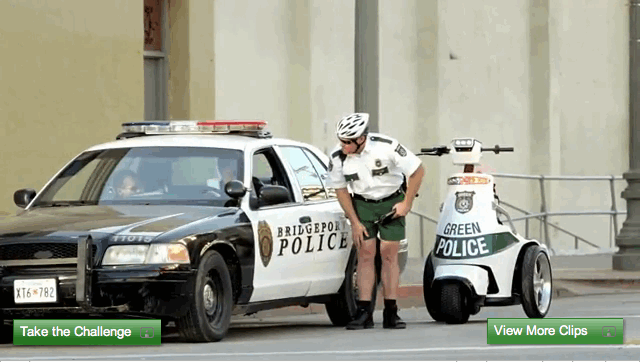
While I was looking through old Super Bowl ads, I came across an Audi ad featuring the “Green Police”:

https://www.youtube.com/watch?v=NxTNZUhesZk

This ad demonstrates typical citizens, living their day-to-day lives, being chased and/or arrested by the “Green Police” for choosing to use various products that aren’t necessarily the greenest choices. The ad illustrates these citizens using plastic, rather than paper bags, throwing batteries away into the trash, not composting orange rinds, using incandescent light bulbs, placing the hot tub at an above-normal temperature, and drinking from foam cups. The only product or alternative that the “Green Police” approved of was the Audi A3 TDI Clean Diesel car, which has been awarded as being the “Green Car of the Year” by Green Car Journal.

I believe that this ad is very effective in getting Audi’s position across as being a company focusing on sustainability. It shows that they realize the importance of shifting gears and creating cars that target a possible different type of consumer that they’ve targeted in the past. I believe that their use of humour throughout the ad (which may to some extent belittle environmentalists) is a good way of capturing consumer’s hard to capture attention through the cluster of other advertisements. The ads humour and ability to both increase awareness about environmental issues, and their new green car, appeared to be successful as it finished number 6 on USA Today’s Super Bowl ad meter in 2010.

If you’re interested in viewing more “Green Police” ads, here’s a link with three more ads! These ads appear to be more of a joke, and look as though they’re poking fun at consumers and environmental issues:

https://www.youtube.com/watch?feature=fvwp&v=kGSOQTOYm7E&NR=1

Categories
Comm 486F Blogs

Green Business

After doing research, trying to find a company to blog about, I stumbled upon TerraChoice, an Ottawa-based environmental marketing firm. They did research on Green companies to see how Green they really were. After TerraChoice reviewed over 5296 Green products, they found at least one misleading claim on 95.6% of the products they examined. They also found several symptoms of greenwashing, which is the misleading of consumers about the environmental practices, and/or benefits of products or services. TerraChoice discovered that 100% of Green toys, and 99.2% of baby products have used some form of greenwashing. Measures need to be taken to limit the amount of perpetrators who claim to have Green products. Being a Green, sustainable company is the way of the future and consumers are already leaning towards eco-friendly companies to buy their products from. A better job needs to be done in authenticating companies who claim their products are Green. This problem could be solved if TerraChoice could get assistance on researching the “so-called” Green companies, which would surely help in raising awareness of this issue. Additionally, government support of this cause, such as stricter regulations (which are slowly starting to arise) will help companies resist from using greenwashing as a fraudulent technique to sell their products or services.

Categories
Uncategorized

Are Soft Drinks the Cigarettes of 2012?

In this post, I will be responding to the blog by Lauren Chimko entitled “Are Soft Drinks the Cigarettes of 2012”.

In her posting, she spoke about Coca Cola and Pepsi and how their products potentially are associated with causing cancer. Unless these mega soft drink providers changed their manufacturing process, they would need to change their packagings labels to indicate that their brands cause cancer. For both Coca Cola and Pepsi, the decision was clear, avoid the new labels by accepting the new manufacturing process. Besides, the change in this process would only cost millions, and who knows how much more the new packaging could affect publicity and their brand image? Ultimately, sales would drop drastically and consumers would begin switching to other beverage alternatives, such as bottled water or juice. Ironically however, both Coca Cola and Pepsi own most substitute beverages, so only the direct cola sales would decrease.

I find it interesting how influential packaging can be. Simply because these brands were being warned of having to change their packaging to include a logo signifying cancer, they changed their entire manufacturing process. This shows how much these brands care about their carefully constructed brand image. When someone buys a Coca Cola or a Pepsi, they aren’t necessarily buying the exceptional taste that these brands provide, rather, they’re buying the brands and everything that the brands are linked with and believe in. If consumers were given the opportunity to doubt their beloved brands and ethics, they would begin searching for alternatives, such as the “no-name” brand colas or substitutes. Thus, it is easy to see why Coca Cola and Pepsi were so keen on going ahead with the alternate manufacturing process. If they didn’t, consumers would begin aligning these “friendly” brands with cigarette companies packaging, which would surely have a negative impact on them in the long-run.

http://www.montrealgazette.com/health/Coke+Pepsi+change+production+process+California+after+cancer+warning/6277328/story.html

Spam prevention powered by Akismet