The resource that I would like to share is the interactive simulation called PhET, which stands for Physics Education Technology. This project is through the University of Colorado which was founded in 2002 by Carl Wieman. Phet began with “Wieman’s vision to improve the way science is taught and learned and the mission is to advance science and math literacy and education worldwide through free interactive simulations” (https://serc.carleton.edu/sp/library/phet/what.html ).
I mentioned this resource briefly in one of my posts for Module B but I was not able to elaborate on it. In math and science, many concepts are much too abstract for learners to grasp and understand with no visualization of the concept. With PhET, the “simulations are animated, interactive, and in a game-like environment where students learn through exploration” and these simulations also “help to make visual and conceptual models” which helps to make real-world connections. I remember being in science and math classes where I was not able to understand complex concepts and I struggled a lot with those courses. I am a visual and hands-on learner and I had no exposure to such tools. I think my experience with those classes would have been more positive if I was.
PhET simulations are not just animations, “students can interact with simulations by grabbing real and moving objects, such as batteries, bulbs, magnets, handles, and switches” to enhance student learning and students are able to construct their own knowledge through these interactive simulations which can increase scientific literacy and foster student engagement both in and outside of the classroom. Furthermore, there are not just simulations but also graphs and charts to help the learner decipher information and data in the written form; there are different forms of knowledge representation within PhET to increase cognitive functions for the learner.
Previously, I have used this resource with my students to help them with their multiplication facts. I have been using it for a couple of days now using the ‘arithmetic’ simulation and I already see a big difference. Not only are my learners having fun but they are also understanding the relationship between concepts that were hard for them to comprehend. I think that this technology could be used in many ways:
- Supplementary tool to further student learning
- Can be used for demonstrations
- Students can test out their learning through the online quizzes
- The teacher can manipulate the variables and adjust the simulations according to questions from students so that they can see what would happen if they, for example, moved the slope into the negative quadrant, and how that would affect the answer (slope-intercept relationship).
- Students can make predictions and explore those predictions
These simulations allow students to be a part of the process and not just passive learners. They are able to see concepts and change certain aspects to see what would happen if they did this instead of that. The best part of this digital resource is that it is free! This is important because even if it was not free and the school bought the program for a year, students would not have access to it at home but since it is free, students are able to use this at home as well for their learning. It is engaging, fun, and is able to represent knowledge and conceptions that are difficult for students to understand; in this way, learning is meaningful and constructivist.
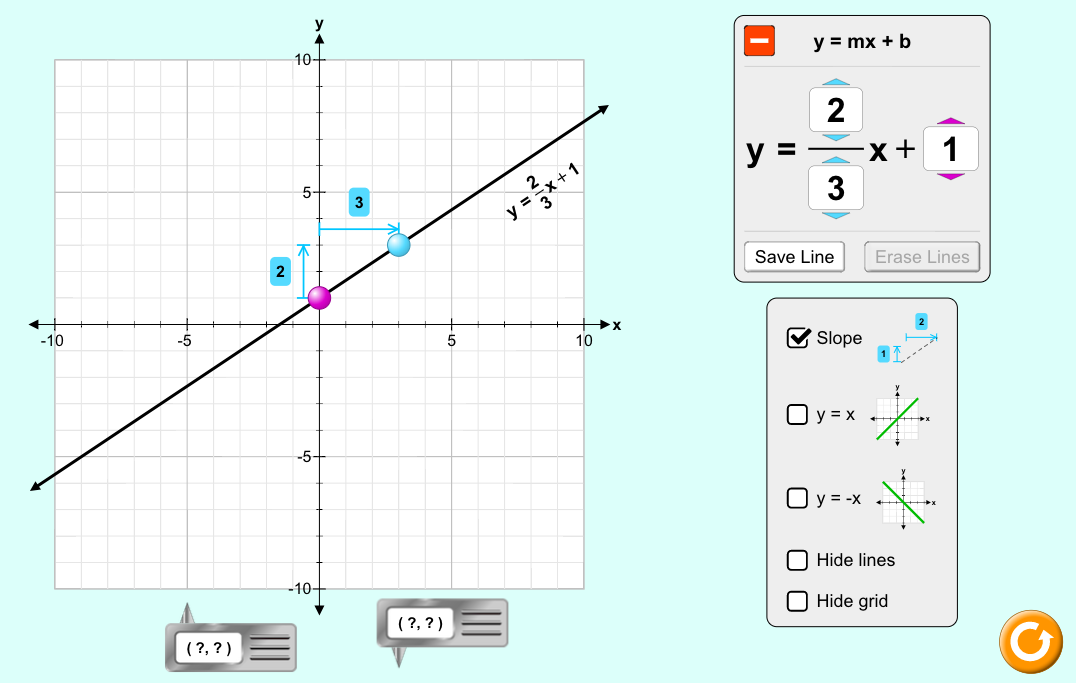
I wish I had this tool when I was in my math classes, I struggled quite a bit with slope-intercept because it was so abstract to me.
References:
https://phet.colorado.edu/
What a great resource! Love that it bills itself as being “fun but not too fun”. So often it’s easy for students to get pulled off into playing with tools (changing avis, adding emoticons) rather than exploring the concept they are supposed to be working with. I like that the graphics illustrate the concepts without being overly cute. I also appreciate that there are resources for the primary level! I could see myself using this in the classroom!
Hi Tracy,
It really is a fantastic resource! Its fun and engaging and students actually learn from it. They can see those concepts that are difficult to grasp!:)