Categories
Uncategorized

E-commerce on Facebook

1-800-Flowers.com Facebook Storefront

Today in eMarketing class I asked our two presenters from 6s Marketing whether they were familiar with Facebook’s e-commerce options. This is a relatively new feature so it isn’t surprising that it hasn’t been considered by most companies and agencies yet.

Currently, companies are able to set up online stores and storefronts on the Facebook platform itself through the use of various third party applications such as Payvment, Storefront Social, BigCommerce SocialShop and Ecwid. Some applications such as Ecwid and Payvment allow customers to check out their shopping bag without leaving Facebook. Payvment allows for credit card and PayPal payments which are credited to the company’s PayPal account. Other applications, such as Storefront Social and BigCommerce Social shop either forward the customer to the company’s e-commerce site or their the application’s own online store.

Marketers are currently debating the merits of these new features. Some say that they will encourage sharing and product awareness through word of mouth as well as direct traffic to the product pages on the company’s official website. The likes and shares feature on Facebook also allow companies to customise their Facebook stores by demographics and user behaviour. Facebook is also testing a

Categories
Uncategorized

Ambassadors: Sometimes your customers create the best content

At a loss for how to find the time and resources to create high quality content to drive traffic to your company’s website? Here’s an idea, incentivize your customers to do the work for you!

The California Academy of Sciences promoted its weekly music, science, entertainment and cocktails event NightLife by inviting bloggers, and Yelp users to become embassadors for the brand by creating buzz through these networks with word-of-mouth marketing. These “Insiders” volunteered to blog, tweet, post to Facebook, yelp and create videos during a three-month period during which they attended the weekly Nightlife events. Participants were incentivized with free access to NightLife events, complimentary VIP tours, reserved passes, and planetarium shows amongst other nifty freebies. The content these ambassadors created were reposted as content on NightLife’s pages on Facebook, Twitter and YouTube.

The key to this strategy is finding the “influencers” in your category. Who is already creating content that reaches and influences a wide audience? This can be determined by carefully monitoring blogs, forums, Facebook and Twitter for key individuals who drive the most traffic to your online brand properties.

Categories
Uncategorized

Integrating e-mail marketing with social media

According to eMarketer, 54% of respondents of a 2010 Lyris Email Optimizer Report stated that integrating e-mail marketing with social media has either improved or significantly improved their marketing results. A study by GetResponse also revealed that including a social sharing option in an email increased click-through rates from 7.2% to 8.7%. Including at least three sharing options increased the rate further to 11.2%.

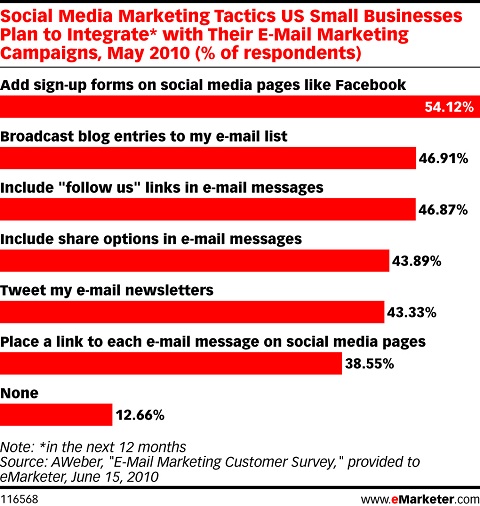
Most small businesses use integration to promote their Twitter and Facebook pages through e-mail newsletters by including “follow us” or “like us” links in e-mail messages. Marketers also enable the user sharing of e-mail content on social networks by including share options in the messages and tweeting the newsletters. However, integration can also be done the other way around, by adding newsletter sign-up forms and placing links to each e-mail on social media pages. User-generated content such as reviews can also be promoted by being included in e-mail campaigns.

Social Media Marketing Tactics

Objectives for integrating social media and email marketing

A Mashable.com post describes a few companies that have found substantial success integrating their e-mail marketing and social media strategies. Pet-food company Dingo achieved 5000 Facebook fans in 3 days by creating a promotion that gave customers a $20 coupon if 5000 of them signed up for the newsletter and “liked” the Facebook page. When bag and accessory retailer Timbuk2 decided to promote a Facebook application-based contest through their 100,000 subscriber newsletter, they found that the promotion generated 6,500 clickthroughs to their Facebook page. In comparison, the company’s usual prompt that encourages e-mail subscribers to become Facebook fans only resulted in 9 clicks.

Categories
Uncategorized

Surprising fact: 80% of kids under the age of 5 use the internet

Just this morning I blogged about increasing internet and social media usage amongst seniors, and later today I find a Mashable headline stating that 80% of kids 5 and under in the U.S. use the internet. This figure, coming from a report by the Joan Ganz Cooney Center and Sesame Workshop, is even more surprising.

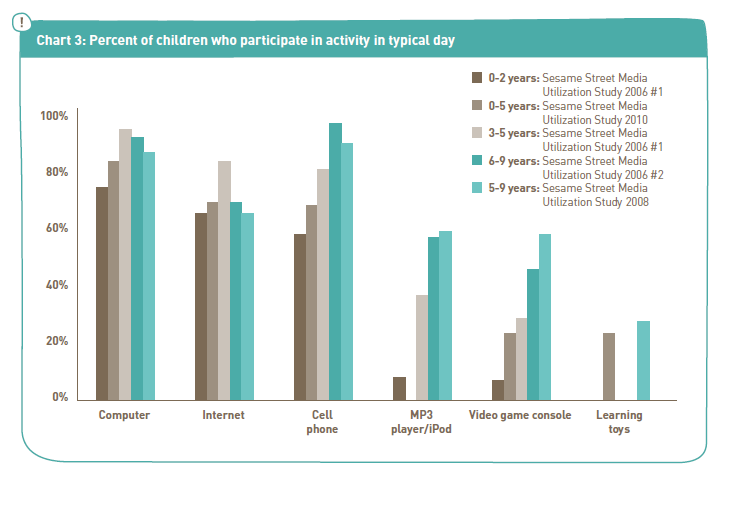
The report finds that although children still spend most of their media time in front of the TV, more children are making regular use of the internet for longer periods of time than before. About 80% of children aged 0-5 use the internet at least once a week. One quarter of 3 year olds venture online daily, and by the age of 5 one half of children log online at least once a day.

But not to worry parents! According to the report, print media such as usage of books has remained constant over the years, with 90% of 5 to 9 year olds spending an average of one hour a day reading.

Percent of children who participate in media activity in typical day

Categories
Uncategorized

Why e-marketers should watch the senior demographic

In the US, those aged 60+ currently represent about 13% of the population. This number is expected to increase to about 20% of the total population by 2030 as baby boomers come of retirement age. Although seniors experience a lower average income than the rest of the population, they tend to spend more in proportion to their income, especially on healthcare.

Seniors are still most likely to spend their time watching tv or reading newspapers. However, internet usage has overtaken radio in the female senior demographic, and according to a Media Comparisons Study conducted by the Television Bureau of Advertising, about half of senior respondants had used the internet the previous day. Internet among seniors is also expected to grow from 45% in 2010 to 56% by 2015, a growth rate much higher than that of the total population.
senior media consumption
internet penetration

Currently, seniors spend most of their online time checking e-mail and getting news. They are also interested in finding information about travel, healthcare and financial concerns. This suggests that e-mail marketing and display ads would be the most effective way to target seniors online.
daily online activities


Senior penetration in social networking remains low, at around 28%. However, this figure has increased from only 4.7% in 2008, a sixfold increase in two years! Social network penetration for the senior demographic is expected to grow further to 36% by 2013. Anecdotal evidence suggests that seniors find social networking fulfilling because it allows them to reconnect with old friends and family members. This suggests that if the senior population gains digital skills and literacy, social networking would be a natural fit for their needs and values. Moreover, as the more tech-savvy young boomers enter retirement age, online engagement for the senior population is sure to continue to catch up to the rest of the population.

Categories
Uncategorized

Community Sharing vs. Consumption

As someone who often wishes city communities were as closely knit as their country counterparts, I find online resource sharing communities like NeighborGoods an extremely exciting phenomenon. Not only do you get to save money and space from borrowing things you don’t use very often but you can also get to know your next-door neighbors a little better!

Community sharing brings up some interesting questions for economists. For example, websites like NeighborGoods increase the welfare of individuals by saving them time and money. They also benefit the environment by encouraging resource re-use. However, community sharing decreases the sales of companies who depend on consumer demand for these goods. End result? They detract from a nation’s GDP, but create an intangible value of welfare. Which is the optimal choice? Perhaps we should be taking alternative measures of welfare more seriously in order to determine the answer?

How NeighborGoods Works from sparky rose on Vimeo.

Categories
Uncategorized

Information overload: Why companies are unfollowed on Twitter

Credit: http://twittercism.com

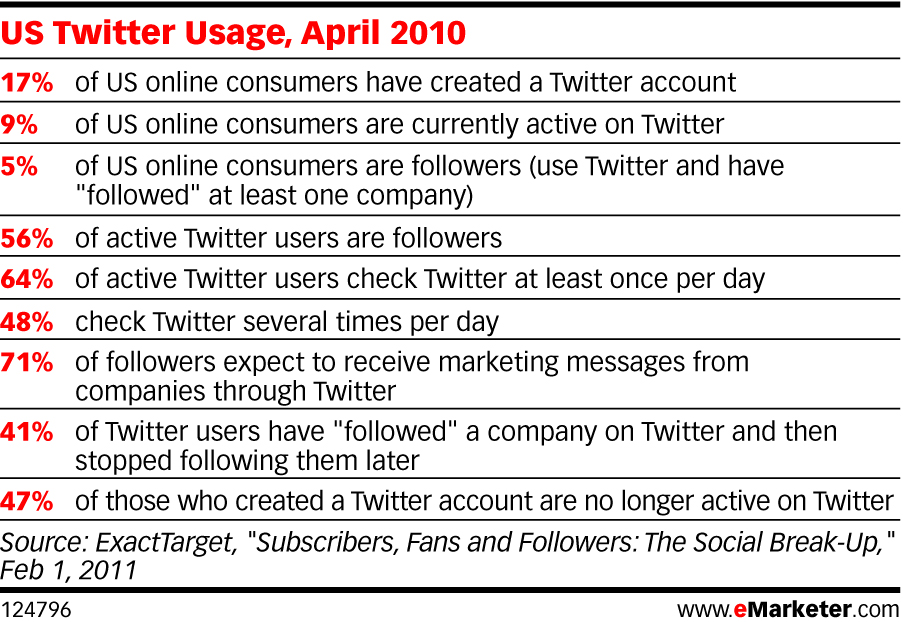
According to emarketer.com, 41% of Twitter users have subscribed to a company’s twitter feed and then stopped following them later. The top reasons for unsubscribing to a feed are repetitive content, over-filled twitter streams and posting too frequently. In a nutshell, consumers just don’t have the time and spare attention to devote to reading a company’s frequent twitter posts. Wanting to keep an active and responsive twitter account is one thing, but overwhelming the customer with messages is another. Companies should take steps such as using Twitter’s analytics product to determine which tweets are the most engaging and which tweets have caused readers to unfollow in order to ensure that their twitter feed content is optimized and relevant to their customers.

Categories
Uncategorized

When will Gov 2.0 come to Canada?

As BC Liberal candidates jockey for the top spot, promises are being made to create a more open and responsive government. Christy Clark in particular vows to hold a dozen town hall meetings a year in order to “reconnect people with government”. Does anyone else in generation Y think this proposal is a little, well, lame? I sure do. It sounds like Christy’s approach is still stuck in government 1.0.

Many organizations in the business sector have come to find social media an invaluable tool for their strategic goals. Companies are discovering new ways to communicate and engage with their customers and are actively listening to online chatter in order to uncover new business opportunities. Moreover, consumers are discovering a new power to shape the very companies they used to passively purchase products from. In a sense (ok, a slight sense), social media allows for a democratization of private companies.

Given this phenomenon, one would assume that social media and government would go hand in hand. But this hasn’t been the case. Governments have been quite slow to jump on the web 2.0 bandwagon. Some governments, like those of the U.S. and theU.K., have started open-data initiatives in which they release raw data that app developers can take advantage of to create nifty tools that are both cost effective and help citizens truly engage with their government. However, the Canadian Federal government has been a little slow on the uptake. So slow in fact, that private citizens have already started the movement on their own. OpenParliament.ca and DataDotGC.ca are two good citizen-led sources for government data and information about the goings-on of parliament.

On October of last year, the federal Liberal Party announced that they are committed to opening an open data website. However, the months are passing by and Canada is looking embarrassingly slow compared to its western counterparts.

Image credit: gotze.eu

Categories
Uncategorized

National Differences in Social Media Usage

When it comes to social media, does nationality affect online behaviour? The answer is a resounding yes, according to Universal McCann’s Wave 5 study: The Socialization of Brands.

A few fun facts (click to enlarge):

1. Chinese and Brazilian internet users are twice as likely to use blogs as Germans, and the rate of blog usage in western countries is declining.

Blogging - On the decline in the west

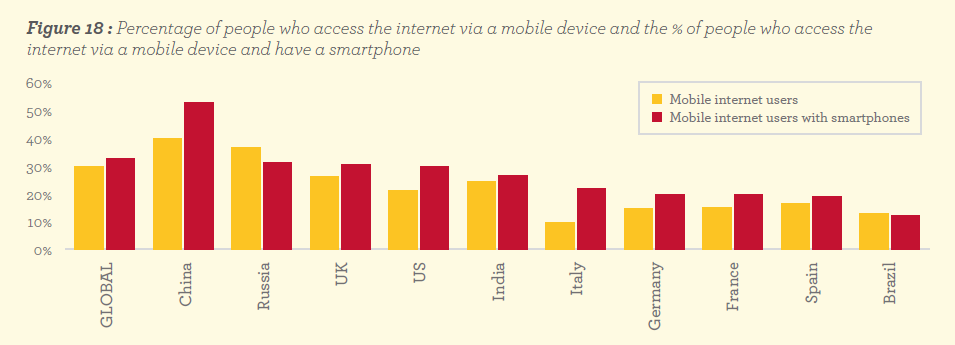
2. Chinese consumers are more likely to be surfing the net through mobile phones.

Mobile users - Chinese consumers more likely to access the web through their phones

3. There’s something about Thailand. Thai consumers are very likely to engage in brand communities, whereas the Japanese aren’t buying it.

Brand communities - Thai consumers very likely to join a company's online community

Check out the rest of the report at Universal McCann.

Spam prevention powered by Akismet