Weekly Update (March 21 – March 28)

After last weeks modelling excitement, we have updated our model and it is complete. We had to return and refine our model to include the deciduous volumes in the yield curves. The basal area we used as the basis for our treatment is based on the total volume in the stand, and for accurate outputs we required deciduous volumes be included. Our buffer treatment area now switches to a deciduous yield curve after the third treatment, as the conversion period will have then completed.

Our fuels classification project is ongoing. Algorithm development and refinement has been painstaking, but progress continues. The nature of the data we have obtained has required quite a bit of tinkering with the coding portion, but we are beginning to create a map of the fuels in the AOI.

In other news, we have finalized map creation and context information for the AOI, and the first draft of our report is being developed.
Thanks,

Conor
Weekly Update (March 14 – 21)

“On Thursday evening we had a little modelling panic attack due to how we had organized our model. In order to simulate different harvesting regimes across the AOI we had organized our data into separate “zones” and set these to the same priority in the model. However FPS does not behave as we initially expected and instead treats each zone as a separate forest estate and as such our model began to behave erratically – cue panic. Our entire approach to date has been premised on the use of zones and we were suddenly not sure how or if we could fix the problem.

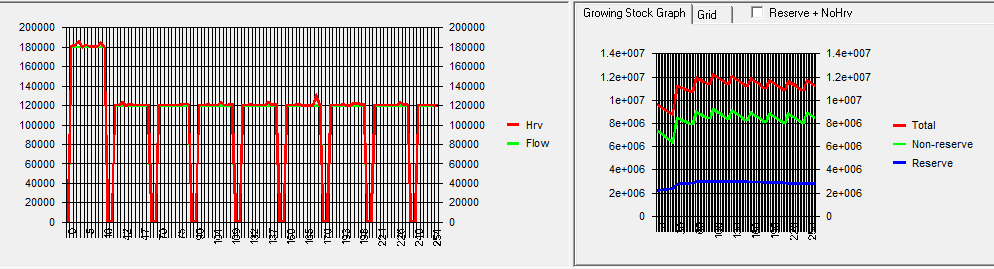
Unsure of just how much trouble we might be in we appealed for help from Reg Davis and Cosmin Man who very kindly provided us with A LOT of feedback over the weekend as to our options. We’ve since been able to implement a treatment using the fixed harvest scheduler and we think we’re sorted out now. As such, we are happy to announce that we have some preliminary flows from our treatment buffer area (see below).”

– Cody Gold

Tentative numbers for timber flows from the treatment area within the W.U.I. have been produced. Following the conversion period (two iterations) public and private land would create 1.2 million cubic meters over ten years, at thirty year intervals, whereas public land only would create 1.06 million cubic meters.

Data visualizations are underway and tasks for this portion of the project have been assigned.

The SWOT analysis is being finalized over the next two days and timber flow numbers will be integrated into the analysis.

Report writing is progressing, the introduction has been written and context maps are being finalized over the week.

Thanks!

Leslie

Weekly Update (March 6-13, 2017)

Preliminary timber flows from the wildland urban interface (WUI) have been set up in FPS. Current values are based on a WUI conversion period of 10 years followed by 30 years of no treatment.  These will be modified upon further discussion but can be seen below:

The basecase model is complete and decadal harvest flows have been set. Visualization of this scenario is in progress.

Fuel classification from VRI conversion is underway though we are running into some roadblocks with gaps in the data.

With regards to the SWOT analysis, the framework is complete and subheading research will begin shortly.

We also have an extra helper in the office today, here’s a photo of Charlie working hard.

All for now,

Peter

Weekly Update (Feb.27th, 2017)

Three scenario models have been set up in FPS with unique stand groups for the WUI buffer zone. This will allow us to model our buffer zone in a different manner from the rest of the land-base. Next steps are determining treatments based on basal area or a stems per hectare target.

With regards to our progress on SWOT, our infrastructure areas have been identified and we are in contact with Enderby and Revelstoke attempting to gather some financial numbers on their bio-energy operations.

Work has begun on classification of fuel types in the WUI zone and a map will be produced in the future.

Netdown map has been completed for the new resultant. BEC Zone map for the WUI has been completed as well.

Until next time,

Devin