Last class, we discussed primary and secondary data collection and approaches to retrieve this data. Secondary data is the data that has already been gathered and collected. Using secondary data is cheap and quick but may not provide the most current and relevant results. Primary data is actually going out and collecting the data yourself. The three approaches that we discussed are observation (observing people, actions and situations), surveys (a set of questions needed to be answered), and experiments (cause-and-effect relationships). What we learned was online surveys tend to be the quickest and easiest way to gather primary data. What we didn’t talk about was how online survey can be incorporated with social media marketing to increase interaction with customers and gain feedbacks. This article I found (link below) explains that when incorporating surveys into social media marketing, there’s an opportunity to make that intersection a part of our social cycle of interaction through 6 steps. These steps include: listening, grow network, crowd source survey questions, invite surveys socially, recognize super friends, and promote survey results socially. I agree completely with this article because surveys are getting boring and people have less time to waste. Online surveys need to be targeted towards the right group of people, and these people need to trust and be interested enough in the survey in order for them to take the time to complete it. Social media can help to find the topics of interest. It helps to grow a strong and large social network across different channels, so that when we have a large enough network, trust can be earned. Social media can also quickly leverage feedback to construct the flow of online surveys. Different relevant communities can also be tapped to help promote surveys and increase survey exposures. Moreover, social media can help to recognize people who contribute with good ideas and who help promote surveys, this kind of public recognition encourages further contribution from people to future surveys. Finally, social media can be used to promote survey results, I think through extensive communication about survey outcomes; we can quickly gain knowledge from survey feedback and learn what’s working. Overall, I think social media really helps to improve the efficiency of online surveys.
Article: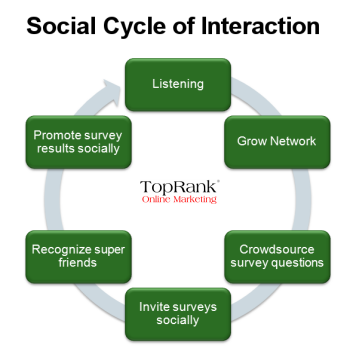
http://www.toprankblog.com/2010/08/online-surveys-social-media/