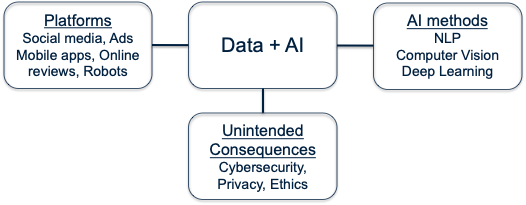
Welcome to the Data + AI Research Group!
We study how AI reshapes firms, labor, and institutions — and where its efficiency gains collide with integrity risks.
- Research published in MIS Quarterly, Information Systems Research, and Journal of MIS
- Ph.D. graduates placed in tenure-track roles at CUHK and NTU
- Active research support from SSHRC, Samsung Electronics, and Hyundai Motor Group
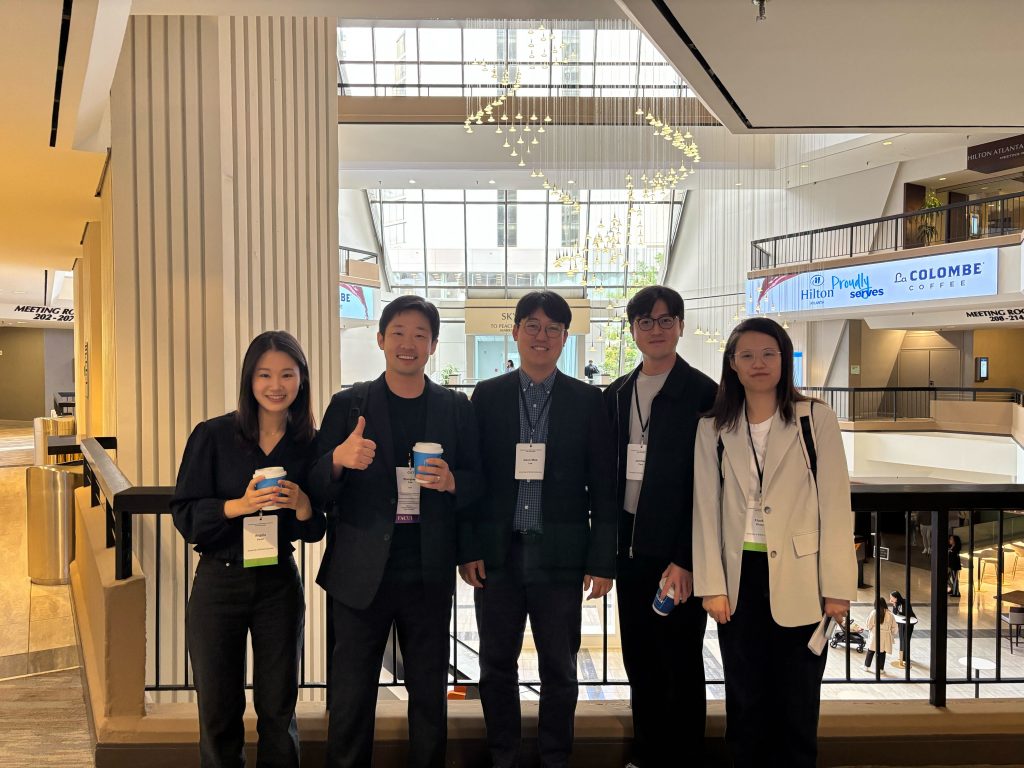
Angela, Myunghwan, Gene, Jaecheol, Xiaoke (CIST 2025)
Our group advances business analytics using AI — creating theoretical knowledge and business value from big data, especially unstructured data (text, images, video, audio). Across settings from auditing and journalism to clinical trials, restaurants, and firm strategy, we show that AI adoption is not monolithic: its impact depends on whether it is product- or process-oriented, partial or full, embodied or disembodied. Using causal inference, multimodal analysis, and field interviews, we find that AI can boost productivity, output, and firm value — but can also erode trust, displace workers, and compromise information quality without governance and human–AI collaboration. Together, this work maps the efficiency–integrity frontier of AI adoption.
The main contributions include:
- To examine the impacts of AI and IT in business and society:
- firms’ AI strategies: MISQ R&R (ML innovation); ISR R&R (AI strategies);
- AI and institutions: MISQ’26 (LLM journalism); WISE’24 (labor union);
- Generative AI and creativity: MISQ R&R (AI voice videos)
- AI in drug development: WISE’25 (clinical trials); KrAIS’26 (oncology);
- AI in different sectors: WP’26 (audit); DS’22 (service robots);
- To develop novel AI methods and frameworks:
- AI-based firm-level measures using text/network analytics: MISQ’16 (LDA business proximity); JMIS’26 (structural hole);
- Multimodal data analytics in online platforms: MISQ’20 (social media images);
- generative AI-based systems: INFORMS’25 (car design); ICIS’22 (online dating);
- To study data-intensive online platforms:
- Matching: JMIS’16 (location apps), ISR’20 (mobile apps); ICIS’22 (online dating);
- E-commerce: ISR 2021 (review spillover); CIST’22 (incentivized reviews);
- Security analytics and policies: JC 2016 (security disclosure); JMIS 2020 (security awareness), DSS 2022 (stealthy attacks);
- Fake news: JBE 2019 (fake news);