Categories
Biological Sciences New and innovative science

Will this New Drug End the Obesity Epidemic?

Orlistat. Sibutramine. Rimonabant. Metformin. Exenatide. Pramlintide. These are the six main anti-obesity drugs that are prescribed to patients suffering from morbid obesity. The reason these names are not better known is because of the side of effects that each of these drugs possess. Only in a last ditch effort, are these drugs prescribed, where the benefits outweigh the potential side effects.

Red Pill or Blue Pill?

For example, the use of Sibutramine, a now withdrawn drug, resulted in higher blood pressure, higher incidence of strokes and heart attacks, and even seizures.  What is worrying is that it was recently withdrawn in 2010.  This speaks volumes on the now-prescribed weight-loss drugs, all of which possess side-effects of their own, but only serve to suppress appetite or increase metabolism.


Adipotide, the potential cure

Fortunately, another drug is now posed to join the fray.  Adipotide, an experimental drug, has recently been tested on obese rhesus monkeys by a team of scientists at the University of Texas Anderson Cancer Centre.  This new drug acts on white adipose tissue, the unhealthy type of fat that is found under the skin and engulfing the abdomen, and is also a predictor of mortality.


Adipotide destroys the blood supply of the white adipose tissue.  With the use of a homing agent, the drug binds to a protein on the white adipose tissue, and uses a synthetic peptide to trigger cell death.  The fat cells, having lost their blood supply, are then reabsorbed and metabolized.  This is completely different from the six above-mentioned drugs, which indirectly control obesity by suppressing appetite, while Adipotide attacks the problem directly by cell death.

Fat Monkey
Overweight Primate


The obese monkeys that were administered Adipotide lost on average 11 percent of their body weight, lowering their body mass index (BMI) and abdominal circumference (waistline) as well.  The rhesus monkeys that were in shape did not lose any weight, demonstrating that the drug only has an effect on obese subjects.  Only one side effect was noted for the kidneys, which was said to be dose-dependent, predictable, and reversible.  Furthermore, the monkeys did not experience any nausea or food avoidance. A prior study testing Adipotide on obese mice resulted in 30 percent weight loss.

Fat Rat
Fat Rat


Anti-obesity drugs that are developed to work on rodents tend to fail when administered to primates, due to the vast differences in metabolism and control of appetite.  With Adipotide’s stellar results, the team of scientists are preparing for a 28 day clinical trial on obese prostate cancer patients, seeking to improve their condition through weight loss and reduction of the associated health risks that come with obesity.

Obesity rates
America: From Seam to Splitting Seam

Obesity is a serious condition, especially in the United States, with approximately 75 percent of Americans overweight or obese.  It increases the possibility of breast, ovarian, prostate, and colon cancer, and diabetes.  Furthermore, it has been cited as a contributing factor for up to 400,000 deaths in the United States per year.  One problem lies in the terminology used in the explanation of Adipotide’s method of weight control: Cell death.  While it may sound worrisome to the uneducated, the fact that cell death occurs at a rate of 50 to 70 billion cells per day in the average human adult should settle the uneasiness that comes with the word “death”.  With the advent of Adipotide, can the obesity epidemic be ended?

References

http://www.sciencedaily.com/releases/2011/11/111109143009.htm:

http://www.forbes.com/2007/02/07/worlds-fattest-countries-forbeslife-cx_ls_0208worldfat_2.html

https://www.youtube.com/watch?v=ybbVHTnmI4A&feature=related

Karam, Jose A. (2009). Apoptosis in Carcinogenesis and Chemotherapy. Netherlands: Springer. ISBN 978-1-4020-9597-9.

Media:

http://upload.wikimedia.org/wikipedia/commons/8/82/USObesityRate1960-2004.svg

http://www.geninv.net/wp-content/uploads/lipozene-weight-loss-pill-truth-lipozene-medicine.jpg

http://3.bp.blogspot.com/_j4SmoTqBAQA/SEkTtrKdPJI/AAAAAAAAAPo/kkOQFyJEn-0/s400/ohama_fat_monkey1.jpg

http://autotechie.com/blog/wp-content/uploads/2008/11/fatmouse.jpg

Categories
Biological Sciences

How Contagion Really Ends: The Breakthrough Antibody

Have you ever heard of the Hendra virus?  What about the Nipah virus?   Living in the western hemisphere means you have most likely never heard of either of these viruses.  However, you probably heard of the movie “Contagion”, a movie that was released early September of this year.  The featured virus of the movie, MEV-1, was inspired by the Nipah virus, both being spread by fruit bats.   An antibody against the Hendra virus has been designed (source: http://www.sciencenews.org/view/generic/id/335331/title/Stopping_a_real-life_Contagion), and is in the process of mass production.  The Nipah virus invades cells through the same portals as the Hendra virus, and as such, the antibody has the potential to cure both viruses.


The Hendra virus is not known for killing people.  Rather, it is better known for infecting and killing horses, with only a dozen people having contracted the Hendra virus, and even fewer dying.  Conversely, the Nipah virus, its close cousin, is transmitted from infected pigs, and has infected hundreds of people in south East Asia, with a mortality rate of 40 to 70 percent.

http://www.who.int/csr/disease/nipah/Global_NiphaandHendraRisk_20090510.png

A team of Canadian and American scientists were testing antibodies for the Hendra virus, and found that a particular antibody, named m102, had the ability to block the Hendra virus from attaching to a cell.  The antibody was then modified and, like a drug, mass-produced.

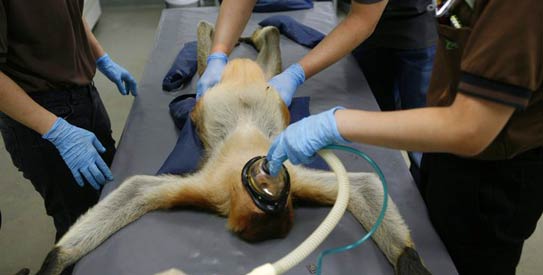
In the Health’s Rocky Mountain Laboratories in Hamilton, Montana, the researchers tested the fruits of their work on 14 African green monkeys.  The Hendra virus was squirted into the monkey’s tracheas to infect them with the Hendra virus.

http://www.dawn.com/wp-content/uploads/2011/10/ailing-monkey-r543.jpg


The control group contained two of the infected monkeys, both left untreated.  Within eight days, both monkeys were lethally diseased.

The 12 monkeys of the experimental group were given two doses of the m102 antibody within 10, 24, or 72 hours of being infected.  All 12 monkeys survived.

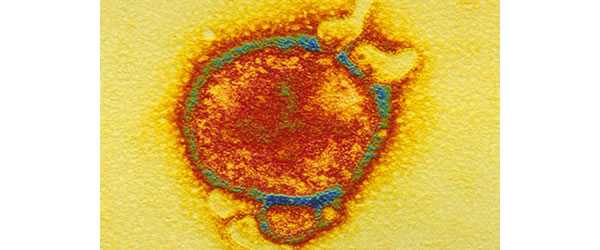
The Hendra and Nipah virus use two cell-surface protein transporters to invade cells.  The modified m102 antibody binds to these membrane proteins, preventing entry of the Hendra and Nipah virus.

http://frontier.k-state.edu/Images/ResearchAndAnalysis/Updates/OverlapAgents/Henipavirus_lg.jpg

The m102 antibody has already proven successful on fending the Nipah virus in ferrets, with testing on Nipah-infected green monkeys currently underway

With the test on monkeys yielding positive results, the research team now plans to pass the regulations that bar them from human testing.  Prior to this, a woman and her daughter had taken the antibody as an emergency treatment to a possible infection to the Hendra virus.  While they did not become sick, it is yet unclear whether they were in fact, exposed to the Hendra virus.

The findings of this study are good news to those who live in South East Asia, the most exposed region of the world to the virus.  Since 1998, 10 tragic Nipah virus outbreaks have been recorded.  The most recent outbreak, in February 2011, resulted in the deaths of 21 infected schoolchildren.  Clearly, the Nipah disease is still deadly and prevalent.   With all the regulations that the antibody must pass, it may be a while till the antibody is available for public use.  While the regulations for human testing and human use serves to protect us from further debilitation or even worse problems, it may hamper the process of making the modified m102 antibody available.  In the face of the Nipah virus’ 40-70 percent fatality rate, do the regulations become inconveniences?

Sources:
http://en.wikipedia.org/wiki/Henipavirus
http://www.sciencenews.org/view/generic/id/335331/title/Stopping_a_real-life_Contagion


Categories
Uncategorized

The Upside to Being Anemic

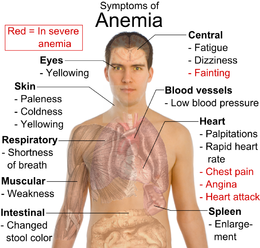
Anemia is a common condition exhibited in one in four people around the world.  In fact, 50 percent of all patients that visit hospitals for surgery are anemic.  The condition has a multitude of causes, ranging from malnutrition, genetic mutation, pregnancy, infection and blood loss.  All of the above listed causes inhibit red blood cell (RBC) production, increase RBC destruction, cause blood loss and cause hypervolemia (a condition in which the blood contains too much fluid).

The role of hemoglobin

The lack of RBC or hemoglobin resulting from this causes a problem for body tissue; all cells need oxygen for survival and energy to continue functioning, and without sufficient hemoglobin to deliver it, anemia can be a deadly condition to the bodily tissues.

There is good news for people afflicted by anemia, as researchers at St. Michael’s Hospital have discovered a new use for a previously known enzyme that has an additional function should the host be anemic.  Neuronal nitric oxide synthase (nNOS), an enzyme present in the nerve cells of the brain, produces nitric oxide, which increases bodily response and improves adaptation to low levels of oxygen, increasing the body’s efficiency in oxygen delivery to the body.

“Identifying this mechanism may lead to new therapies and approaches to improving outcomes for anemic patients,” said Dr. Greg Hare, a researcher at the Li Ka Shing Knowledge Institute of the hospital and one of the lead investigators of the study.

The researchers at St. Michael’s Hospital monitored the nNOS levels in anemic mice.  They found that the nNOS present in the brains of anemic mice was increased, and these mice outlived the mice without nNOS.  This result proves most curious, as people that are afflicted by anemia are often associated with weakness and low energy, contrasting with the longevity of the anemic mice.

“This research will help us identify when an anemic patient is at greatest risk for injury and death when undergoing surgery,” said Dr. Hare. “Research is underway to test these findings in humans.”

Should this new discovery be introduced into surgical procedures of anemic patients, the nNOS levels can be monitored, which will serve as a warning signal to the surgical team should the anemic patient’s body encounter any complications.   The effect of this finding is especially pronounced when the above statistic, 50 percent of all surgical patients suffer from anemia, and the fact that anemia can stem from a great variety of causes, is put in mind.  The discovery of this new function of an enzyme only present in people suffering from anemia begs the question: Are there any other diseases or conditions that have enzymes and yield similar beneficial results?  Can being afflicted by a disease or condition result in any advantages that are not yet discovered?


References:

“Anemia – Wikipedia, the free encyclopedia.” Wikipedia, the free encyclopedia. N.p., n.d. Web. 3 Oct. 2011. <http://en.wikipedia.org/wiki/Anemia

Taylor, Kate. “Our Stories – What’s New – Who We Are – St. Michael’s.” St. Michael’s. N.p., n.d. Web. 3 Oct. 2011. <http://www.stmichaelshospital.com/media/detail.php?source=hospital_news/2011/20111003b_hn>.

St. Michael’s Hospital (2011, October 3). Researchers discover new enzyme function for anemia. ScienceDaily. Retrieved October 3, 2011, from http://www.sciencedaily.com­/releases/2011/10/111003151832.htm


Spam prevention powered by Akismet