Categories
Environment Fun! New and innovative science

One Plastic Bottle Can Light Up My Life

One of the goals of education is to teach students to apply the knowledge they’ve acquired in the classroom to solve problems that exist around the world. Inspired by the Appropriate Technologies Collaborative principles, students from the Massachusetts Institute of Technology (MIT) took heed to this concept and developed the “solar bottle bulb.”

In Manila, the capital city of the Philippines, there is a remarkable contrast in the quality of life between the rich and the poor. Specifically, there are millions of homes in the poorer areas without a single light source because very few of these homes have connections to electrical grids, and even fewer families have the resources to pay for lighting and electricity. In addition, the metal roofs of these homes block out all the light.
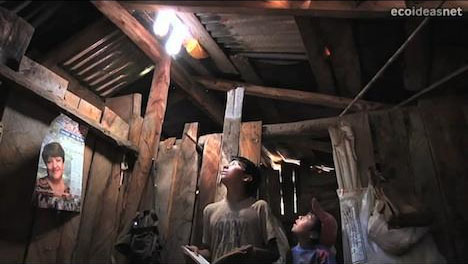
 

Source: Eco Ideas Net

An illustration demonstrating the capabilities of the solar bottle bulb.

To combat this problem, students at MIT developed a solar bottle bulb to be inserted into the roofs of these homes. It is a one-liter, plastic bottle filled with water and three tablespoons of bleach. In contrast to developing a single hole in the roof that would supply light to a single spot – picture shining a flashlight onto a wall in complete darkness – the water diffracts light 360° and is capable of illuminating an entire room. The solar bottle bulb is able to emit as much light as a 55-Watt light bulb. Furthermore, the added bleach prevents algae, mold and bacteria growth within the bottle.

Because the materials to build a solar bottle bulb are readily available in these communities, installation is simple. It requires sealant, one sheet of metal with a hole (of the same diameter of the bottle) cut in the middle and an equivalent hole cut in the metal roof it is to be installed in.

To make this sustainable innovation accessible, Isang Litrong Liwanag (A Liter of Light), a Philippines-based organization, plans to supply indoor lighting to one million homes throughout the country by 2012. They have currently installed over 10 000 solar bottle bulbs. Moreover, the Manila city government has helped fund the expenses of lighting homes in their city respectively.


[youtube=https://www.youtube.com/watch?v=5Ms-oX-kdb8&w=640&h=385]

A video by Isang Litrong Liwanag reposted by SaurabhMore introducing the solar bottle bulb.


Although one of the cons of this innovation is its inability to store energy and generate light at night, we need to recall that many of these homes do not have access to light during any time of the day. To this end, any illumination is helpful. Also, this design does not create any harmful pollutants and prevents electrical fires due to the faulty electrical connectors that exist in some homes.

Overall, we should remember not to take lighting and electricity for granted. If it is possible for countries overseas to find sustainable resources and limit their carbon footprint, we should follow in their footsteps and stay green as well! Next time you are the last person to leave a room, turn off the lights and save some energy!


Further Reading:

http://www.gizmag.com/pop-bottles-provide-light/19829/
Categories
Fun!

Fish are smarter than we think

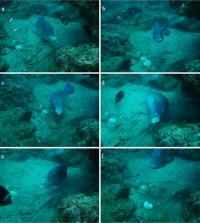
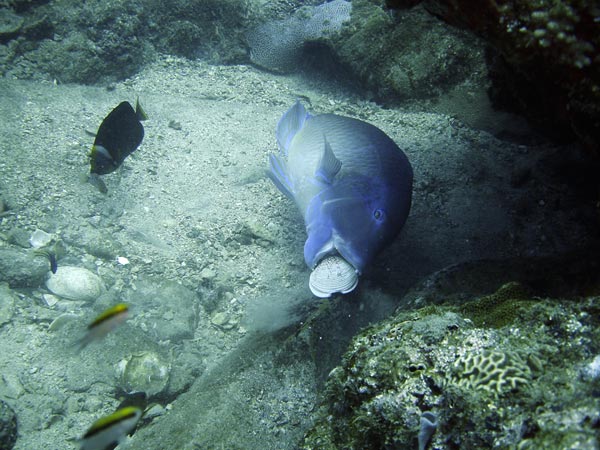
Scientists have captured videos showing that primates, birds and other mammals are not the only organisms that utilize tools; the newest addition to this list is fish! The Blackspot Tuskfish has been filmed to pick up a clam and repeatedly throw it against a rock until it breaks open. Even though the ability to use tools has been identified in a wide variety of animals such as crows and octopus, this is the first time that evidence has proven that fish are just as intelligent.


Credit: Scott Gardner


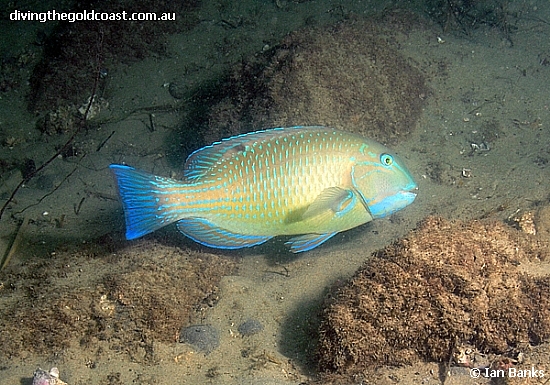
Blackspot Tuskfish (Choerodon schoenleinii) are found in coral reefs located in the South China Sea as well as Southeast Asia including Australia. They are typically one foot long and weigh an average of about 14 kg.


Credit: Ian Banks


Professional diver Scott Gardner took the first ever photo of the tuskfish using a rock to crack open a shellfish off of the coast of the Great Barrier Reef. Even though this appears to be very simple task, the mental process that the fish must go through to associate throwing clams at rocks with cracking the shells is phenomenal and unexpected of typical wild fish. Gardner found many fragments of shells close to nearby rocks which indicate that this behavior was not a result of mere coincidence.


Credit: Scott Gardner


In 2009, evolutionary biologist Giacomo Bernardi from the University of California provided definitive proof of this process by capturing a video from the Pacific island of Palau. Experts who analyzed the video said that the fish are very “forward thinking in their hunt for sustenance.”


Below is the video that is taken by Dr. Bernardi:


Categories
Fun! General Science Communication

Do dinosaurs go RAWR?

Chris Cook of NovusTV interviews Iain Fraser, Science Facilitator at Science World about Extreme Dinosaurs. Source: Youtube Channel (NovusTV)

Not everyone can truthfully say that they work amongst a collection of giant robotic dinosaurs. However, I actually can live up to that claim, as I work part-time as a Science Facilitator at Science World during the weekend.

The Extreme Dinosaurs exhibition currently at Science World hosts 18 species of dinosaurs in animatronic form (essentially robots that look and move in a very lifelike fashion), most of which are life-sized. All of these dinosaurs have strange characteristics that were used to help them survive during the Mesozoic Era; these range from horns, plates, and crests to even feathery down, bony tail clubs, and thick skulls.

Pachycephalosaurus skeleton on display at the Royal Ontario Museum. Source: Wikimedia Commons

The actual purpose of some of these adaptations is still up for debate. For example, some scientists hypothesize that Pachycephalosaurus may have butted heads like rams to show dominance while looking for mates due to their thick skulls. Others think that the skulls were too fragile for the dinosaurs to butt heads, and aimed for the side of their competitors’ bodies instead.

Even with fossil evidence, there are still many adaptations that paleontologists have not been able to come to a consensus as to what their purposes were. There are some characteristics that can’t be verified from the fossil record, like the colour of dinosaurs and the sounds that they make. These still remain a mystery, and the best that scientists can do is to make an educated guess.

With many new species of dinosaurs being discovered within the past few years, the scientific method of making and testing hypotheses is alive and well in the field of paleontology.

Categories
Fun! New and innovative science Science in the News

Waking up to the smell of wasabi

You might be familiar with the green horseradish paste that comes with sushi — wasabi. Scientists in Japan used the pungent smell of wasabi as an alarm to alert people of a fire. This idea seems incredible, but it was motivated by efforts to create an alarm system effective for people with hearing difficulties.


Wasabi smoke alarm. Photo by Air Water Safety Service.

Japan’s news stations Asahi and NHK described the progress of this project from 2006 to 2008 (link to news in Japanese text). The basic structure of the alarm is as follows. A mix of wasabi and mints create a bitter and stinging smell that stimulates the mucous membrane within the nose. This smell is then collected into a pressurized can. When the fire alarm bell rings, the machine detects the sound and relays an electric signal to trigger the release of the wasabi smell.


Medical equipment manufacturers collaborated to produce this wasabi alarm. Experiments conducted by the Shiga University of Medical Science illustrated the efficacy of this wasabi alarm to wake up people who are sound asleep. For a subject pool of 14 males and females in their 20s to 40s, the researchers found that except for one person who had a stuffy nose, all other 13 people woke up within 2 minutes. Four of these subjects had a hearing impairment, and these people woke up within thirty seconds. The fastest record-response was ten seconds. After experiencing the pungent smell, the test subjects strongly supported the implementation of this wasabi alarm device.


This invention received international attention in the Ig Nobel Prize and in news reports by BBC and Reuters. The following video shows BBC’s report on the wasabi alarm.


Other fire alarm systems made for the deaf have used light and vibrations but with mediocre success. Light is hard to notice while asleep, and vibrations require the machine to be worn by the person at all times to detect any movement. Researchers hope that this wasabi alarm system would be used effectively in conjunction with these earlier alarm systems.


“Achievements that first make people laugh, and then make them think” is the core principle of the Ig Nobel Prize. The humorous aspect of the wasabi alarm caught my attention. However, I soon started to question the use of such an invention, and this curiosity directed me to read about the weaknesses of a sound-based alarm. This research for sure made me think.

Categories
Biological Sciences Fun! General Science Communication Science in the News

“Go” health benefits of “Bananas”

Bananas are common fruits that one can fine in grocery stores. Many people dislike banana for its taste, its texture, or other reasons. I am a person who do not eat banana for its taste until I came across this video: Dole Banana Nutrition Facts. It makes me think twice about it. Is it the taste of banana much important than the health benefits that it provides?

Here are some nutritional facts of bananas:

  • Bananas have resistant starch that aides the digestion of fat. Including bananas in diet helps weight loss.
  • Stroke is a leading cause of death in Canada, and bananas prevent stroke because the ratio between the content of potassium and the content of sodium in banana is ideal.
  • Potassium also helps the body regulate hear rate and water balance.
  • The high content of iron content in bananas can prevent anemia, a low level of red blood cells in blood.
  • Vitamin B6 that are present in bananas helps to repair DNA and prevent cancer.
  • Eating bananas in prenatal stage can decrease the chance of baby’s being born with leukemia.
  • Consumption of bananas can help children build a good immune system.
  • Tryptophan, an amino acid, in bananas decreases the chance of getting depression.

It is said “do not judge a book by its cover”, and I think it is true that I cannot dislike banana for its taste, because it has a lot of health benefits.

With these information in mind, be sure to consider including bananas in your diet!

Sources:

Banana Nutrition Facts, Health Benefits of Bananas, Banana Nutrients

Dole Banana Nutrition Facts

WHFoods: Bananas


Categories
Biological Sciences Fun! Issues in Science Science Communication

I’m sorry this is late, I really meant to post this earlier…..or iProcrastinate

As summer comes to an end and we’re back to school, some of us are still on vacation time. Assignments just keep coming, due dates are approaching and, surprisingly, nothing gets done. Where did the excitement for the new school year go? Procrastination is the answer.

Are we the only victims of procrastination? Definitely not. Ancient Greeks used to represent procrastination as a “state of acting against one’s better judgment”, or akrasia. Akratic behaviour is documented in discussion between Socrates and Protagoras. Socrates claimed “No one goes willingly toward the bad”. This makes sense from a biological prospective of natural goals of an individual. Aristotel, however, took this idea and examined it deeper. From his prospective, akrasia occurs as a result of opinion. An opinion is mentally developed form of reality or truth.

So when we think another 30min nap before writing a paper might help, we are sincere in our intentions to write the paper. However it does not necessarily mean we are right that we need a nap.

Did modern scientists figure out something more useful than ancient Greeks’ theory? Yes.

According to physiologists, procrastination arises in the front part of our brain, or prefrontal cortex. Earlier studies agreed upon the impulsive nature of procrastination. Prefrontal cortex is responsible for such brain functions as planning, attention, motivation and impulse control. When impulse control does not function in its maximum ability, the overall function of planning, attention and motivation decreases. This causes procrastination.

Is a procrastination purely physiological phenomenon or are the psychological aspects? Needless to say there are numerous psychological theories trying to explain procrastination. One of the most common theories is the lack of self-confidence. Also anxiety levels of procrastinators are especially high near exam period, and these individuals feel the most relief right after exams are done or papers are turned in.  Tice and Baumeister (1997) reported a study where they show a number of college students, procrastinators and non-procrastinators. Research found that procrastinators get lower grades than non-procrastinators, as opposed to a belief that best work is done under pressure.

Procrastination is a problem for scientists publishing a paper. As we know, whoever publishes his work first gets the acknowledgments. That is why it is so important to concentrate on true long term benefits and produce a great piece of work that will contribute to humankind, whether is it is just another paper or a finished experiment. Procrastination should neither affect the quality of our work not stay in our way of enjoying what we do.

Further reading:

Evans, James R. (8 August 2007). Handbook of Neurofeedback: Dynamics
Adler, J.E. (July 2002). “Akratic Believing?”. Philosophical Studies 110 (1): 1–27
Ferrari, J.R.(2001). Procrastination and attention: Factor analysis of attention deficit, boredomness, intelligence, self-esteem, and task delay frequencies. Journal of Social Behaviour and Personality, 16, 185-196

Categories
Biological Sciences Fun! Science Communication

It’s like Autocorrect, but for your brain


If you’ve ever used a word processor like Microsoft Word before, you’ve probably encountered the wonderful Autocorrect function. Autocorrect fixes some commonly made spelling errors as you type, which helps improve typing speed by reducing the need to manually correct those mistakes.

Interestingly enough, the human brain also has a built-in mechanism that catches these types of errors and mentally fixes them while they’re being read. Let’s take a look at this paragraph:

Aoccdrnig to a rscheearch at Cmabrigde Uinervtisy, it deosn’t mttaer in waht oredr the ltteers in a wrod are, the olny iprmoetnt tihng is taht the frist and lsat ltteer be at the rghit pclae. The rset can be a toatl mses and you can sitll raed it wouthit porbelm. Tihs is bcuseae the huamn mnid deos not raed ervey lteter by istlef, but the wrod as a wlohe.

Weird, isn’t it? However, there are a few flaws in this argument.

According to the way the letters are supposed to be shuffled (the first and last letter of each word stays in the same position), words with three or fewer letters are unchanged. There are 32 words that are unaffected by the shuffling — that’s almost half the paragraph! Likewise, the shuffled four-letter words are easy to read because they can only be rearranged by swapping the middle two letters. For the remaining words, the rearrangements of the letters are fairly intuitive. For example, “porbelm” is only two letter switches away from “problem.”

Although it is true that we consider the entire word instead of just the individual letters when we read, the examples presented in the paragraph above are much too simple. Consider words like “Cgibramde” as opposed to “Cmabrigde” that was in the paragraph; a well-shuffled word is much harder to recognize.

What does this have to do with communicating science? Being able to be clearly understood is an important skill to have when it comes to sharing knowledge and information with others. While there is some truth with the “letter order doesn’t matter” argument (in the fact that the brain processes entire words at a time instead of letter-by-letter), a lot of it is just misleading science.


Further reading:

Spam prevention powered by Akismet