You might be familiar with the green horseradish paste that comes with sushi — wasabi. Scientists in Japan used the pungent smell of wasabi as an alarm to alert people of a fire. This idea seems incredible, but it was motivated by efforts to create an alarm system effective for people with hearing difficulties.
Wasabi smoke alarm. Photo by Air Water Safety Service.
Japan’s news stations Asahi and NHK described the progress of this project from 2006 to 2008 (link to news in Japanese text). The basic structure of the alarm is as follows. A mix of wasabi and mints create a bitter and stinging smell that stimulates the mucous membrane within the nose. This smell is then collected into a pressurized can. When the fire alarm bell rings, the machine detects the sound and relays an electric signal to trigger the release of the wasabi smell.
Medical equipment manufacturers collaborated to produce this wasabi alarm. Experiments conducted by the Shiga University of Medical Science illustrated the efficacy of this wasabi alarm to wake up people who are sound asleep. For a subject pool of 14 males and females in their 20s to 40s, the researchers found that except for one person who had a stuffy nose, all other 13 people woke up within 2 minutes. Four of these subjects had a hearing impairment, and these people woke up within thirty seconds. The fastest record-response was ten seconds. After experiencing the pungent smell, the test subjects strongly supported the implementation of this wasabi alarm device.
This invention received international attention in the Ig Nobel Prize and in news reports by BBC and Reuters. The following video shows BBC’s report on the wasabi alarm.
Other fire alarm systems made for the deaf have used light and vibrations but with mediocre success. Light is hard to notice while asleep, and vibrations require the machine to be worn by the person at all times to detect any movement. Researchers hope that this wasabi alarm system would be used effectively in conjunction with these earlier alarm systems.
“Achievements that first make people laugh, and then make them think” is the core principle of the Ig Nobel Prize. The humorous aspect of the wasabi alarm caught my attention. However, I soon started to question the use of such an invention, and this curiosity directed me to read about the weaknesses of a sound-based alarm. This research for sure made me think.
Plastic. Everyone is familiar with it; it’s used in the majority of products that are available to us. Yet because it is so frequent, many people do not take enough time to consider the effects that such a large industry has on the environment. Unknown to many, over 1 trillion plastic bags are used worldwide every year. According to the China Trade News, China alone uses 3 billion plastic bags per day. All this amounts to about 1 million plastic bags being used every minute. However, despite the immense usage of plastics bags, hardly any actually end up being recycled. For example, according to the BBC, in the UK, only 1 in 200 plastic bags get recycled. As such, more than 3.5 million tons of plastic was discarded in 2008 alone. This amounts to a massive global footprint, whose blame can be shared throughout the world.
What people fail to understand is that it takes up to 1,000 years for a plastic bag to degrade. This means that when you throw out the plastic bag that your subway sandwich came in only a few minutes ago, that bag will still be around a millennium later, long after your have passed away.
Plastic In Our World
plastic can end up in the environment by a simple gust of wind. (taken from www.reuseit.com)
So, from this, one can understand that every piece of plastic ever made, since its creation in 1862 by Alexander Parkes, is still floating around somewhere today. As such, where is all this plastic ending up? There are many theories and myths out there, but one of the main ones is of an island of plastic in the middle of the ocean that is bigger than the state of Texas. The sad thing is that this story holds more truth than fiction.
News broadcast on the Great Pacific Gyre found on YouTube
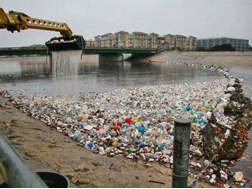
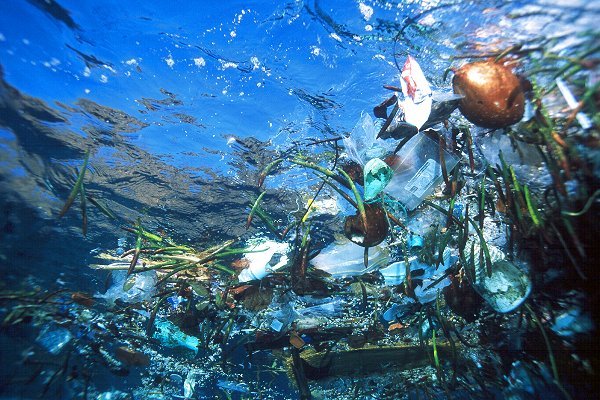
Even more plastics end up floating to the sea via our modern waterways
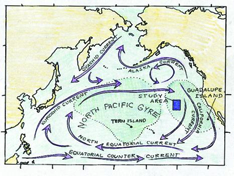
The Pacific Gyre
Every story about the island is slightly different, just as every researcher has observed a different thing. As such, many people have written it off as an urban myth. The fact is that there is a vortex of currents called to Pacific Gyre, located in the Pacific Ocean and stretching from coast of California to Japan. This current formation has historically been the collecting point for all different kinds of debris. However, in recent history, it has become known as the collection point for plastic. It is estimated that over 90% of the floating debris is plastic. Originating from land, waterways and wind, millions of tons of plastic are cast into the environment from all over the world. This has resulted in some areas having six times more plastic than plankton, which is the major source of food for many marine organisms. Basically, we have created an ecological disaster.
Current flow of the Pacific Gyre
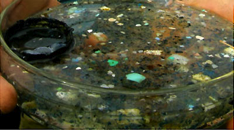
A scientist, named captain Charles Moore, who is the captain of an oceanographic research vessel, took a detour into North Pacific Gyre, on his way back to the United States from Australia. What he found was an ocean filled with tiny pieces of plastic. He and his crew cast plastic trolls into the water and found they came back filled with plastic. Moore commented that many people believe that the worst kind of spill for the ocean is oil, but the reality is that the worst is really the plastic bottles we throw away.
Sample taken from mile long troll for plastic in the Gyre.
Effects on Humans
Amazingly, this section of ocean, literally in the middle of nowhere, with no land or other ships around, holds one of the highest concentrations of plastic per square inch of water. The danger here lies in the main component of plastic, Bisphenol A. This compound, used for the plastic polycarbonates, is made at 7 billion pounds per year and is completely non-recyclable. The scary part is that evidence from all over the world says that every person examined has these chemicals in their bodies. Worse still, in Japan, women who had increased levels of Bisphenol A were the ones who were unable to get pregnant, and continually had miscarriages.
Effects on Animals
But how is it possible that our trash is coming back to haunt us? It can be explained with one word: bioaccumulation. The ecological effects of plastic in the oceans, starts out at the smallest scale: plankton. There is six times more plastic than plankton in many parts of the ocean, specifically in the Pacific Gyre. Since plankton is one of the most common food sources for marine life, animals are mistaking small pieces of plastic for their food. For example, turtles may mistake a floating plastic bag for a jellyfish, which they can consume. Thus, there is a build up of Bisphenol A in animals. These are then the prey of other, larger animals, and as such bioaccumulation begins. It doesn’t stop until it reaches the top of the food chains and humans. As a result, the contaminations and poison associated with plastic is passed on through nearly every organism. Even despite bioaccumulation, many marine animals die due to the direct effects of being caught in or choking on plastic pieces.
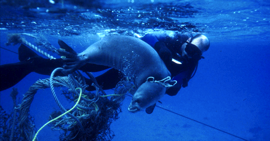
Seal tangled in mass of various strings and fishing line
Dead Albatross found filled with all sizes of various plastics in its stomach.
The main problem with plastic is that it doesn’t chemically break down over time; it simply slowly degrades into smaller and smaller pieces. As a result, the chemicals in this material, specifically the Bisphenol A, increases in concentration, as the pieces get smaller. So it becomes increasingly toxic and near impossible to clean up. These toxins all work their way up the food chain back onto our plates at home.
Since ocean is full of plastic products, the really mystery is, where in the world is there not exposure to them?
What can we do?
Although it seems like too big of a problem to even think about dealing with, we cannot give up hope. There are many ways that you can reduce your plastic intake and output.
Use reusable shopping bags to cut down on unnecessary plastic usage (not only for shopping, but for an everyday bag!)
Buy loose fruit and vegetables from the shops instead of ones that are pre packed in plastic
Buy your meats from a butcher, that way it will be wrapped in paper instead of plastic
If you bring packed lunches with you, don’t wrap everything in plastic, use paper or other containers instead
The goal here, of course, is not to get rid of all the plastic in our lives, that would be impossible. Instead, it is for us to be aware of the damaging effects plastic has on our environment and the simple things that we can do to limit our consumption. This is a real world problem that will be the test for our future scientists to come up with alternative solutions to plastic. As of today it is embedded into our everyday lives, so much so that many people don’t even realize it, but hopefully, in the future, an alternative can successfully be mass produced to limit out plastic waste.
Warning: Blog Post contains graphic images and video which may offend or disturb some viewers. Blogger does not take responsibility for any sudden onsets of nausea. Viewer discretion is advised.
What Is It?
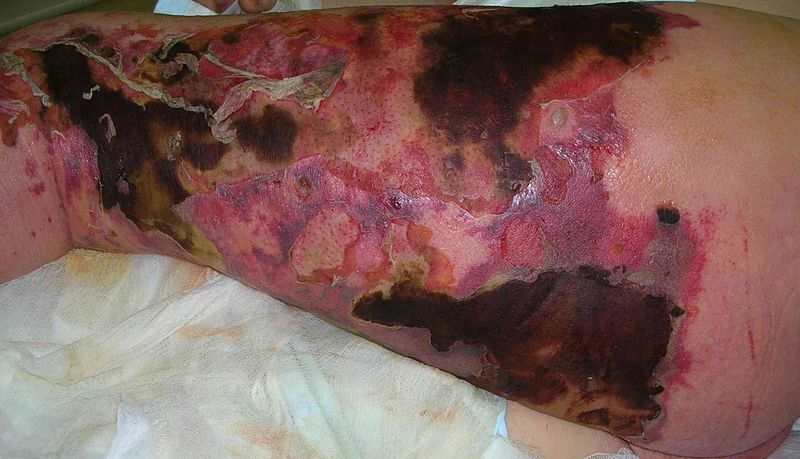
Flesh-eating disease, or Necrotizing fasciitis as it is formally known, is actually a bacterial infection caused by several types of bacteria but most commonly, Streptococcus pyogenes. Invading by a very small wound, the bacteria will produce chemical toxins which begin to destroy tissues and muscles. Within a day, symptoms will begin to appear but they are mild at first and often mistaken as the flu with fever, nausea, and vomiting common. Eventually, the wound area will begin to swell and pain will increase. In the picture below, you can see the presence of gangrene or dead tissue in a leg with the disease.
Necrotizing fasciitities left leg. Image from Wikipedia.
Now, antibiotics will treat the disease in its early state but all too often, the disease is discovered too late in its progression. In that case, the only treatment is to remove the infected body parts. A few patients have gone to the hospital, only to wake up a few days later out of a medical coma to find themselves missing their limbs. About 20-30% of cases are fatal.
Check out this compelling video of a woman who was lucky enough to survive the disease but was not lucky enough to keep all her limbs.
“Flesh-eating disease took her arms and legs, but not her spirit.” Video posted by YouTube user druidhills2005.
Where Is It Today?
In New Zealand, cases of flesh-eating disease have actually been on the rise according to the Ministry of Health of New Zealand. In 1990, there were only about 10 cases of the disease but in 2006, there were more than 70 cases. New Zealand is a first world country just like Canada and the United States so this is some surprising news that should hit close to home.
Whoa! What Should I Do?
Don’t panic yet! The disease is still very rare and in Canada (with a population almost 8 times larger than New Zealand), only 90-200 cases are reported each year. However, it is still probably a pretty good idea to avoid it. To minimize your risk, Health Canada advises you to “take care of minor wounds and cuts” making sure to “wash the affected area in warm soapy water.” Additionally, if you do come in contact with someone you know that has been inflicted with the disease, see a doctor immediately. In general, take care of yourself. Those with a weakened immune system or with chronic diseases are particularly vulnerable.
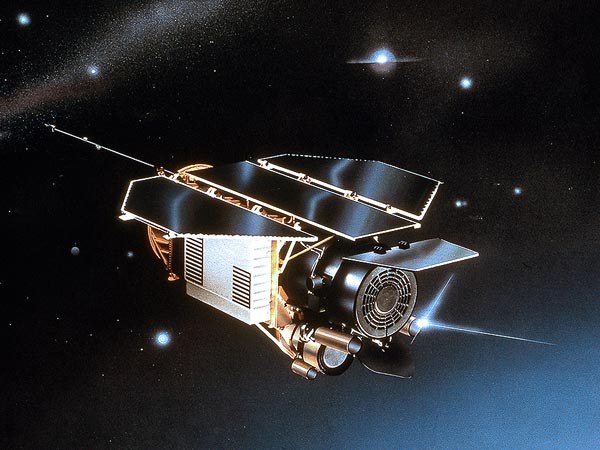
Illustration courtesy DLR: An artist’s impression of ROSAT in orbit.
Dead Satellites are being ‘unwelcome guests’ recently. The 6-ton Upper Atmosphere Research Satellite (UARS) satellite has entered the Earth’s atmosphere early morning of September 24th 2011, but where it has crashed remains unknown. According to NASA, debris would likely have fallen in Ocean, and it may never be found.
Another defunct German satellite called ROSAT is headed straight for the earth this weekend and there is a higher chance(1 in 2,000 while UARS’ has been 1 in 3,200) that a piece of space debris could hit someone.
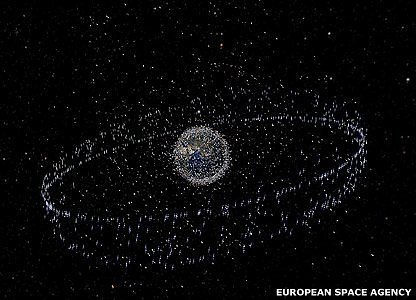
European Space Agency : The Earth
Usually satellites’ lifespan depends on their sizes; life span is determined by how much liquid fuel they carry aboard. A satellite that has exceeded its useful purpose has several final resting places. These depend on the amount of fuel available on the satellite, and whether ground control is still able to manoeuvre it. One method is to move the satellite into a ‘graveyard orbit’ (geostationary orbit), which is higher in orbital band and no other satellites are orbiting. Dying satellite can be left to degrade over time, but as it breaks up and potentially shifts in orbit, this could still prove dangerous to other satellites.
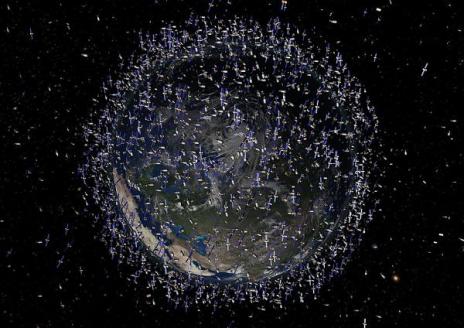
European Space Agency: Red dots= debris, White dots= operating satellites, Outer ring= satellites in geostationary orbit
Some satellites are merely left in their current orbits if uncontrollable. Other satellites are purposely moved lower into the atmosphere so they burn up and hopefully disintegrate before reaching the Earth. While this is usually the case there have been some notable exceptions, including NASA’s Skylab station in 1979, NASA’s UARS and ROSAT as mentioned earlier.
According to the Federal Communications Commission, any satellite with altitude in geostationary orbit, meaning that satellites just below 36,000 km, must be moved farther away from the Earth at the end of its useful life.
Satellites fall because of frictions and resistance of the atmosphere. In theory, if satellites’ centrifugal force and the Earth’s gravity balance, satellites can circulate the orbit without falling. Scientists probably have worked on different calculations on how satellites work; however, such recent events may appear as lack of preparation and carefulness. There are no clear back-up plans suggested if their expectations are not met. Our lives certainly have become more convenient with satellites, but if what we sent out in the past can come back to hurt us, how meaningful are those techniques? We have to look out for the safety of satellites rigorously.
European Space Agency: Computer-generated image of the Earth
Not only that, there is a real danger. Concerning that we are sending the dead satellites to outer orbit and keep sending new satellites without proper disposal methods, our planet is turning into the largest dumping ground. Is this what you expect our planet to look like? Would this be what aliens expect the earth to be? They will have problems figuring out whether this Saturn-like planet is the earth!
The Tasmanian devil is a resilient and notoriously fiendish predator. Weighing up to 26 pounds, this carnivorous marsupial may not seem like a threat. However, pound for pound, its muscular jaws and sharp teeth add up to one of the most powerful bites of any mammal. To this end, it is hard to believe that the species is facing a rapidly declining population – over 60% in the last decade.
Provided that humans have an exceedingly influential role in the ecosystem, it is surprising to find that human-induced climate change, water pollution or land development isn’t the culprit behind this population decline. Rather, cancer (a disease that also targets humans) is the disease that has taken this species by the thousands.
Specifically, this rare and highly parasitic cancer has been named the Devil Facial Tumor Disease (DFTD). Characterized by lesions on and around the mouth, these tumors have been known to spread from the face to the entire body within months. These tumors also interfere with feeding and lead to starvation – the primary cause of death.
Source: Australian Geographic, Getty Images
An illustration of DFTD in a Tasmanian Devil. Based on the size and texture of the tumor, it is easy to imagine how detrimental DFTD is to the survival of the Tasmanian Devil.
One of the reasons why DFTD is so transmissible is because of the devil’s behaviour: frequently biting each other’s faces while fighting for food or mates. Scientists studying the disease have also found that the cancer cells in these tumors shed, and take root in the wounds of bitten Tasmanian devils. Further analysis has shown that the tumors have a remarkably similar genetic makeup to Schwann cells (cells that cushion nerve fibers in the nervous system). For this reason, the Tasmanian devil’s immune system is unable to detect the cancer cell as a foreign cell, and will not take the necessary steps to mount an immune defense against the disease. As a result, DFTD is able to develop and proliferate throughout the entire body.
A video by Al Jazeera English (News Network) demonstrating the preliminary experimental method used to study DFTD. It also illustrates the physical features of DFTD in the Tasmanian devil.
Because the severity of DFTD has scientists predicting that the species could be lost within the next 25 years, it is commendable that humans are making great strides to prevent the extinction of the Tasmanian devil. Not only have scientists been able to receive grants to aid in DFTD research, but also, the Australian government has now listed Tasmanian devils as vulnerable and is drawing up captive breeding programs to save the species from extinction. To this end, we have simultaneously added to the existing knowledge of cancer as a multi-faceted tumor disease and are taking the steps to further study, isolate and find a vaccination. Ultimately, researching cancers in different mammals may help us find a cure in the future for cancers that plague the human race.
How cool would it be to track your ancestors back over 650 years? Well, if you are a Yersinia pestis, you are lucky because recently a group of Canadian scientists mapped the entire genetic makeup that will allow researchers to track your ancestor’s evolution and virulence over the centuries.
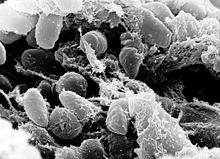
A scanning electron microscope micrograph depicting a mass of Yersinia pestis bacteria. Source: Wikipedia
So you may ask, what is a Yersinia pestis? Yersinia pestis is the bacteria that caused the Black Death in Europe. The epidemic caused by the bacteria was so great that it is estimated to have killed 30-60% of the population of Europe, in a span of two years. Due to their high virulence, when left untreated with antibiotics, two-thirds of those that get infected die usually within four days.
Source: WikipediaSource: Vancouver Sun
To gather data on the bacterium, the scientists took the remains of bones and teeth samples, carefully went through each piece to get all the different DNA’s found on the body. Then they filtered through all the DNA’s to find the one that belonged to Yersinia pestis. This “fishing” method of DNA could be used to study and reconstruct other ancient pathogens that turned into deadly killers, according to one of the researchers.
The Canadian scientists found that while comparing their reconstructed plasmid against the modern Y. pestis, it was found that the varient of Y. pestis maybe no longer be existing today. However, their study shows that Y. pestis DNA was found in the medieval dental tissues from the victims of the Black Death. This is another support that strengths the hypothesis that this bacterium was the organism that caused the medieval plague.
So, the mapping of Y. pestis may just be the start of genetic mapping of bacterial species. I wonder which virulent bacterium will be mapped next, revealing its stories of mutations and evolution through time.
It is apparent that the trend of products today is to become smaller and smaller. We use many products today that achieve the same uses as its much bulkier predecessors. Just think back to the days of primitive cell phones. To say they were ‘big’ would be an understatement. While most would say that having small and compact devices are a matter of convenience, there are other compelling reason for us to look as deep as nanotechnology. One of these reasons includes potential medical applications.
Source: Wall Street Journal
In fact, medical researchers have been trying to devise useful nano-machines or nano-robots for quite some time. A barrier they had in successfully applying them to medical treatments was the lack of a means of propulsion. This is crucial for maneuvering these machines through areas of the body such as the bloodstream.
Source: University of South Caroline Beaufort
Until recently, there had been no viable motor to accomplish this task. Researchers have now discovered a means to make motors at the nano-level, which spin at 600 revolutions per minute and can move things 2,000 times their weight. What is the secret to such magnificent specifications? Carbon.
Source: BBC News
Carbon is one of the most abundant elements in the universe. However, it is often overlooked in materials manufacturing in favor of metals. Interestingly, carbon is convenient to work with and has suitable properties for nanotechnology. Nano-tubes composed entirely of carbon atoms arranged in hexagons can be made into a yarn that can be used as a type of electric motor.
These carbon fibers, which are 100 times stronger than steel of the same dimensions, are coated in an electrolyte. This allows the fibers to expand when voltage is applied. The expansion can produce a torque on par with much larger conventional electric motors.
Researchers propose that this type of motor can be used to produce ‘flagella’ for nano-robots. These nano-robots can then be used to deliver drugs, fight diseases, and remove parasites. The applications do not end there. Scientists can apply this technology in several other ways to treat the body’s problems.
I am awestruck as to how ideas which were once science fiction are now commonplace. In the future we can perhaps expect to see nano-machines populating our bodies, constantly monitoring and regulating it, defeating disease once and for all. Nanotechnology may give us the ultimate bond between man and machine.
Source: BBC News
Readers may be interested to note that researchers from UBC were involved in this collaboration with researchers from other countries.
If you think back of the summer in 2008, remember the contamination found in Maple Leaf Products? Yes that’s right, it was Listeriosis. The Listeriosis victims and families are now waiting for compensation after they have been sick from eating tainted meat. This largest food recall outbreak in Canada happened three years ago killing about 23 people and injuring many more. The victims were contaminated with the bacterium Listeria. One of the victim’s daughters, Francis Clark, reported viewing her mother became short of breath and suffering from the illness. The settlement for these victims was out-of-court and was declared in January 2009. Michael McCain, CEP and president of Maple Leaf, payed about up to $27 million to the victims suffering from Listeriosis in the summer of 2008. None of the victims have received the money yet due the to the wait for Court approval.
Source from CBC News
“The reason for the settlement was two-fold: the families didn’t want to go through a long, drawn-out court case, which only increases the hurt and the agony and pain as the result of somebody’s death.
“And in fairness to the company involved, it didn’t want to go through a long, drawn-out court case that’s going to be bad for its reputation and costly. So you come to a settlement — but a settlement so that the money can get out there in a timely way. And this long after the fact is not timely at all.”
Source from The Vancouver Sun
The symptoms of Listeriosis would commonly appear after two to 30 days after the consumption of the product. However, it can also take up to 90 days for the symptoms to show. The average age of the people who were diagnosed with Listeriosis was 67. The Maple Leaf products is served widely among residential homes or elderlies. Young children, pregnant women, and elders are most vulnerable to getting sick due to their weak immune system.
McCain apologized to those victims and families. The company took full responsibility of their actions and this has saved their reputation as they confronted the situation heads-on rather than putting blames on others.
Source from The Globe and Mail
Listeriosis is the disease caused by Listeria monocytogenese. This bacterium exists in natural environment. The products that are contaminated with Listeria are hard to be detected. Thus to prevent the disease from further harming people, food product including farm products must be carefully detected by food inspection.
Source from Wikipedia
I believe we have to watch out for what we eat and beware there are more bacteria out there that could harm or even lead to severe illnesses. The best way to prevent any contaminations is to simply wash the raw food material thoroughly with water and avoid eating raw meat. Keeping up with the current events will also help us stay alert.
Dr. Kevorkian dies at the age of 83 on June 3rd, 2011. (CNN blog-reports “Dr. Jack Kevorkian dead at 83”)
Dr. Death is the name given to a pathologist Jack Kevorkian. He made the headlines of national news in early 1990s for his legislation of a “right-to-die”. Is Dr. Death a murderer?
Early life
Jacob “Jack” Kevorkian, or Hagop Kevorkian, was born in Pontiac, Michigan, to a family of immigrants from Armenia. His mother Satenig and her family escaped Armenian genocide in 1915 and eventually immigrated to Pontiac where she met his father Levon. The couple had a daughter, Margaret, son Jacob, and lastly, daughter, Flora.
Kevorkian, who taught himself German and Japanese, graduated from Pontiac Central High School with honours in 1945, at the age of 17. In 1952, he graduated from the University of Michigan Medical School.
Career
Kevorkian’s career begins in 1980s with a series of articles written for the German journal Medicine and Law capturing his views on euthanasia. He started advertising in newspapers as a physician consultant for “death-counselling”. His first assisted suicide was of Janet Adkins who suffered from Alzheimer’s disease. He was charged of murder, but charges were dropped because of no law in Michigan regarding assisted suicides. However, a year later his medical licence was taken away and he was no longer allowed to work with patients. This did not stop Dr. Kevorkian from assistance of over 130 deaths from 1990 to 1998.
Methods
In each of the cases, when patient agreed to death, Kevorkian assisted by attaching them to a euthanasia device that he made. The individual then pressed a button that would end their own life. Two people were assisted by “Thanatron” (death machine), others with “Mercitron” that had a gas mask filler with carbon monoxide.
Later career, imprisonment
In 2010 interview with Sanjay Gupta, Kevorkian stated “what difference does it make if someone is terminal? We are all terminal”. He also mentioned that he declined four out of five requests, on the grounds of possible treatment.
On November 22, 1998 Kevorkian allowed videotaping Thomas Youk’s,52, voluntary euthanasia, who was in final stage of lateral sclerosis. In this act Kevorkian injected Youk. During the videotape, Kevorkian dared the authorities to try and stop him from carrying mercy killing. After that incident going on public, Kevorkian was charged with second-degree murder and sentenced to serve 10-25 year in prison. He spent eight years and 2.5 months in prison before he was paroled for good behaviour in 2007. He was paroled under the conditions that he cannot practice medicine or provide care to anyone older than 62 or disabled. He was also forbidden from making comments about his assisted suicides.
Death
Kevorkian suffered from kidney problems for years and had been diagnosed with liver cancer. He was hospitalized in May, 2011 and died in June of the same year.
Dr. Kevorkian was a jazz musician, composer and an oil painter. He sometimes painted with his own blood. Of his known works, six were made available in the 1990s for print release.
The capability that living creatures have to repair themselves is astounding. Imagine you accidentally cut yourself with a knife while you’re making dinner. It’s not a huge deal, a little inconvientent perhaps, but nothing your body can’t handle. Now imagine cutting a sheet of plastic with that same knife. The plastic does not have the same capability to re-heal itself like we do. Once it’s cut, it can’t spontaneously heal itself back into it’s original conformation.
However, this is a phenomenon scientists have been trying achieve for nearly a decade. By experimenting with plastics, metals and carbon composites, researchers are attempting to create self-healing materials.
Mediocre Microcapsules
Self-healing fluid and hardening agent in a cracked material. Source: The University of Illinois
For the past decade, self-healing technology involves microcapsules filled with a self-healing fluid embedded into the material that is to be repaired, say a plastic. The fluid in the capsules is a monomer of the polymer plastic. Accompanying the microcapsules are catalyst hardening agents that react with the healing fluid to solidify it.
When the crack in the plastic punctures the microcapsules, the healing fluid within is released into the crack. The fluid polymerizes when it comes into contact with the catalyst, and the mixture seals the crack.
This method is effective, but not very efficient. It can repair cracks between fifty and one hundred micrometers wide, but the fluids have to move through the material by diffusion, which can take a long time. Also, there is a limit to the number of capsules that can be put in the material without weakening it’s structural integrity.
Circulatory Channels
Pressurized self-healing channels. Source: The Journal of the Royal Society Interface. Hamilton et al. September 2011.
New research being conducted by scientists at the University of Illinois attempts to mimic an animal circulatory system by copying the blood vessels and heart. Instead of having the self-healing fluids in capsules, they have put it in channels in the material. Similar to the microcapsules, when the channels are punctured, the fluid within them is released into the crack.
In addition to this change, pressure is also applied at the inlets and outlets of the channel to force the fluid into the crack in the material. This added pressure acts like a heart does in a circulatory system. The heart forces blood to move all throughout an animal’s body. The pressure applied to the self-healing fluid has the same effect. This technique ensures that the entire crack can be effectively repaired. With the applied pressure method cracks up to one millimetre wide can be repaired.
Current Applications
This technology has innumerable applications in infrastructure and engineering. NASA is looking into self-healing materials particularly for their space stations. Cracks and damages on these structures could risk the safety of the entire mission. With self-healing materials, the lives of astronauts are more secure, and they can focus on exploration, rather than restoration.
For more information on NASA’s work on self-healing materials, check out this video.