On October 28, 2011, Dr. John Hepburn, (Vice President, Research and International) sent an email to the UBC community on the subject of animal research. He outlined the university’s plans to increase transparency on its animal research by releasing details on the number of animals and categories of species being used.
According to www.animalresearch.ubc.ca, 211,764 animals were used in research at UBC in 2010. Of those, 56% were rodents, 35% were fish, and 6% were reptiles or amphibians. Chimpanzees, gorillas and orangutans were not studied at all, and are not used for research in Canada primarily due to their classification as endangered species. Instead of these primates, rhesus macaques are often used in research. At UBC they are involved in studies investigating depression, Parkinson’s disease and other brain disorders.
It is worth noting that not all animals involved in research are used in a typical lab setting. Animals involved in catch & release and observational studies are counted, as well as those in laboratory research. The majority (68%) of animal research at UBC involves less than minor or short-term stress to the animal. Examples of this type of research include tagging of wild animals for conservation purposes.
Part of the reason that UBC has not released such details about its animal research until now is because of the potential negative backlash from animal rights activists. Undoubtedly this is a problem that faces every member of the animal research community, and increasingly this is an issue that they are attempting to address.
This video from Understanding Animal Research outlines some of the key reasons why animal research is critical in modern society.
Highlighted in this video is what can happen when proper animal research and testing is not carried out on drugs prior to their release to the public. Thalidomide was sold starting in 1957 as an effective tranquilizer and painkiller, often prescribed to pregnant women to treat morning sickness. However, thalidomide caused major birth defects in over 10,000 children, and was outlawed in most countries by 1962. Much stricter testing is now required on drugs before they can be approved for sale as a result of the thalidomide disaster, often referred to as one of the worst medical tragedies of modern times.
In today’s society where humans are extremely close to their pets, animal research is often though of as harmful and unnecessary. However, not only does animal research help humans, but other animals as well. For example, a cure for feline leukemia, a type of cancer common to both humans and cats, has been found thanks to animal research.
While scientists make every effort not to use animal research by taking advantage of computer modeling, there is only so much an inanimate machine can replicate. If the day ever comes when a computer can accurately represent an animal cardiovascular system, perhaps animal research can stop. Until then we will have to make do with the next best thing, and remain diligent about our ethics.
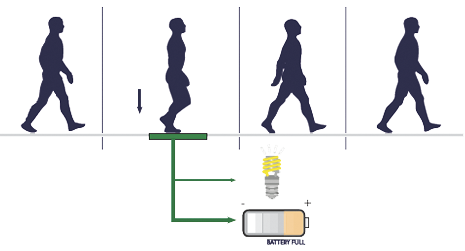
Figure 1: Demonstates potential incorporation of technology into existing sidewalks in populated areas.
The world today is constantly struggling to find new, environmentally friendly ways to generate energy. The major power sources today include oil, gas, coal, hydroelectric, and nuclear power. Until recently no one has thought to use everyday life to help generate usable energy.
Laurence Kembell-Cook, director of Pavegen Systems, has had the ingenious idea to harvest electrical energy from pedestrian’s footsteps. He is going to use sidewalk tiles that will be connected to a lithium battery to supply energy to electrically powered devices in the surrounding area. This could range from traffic lights to advertisement boards on sidewalks or supply energy to light up displays at the mall.
Figure 3:Simple schematic of Pavegen tile mechanism
The basic design is outlined in Figure 2 and a demonstration of the Pavegen tile system can be found online . The pedestrian will step on the tile, displayed in Figure 3, which will cause it to glow, just like the tiles in Michael Jackson’s “Billie Jean” music video. The five-millimeter compression will initiate a mechanism (unreleased to the public) which allows the kinetic energy to by converted to usable electricity. The tile can also store the energy for up to three days in an onboard battery. Each step on one of these tiles contributes 2.1 W per hour of electricity. Out of the energy the tile absorbs, only five percent goes into lighting up the tile leaving 95 percent of the energy to be used elsewhere. Personally, I believe the energy to light the tile is significant as it gives people a positive reinforcement,which may increase their participation. However,
Figure 3: The light up tile model to be used
it also could be argued that energy lighting the tile is wasting energy that could be used elsewhere which I also recognize. The tile itself is made of nearly 100 percent recycled materials, mostly consisting of rubber and some stainless steal which both contribute to its durability. These tiles are designed to be weather resistant, water-resistant, and are easily added to existing structures. The company claims the lifespan of each tile is approximately 5 years or 20 million steps.
Figure 4: Computer generated models of the applications of this technology on sidewalks in front of the Westfield Stratford City Mall.
The first commercial application will be placing 20 tiles across a very busy intersection in London between London’s Olympic stadium and the newly opened Westfield Stratford City mall. The opening of the mall alone is estimated to bring in around 30 million customers within the first year, that’s a lot of steps!
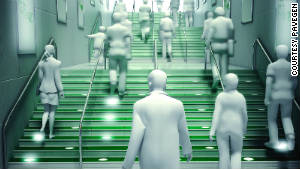
The aim of this project it to collect a small amount of energy from a large number of people. The growth of this technology will rely heavily on the tiles production costs. If this project gets approved the company hopes to introduce this technology into subway stations, malls, or any other high traffic areas. I believe this would be a fantastic venture for our society so we can finally take a stand, or a stroll, towards helping generate clean energy in the future.
Figure 5: Computer generated models of the applications of this technology in subway staircases.
Plastic. Everyone is familiar with it; it’s used in the majority of products that are available to us. Yet because it is so frequent, many people do not take enough time to consider the effects that such a large industry has on the environment. Unknown to many, over 1 trillion plastic bags are used worldwide every year. According to the China Trade News, China alone uses 3 billion plastic bags per day. All this amounts to about 1 million plastic bags being used every minute. However, despite the immense usage of plastics bags, hardly any actually end up being recycled. For example, according to the BBC, in the UK, only 1 in 200 plastic bags get recycled. As such, more than 3.5 million tons of plastic was discarded in 2008 alone. This amounts to a massive global footprint, whose blame can be shared throughout the world.
What people fail to understand is that it takes up to 1,000 years for a plastic bag to degrade. This means that when you throw out the plastic bag that your subway sandwich came in only a few minutes ago, that bag will still be around a millennium later, long after your have passed away.
Plastic In Our World
plastic can end up in the environment by a simple gust of wind. (taken from www.reuseit.com)
So, from this, one can understand that every piece of plastic ever made, since its creation in 1862 by Alexander Parkes, is still floating around somewhere today. As such, where is all this plastic ending up? There are many theories and myths out there, but one of the main ones is of an island of plastic in the middle of the ocean that is bigger than the state of Texas. The sad thing is that this story holds more truth than fiction.
News broadcast on the Great Pacific Gyre found on YouTube
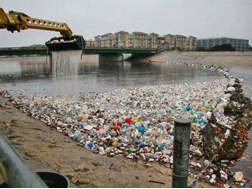
Even more plastics end up floating to the sea via our modern waterways
The Pacific Gyre
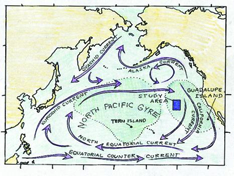
Every story about the island is slightly different, just as every researcher has observed a different thing. As such, many people have written it off as an urban myth. The fact is that there is a vortex of currents called to Pacific Gyre, located in the Pacific Ocean and stretching from coast of California to Japan. This current formation has historically been the collecting point for all different kinds of debris. However, in recent history, it has become known as the collection point for plastic. It is estimated that over 90% of the floating debris is plastic. Originating from land, waterways and wind, millions of tons of plastic are cast into the environment from all over the world. This has resulted in some areas having six times more plastic than plankton, which is the major source of food for many marine organisms. Basically, we have created an ecological disaster.
Current flow of the Pacific Gyre
A scientist, named captain Charles Moore, who is the captain of an oceanographic research vessel, took a detour into North Pacific Gyre, on his way back to the United States from Australia. What he found was an ocean filled with tiny pieces of plastic. He and his crew cast plastic trolls into the water and found they came back filled with plastic. Moore commented that many people believe that the worst kind of spill for the ocean is oil, but the reality is that the worst is really the plastic bottles we throw away.
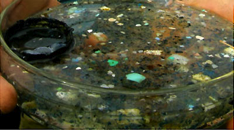
Sample taken from mile long troll for plastic in the Gyre.
Effects on Humans
Amazingly, this section of ocean, literally in the middle of nowhere, with no land or other ships around, holds one of the highest concentrations of plastic per square inch of water. The danger here lies in the main component of plastic, Bisphenol A. This compound, used for the plastic polycarbonates, is made at 7 billion pounds per year and is completely non-recyclable. The scary part is that evidence from all over the world says that every person examined has these chemicals in their bodies. Worse still, in Japan, women who had increased levels of Bisphenol A were the ones who were unable to get pregnant, and continually had miscarriages.
Effects on Animals
But how is it possible that our trash is coming back to haunt us? It can be explained with one word: bioaccumulation. The ecological effects of plastic in the oceans, starts out at the smallest scale: plankton. There is six times more plastic than plankton in many parts of the ocean, specifically in the Pacific Gyre. Since plankton is one of the most common food sources for marine life, animals are mistaking small pieces of plastic for their food. For example, turtles may mistake a floating plastic bag for a jellyfish, which they can consume. Thus, there is a build up of Bisphenol A in animals. These are then the prey of other, larger animals, and as such bioaccumulation begins. It doesn’t stop until it reaches the top of the food chains and humans. As a result, the contaminations and poison associated with plastic is passed on through nearly every organism. Even despite bioaccumulation, many marine animals die due to the direct effects of being caught in or choking on plastic pieces.
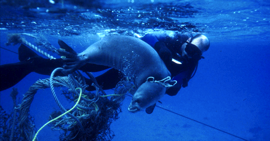
Seal tangled in mass of various strings and fishing line
Dead Albatross found filled with all sizes of various plastics in its stomach.
The main problem with plastic is that it doesn’t chemically break down over time; it simply slowly degrades into smaller and smaller pieces. As a result, the chemicals in this material, specifically the Bisphenol A, increases in concentration, as the pieces get smaller. So it becomes increasingly toxic and near impossible to clean up. These toxins all work their way up the food chain back onto our plates at home.
Since ocean is full of plastic products, the really mystery is, where in the world is there not exposure to them?
What can we do?
Although it seems like too big of a problem to even think about dealing with, we cannot give up hope. There are many ways that you can reduce your plastic intake and output.
Use reusable shopping bags to cut down on unnecessary plastic usage (not only for shopping, but for an everyday bag!)
Buy loose fruit and vegetables from the shops instead of ones that are pre packed in plastic
Buy your meats from a butcher, that way it will be wrapped in paper instead of plastic
If you bring packed lunches with you, don’t wrap everything in plastic, use paper or other containers instead
The goal here, of course, is not to get rid of all the plastic in our lives, that would be impossible. Instead, it is for us to be aware of the damaging effects plastic has on our environment and the simple things that we can do to limit our consumption. This is a real world problem that will be the test for our future scientists to come up with alternative solutions to plastic. As of today it is embedded into our everyday lives, so much so that many people don’t even realize it, but hopefully, in the future, an alternative can successfully be mass produced to limit out plastic waste.
Warning: Blog Post contains graphic images and video which may offend or disturb some viewers. Blogger does not take responsibility for any sudden onsets of nausea. Viewer discretion is advised.
What Is It?
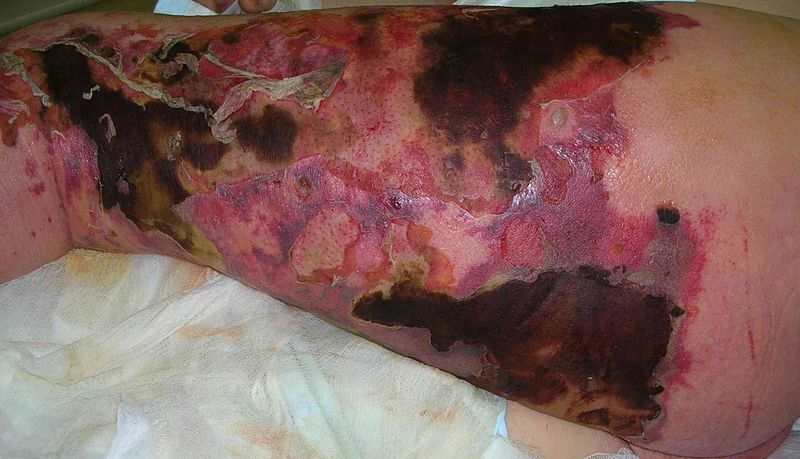
Flesh-eating disease, or Necrotizing fasciitis as it is formally known, is actually a bacterial infection caused by several types of bacteria but most commonly, Streptococcus pyogenes. Invading by a very small wound, the bacteria will produce chemical toxins which begin to destroy tissues and muscles. Within a day, symptoms will begin to appear but they are mild at first and often mistaken as the flu with fever, nausea, and vomiting common. Eventually, the wound area will begin to swell and pain will increase. In the picture below, you can see the presence of gangrene or dead tissue in a leg with the disease.
Necrotizing fasciitities left leg. Image from Wikipedia.
Now, antibiotics will treat the disease in its early state but all too often, the disease is discovered too late in its progression. In that case, the only treatment is to remove the infected body parts. A few patients have gone to the hospital, only to wake up a few days later out of a medical coma to find themselves missing their limbs. About 20-30% of cases are fatal.
Check out this compelling video of a woman who was lucky enough to survive the disease but was not lucky enough to keep all her limbs.
“Flesh-eating disease took her arms and legs, but not her spirit.” Video posted by YouTube user druidhills2005.
Where Is It Today?
In New Zealand, cases of flesh-eating disease have actually been on the rise according to the Ministry of Health of New Zealand. In 1990, there were only about 10 cases of the disease but in 2006, there were more than 70 cases. New Zealand is a first world country just like Canada and the United States so this is some surprising news that should hit close to home.
Whoa! What Should I Do?
Don’t panic yet! The disease is still very rare and in Canada (with a population almost 8 times larger than New Zealand), only 90-200 cases are reported each year. However, it is still probably a pretty good idea to avoid it. To minimize your risk, Health Canada advises you to “take care of minor wounds and cuts” making sure to “wash the affected area in warm soapy water.” Additionally, if you do come in contact with someone you know that has been inflicted with the disease, see a doctor immediately. In general, take care of yourself. Those with a weakened immune system or with chronic diseases are particularly vulnerable.
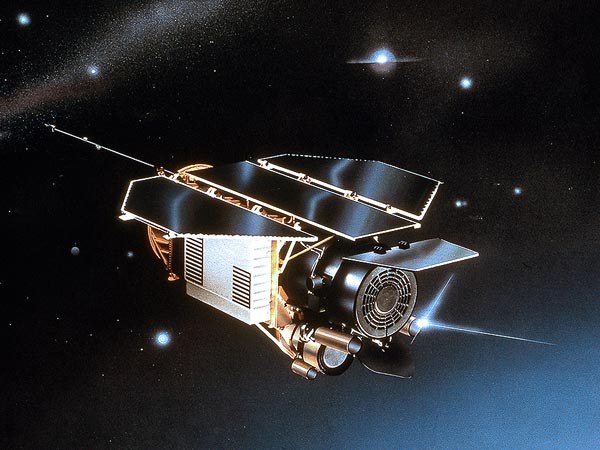
Illustration courtesy DLR: An artist’s impression of ROSAT in orbit.
Dead Satellites are being ‘unwelcome guests’ recently. The 6-ton Upper Atmosphere Research Satellite (UARS) satellite has entered the Earth’s atmosphere early morning of September 24th 2011, but where it has crashed remains unknown. According to NASA, debris would likely have fallen in Ocean, and it may never be found.
Another defunct German satellite called ROSAT is headed straight for the earth this weekend and there is a higher chance(1 in 2,000 while UARS’ has been 1 in 3,200) that a piece of space debris could hit someone.
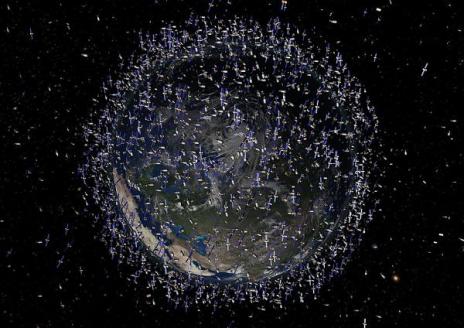
European Space Agency : The Earth
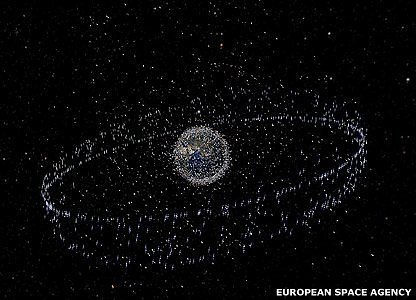
Usually satellites’ lifespan depends on their sizes; life span is determined by how much liquid fuel they carry aboard. A satellite that has exceeded its useful purpose has several final resting places. These depend on the amount of fuel available on the satellite, and whether ground control is still able to manoeuvre it. One method is to move the satellite into a ‘graveyard orbit’ (geostationary orbit), which is higher in orbital band and no other satellites are orbiting. Dying satellite can be left to degrade over time, but as it breaks up and potentially shifts in orbit, this could still prove dangerous to other satellites.
European Space Agency: Red dots= debris, White dots= operating satellites, Outer ring= satellites in geostationary orbit
Some satellites are merely left in their current orbits if uncontrollable. Other satellites are purposely moved lower into the atmosphere so they burn up and hopefully disintegrate before reaching the Earth. While this is usually the case there have been some notable exceptions, including NASA’s Skylab station in 1979, NASA’s UARS and ROSAT as mentioned earlier.
According to the Federal Communications Commission, any satellite with altitude in geostationary orbit, meaning that satellites just below 36,000 km, must be moved farther away from the Earth at the end of its useful life.
Satellites fall because of frictions and resistance of the atmosphere. In theory, if satellites’ centrifugal force and the Earth’s gravity balance, satellites can circulate the orbit without falling. Scientists probably have worked on different calculations on how satellites work; however, such recent events may appear as lack of preparation and carefulness. There are no clear back-up plans suggested if their expectations are not met. Our lives certainly have become more convenient with satellites, but if what we sent out in the past can come back to hurt us, how meaningful are those techniques? We have to look out for the safety of satellites rigorously.
European Space Agency: Computer-generated image of the Earth
Not only that, there is a real danger. Concerning that we are sending the dead satellites to outer orbit and keep sending new satellites without proper disposal methods, our planet is turning into the largest dumping ground. Is this what you expect our planet to look like? Would this be what aliens expect the earth to be? They will have problems figuring out whether this Saturn-like planet is the earth!
Imagine yourself walking on the street, surrounded by mirrors. You would be seeing myriad of yourself straying alongside and pass you. That may be how the world would be like if cloning is to be successful and legal.
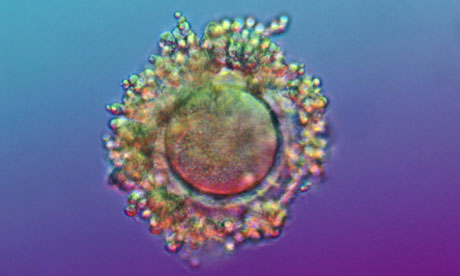
Image: The Roslin Institute
The most renowned successful case of cloning is undoubtedly Dolly the sheep. Born in 1996, Dolly was a shock to the scientific world. However, it raises ethical concerns. Should we be cloning animals?
May it be to bring back the dead to live, to preserve the looks of a being, or for whatever other reasons, cloning is still considered unethical, illegal or both in most countries.
Image: Yorgos Nikas/Getty
Dr. Panayiotis Zavos had been continuously attempting to clone the first human being, working in a surreptitious lab in the Middle East. Over the past 10 years, he had been implanted numerous embryos into anonymous surrogates, though none of the women had become pregnant or gave birth to any infants. As Sample mentioned in his article, “almost every attempt to clone a new animal species has been married with birth defects or worse.”
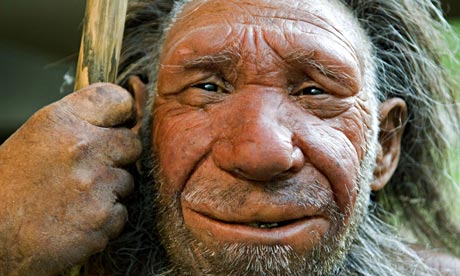
Cloning animals could give rise to many other problems too. Debates had been carried out on whether we should clone Neanderthals, or resurrecting mammoth from the ice age. Bringing these back to life may be chaotic and cause disorders in the nature’s ecosystem. The food chain could be stressed and scrambled, with new species being re-introduced. Organisms could become extinct, while many others would have to strive for survival.
Image: Action Press /Rex Features
If it does happen that we clone the extinct species from their DNA, we have to be responsible for any difficulties caused. It is difficult to map the whole DNA sequence of a species to clone it without any deficiencies especially if no live specimen is present for comparison.
Despite the arguments over cloning an individual, extensive effort had been put into the researches of therapeutic cloning. Therapeutic cloning, also called “embryo cloning” is the use of embryos and stem cells to generate specialized cell in the human body. This technique is still under research for improvements in human development and disease treatment.
When the technology is mastered, whole healthy organs can be produced from a single cell to replace the damaged ones, and treat diseases and disorders that normally require transplants or other complicated procedures.
Nonetheless, cloning still remains as one of the biggest controversies in the society and will carry on regardless of whether the technology of cloning is improving or not.
The Tasmanian devil is a resilient and notoriously fiendish predator. Weighing up to 26 pounds, this carnivorous marsupial may not seem like a threat. However, pound for pound, its muscular jaws and sharp teeth add up to one of the most powerful bites of any mammal. To this end, it is hard to believe that the species is facing a rapidly declining population – over 60% in the last decade.
Provided that humans have an exceedingly influential role in the ecosystem, it is surprising to find that human-induced climate change, water pollution or land development isn’t the culprit behind this population decline. Rather, cancer (a disease that also targets humans) is the disease that has taken this species by the thousands.
Specifically, this rare and highly parasitic cancer has been named the Devil Facial Tumor Disease (DFTD). Characterized by lesions on and around the mouth, these tumors have been known to spread from the face to the entire body within months. These tumors also interfere with feeding and lead to starvation – the primary cause of death.
Source: Australian Geographic, Getty Images
An illustration of DFTD in a Tasmanian Devil. Based on the size and texture of the tumor, it is easy to imagine how detrimental DFTD is to the survival of the Tasmanian Devil.
One of the reasons why DFTD is so transmissible is because of the devil’s behaviour: frequently biting each other’s faces while fighting for food or mates. Scientists studying the disease have also found that the cancer cells in these tumors shed, and take root in the wounds of bitten Tasmanian devils. Further analysis has shown that the tumors have a remarkably similar genetic makeup to Schwann cells (cells that cushion nerve fibers in the nervous system). For this reason, the Tasmanian devil’s immune system is unable to detect the cancer cell as a foreign cell, and will not take the necessary steps to mount an immune defense against the disease. As a result, DFTD is able to develop and proliferate throughout the entire body.
A video by Al Jazeera English (News Network) demonstrating the preliminary experimental method used to study DFTD. It also illustrates the physical features of DFTD in the Tasmanian devil.
Because the severity of DFTD has scientists predicting that the species could be lost within the next 25 years, it is commendable that humans are making great strides to prevent the extinction of the Tasmanian devil. Not only have scientists been able to receive grants to aid in DFTD research, but also, the Australian government has now listed Tasmanian devils as vulnerable and is drawing up captive breeding programs to save the species from extinction. To this end, we have simultaneously added to the existing knowledge of cancer as a multi-faceted tumor disease and are taking the steps to further study, isolate and find a vaccination. Ultimately, researching cancers in different mammals may help us find a cure in the future for cancers that plague the human race.
Dr. Kevorkian dies at the age of 83 on June 3rd, 2011. (CNN blog-reports “Dr. Jack Kevorkian dead at 83”)
Dr. Death is the name given to a pathologist Jack Kevorkian. He made the headlines of national news in early 1990s for his legislation of a “right-to-die”. Is Dr. Death a murderer?
Early life
Jacob “Jack” Kevorkian, or Hagop Kevorkian, was born in Pontiac, Michigan, to a family of immigrants from Armenia. His mother Satenig and her family escaped Armenian genocide in 1915 and eventually immigrated to Pontiac where she met his father Levon. The couple had a daughter, Margaret, son Jacob, and lastly, daughter, Flora.
Kevorkian, who taught himself German and Japanese, graduated from Pontiac Central High School with honours in 1945, at the age of 17. In 1952, he graduated from the University of Michigan Medical School.
Career
Kevorkian’s career begins in 1980s with a series of articles written for the German journal Medicine and Law capturing his views on euthanasia. He started advertising in newspapers as a physician consultant for “death-counselling”. His first assisted suicide was of Janet Adkins who suffered from Alzheimer’s disease. He was charged of murder, but charges were dropped because of no law in Michigan regarding assisted suicides. However, a year later his medical licence was taken away and he was no longer allowed to work with patients. This did not stop Dr. Kevorkian from assistance of over 130 deaths from 1990 to 1998.
Methods
In each of the cases, when patient agreed to death, Kevorkian assisted by attaching them to a euthanasia device that he made. The individual then pressed a button that would end their own life. Two people were assisted by “Thanatron” (death machine), others with “Mercitron” that had a gas mask filler with carbon monoxide.
Later career, imprisonment
In 2010 interview with Sanjay Gupta, Kevorkian stated “what difference does it make if someone is terminal? We are all terminal”. He also mentioned that he declined four out of five requests, on the grounds of possible treatment.
On November 22, 1998 Kevorkian allowed videotaping Thomas Youk’s,52, voluntary euthanasia, who was in final stage of lateral sclerosis. In this act Kevorkian injected Youk. During the videotape, Kevorkian dared the authorities to try and stop him from carrying mercy killing. After that incident going on public, Kevorkian was charged with second-degree murder and sentenced to serve 10-25 year in prison. He spent eight years and 2.5 months in prison before he was paroled for good behaviour in 2007. He was paroled under the conditions that he cannot practice medicine or provide care to anyone older than 62 or disabled. He was also forbidden from making comments about his assisted suicides.
Death
Kevorkian suffered from kidney problems for years and had been diagnosed with liver cancer. He was hospitalized in May, 2011 and died in June of the same year.
Dr. Kevorkian was a jazz musician, composer and an oil painter. He sometimes painted with his own blood. Of his known works, six were made available in the 1990s for print release.
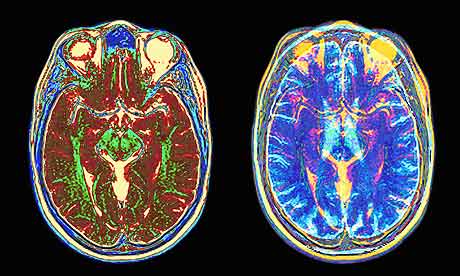
In our society, people probably have wondered about what is in one’s mind. We are always curious about what others think; but we cannot just dissect their brains to figure out. Now there is an alternate way to do this. The ‘mind-reading machines’ have been developed. Scientists have developed a computerized mind-reading technique which lets them accurately predict the images that people are looking at by monitoring brain activity.
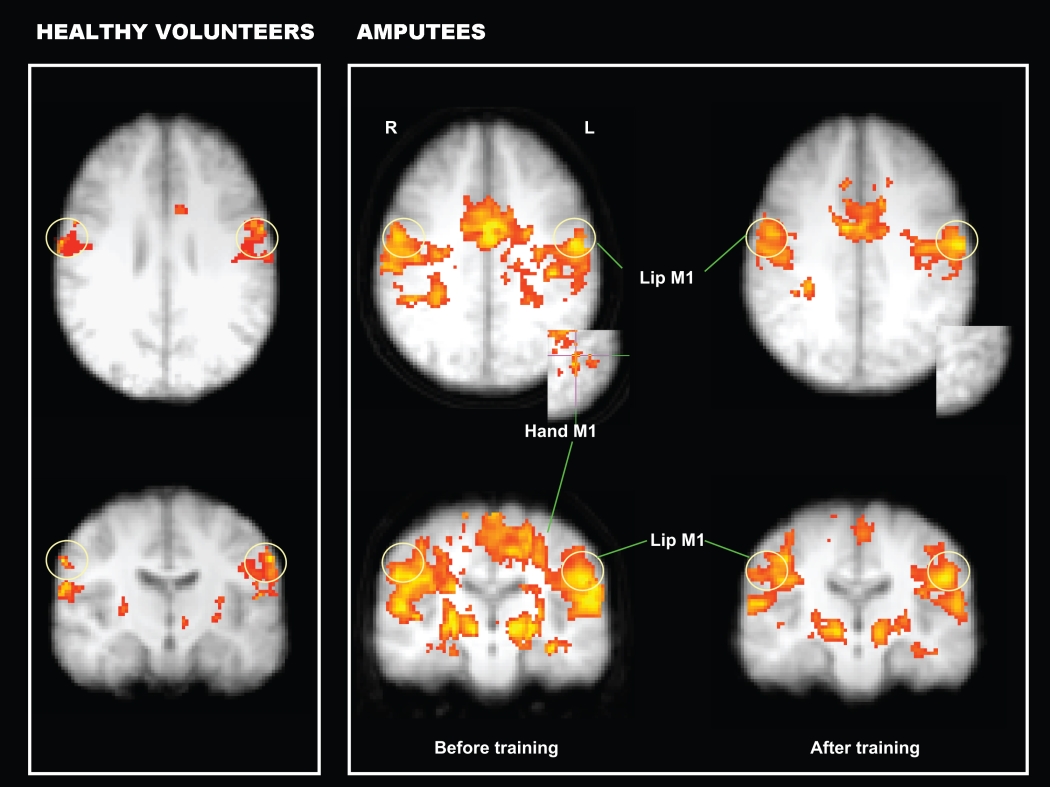
Scientists at the University of California have developed a computational model that uses functional MRI (fMRI) data to decode information from an individual’s visual cortex – the part of the brain responsible for processing visual stimuli.
The scientists have tested three of their members in fMRI to watch videos and they have figured out that blood is gathered at a certain part of the brain when members watched a specific video. For example, the scientists compare the different signals of brain when two different images of a hammer and ball are watched. Based on the database, they have developed a computer program that selects the most similar image of the actual image. This computer program also selects number of the most similar videos and engrafts them into one video. The scientists say that the study raises the possibility in the future of the technology being harnessed to visualize scenes from a person’s dreams or memory.
Furthermore, there is a similar machine developed in Korea in 2009. The team has made a motion detecting system that expresses a delicate face expression into an exaggerated face motion. This technology allows a machine to read a very detail change on face and possibly detect expressions of people. This technology is similar to a recent digital camera mode which automatically takes picture once people smile. There has been 88% of successful reading of the face when Dr. Kim’s team has tested on 20 people.
Moreover, United States also has a system that is much like a movie, “Minority report” which introduces a system that predicts crimes and prevents them beforehand. The cameras and sensors check people’s heart rate, respiratory rate, and body temperature to find out people with intention of committing crimes.
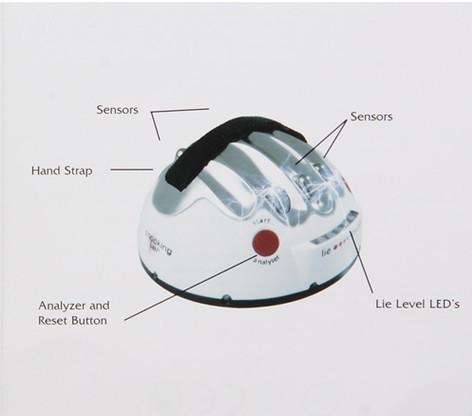
There have been different approaches to sort out liars through lie-detecting machine. Even though this machine is not reading one’s mind, it could be seen as application of detecting a change in mind state; breathing rate, blood pressure, and heartbeat will likely be different if one is telling a lie, and feel nervous.
Unfortunately, we cannot just accept and apply this continuous development of new techniques to our lives. Even though these machines could make our lives convenient, there is a risk. It has potential to disrupt individual’s private rights and result in moral violation. We should be aware that there is no scientific evidence about the accuracy of machines. Therefore, communicating skills to deal with this dilemma, further supports to provide evidences, and enough discussion on pros and cons of ‘the new’ are required for accepting new technology in science.
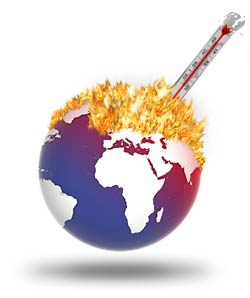
Scientists from universities across the United Kingdom are hoping to test one of their solutions to the worldwide issue of global warming. To understand the mechanism of the project, however, one must first be familiar with the process of global warming.
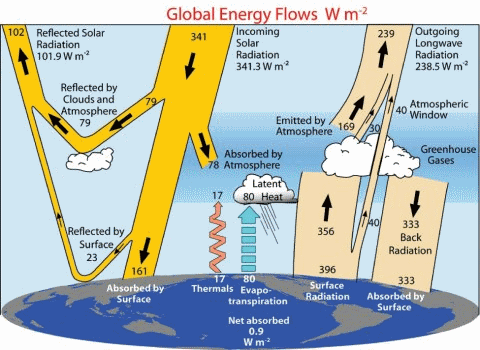
Global warming is based on the imbalance of infrared radiation (IR) entering and leaving the planet. This imbalance is caused by gases in the atmosphere, commonly referred to as greenhouse gases, which absorb the IR and emit it back towards the Earth’s surface instead of allowing it to travel back out into space. This process means more energy in the form of heat is being stored in the atmosphere and is consistently increasing Earth’s average temperature each year. Most of the greenhouse gases that are accumulating in the atmosphere are released through aspects of human activity such as farming, transportation, and electricity. Stopping all of these aspects isn’t going to stop the problem, as some of these harmful gases that have already been released will remain in the atmosphere for thousands of years. This gives scientists the opportunity to devise a system to cool the planet.
Global energy overview of radiation flow
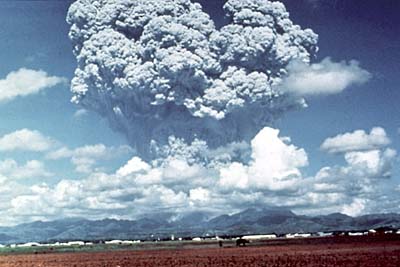
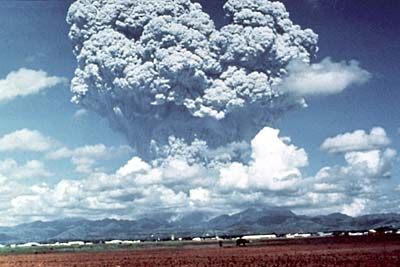
The SPICE project (Stratospheric Particle Injection for Climate Engineering) aim is to discover the best particle to introduce into the top of the atmosphere that will decrease the amount of IR entering the atmosphere. Their plan is to inject reflective aerosol particles into the atmosphere in hopes that they reflect the incoming radiation before it can enter the atmosphere. They based this idea on volcanic eruption effects on global temperature. Large eruptions release multiple cubic kilometers of ash and gas that then disperses across the globe creating a layer or reflective particles. Two years following the Mount Pinatubo eruption the global temperature dropped by 0.5 degrees Celsius.
Ash cloud produced from Mount Pinatubo eruption
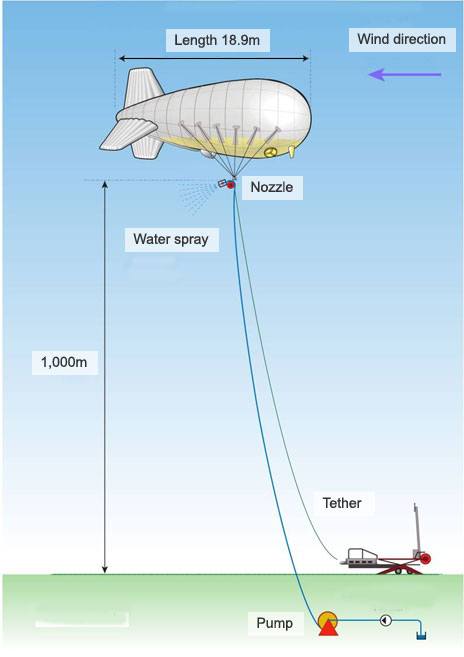
Scientists want to mimic this effect in their tests by spraying reflective particles from a hose at a rate of 100 liters per hour from a 20 m long balloon at a height of 1 km. The balloons success in launch and recovery and its tolerance to high winds will be monitored and help in planning the final result of a colossal balloon at a 20 km altitude. Projections indicate we could lower the global temperature by 2 degrees Celius by spreading 10 – 20 of these balloon mechanisms set at a 20 km altitude around the world.
I think that though global warming isn’t showing how devastating it can be quite yet but will prove a difficult problem in the near future. The problem scientists are facing is either trying to convince people that global warming is real or that it is an urgent issue we should address. To accomplish this they have to be able to convey their message effectively to their specific audiences. This is where Science 300 concepts apply as we are learning how to use wording, diagrams, and presentation to entice and convince our audience. These skills need to be utilized by scientists to explain the necessity of their research to the public.
Sources:
Note from EOSC 340-Global Climate Change Class
Archer, David. Global warming: understanding the forecast. USA: Blackwell Pub., 2007. Print.
Battison, Leila. “Giant balloon to be launched to test climate fix hope.” BBC News: Science and Environment. BBC, 14 Sept. 2011. Web. 29 Sept. 2011. <www.bbc.co.uk/news/science-environment-14916451 >.
“Global warming – Wikipedia, the free encyclopedia.”Wikipedia, the free encyclopedia. N.p., n.d. Web. 2 Oct. 2011. <http://en.wikipedia.org/wiki/Global_warming>.
“Greenhouse gas – Wikipedia, the free encyclopedia.” Wikipedia, the free encyclopedia. N.p., n.d. Web. 2 Oct. 2011. <http://en.wikipedia.org/wiki/Greenhouse_gas>
“The SPICE project: a geoengineering feasibility study .” NERC. N.p., 14 Sept. 2011. Web. 30 Sept. 2011. <www.nerc.ac.uk/press/releases/2011/22-spice.asp>.