Categories
Environment Issues in Science Public Engagement Science Communication Science in the News

So is it too late?! Just ask David Suzuki…

On November 3rd, I witnessed one of the greatest examples of communicating science that I have ever seen. That evening, the University of British Columbia (UBC) was the lucky host to one of the most influential Canadians of our time: David Suzuki. He presented a lecture entitled “The Global Eco-crisis: Is it too late?”
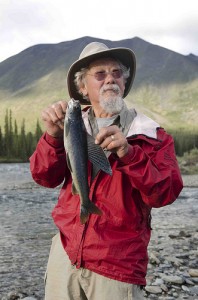
 

David Suzuki, with a grayling from the Hart River, 2011. Photo by peelwatershed.

Who is David Suzuki?

If you have been living under a rock for the past few decades, you wouldn’t know that David Suzuki is one of the most well-known activists for reversing climate change, writing many books and hosting several TV shows on the subject. Most notably, he hosted the Canadian TV series, “The Nature of Things.” In 1990, David Suzuki co-founded the “David Suzuki Foundation,” a non-profit organization, which focuses on sustainability and climate change.


As David Suzuki braced the speaking podium, I prepared myself to be changed.


Humans are unique

David Suzuki began to trace the origin of humans from our common ancestors in Africa to today. What made   humans unique, he claimed, was their foresight. That is, our innate ability to predict or plan the future. He   explained that humans moved from Africa to eventually cover the world. Using our foresight, we exploited the resources of every location, only to move on when those resources were depleted.


Laws that we CAN change

Dr. Suzuki went on to describe the so-called “laws” that we have imposed on society today, specifically, a “law” called capitalism. But, he said, “laws” like capitalism aren’t really laws at all but they are “nuts!” because we can change them. With capitalism, economists rule the world and they just don’t give a “shit” about our environment and what we do to it. It is time that we change these laws and take control back from the economists. To do so, we have to take back our government and make it more representative. Vote.


Stop the excuses!

Moving on to current efforts being made, David Suzuki claimed that our government is full of excuses. As an example, he discussed the carbon tax. In Canada, we claimed that our businesses couldn’t survive a $15/ton carbon tax. But in Sweden, their business are doing just fine with a $120/ton carbon tax. It is time that we stop making excuses and get to work.


Never too late
Drop in the bucket. Photo by theilr.


Inspiring us, David Suzuki concluded that it isn’t too late. We can save our environment but first, we have to take back our government and the only way to do that is to vote. You may just feel like a drop in a bucket but he reminded us, with enough drops, we can fill the bucket.

From this lecture, I didn’t just learn that we need to change our environment but I also learned how to connect with your audience. David Suzuki kept the science basic and used language that was not only fun (there were more than a few swear words…) but easy to understand.

David Suzuki left me stirred.

Categories
Environment Public Engagement Science in the News

“Doomsday” Pushed Back: Comet Elenin Desintegrated

A large comet spanning 3-5 km in width, large enough to have severe consequences if it had crash landed on Earth’s surface. Theorists hypothesized that it would be similar to the events that led to the extinction of dinosaurs 65 million years ago. These events may include unnatural drop in Earth’s atmospheric temperature, nuclear winters, and decreased sunlight.


http://en.wikipedia.org/wiki/Impact_event

A comet is made of rock, ice, dust, and organic compounds and can be several kilometers long in diameter. However, comets are fragile and can be broken into smaller pieces fairly easily. NASA noted that comet Elenin flew within 75 million kilometers of the sun and broke apart. As the comet approached Earth, it was only a cloud of debris, only visible through a telescope.


Don Yeomans of NASA’s Near-Earth Object Program says that the comet won’t be back for another 12,000 years. He noted that there has been hype on the internet about the comet and the consequences of it entering Earth. Yeomans said that in scientific reality, the comet is incredibly miniscule to have any impact on Earth’s gravitational pull to affect any environmental changes on Earth. The comet passed Earth at a distance that is ninety times the distance of the moon, and its mass was one-hundredths the size of the moon. If anything, the moon is currently exerting significantly more environmental changes than Elenin.

Image credit: NASA/JPL-Caltech


Maybe this event was nothing we should’ve been scared about in the first place. Only time will tell if the next space matter heading towards Earth is large enough for the hypothesized phenomena that were attributed to this comet.


Comet Elenin heads towards Earth


Further Reading:

http://thewatchers.adorraeli.com/2011/10/25/remains-of-comet-elenin-maybe-spotted/

http://www.jpl.nasa.gov/news/news.cfm?release=2011-135


Categories
Issues in Science Science Communication Science in the News

Where Do Satellites go when they die? -Another Dead Satellite to Fall This Weekend


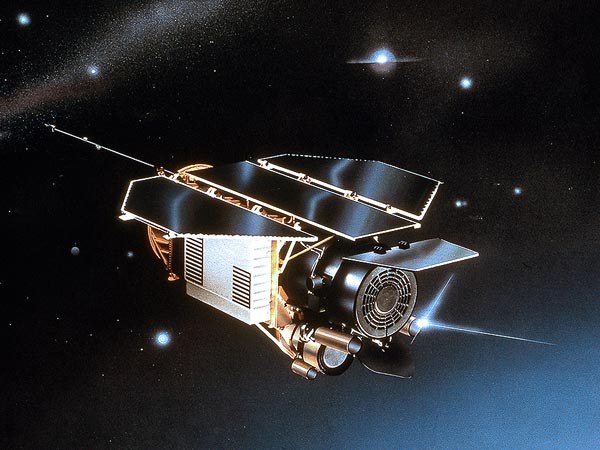
Illustration courtesy DLR: An artist’s impression of ROSAT in orbit.

Dead Satellites are being ‘unwelcome guests’ recently. The 6-ton Upper Atmosphere Research Satellite (UARS) satellite has entered the Earth’s atmosphere early morning of September 24th 2011, but where it has crashed remains unknown. According to NASA, debris would likely have fallen in Ocean, and it may never be found.

     Another defunct German satellite called ROSAT is headed straight for the earth this weekend and there is a higher chance(1 in 2,000 while UARS’ has been 1 in 3,200) that a piece of space debris could hit someone.
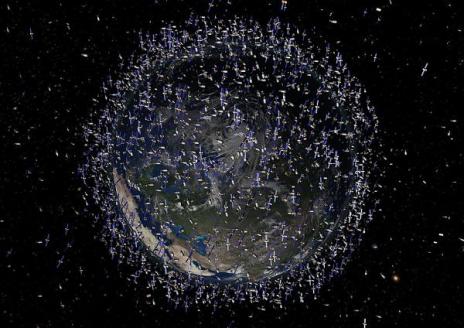
European Space Agency : The Earth

Usually satellites’ lifespan depends on their sizes; life span is determined by how much liquid fuel they carry aboard. A satellite that has exceeded its useful purpose has several final resting places. These depend on the amount of fuel available on the satellite, and whether ground control is still able to manoeuvre it. One method is to move the satellite into a ‘graveyard orbit’ (geostationary orbit), which is higher in orbital band and no other satellites are orbiting. Dying satellite can be left to degrade over time, but as it breaks up and potentially shifts in orbit, this could still prove dangerous to other satellites.


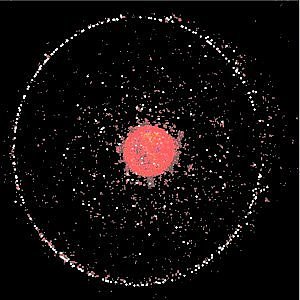
European Space Agency: Red dots= debris, White dots= operating satellites, Outer ring= satellites in geostationary orbit

    Some satellites are merely left in their current orbits if uncontrollable. Other satellites are purposely moved lower into the atmosphere so they burn up and hopefully disintegrate before reaching the Earth. While this is usually the case there have been some notable exceptions, including NASA’s Skylab station  in 1979, NASA’s UARS and ROSAT as mentioned earlier.

 According to the Federal Communications Commission, any satellite with altitude in geostationary orbit, meaning that satellites just below 36,000 km, must be moved farther away from the Earth at the end of its useful life.

    Satellites fall because of frictions and resistance of the atmosphere. In theory, if satellites’ centrifugal force and the Earth’s gravity balance, satellites can circulate the orbit without falling. Scientists probably have worked on different calculations on how satellites work; however, such recent events may appear as lack of preparation and carefulness. There are no clear back-up plans suggested if their expectations are not met. Our lives certainly have become more convenient with satellites, but if what we sent out in the past can come back to hurt us, how meaningful are those techniques? We have to look out for the safety of satellites rigorously.

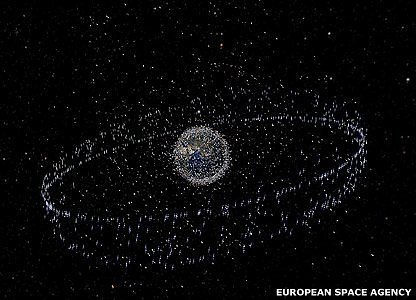
European Space Agency: Computer-generated image of the Earth

    Not only that, there is a real danger. Concerning that we are sending the dead satellites to outer orbit and keep sending new satellites without proper disposal methods, our planet is turning into the largest dumping ground. Is this what you expect our planet to look like? Would this be what aliens expect the earth to be? They will have problems figuring out whether this Saturn-like planet is the earth!


Spam prevention powered by Akismet