Categories
Uncategorized

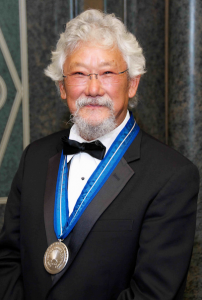
Gamechangers: David Suzuki

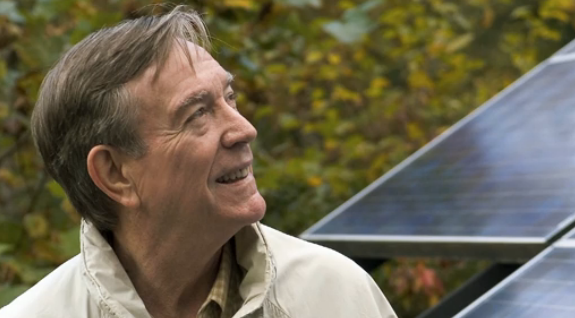
From my experiences volunteering with S.U.C.C.E.S.S.’s Youth Leadership Millennium Program, I’ve had the privilege to work with many community activists. One of the program’s partners is the David Suzuki Foundation. Obviously, if we’re talking gamechangers and we’re talking Vancouver, David Suzuki’s name should be near (if not right at) the top of the list.


David’s passion for protecting the environment is notorious. From his academic pursuits in zoology and genetics, he became a professor at our very own UBC, teaching for almost forty years and publishing over 30 books during this time. Somehow, David also found time to host The Nature of Things, a weekly television series that was broadcast in over fifty countries worldwide – one of the reasons for David’s international fame and recognition.

After his retirement from UBC in 2001, he became Professor Emeritus at the university and continued his climate change activism work through the David Suzuki Foundation. He is a highly in-demand speaker and commentator, but has stated that he prefers speaking via video conference technology because of the excessive carbon footprint from his traveling to engagements.

David is, I think, one of the main reasons Vancouver is also known to be a highly environmentally-conscious city. With such a powerful and convicted figure living among us, how could we not “get the message”? B.C., Canada’s west coast, is blessed with the abundance of visible nature that many other places in the world don’t have the privilege of having direct contact with. Our lifestyle will always be intensely connected to nature here, and it’s part of the reason why Canada, as traditionally “governed” by the East, had dramatically declined in terms of environmental protection regulations. It really needs to change from the federal level down. No matter how many inititaives are produced from the municipal or provincial level, the ripple effect quickly wears off as a united national movement is lacking. If only there were more climate change activists who were also politically engaged. Let David be all of our role models. If they don’t hear us, they’ll forget we’re here. 

And of course…here’s David’s daughter speaking at the Rio Summit of 1992. Sadly, while words are very powerful, if action does not follow, we’ll never progress.

P.S. The second half of the post is a little sad…but of course, we can’t lose hope!

Categories
Uncategorized

Spotlight: Brinkman Earth Systems

I live in the Vancouver Quadra federal electoral district, and our MP is Liberal politician Joyce Murray. Joyce is currently running for the Liberal Leadership Race and I’m 100% behind her campaign and would love a woman from the West Coast to lead the Liberal Party to a much more sustainable future.

But political agendas aside, Joyce Murray also has a very legitimate background for envisioning a “Sustainable Society”. She and her husband, Dirk Brinkman, founded a tree planting company in the 1970s. Brinkman & Associates, which has now grown to the Brinkman Earth Systems Group of Companies (including Brinkman & Associates, BARCA, and Brinkman Forest Restoration), has planted over 1 billion trees in over 6 countries.

I found an excellent article profiling Dirk Brinkman on The Walrus, where he argues for carbon markets so that environmental protection can also be a profitable business venture.

“It’s too late to avoid catastrophic climate consequences by reducing energy emissions, but it isn’t too late to avoid catastrophic climate consequences altogether. We’ve just got to mount an equal initiative to increase removals.”

It’s an debatable topic that is probably best left to the experts, but there are advocates such as Annie Leonard who are adamant that cap and trade and other types of carbon markets are detrimental to progress on combating climate change. See her “The Story of Cap and Trade” video below:

What’s your stance on carbon markets? Is it wrong that people like Dirk Brinkman are looking out for their self-interests in the name of environmental advocacy? I think I agree with the last quote of Brinkman’s in the article, “You can’t apologize for the fact that what you’re advocating is congruent with your self-interest if it is truly in the public good.” Right?

Source.

Categories
Uncategorized

Gamechangers: Bill Morrissey @ The Clorox Company

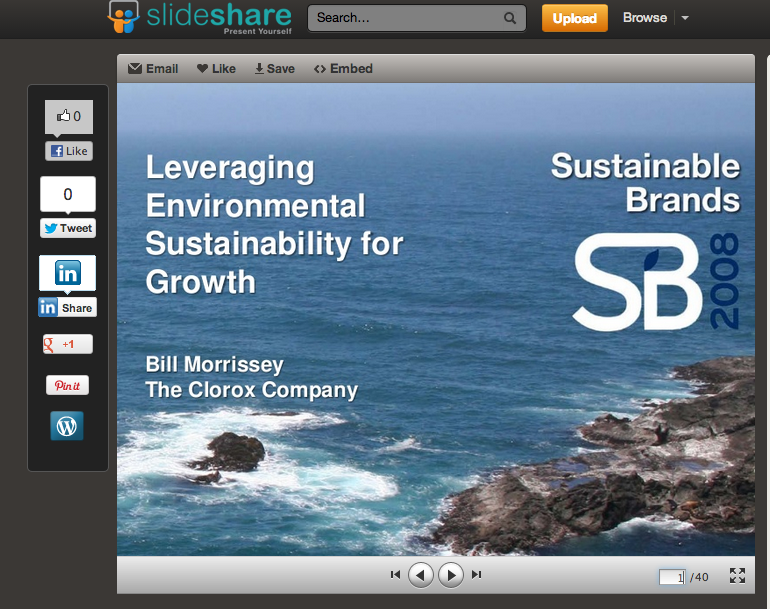
Recently, I stumbled upon this presentation on Slideshare.

It gave me a really interesting “insider” perspective into how Clorox made an obvious shift in strategy in regards to environmental stewardship and corporate social responsibility. Bill Morrissey, the Vice President of Environmental Sustainability, played a huge role in developing this new eco-strategy.

In 2007, when The Clorox Company was given a score of 1 (out of 100) in the inaugural Climate Counts rankings (the rankings have a comprehensive 22-criteria scorecard available here), the company decided that it needed to change its ways and do its part in ensuring that future generations can have a healthy and desirable environment to live in. They created an Eco Office that executed the company’s “sustainability strategy”, and Bill Morrissey returned to The Clorox Company after acting as the COO of Naturize Biosciences.

Bill outlines in his presentation (the video is also available here) how the company has not only acquired or architected “green brands”, but have found ways to profit from these brands as well. The successes of Brita and Greenworks is admirable, and Burt’s Bees penetration has also evidently skyrocketed in the past couple of years. Even I have noticed it in more and more distribution channels! (I love their lip balms!)

It’s also quite remarkable how Brita achieved such growth in sales simply from a marketing campaign. As my group is working on a social marketing plan to discourage the consumption/purchase of plastic water bottles, I am pleased with Brita’s campaign that highlights the number of water bottles it is diverging from landfills if consumers use one Brita filter; however, in Vancouver, our tap water is completely safe for direct consumption, and the act of filtering is really quite unnecessary.

After a little research (Googling) of the event where Bill’s presentation originated from, I found that it’s an annual conference that brings together sustainability, brand, and innovation professionals. It sounds really cool and I’d love to attend one day! This year’s is in San Diego from June 3rd to 6th. If I didn’t already have travel plans for May, I’d definitely head down to California for this!

Source.

Categories
Uncategorized

Gamechangers: Ray Anderson, Interface Inc.

Having never heard of Interface, the U.S.-based (and “world’s largest”) carpet manufacturer, before this year, I wanted to find out more about how the company evolved in a sustainable and innovative direction. Seeing the Founder and Chairman, Ray Anderson, the a short clip from The Corporation, especially captured my attention. You could just tell that his actions were genuine.

Ray Anderson’s TED Talk from 2009 about the manipulation of the I = PAT formula and his company’s Mission Zero plan was uplifting. The abundance of people who think “differently” and “challenge the status quo” in the sustainability field is what captivates me to study it. From every single issue in our world today, using a sustainable perspective forces you to think collaboratively with people in different backgrounds. The poem he read at the end, Tomorrow’s Child, inspired me to reflect on the challenges future generations will face because we have been such a consumption-fuelled society in the past. But if Ray Anderson can completely revamp his carpet manufacturing company, then there must be hope, right?

That Anderson made it his signature speaks volumes about this Southern industrialist, a businessman thoroughly committed to all that sustainability stands for. ~ Joel Makower, Green Biz

a man with a vision.

Categories
Uncategorized

Whistler: Pioneering Sustainability

I was in Whistler this weekend for a conference hosted by the ICSC. I’m so glad that I decided to attend (alone!) because I learned a lot and it was a good way for me to meet people in the real estate industry and a valuable experience simply to observe how professionals in that industry interacted. Note to self: journey outside of your comfort zone more often!

On the way up to Whistler, although I have been passenger and even driven along the Sea-to-Sky Highway myself many times, the beauty of the route never ceases to take my breath away. We are so lucky to live where we live – surrounded by mountains, bodies of water, and dense greenery. It’s so cliché but that phrase on our B.C. license plates are bang-on.


Last term, I took a course called Sustainable Real Estate (Comm 486L) with Mark Monroe and we discussed in class Whistler’s pursuit of conserving its world-class resort status and ensuring that the resort municipality has a sustainable future. The Whistler Centre for Sustainability is one initiative to also extend the first-hand knowledge that the community has experienced to other communities in Western Canada. It’s an example of a consultant firm in the form of a “non-enterprising non-profit” with a mission that is clearly centered on sustainability and – something that goes hand-in-hand for many communities – tourism. For such municipalities, initiatives to minimize negative environmental impact and promote a lifestyle that leans a little more radically in the eco-conscious scale is integral to economic viability.

I wish I had a chance to stop by the Centre and see what projects they’re working on right now!

Categories
Uncategorized

Spotlight: Offsetters

My first Spotlight! Offsetters is based in Vancouver AND completely relevant to the course (you’ll see why). Two birds with one stone!!


Offsetters is one of the companies that our class will be working with to develop a marketing plan; I believe Offsetters is looking for a stronger online presence and some social media consultancy from whichever group it will be working with. (I’m personally interested in working with CityStudio, my dad is a contractor and the entire project sounds really cool!)

I recognized the Offsetters logo but quickly realized that it was probably because James Tansey, the CEO and Co-Founder of Offsetters, is also the Executive Director at ISIS, and a guest speaker from one of my Comm 101 lectures back in first year.

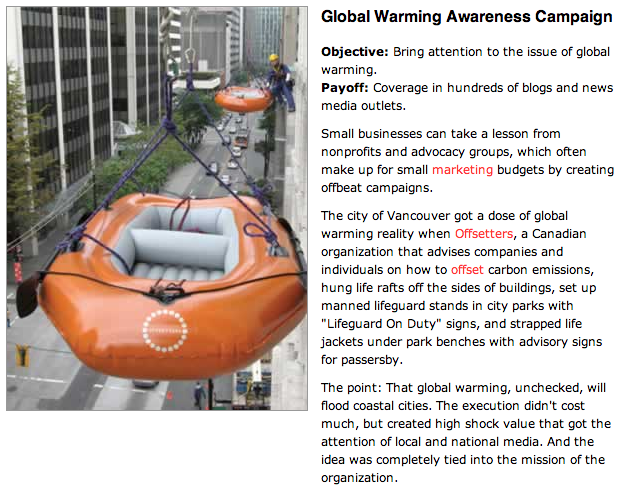
I didn’t know much about the organization, and somehow stumbled upon this while I was doing a quick search on “Offsetters marketing”:

Crazy Marketing Ideas

Since the core competencies of Offsetters is sustainability-driven – offering a service that helps people, organizations, and corporations to “offset” their carbon footprint – this marketing campaign accomplishes both goals of marketing in the traditional sense of promoting a business’ services, and campaigning for a sustainable and eco-driven cause. Smart!

Categories
Uncategorized

Spotlight on Sustainable Businesses

I think that there are a ton of ways to define a “sustainable business”, and I am dreaming of ways to showcase some sustainable businesses that I know of, right here in Vancouver. This should be a good way for me to take classroom knowledge and see where connections can be made in the community. I was born and raised here, so being aware of my hometown is important to me.

When I can, I’ll post “Spotlights”: I’ll also try to tie in how these businesses can be sustainable in their marketing tactics as well. But to be honest, without being “sustainable” and “planning for the future”, there would be nothing to market anymore, right? (We briefly discussed this in class. Without sustainability, there won’t be any more need for marketing. The world has finite resources and we can’t keep producing and producing at this rate for the long term.)

Categories
Uncategorized

Sustainability Marketing, Marketing Sustainability

I’m glad to have a reason to resurrect my UBC Blogs site, since I’m required to write weekly blogs for my Commerce 486F: Sustainable Marketing class. It’ll be really interesting to reflect on course topics and share relevant items here. I’m looking forward to this “assignment”!

First off, what is this class all about? As the title of this post shows, Commerce 486F really explores two different topics. How can we as marketers continue to promote goods and services in a sustainable manner (in the long run)? And then the latter phrase, ‘Marketing Sustainability’, is more focused on how to market the lifestyle and principle that is sustainability. In my opinion, these could be two individual courses because they are so different…but it is already impressive enough that Sauder offers anything along these lines, so let’s not ask for too much at the moment…

In regards to the marketing sustainability side of the course, I’ve always paid extra attention to companies that embrace the business buzz word that is CSR (corporate social responsibility); admittedly, it’s hard to ignore as a business student. Just last term, our Business Writing class spent a significant amount of time researching Enbridge’s Northern Gateway Pipeline project and analyzing its CSR policies. Companies seem to like to attach ‘sustainability’ to CSR, listing environmental initiatives as one of the ways they are achieving their CSR targets. However, I would argue that sustainability should not be an afterthought of how to offset damage done to the environment and promote it as a CSR accomplishment; sustainability should more and more be a mindset that is immersed into a business’ operations, its mission statement, and its management.

I’m looking forward to learning strategies to achieve this ideal business model, and am hopeful that sustainable businesses can change (and save) our world.

____

Some food for thought:

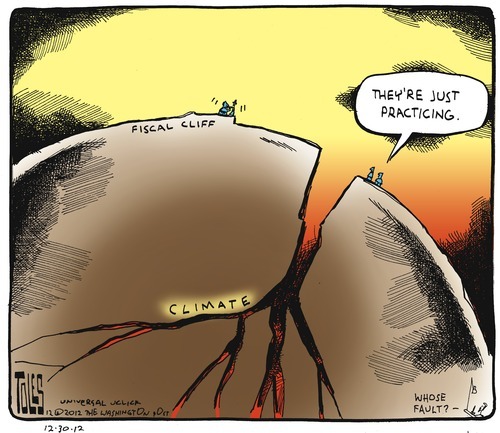
Where are we focusing media, political, and economical resources as a society?


Categories
Uncategorized

Hist 482 Journal #5

Some members of my group woke up early Saturday morning for our interview with Samuel Chan, a famous Geography tutor in Hong Kong, and part owner of an education centre that is very popular here. He’s also on the Board of Directors of an elementary school in Tseung Kwan O, so we were able to interview him in one of the rooms of the school that day. Even though Samuel Chan was Katrina’s contact, I ended up interviewing him. My Cantonese is decent, but we had prepared the interview questions in English and when Samuel told us that he would be able to give us more comprehensive answers in Cantonese, I felt nervous for a moment to conduct an interview in Cantonese. Reminded me of how we heard last week of dialects as a very localized product of people who live in the same region and have the same type of speech and behavior. It was my first (that I can reflect on, at least) moment of hesitation and almost a misplacement kind of feeling while in Hong Kong. The interview went well though, even though the air conditioning was really loud in the room. I learned a lot from Samuel. There were so many things about Hong Kong’s education system that I had always perceived to be fact and I guess are all now misconceptions. I was also surprised to learn that private schools are not similar to private schools in Vancouver. It changes how we write our paper because we had originally thought that Hong Kong people chose or preferred private schools in Vancouver because they liked private schools in Hong Kong. I always presumed that Hong Kong schools that I hear about a lot in Vancouver must all be private schools, but as it turns out they’re all government subsidized schools. It’s a much more complicated system, but I guess that’s required because of the huge population of students. It must be hard to control people by neighbourhood as we do in Vancouver’s public school system.


I had Father’s Day dinner with my family on Sunday and then we had our last class lecture on Monday with Dr. Lee Ho Yin. His lecture was very interesting! His powerpoint slides were amazing, even though I see a fair share of snazzy presentations in business school. It’s too bad there was a typhoon warning so we couldn’t go see the places in Wan Chai that Dr. Lee was talking about in his slides. I’m glad Adrian got his slides and shared them with us, maybe I’ll be able to visit the sites he mentioned (in Wan Chai and in Singapore!) after the course is over.


The rest of the week was crammed with transcriptions, translations, research, essay outlining, essay drafting, video editing, and title composing. There was so much that had to be done in SO LITTLE TIME! Our group worked quite well together though, the workload was split between the video and the paper. It was unfortunate that more of us weren’t able to help with the video editing, but it was not a time for the people with no experience to be learning. We already had technical difficulties and it would’ve delayed progress much more if Ewout and Alan were trying to teach us and also ask for our opinion and input for every little thing. We trusted them with the footage and photos of the Yip family (which I had to ask for every day until we finally got them on Thursday!!!) and everything turned out quite well! Likewise, we were entrusted with the research paper, and I hope we didn’t let them down. We did a lot of research (we almost read David Ley’s entire Millionaire Migrants book, which I brought over from Vancouver because I had checked the book out, but I didn’t realize that the due date was late June – Peggy will be bringing it back to Vancouver for me) and there is definitely support for education as a major motivating factor for families who move from Hong Kong to Vancouver. It was an insane experience to live through with people who you were completely unfamiliar with only five weeks ago. Hong Kong was where our group really bonded and had opportunities to spend good and not so good times together, creating lasting memories to each other and to Hong Kong the city. I was exposed to working with more people of different personalities and working styles, and it was an eye opener for me. When we finally presented our project to the class and guests (one of whom was Jerri, a friend of mine from Vancouver; what a crazy coincidence!) it was a very gratifying moment. I also really enjoyed watching the other group’s video. I was always curious about the content of their interviews and it was an intriguing video discussing the definitions of heritage and how people perceive it to be best preserved in Hong Kong and Vancouver, comparatively. We also had a very nice group lunch at Pokka Café afterwards, since Henry needed to fly to Calgary in the late afternoon.


I’m so glad that I took this course this summer. I learned so much more about the topic and honestly, about myself, in the past five weeks than I could ever possibly absorb in a classroom in UBC. This exchange has helped me mature; I’ve grown more independent, responsible, and maybe a little bit neater as well! I’ve never lived in a dorm before, and staying at S.K.Y. Lee was a very new experience, probably the only ‘culture shock’ I suffered from overall. My respect for Henry as a professor is also immense. There is no other person who could have prepped and then brought a class overseas and maintain such a casual and relaxed learning environment with such an intensive project assignment. Wendy also has been a superstar. I don’t know how she can be so organized and give such great advice, all the while sharing her kind and generous smiles. This class will never be forgotten. Thank you!


Categories
Uncategorized

Hist 482 Journal #4

This week was so packed! Every single day has been extremely long, especially since a lot of us are still fighting jetlag. I didn’t really have jet lag, I just ended up living through really long days because I would wake up unnaturally early (for me). Alyssa, Alan, Christine, Abby, and I were all on the same flight from Vancouver to Hong Kong, and Wendy, Ben, and Joanna arrived a day or two before us so I’ve had lots of company in Hong Kong. Henry arrived on Sunday and then we all went to Tsim Sha Tsui and walked around (it was really really hot) and even found Chungking Mansion.


Hong Kong doesn’t feel very foreign to me. It’s been pretty easy for me to communicate with people and understand conversations around me. I think partly the reason is that I was back quite recently (in December), so I can still remember places that I went to last time I was here, and things haven’t changed since then. Most of my relatives come back somewhat frequently, but if someone who hasn’t been to Hong Kong for over 5 years came back, they would probably find that a lot of things have changed. There are always new shopping centres and new trendy areas and restaurants in Hong Kong. It’s always changing. I definitely don’t feel the culture shock that we’ve been talking about in Vancouver, but that’s to be expected. My mom was born here, after all.


We had class with Paavo on Monday, which started with a walking tour of Sheung Wan, and we also met John Carroll, who says that he leads a U of T exchange program. I think my friend was in it before. It seems like HKU has a lot of summer exchange programs with other universities. It would be really cool if UBC had more of these things. I guess our summer school makes it difficult though. HKU students don’t have summer courses that count for credit like us, so most of them are off campus during the summer months. Peggy and I left the lecture early because she needed to apply for her HKID renewal and I knew the way to the Immigration Office because I went back in December. We still weren’t quite used to the directions to get out of HKU and find the bus stop so we were very rushed in the end and had to run to the building because we were late to her appointment. While we were there, we missed Roger Chan’s lecture too. He was supposed to lecture us on Tuesday but rescheduled.


Some other highlights of our week are the Hong Kong Heritage Museum in Shatin, which is a city in the New Territories, where most of my relatives in Hong Kong live. We also went to Hong Kong Housing Authority offices in Ho Man Tin (next to Ho Man Tin Estates) and saw an interesting exhibit on public housing projects in Hong Kong, especially with models of apartments and complexes in the New Territories. They also had a mini-exhibit on the changing doors and washrooms of the public housing units that are designed by the HKHA’s architects. One of the architects for HKHA also showed us the changing building forms (for periodically different purposes) for public housing projects. I never realized how the shape of a building could either facilitate or inhibit communication and ‘neighbourly’ habits. Especially in a city like Hong Kong, I can see how the building design would be so important and can be an effective way of observing social norms. The next day, we went to the Urban Renewal Authority in Sheung Wan. We heard from a very interesting presenter, Michael Ma, who showed us a lot of the URA’s initiatives in preserving cultural landmarks (but beyond the façade, and more towards the purpose and the understanding of the history of a place or a region or a building). Someone named Wilfred also brought my group and Henry and Wendy to the Central Oasis after the presentation, because the other group was going to interview Michael for their documentary. We went to the escalators that are iconic in Tony Leung and Faye Wong’s part of Chungking Mansion and saw hawker stands that were in the old style as well as in the new style designed by the architect with us at the URA room (I forgot his name…maybe it was Edward?). It was a nice walk around the area because locals own the hawker stalls and they sell a diverse variety of items, from incense to records to fruits, and it was quite lively. But our group was in a hurry to get back to HKU for our own interview with Hayne that day. We ended up having a pretty good interview with Hayne back at school and we went for a late lunch at Triple O’s in Pacific Place in Admiralty. Everyone was satisfied with the taste of Vancouver, and we even met the owner of the Triple O’s chain in Asia! It’s amazing what a small act (taking a photo of the Triple O’s sign) can tell a person about a complete stranger. I guess there are some really defining characteristics of Vancouverites after all!


Like I said, it’s been a really long week. After late lunch with Hayne, our group stayed around Admiralty until we went to a late buffet dinner at the Holiday Inn in Tsim Sha Tsui with my relatives, who were also going to bring us to the fruit market in Yau Ma Tei that late evening. It was a pretty good meal overall at Holiday Inn (the Holiday Inn in Hong Kong is definitely much fancier than what we have in Vancouver), there was even a sashimi bar and a mini Häagen-Dazs freezer. The fruit market was a good time. A lot of fruit that we take for granted in Vancouver is really expensive in Asia. All berries are basically luxury goods. After shopping around, we ended up purchasing a box of mangoes, a box of cherries, and two watermelons. The first time I came to the fruit market was in December, and I couldn’t believe that a fruit market could be so alive at night in Hong Kong. It gets busier as the night progresses, and the people are all very familiar with each other and it’s a place I could get lost in. There’s nothing to compare it to in Vancouver, except maybe the community in the Downtown Eastside, but in a completely different context and gathering purpose.


One more interview tomorrow and then crunch time!!!
Spam prevention powered by Akismet