Categories
Uncategorized

Got a old phone sitting around collecting dust?

There was a feature on the news tonight that caught my attention because it was related to what we learned in class as well as to my previous post. It was basically saying that due to planned and perceived obsolescence it has become the norm to replace our cell phones every two years or so. They interviewed people on the streets of Vancouver and it’s alarming the fact that most of them have already gone through five to fifteen cell phones.

The point – apart from the need to completely reform consumer mentality – is that rather than letting these perfectly functioning phones waste away in the depths of our drawers we can donate them! There are local non-profit organizations who have started initiatives like Phones for Fearless where you can donate your old phones to residents of the impoverished downtown eastside neighbourhood.

Categories
Uncategorized

What ever happened to that old chunky computer?

After reading my classmate’s post, E-Waste: Who’s Responsible, I was reminded of a documentary I watched a couple years ago that was made by a group of graduate students at UBC’s School of Journalism. The film is called Ghana: Digital Dumping Ground and it’s an investigative news documentary that explores the health and environmental impacts of electronic waste.

YouTube Preview Image

This was an eye-opener for me, to be honest, prior to watching this I had never thought about what happened to our old electronics. I think it’s great that large companies like Samsung are starting to take action – with the Samsung Recycling Direct program consumers now have  a simple and safe way of disposing electronic waste. There are also local organizations such as Free Geek Vancouver who will gladly take in unwanted electronics for reuse or recycling.

Categories
Uncategorized

Can fast fashion be ethical?

In the past few years, the multinational retail clothing company H&M started integrating sustainability into its long term business strategy. Last week, the company released its 2012 Sustainability Report. The major highlights of 2012 include:

1. One of the first and largest fashion companies to make its supplier factory list public.
2. First clothing retailer to create a global system for recycling old clothing.
3. The number one user of organic cotton.
4. Raised support for higher wages and yearly wage reviews for garment workers in Bangladesh.
5. Launched a global water stewardship program in partner with WWF – taking the whole supply chain into account.

While these actions are admirable, H&M is still the second largest clothing retailer in the world selling more than 550 million garments each year. Currently there are 2,500 stores worldwide and the plan is to increase the number by 10-15% each year. The average monthly wage of a factory worker in Bangladesh is $43 which is the lowest in the world. Let’s face it, these fast fashion retail giants are largely responsible for the many environmental and social issues we face today.

What I’d much rather see is  quality clothing that’s made to last so that they can decrease the amount of clothing being manufactured and in turn change customers’ habit of overconsumption. Nonetheless, I think H&M is heading in the right direction and I look forward to what they have in store.

Categories
Uncategorized

Pinterest: Now open for business!

Over the past year, Pinterest experienced a significant growth in its number of users. In mid-October, Erik wrote a post that mentions the great potential Pinterest holds for business purposes; firstly, due to the average time people spend on the site (second to YouTube) and secondly due to its ability to drive users to purchase (47% compared to 33% on Facebook and 31% on Twitter). These numbers are expected to increase with the recent launch of Pinterest for Business.

This new service, unlike the regular user account, is designed for businesses to help them expand and eventually make profit from the site. There has also been buzz about the various services that may be available in the future such as Pinterest analystics, monetary plans, and business models.

Though for the time being, businesses should take advantage of the features that Pinterest currently has like the newly introduced secret boards. As pointed out by Forbes, secret boards are a great feature for improving communication around the office. It’s an excellent place to share and organize ideas before the launch of a specific product and it’s an easy way to keep the entire team up to date.

Check out who’s using Pinterest!

Categories
Uncategorized

Starbucks’ Mobile Wallet

Starbucks has teamed up with Square in attempt to create best possible transaction experience for the people on both sides of the counter. In early November, Starbucks began accepting mobile payments in 7,000 U.S. locations.

How does the Starbucks mWallet work?

Square Wallet is linked to a credit or debit card so, unlike a gift card, the customer never has to reload the balance. Using this app is as simple as downloading and setting up an account.  Once the customer arrives at Starbucks, they just need to scan their QR code at the register – quite similar to the current Starbucks mobile payment applications.

However, customers currently using the mWallet can expect something like this in the near future:

  1. Activate Pay-with-Square app once you enter Starbucks
  2. Your picture, name, and last few purchases will be displayed on the Starbucks’ POS system
  3. Once you get the cashier, the barista will confirm your order
  4. The barista will then put your order on your  “tab”
  5. The payment will be processed automatically – moving money from your Square account to the Starbucks store account

There will no longer be a need to swipe your card nor scan a bar code – you don’t even need to tap your phone to finalize the purchase. It’ll all be done automatically.

YouTube Preview Image
Categories
Uncategorized

Wallets, a thing of the past?

The other day I was in a bit of a rush to get out of the house to catch the bus for my first class. As the bus pulled up, I reached into my bag but my wallet wasn’t in its usual spot. I frantically dug through the other compartments of my bag but it was no where to be found. Then it struck me, I had left if on the kitchen counter and this wasn’t the first time I’d forgotten it. With no wallet, it meant I had no bus pass nor change for a bus ticket; thus, the bus driver refused to let me on.

As I was walking home to retrieve my wallet, I started thinking about how convenient it would be if I were able to store my uPass in my phone since I’d be very unlikely to go out without it – it would practically be like leaving the house without a shirt on! It’s funny, I tell this story because I came across an article in the Globe and Mail today that touched on this very issue.

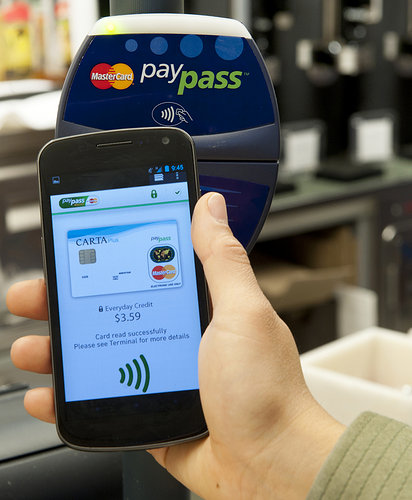
Back in 2005, MasterCard introduced PayPass to Canadians which allowed consumers to make payments by a simple tap of a card or mobile device – with no need to sign or enter a PIN. According to the article, almost all MasterCard credit cards issued in Canada are Pay-Pass enabled and 19 out of 25 of the largest brick and mortar businesses in Canada have  agreed to use to this technology. Canada is the second most mobile payment ready country in the world according to a Mobile Payments Readiness Index study recently conducted by MasterCard.

With MasterCard expanding mobile payment to more and more platforms, there will soon be no need to carry cash, payments cards,  credentials, loyalty cards, and coupons. “The average Canadian has from 15 to 20 credentials in their wal­lets today,” says Ledas.

Which do you prefer?


Categories
Uncategorized

Heinz’s Talk to the Plant Campaign

Back in 2008, Heinz racked up 18,000 participants and blog posts all over the world in a mere two weeks without spending a single dime on advertisement. How did they do this? The idea was simple.

Mission: Communicate global tagline, “No one grows ketchup like Heinz”

Idea: Let’s prove it and not just say it

Solution: Test the effect of human voice on plant growth through an interactive experiment

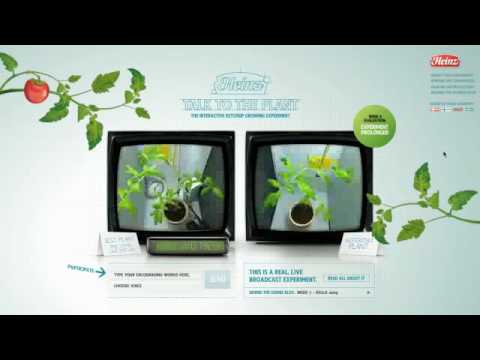
We’ve all heard of the theory that plants grow better if you talk to them. And the marketers of Heinz figured why not try it out while strategically communicating their tagline that “no one grows ketchup like Heinz”.

Essentially the experiment consisted of two sound proof rooms and two tomato plants that received the same amount of light, water, and heat. The test plant was equipped with a speaker and a microphone while the control plant remained as it was. Participants could go onto talktotheplant.com and write their desired message to the plant and the voice synthesis device would send a live stream from the site to the speaker. The experiment was simple, fun, and allowed anyone to speak to the plant and anyone to listen. The plants grew along with the number of participants.

They also kept an up-to-date Talk to the Plant – Behind the Scenes blog that tracked the plant growth, followed the development, as well as the technical difficulties. The experiment ran for six weeks though the evaluation phase afterwards prolonged the experiment for another two week – resulting in a two month long campaign.

Result of the Experiment
With 18,774 messages in total the test plant grew a whopping 153 cm while the control plant grew……… 146cm! Though the results of this experiment weren’t as dramatic as participants would have hoped, I would say this campaign was very successful in that it makes people think about what goes into something as simple as their ketchup. Additionally, the interactive experience basically guarantees that participants will tell their friends, but more importantly participants will have developed a connection and come back perhaps multiple times to check on the progress of their lovely tomato plant.
YouTube Preview Image
Categories
Uncategorized

Window Shopping Redefined

In prior times window shopping was simply about admiring the goods through the glass in storefront windows without making an actual purchase. Today, window shopping has new meaning.

In September 2012, an interactive digital window was installed at the Adidas NEO Nürnberg store. The technology allowed passerbys to shop the store after hours by connecting with their smartphones. To connect, users simply had to type a URL into their smartphone and enter a one-time PIN.

The interactive storefront basically worked as a virtual store. The window’s simple interface and touch screen functionality allowed users to easily browse through the store’s products. Apart from this, shoppers could also see how the products fit on an active life-sized virtual model. By tapping on certain parts of the screen, shoppers could view the products in further detail.

When shoppers put items in their virtual shopping bag, the product would appear instantly on their mobile phone. From here they are given the option to edit the product details, purchase the product immediately from Adidas NEO online or save the product for purchase later, as well as share their experience with their friends through various social media platforms.

Take a look at the six-week pilot test at Adidas NEO Nürnberg in September 2012.

YouTube Preview Image
Categories
Uncategorized

Where Will Happiness Strike Next?

I still remember nearly two years ago, as I walked through the crowded streets of Yaletown, a bright, roaring vehicle approached me and an enthusiastic volunteer dressed in red from head to toe handed me a cool, refreshing, limited edition bottle of Coca-Cola.

We watched a series of Coke commercials in my IMC class that reminded of the dose of happiness I experienced during the Vancouver 2010 Winter Olympics. In this video, filmed in the streets of Rio de Janeiro, several passers-by push a button on the back of a specially rigged Coca-Cola truck dispensing items from beverages to soccer balls to sunglasses to surfboards spreading refreshment and smiles all around.

YouTube Preview Image

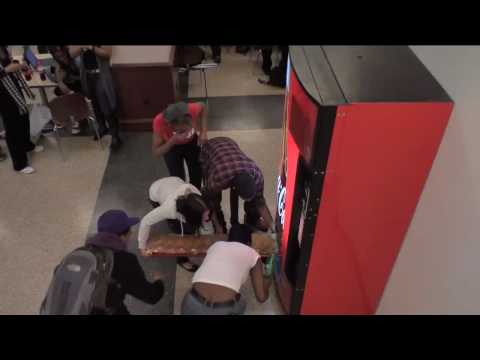
This short film is only one of the many created by local Coca-Cola teams around the world (in Brazil, Japan, Egypt, Hungary, and India etc.) based on the theme of the award winning “Happiness Machine”, which got more than 3 million views online. To compliment these films, they launched an interactive Facebook hub to allow customers to view and vote on Where will happiness strike next?. With television no longer as the leading  medium for advertising, Coca-Cola has found a cost effective way to reach and interact with millions across the globe.

The original ‘Happiness Machine’:

YouTube Preview Image

“‘Happiness Machine’ connected with so many people because the emotion was authentic, unscripted and contagious,” said A.J. Brustein, Global Senior Brand Manager, Coca-Cola. “We wanted to inspire that same feeling again by creating something consumers would respond to and want to share with others because it put a smile on their face.”

Categories
Uncategorized

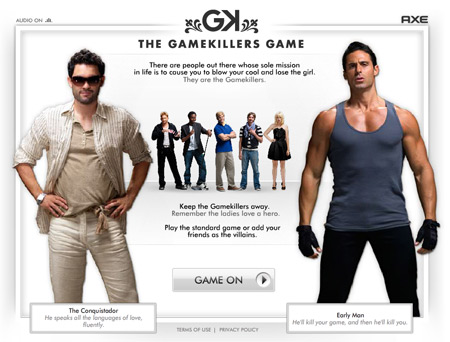
Axe Gamekillers Campaign

YouTube Preview Image

Spam prevention powered by Akismet