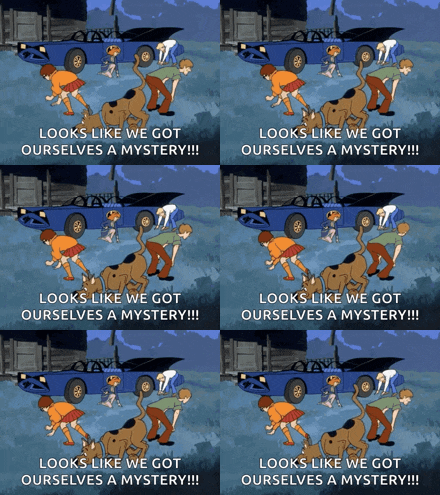
Everything ends

After thinking for a while about the “Everything that begins as comedy ends as ___” lines from chapter 23 of The Savage Detectives, it occurred to me that these phrases don’t strike me as having much to do with comedy, or tragedy, or (maybe) even literature. Mostly, they make me think about how everything just ends — whether that’s a book, or a childhood, or a relationship, or the search for a lost poet. It’s the end of Visceral Realism. It’s the end of another stay in another city where another poet tries to start again. It’s the end of the war that precedes the next war.

(I want to add, I don’t really feel as down about endings as the above might suggest. I think endings are fascinating. I’m looking forward to finding out how Bolaño will deal with the ending of such a lengthy story.)

Another thing I’ve been thinking about this week is the practice of gifting books. Or giving and receiving books. At the end of chapter 24, María Teresa Solsona Ribot writes: “[Belano] gave me four books that I still haven’t read. A week later we said goodbye, and I went with him to the station” (557). When I compare this instance with how Juan García Madero is given books by the other poets in the first section of the novel, I get the sense that there has been a shift in the role of the book as a material thing in Belano’s life (and maybe in the lives of similar figures, like Ulises Lima). Before, it seemed like the gifted books were meant to be absorbed, like they contained lessons just waiting to be learned by the poet/writer who received them. Now, I feel like the gifted books are taking the place of other things — maybe things that Belano doesn’t know how to give; or, maybe they’re supposed to take his place, make up for his absence somehow. For a recipient like María Teresa, I’m not sure that Belano’s books are going to do the job.

Speaking of the materiality of the book: I guess damaging Amulet wasn’t enough, because my copy of The Savage Detectives is also starting to fall apart. She’s peeling a little at the spine now. I’ve bandaged books with tape before, but I always feel sort of bad about it.

My question(s) of the week: How do you feel about giving and receiving books? Would you ever gift someone a book that they had never mentioned wanting to read?

Comments Off on Everything ends

Bolaño 5: learning to enjoy it for what it is

I’m running out of things to write about. This is our fifth blog post on Bolaño, which will make about 2000 words by the end of this, and I’m struggling to come up with likes or dislikes that I haven’t already harped on about. I’m liking the book well enough by now, which is more to do with the amount of time I’ve invested than anything else.

My favourite section from this week took place early on in the reading, where we have Edith Oster, “sitting on a bench in the Alameda” (424). She speaks on meeting Belano for the first time, a casual meeting in Mexico City, and then their subsequent acquaintance in Barcelona.

I think mostly I loved the vibes/aesthetic/energy of this entry, of an artist and all her artist connections and experiences in various artsy cities. I also loved the existential thought processes, first causing her to end her relationship with Abraham and then with her both not caring if she died and fostering an intense love of living. This led to the weirdly intense (kind of a one-sided therapy-esque?) relationship she grew with Belano in such a relatively short time: “I knew, I was conscious of the fact, that there were many things I hadn’t told him that I probably needed to tell him or should tell him, and I thought that if I died riding or if the horse threw me or if a branch in the pine forest knocked me to the ground, Arturo would know everything I hadn’t told him and would understand it without needing to hear it from my lips” (429). She had all this trauma and all this inspiration and plans for her film, and yet she chose to spend so much energy making sure that this one specific person understood her. Then, it was like once she finally finished telling her entire life story (after moving in with him), she got bored of him and left for somewhere new to do it all over again (iconic). I also appreciated that the ending of this section, while not particularly happy, was still hopeful (out of medical care and with a new job) (makes for a pleasant enough ending).

I guess my questions going forward into the final section of our reading are predictably pretty focused on the idea of conclusions. How do you conclude a long book and do you have to do it differently than a short book (is there added incentive or responsibility to make it worth the extra effort of suffering through to the end)? How do I myself want/expect/need Bolaño to end this (what kind of final section could be satisfying versus what would feel like a waste of 600 pages)?

Comments Off on Bolaño 5: learning to enjoy it for what it is

Savage Detectives: I am Still Confused

Hi everyone, I cannot believe we are nearly finished the book, it feels like time has flown by in terms of this course and the rest of the semester. At the same time, this book continues to drag itself out and always finds something else to say. I still like the book, but as it is coming to an end, I am pretty certain that I would likely have never read this book in my life had it not been for this class. That’s not a good thing or a bad thing, but I cannot think of a book that is too similar to The Savage Detectives that I have read before. In comparison to Amulet and my self selected book; those are more aligned with what I typically read. While reading this part of the book, I did not love it or hate it. It feels like world building to me because we are introduced to more characters, told more stories that are loosely related to the main characters that were first introduced in the book, and are given more contextual clues as to these stories interlock and what it means. However, this meaning (based on my own thoughts and reading through other’s blog posts) is subjective. My last initial thought on this part made me think of something Jon said in class, which was that J.K Rowling needed an editor. I kind of feel the same way about this particular chunk of the book.

I think one of my favourite interviews of the section we read was Joaqín Font’s, on page 400. The sentence “Freedom is like a prime number.” had me pause for a minute before getting into the task of reading the next 188 pages. Prime numbers are natural numbers only have two factors; the number itself and one. Did this mean that Joaquín thought his freedom and liberty was in his own hands, or did this mean that aren’t really many pathways to anyone’s freedom, even if it may seem like there is. I felt bad for him because he was thinking about his poor Impala being taken and worn down. I would be upset about that too. “I knew that we were ruled by fate and that we would all drown in the storm, and I knew that only the cleverest, myself certainly not included, would stay afloat much longer” (406). Drown in what? The revolution of visceral realism, the rejection of freedom or something completely else? It is hard to say with certainty.

Comments Off on Savage Detectives: I am Still Confused

The Savage Detectives IV (pp. 400-588)

Well folks, we’re finally approaching the end of The Savage Detectives, yet for some reason, I don’t quite have the same feeling I usually get with other works of fiction nearing their inevitable end. Perhaps this is just the nature of long books, or maybe it’s just how Bolaño writes, or maybe it’s solely The Savage Detectives that produces this unique feeling. What is this feeling you ask? To be honest, I’m not completely sure and it’s hard to put in words… but let me try anyways!

Upon starting this week’s reading on page 400, we were already more than halfway done (pagewise at least, one could argue that a book’s halfway point shouldn’t actually be measured in pages, but that’s another discussion for another day), by this point I’m sure we’ve all realized we have many questions based on this portion of The Savage Detectives. What happened to García Madero? Who is conducting these interviews? What exactly are the purposes of these interviews? Who/what is the meaning of the book and part’s title of “The Savage Detectives”? The list goes on and on. Now I can’t speak for everyone in the class, but for me at least, I expected to get the answers to some of these questions in the latter chapters of Part II. Nothing, nada, zilch. Quite frankly I think the list of questions I have now is longer than that of the beginning of this week’s reading, completely going against my expectations. Yet the feeling I have is not of frustration nor confusion. Why though? Partway through I think I realized that we would never get the answers to most of these questions, and I became at peace with that fact. I know the professor has made references to a moment in Part II where something just clicked for him or he had some revelation (I don’t remember the exact words he used). For me though, it was more like a slow burn over time. It should be noted that I’m not even sure if we’re both referring to the same thing, so just to be clear, I’m talking about the realization that our questions would never be answered, something deep down I always had a slight suspicion of but didn’t want to admit. If I had to pick a moment in my reading when I finally came to that realization, it was around the first mention that Belano had previously had a wife and child: “Have you seen your son? Yes, he said. How is he? Very well, he said, good-looking, getting bigger every day. And your ex-wife? Very well, he said” (491). Who was his wife? Where did they meet? When did he have a child? Why did they separate? All these questions that I would speculate about certainly came to mind, and under different (more normal) circumstances I would expect them to be answered in later pages, but this time I knew… I knew I wouldn’t get those answers. In chapter 24, Belano’s ex-wife and child are again mentioned in Maria Teresa Solsona’s account, and like I had guessed, no real answers, only more questions. These “answers” aren’t really the point though. Bolaño isn’t writing some grand mystery that will be solved, we aren’t (savage) “detectives”, these many short stories within The Savage Detectives aren’t some kind of Chekhov’s Gun (in fact, quite the opposite), and there is no big climax that we’re building toward in Part III! The uncertainty, the fragments of Belano’s life, we’ll never truly know and that’s the point. Belano is Bolaño’s sort of alter ego, and through the telling of Belano’s life he shares with us the generation of these Latin American poets he belonged to, a documentation of his life. In the real world, life isn’t filled with neat answers and closure like in many books, and The Savage Detectives reflects that, which makes it feel “real” in a sense. I’m not really sure, maybe I’ve gotten it all wrong (can you even be wrong? what each person feels and the meaning they get from their reading is unique to them and inherently right), maybe I don’t mean to say “wrong,” what I’m saying is tomorrow I might feel differently about The Savage Detectives (after all I just finished reading this portion yesterday so I’ve had less than 24 hours to digest), or I might feel differently after I read Part III, or maybe in a year from now. Who knows? (Hu, me, I know) I’m just giving my first impressions of what I’ve read. As for my discussion question this week, I’d like to ask: “Were there any aha moments for you guys this week as you were reading? If so, when?” Maybe that aha moment is still yet to come and actually in Part III. Another potential discussion question I was thinking about was: “Who do you think is conducting these interviews?” Personally, I think it’s a mix of García Madero, Belano, and potentially others, but as I was saying before, I doubt we’ll ever know and I’m content with never knowing. (By the way, in Andres Ramirez’s account, is he actually referring to Belano directly or just saying his name recounting it as if he were: “I was destined to be a failure, Belano, take my word for it” (406). However, there are also several accounts like the one with Xose Lendoiro, the lawyer, that would undoubtedly not have been conducted by Belano which is one of the reasons why I believe there has to be a mix of interviewers)

Now I’ll just go over some more random thoughts and parts I found interesting with no real structure to it (my blog, my rules). I really loved the story Felipe Muller told at the end of chapter 19, it was sweet, short, and above all, quite strange. In the last chapter with Ernesto García Grajales, the self-proclaimed expert on the visceral realists, we finally get a mention of our boy García Madero! I like to believe that it’s García Madero himself asking Ernesto if he’s heard of García Madero just because everyone else has seemed to have forgotten him. I might actually be dead wrong here though, García Madero might not even be alive by the very end of Part III… Also, how bizarre was that whole part on the duel? I found it kind of funny and amusing in a way, and I wonder if this was actually based on something that happened in Bolaño’s life. On another note, I felt a bit bad when Norman died and I was very curious to know what that “Everything, the most important thing of all” was exactly (482) (yet another question to remain unanswered). One of my favourite characters has to be Maria Teresa Solsona, she struck me as very caring, grounded, and someone I’d like to have as a friend. Finally, it was interesting to see a glimpse of Octavio Paz but then sad to see how Ulises Lima was nowhere to be found on the list of Mexican poets (oh the poor, forgotten visceral realists). Okay, that’s it for now! Everything that begins as jumbled first impressions of a book inevitably ends as jumbled first impressions of a book.

P.S. Edith Oster refers to one of Arutro’s old lovers as Santa Teresa: “Right away I knew it was one of Arturo’s old lovers. I called her Santa Teresa” (432). If you didn’t already know, Santa Teresa is the name of the infamous city in 2666 so I just wanted to point that out. Feel free to check out my other blog posts on 2666 (where there are plenty more questions that will without a doubt go unanswered)!

Comments Off on The Savage Detectives IV (pp. 400-588)

The savage detectives four

HELLO EVERYBODY!!!

And its time to go back to Bolano. I don’t think I am ever enthusiastic to read “The savage detectives” but i always find some pieces that i find interesting. There are a few diaries or testimonies that i read with passion because i want to know how they end or if there is any clue for the future. Here are some reflections.
The diary of Pablo del valle was interesting to me because he starts by mentioning the honor of a poet but he doesn’t seem like someone that has much honor. He is portrayed as highly opportunistic and cold. Yet , he is haunted by the footsteps of a previous girlfriend with whom he never found a strong connection. He always judged her for her work , dated her for a while , then broke up with her ( nicely ish…) and then moves on so quickly (517-518).I mean this is the type of character who fits perfectly in the novel but i find it weird that someone like him would feel remorse for what he did to his previous girlfriend. He is a savage detective in a way because he is looking at his past with an unorthodox perspective to find out why he can’t let go the memory of his ex( he dreams about getting dragged to hell). He knows that what he did was messed up but why his actions weighted so much on him. Maybe she is a reminder of what he used to be before he became a successful writer and felt that he could have done more for her.Sometimes you become the victim of your own horrors.
The first testimony was also pleasant to read. It is a classic SD type of writing. It’s melancholic , hopeful ( the discussions about a better future) and the details about Mexico’s social problems. I like the perspective of Joaquin Font because it shows how life keeps moving forward and sometimes it let you be just a spectator who has no voice in the decisions your family makes. When he mentioned that he got beaten up and didn’t care much about it (401) suggests me a deep emotional detachment as if the violence in Mexico no longer shocks him. His final line confirms to me that his life is rather tragic .People are controlled by forces that are not necessarily human and he will definitely not survive what is about to come.
The future of most of the writers in this chunk of the story doesn’t seem very hopeful.
Discussion question:

Do you think that most of the VR have a bleak future? What can they do to scape it?

Comments Off on The savage detectives four

The Savage Detective

Joaquin Font: In this section he comes back home to realize his family has moved on without him and are busy with their own lives. He states, “my wife, it seemed, has remarried” on page 355. On the same page he mentions that his daughter Maria was living elsewhere and she does not meet with her brother or sister. The other two children are busy with their own partners. You can clearly tell he is struggling with loneliness in this section as he tries to build a routine by walking around the neighbourhood and connecting with people through conversations. The line about his wife moving on was lowkey sad to read because it shows that life moved on without him. Even though he was not there his family had to keep living and now it probably feels like he is an outsider in his own home. You can even see him reminiscing as he states “the room still retained a certain air of happy, carefree adolescence” on page 355. Even though he feels alone, the room reminds him of a happier time when his children were younger and life was probably better. I like this part because it shows nostalgia and how the most random things can become nostalgic. He follows this up by saying “after three days the room only smelled like me, in other words, like old age and madness, and everything went back to the way it was before. I got depressed and didn’t know what to do.” This shift kind of reflects the reality of a lot of individuals where you might think you are doing better than you hit a new low again. That line was sad because it shows that his views on himself are negative and he perceives himself as someone who does not belong anymore and he is still defining himself through his struggles. Although Joaquin is not a main character and feels more of a floater or supporting character I still liked the theme his story added to the bigger picture. It feels relatable because a lot of times an individual might feel disconnected from reality and they are unsure of where they belong and this part captures that really well. Even though he is not a central character his reality depicts the contrast between an idealistic poet vs the more harsh reality of adulthood. It also reflects the reality of other characters in the book as they felt disconnected from the places they belonged. 


Discussion Question: How does Joaquin Font’s story reflect alienation?


Comments Off on The Savage Detective

Everything that begins as comedy ends as…

I have to start by expressing my excitement that there was finally a mention of Juan García Madero, in the last chapter of Section 2. This “expert” of Visceral Realism, Ernesto García Grajales, believes that García Madero was never a true visceral realist, which makes the most sense since he is never mentioned by anyone throughout Section 2, however there is a mention of a 17-year-old boy, so was he perhaps mistaken by his name? But why doesn’t anybody else mention him? I would like to say that we might get an answer to this question in Section 3 but I get the sense that Bolaño doesn’t answer (at least not directly) most of the questions we have as readers.

My favourite part of these last 200 or so pages we had to read for this week was definitely chapter 23. I loved how each author from the Feria del Libro wrote something different about how comedies end: as tragedy, as mystery, even as “graphic exercise” or “triumphal march.” It gave different perspectives of how people express their art; how they believe that stories should end. It made me ponder how Bolaño thinks a comedy should end, and is this story considered a comedy? Whether it is or it isn’t, I wonder how this story is going to end and I appreciate that Bolaño has challenged my ideas on how a good story should be written. I get the sense that he writes for pure enjoyment and that he finds this way of telling a story quite humourous (and perhaps hopes his readers will feel the same way), but that he also leaves a lot of hidden messages throughout the story – perhaps we are meant to find them and put the pieces together ourselves (and I will admit I have probably missed most of them). 

However, through the character of Pere Ordóñez, he points out that Spanish and Latin American writers used to take up writing to revolutionize the world; to set it on fire; to reform it. He said that “to write was to renounce, to foresake, sometimes to commit suicide,” and argues that writers today don’t renounce anything, but they do it to move up the “social ladder” (514). I thought this was interesting and again, made me wonder about why Bolaño wanted to be a writer. Was he simply pointing out a change of culture throughout history or was he challenging writers and himself to write for a bigger purpose? It’s evident that politics are of interest to Bolaño and so for that reason I come back to the point I made earlier: maybe Bolaño has left us many hidden messages throughout this story, or at least things to reflect on in our own lives and our society. For that, I can appreciate Bolaño and this story. 

I am intrigued to see what has happened to García Madero, and how Bolaño has ended this story.

Comments Off on Everything that begins as comedy ends as…

Monje’s family “Chambre” – Justo Antes del Final Part III

One of the main things I miss from home, from being in El Salvador close to my extended family, are the “tardes familiares de chambre de los domingos,” meaning, to an extent, the Sunday evenings of family gossip. But hear me out: I don’t feel that gossip is a good translation for “chambre.” From my biased perspective, chambre in some way carries more care, more truth, whatever that means.

Anyhow, reading Monje’s Justo Antes del Final has felt like a good replacement for my long-missed family chambre sessions. Sitting on the balcony of my grandma’s house, the life stories of my parents, my uncles, my aunts, my cousins, my grandparents, the neighbours, their childhood friends, the towns where they grew up, the country, and its politics created and added every time to this uneven or fragile family dough built in my mind. We… they could be talking about a high school friend who grew up and fell into drug consumption, or the times they escaped at night to go out dancing behind my grandpa’s back, or the ways they had to hide under their beds at night whenever a confrontation broke out between the guerrillas and the military during the twelve-year Salvadoran civil war.

Reading Monje feels like I am back on that balcony. This time, those sitting around me are not my family, but a weirdly similar bunch of people who share problems, dreams, and traumas similar to those I have been deciphering while looking back at those evenings as I grow older.

Now, back to Monje.

Monje does a great job showing the reader the harsh reality of what generational trauma feels like. However, he does it in a way that allows the reader to decide how to take in what they are reading. You can analyze the stories being told by his mother or his uncles and aunts from a satirical point of view, stories that you do not have to take too seriously, but they can also be approached as deeply emotional recollections, dramatic retellings, repetitive family narratives that show how trauma circulates across generations, lies?, or even frustrating stories that reveal how difficult it is for families to move beyond the past.

I guess this is because, similar to Los Detectives Salvajes, Monje too plays the role of a detective. As I mentioned before, he is kind of interviewing his family. However, here you can see the internal and external reactions to some of the stories that Monje collects. You either see the recollection of the past through Monje’s eyes or through your own. Sometimes those perspectives overlap.

Just to give you an idea of the types of conversations Monje is having with his family, here is a list of summarized stories:

  • Monje’s “grandfather” dies in a driving accident. Some of the blame unjustly falls on Monje’s mother. After the accident everyone in the family changes (for good), except the middle brother of Monje’s mother.

  • The middle brother threatens Monje’s mother with a gun. He disagrees with the type of hippie/progressive lifestyle she is living.

  • Monje’s mother stops having several affairs with the intention of finding a stable relationship.

  • Monje has been struck by lightning. He survives.

  • Monje’s mother finds Monje’s elder half-brother trying to asphyxiate him when he was a baby.

All of these stories happen in different years, at different stages of the timeline that starts with the birth of Monje’s mother, as I mentioned in one of my first blogs.

From chapter XXXI (1978), the year Monje is born, he starts adding an extra section to each chapter. Memory now dances beyond the stories of his mother or her siblings and the general global recap of events of that specific year in time. He is now also remembering, along with his mother, what he can recall from that specific year of his life. He tries to recover any fleeting memory he holds at that time as a baby. For instance, how his mother looked at that time, what she was wearing, the color of her nail polish, and the smell of the pomade she used to heal her cesarean scar from her third child, Monje’s youngest sibling. In doing so, he falls into the trap of remembering lies that feel too real not to be true.

I can’t deny I have been trying really hard to see if I still remember some snippets of my early childhood. Surprisingly, I do. But similar to Monje, I am scared those could also be lies that I am telling myself, maybe half lies that I created based on pictures or stories that I heard during chambre sessions like those in my grandma’s balcony.

PS. When I say Monje’s family or Monje’s stories, I am referring to the fictional character of what we believe to be Monje’s author surrogate.

Cesárea Tinajero, why did Bolaño name the character like a C-section?

Comments Off on Monje’s family “Chambre” – Justo Antes del Final Part III

Writing

New perspectives, new povs, new insights into the story of the cult… Enriquez keeps pulling things out of nowhere. That is what baffles me. And not only in Enriquez but also on Bolaño, and almost every single book I’ve read: how the hell do they come up with so much stuff. Did it start from a scene? A daydreaming scene made in a train or a plane somewhere? Did it start from a dream, a terrifying nightmare that led to the images and descriptions of the grotesque Oscuridad in Enriquez? Was it necessity, as we have said about Bolaño, and an incredible exercise of forcing creativity to be able to eat at the end of the month? I think on my own practice of writing, one that fears novels and stays within poetry and the occasional short (very short though not the same as Monterroso) story and the idea of coming up with enough content to fill more than a few pages is intimidating to say the least, let alone content that is somewhat interesting to anyone. How do we write? How do we come up with stories worth telling? What even is a story worth telling? Who is telling us its worth?

The amount of content in the novels is not also daunting when seeing it as a mirror of our own writing experience, but as a scholar, researcher, whatever I am pretending to be as I do this program. There is just so much stuff. I love working with short stories. Poems are really hard to work with, novels are too much, short stories are the perfect middle ground for me. Can I treat Enriquez’s book as a short story? Forgo the plot, the happenings, the order of events, even the characters and their characterization, and focus on the language, the metaphors, the recurring themes and patterns in her language? Is that even something I want to do? See, when working with a short story I can usually summarize the plot in less than a paragraph; their characters, not having to deal with 800 pages of trauma, decisions, and change, are usually simple enough to deal with. In the last essay I wrote, which was about how sound works in a Monica Ojeda short story, I never dealt with the inner dynamics of the characters, I didn’t feel the need to do a psychoanalytical analysis of them. Here, however, it feels like a necessary step (maybe still skipping Freud and Jung) to have a real conversation between myself and the book that has, like its characters, haunted me.

Comments Off on Writing

Retrospective

As we walk we make our way

And turning our gaze to look back

We see the path that never 

Again shall we tread. 

This week’s poem is found transcribed from Juan Gabriel Vasquez’s novel Retrospective. It is written by Antonio Machado.

I am finally advancing on this novel! (In one day, I read six chapters, and have advanced towards 25% of the novel!)

After the first chapter, the novel goes back in time. This is a family saga. The Cabrera family is caught during Franco’s dictatorship in Spain. After many rejected protection from Latin American countries, the Dominican Republic accepts them as exile. Fausto Cabrera is young. They have a hard time in this country. Fausto’s uncle, Felipe establishes Caribbean Fisheries in the city. General Rafael Trujillo’s brother shows up and makes a deal: a “partnership”. It is extortion, for they are to give earnings to them and they get nothing in return. They cannot back up. It is dangerous. Eventually, the family goes near the Haitian border (they are given a plot of land by the Minister of Agriculture) to start cultivating peanuts for sale. During this time, Felipe goes to Venezuela. Fausto starts establishing his vocation. He is always reciting poems, introduces the Stanislavski method for acting to locals. But he’s unhappy. He finds a job at a pharmacy where he is eventually fired for stealing cod-liver pills for his family. (So much hunger!). So, Fausto saves up enough money to go to Venezuela. He frequents places where exiled Spaniards meet. He is always reciting poems. But here, he finds out his uncle moves to Colombia. And he does too. The family saga begins to unfold here. Locals start to take notice of him. Of his voice, of the poems he recites. Eventually, he is to meet Gaitan and interacts with him. Gaitan as a political leader gaining popularity. The people in the capital hear of the massacres of the countryside. And everyone is scared that what is happening in Spain, is going to happen in Colombia. Fausto meets Luz Elena (an aspiring poet). They begin courting each other. Eventually, Luz Elena gives birth to Sergio Cabrera and Marienella Cabrera. Technology arrives in Colombia. The government hires Cuban technicians to curate television programs for the people. The war breaks out in Colombia.

Luz Elena and Fausto create programs. For instance: in one program Fausto recites poetry on live TV as a painter draws on a canvas. Enter Sergio. He plays a role as a child informant during the Nazi regime. As Sergio grows up (he is only 11 years old, c’mon!), he starts picking up bad habits: smoking cigarettes, stealing hood ornaments, skipping classes. He is sent to a boarding school. And Fausto begins to cheat on Luz Elena, so she takes Marienella to Medellin. Their marriage goes sour. Then an opportunity arrives: the Chinese government is hiring Foreign Language Teachers to dub films, teach languages. Moreover, Fausto is able to convince his family. But they are not to say anything, for China is an enemy nation, it is a communist nation. In China, they are given a good stipend, and stay in a luxurious hotel. Other language teachers are from Uruguay and other Latin American countries, so Sergio and Marienella start making friends. And they start taking Mandarin (or Cantonese…? the text does not specify) lessons. Though, this is a luxurious “Hotel”, on their outings, they experience cultural shock. For instance, a kid calls Sergio a “foreign demon” which upsets him. The kids express wanting to go back to Colombia (although they are living a life of luxury in China). Fausto explains they will stay there for many years, so better get used to it.


So, the novel is interesting! It is engaging with its exposition style. The translation, at least (for I am not reading it is its original Spanish prose). Many poems are transcribed. Also, my favourite part, Fausto is able to get recognition is early stages of career as he exploits one memory: of poet Garcia Lorca visiting family and kissing him on the cheek. Fausto exaggerates saying he is a disciple of Lorca. I am excited. I wonder where it will lead next. It is rich in historical context! After all, it is a biographical novel.

Comments Off on Retrospective