No catchy title here folks! All my previous blog posts simply are titled with the title of the book, the part of the book, and the corresponding page numbers. I kind of felt an obligation to come up with a catchy title since this week’s reading was the entirety of the short novel, Amulet, but I decided to keep it consistent and every title that I was thinking of kind of fell short. Let’s actually talk about titles a bit! I feel like they have to be short (obviously) yet they have to capture the essence of the work (be it a book, movie, blog post, etc.). Most importantly though, titles have to capture the reader’s attention/curiosity because it’s really the very first impression that they get of the work. In the case of The Savage Detectives, I’ve seen some discussion floating around about the significance of the title, personally I’m not 100% sure yet, but I’m guessing we’ll figure it out soon enough (perhaps it’s the group of Belano, Lima, García Madero, and Lupe who have gone North to do who knows what). In the case of 2666, it’s actually pretty interesting because just from reading 2666, I had not a clue of the significance of its title. However, thanks to Amulet, there’s actually a mention of 2666 in this line: “Guerrero, at that time of night, is more like a cemetery than an avenue, not a cemetery in 1974 or in 1968, or 1975, but a cemetery in the year 2666, a forgotten cemetery under the eyelid of a corpse or an unborn child, bathed in the dispassionate fluids of an eye that tried so hard to forget one particular thing that it ended up forgetting everything else.” (86) Now I would love to discuss this further on its significance to the book 2666 but let me not stray too far since this is supposed to be a blog post about Amulet, not The Savage Detectives or 2666.
Anyways, in the case of Amulet, I really loved the title and the symbolism of the amulet at the end as a song of hope and love for the young generation of Latin Americans encompassing “youth and valor…violence and exile…memory and history” (Bolaño) (I’m actually not sure how exactly to cite the blurb on the back of books). I thought that this was an excellent ending to this short novel and I found the last couple chapters of Auxilio’s visions sort of fantastical or dreamlike, which I enjoyed. When I say “fantastical” or “dreamlike”, I don’t mean to downplay the student movement and massacre in Mexico, but I think it perfectly reflects Auxilio’s intended narrative. The very first lines of this short novel begin with: “This is going to be a horror story. A story of murder, detection and horror. But it won’t appear to be, for the simple reason that I am the teller.” (1) Rather than hiding the horror, Auxilio, or I guess deep down Bolaño, is framing it through their own poetic lens. Not just as a cold part of history, but instead as a memorable song of resistance, their amulet.
Now for some more general thoughts and impressions I had of Amulet. To be completely honest, I thought it was only okay. I didn’t love it but nor did I hate it. I definitely enjoyed reading certain portions of the book, especially the chapter where they confronted the King of the Rent Boys. I also liked Coffeen’s recount of Orestes and Erigone. However, in classic Bolaño fashion, there are tons of shorter stories within the larger story, some of which I just straight up didn’t find myself enjoying reading. For example, even perhaps the most important one of Auxilio being stuck in the washroom didn’t really interest me. Perhaps that’s due to the point made earlier on how Auxilio is not trying to frame it as a horror story. Additionally, I don’t think I’m quite the target audience that would really get a lot out of reading Amulet. Hell, a few blogs ago I mentioned that I wasn’t really familiar with the Mexican student movement to begin with. On another note though, as someone basically just reading Bolaño this term, I felt that his tone or maybe style of writing in Amulet felt more “lyrical” or at least more similar to his poetry than his other long books (maybe it’s because he’s writing through Auxilio, maybe because it’s a short book, or maybe even because it’s a different translator). But again, if I am to be completely honest once more, I kind of enjoy Bolaño’s writing in his books than his poetry (at least from his poetry we’ve read in class). So, my question to you all this week is: “Do you find any difference in Bolaño’s style of writing between Amulet and The Savage Detectives? If so, which one do you prefer? And what about his poetry?” I know that for the last question a couple of us have already shared our thoughts in class, but I’d like to know what more people have to say!
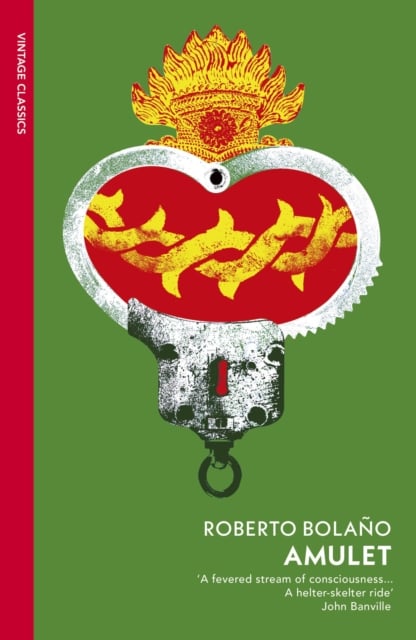
P.S. I really liked the cover of this Picador edition, so shoutout Michael Schmelling and Mike Adams (the cover designer and illustrator)!