Potential for a strange book?

I have to admit that I’m not quite sure what to think of this book so far. I got pulled into it right away – I quite enjoy the journal-entry-style-writing and I was interested following the story of García Madero’s shift from being a law student to joining a group of poets. The part in which I started to feel disinterested was when he started sharing either his or his friend’s sexual experiences. Some of it made me feel sick to my stomach, especially when they spoke about everyone’s interest in taking Angélica’s virginity.

While I understand that the book is set in 1975 Mexico, and is written by a 17-year-old boy, it was evidently very sexist and I was not only feeling disturbed by it, but I also just started to find it all to be boring. It felt like I had read 40 pages of the same thing over and over again and I was considering whether I should start skipping some pages (or at least paragraphs) because I didn’t feel like I needed to read about another man degrading another woman in bed. While this interest for sex never completely went away, it did feel like it at least started to include some other parts of his day, like searching for Ulises Lima and Arturo Belano in book stores, conversations with his aunt and uncle, etc.

I was starting to feel a bit confused around when García Madero got sick. I wondered if he was on drugs or if there were also some hallucinations happening for him too, especially when he was trying to call María. What Lima and Belano shared with him when they went to visit him about Quim pretending to be Angélica left me pondering what was actually true. Quim was referred to many times as not being “in his right mind,” (but then he refers to more people as not being in their “right mind” either) but I began to wonder whether there was something happening to García Madero himself? I’m not sure, I just noticed a bit of a shift in his emotions or thoughts as the story went on and I’m curious if anyone else experienced this.

I felt sad to hear about the situation that Lupe was in throughout the whole book and I’m curious to hear about what happens for her. While this book brought up many different emotions for me, I did still feel interested to know about where this story was going.

There were many parts that I felt like were unnecessary details to include and I didn’t understand their relevance, however whenever I felt this way, I reflected back on our first class and remembered that we would be diving into what long stories are and why they write them, so I am interested to learn more about this (I even find himself getting annoyed in movies sometimes, wondering why they made certain scenes as long as they did).

Comments Off on Potential for a strange book?

Rough beginnings

I tried to like it. I genuinely did. And at the end I did; somewhat. I hope that Bolaño’s intention with Garcia Madero’s epistolar writing in the first part of Los detectives salvajes (1998) was to generate some kind of disgust. I would not say this first part was boring; quite the contrary. It was full of feelings, maybe not the positive feelings one might expect from reading a novel, but feelings nonetheless.

I am amazed by the ability of Bolaño to make someone so unlikable. Garcia Madero reads as a type of person I’ve met many times throughout my academic life: he thinks he is better than everyone else in his life except the few people he chooses to deify and “toxically” admire (I’m looking at you Ulises). He is also a great example of machismo, a prime teen man ready to be groomed into the sexist, violent, Latin American society. Ignoring the sex-obsessed journal writing, not unexpected coming from a teen, Garcia Madero’s attitutde towards the women in his life is tough to read. I don’t say shocking, because this is, again, not something that surprises. This is the “normal”, this is how we usually understand men to behave, specially in a Latin American culture built upon machismo. But there is this specific moment on the novel where I had to put it down, where I had to remind myself this wasn’t a real person, where I started to doubt Bolaño and his intentions with this character.

María nos ofreció una taza de café y luego se levantó y fue a la cocina. La seguí. Mientras esperaba que el agua hirviera la abracé por detrás y le dije que quería acostarme con ella. No me contestó. Quien calla otorga, pensé, y besé su cuello y su nuca. (165, my emphasis)


María offered us a cup of coffee and then got up and went to the kitchen. I followed her. As she was waiting for the water to boil I embraced her from behind and told her I wanted to sleep with her. She did not answer. Silence is giving, I thought, and I kissed her neck and nape (165, my translation, my emphasis)

This horrible scene exemplifies for me what García Madero is. Once again, I hope this book doesn’t portray García Madero as some kind of hero, at least not if his attitude and behavior does not change. For me, ignoring whatever intention of beliefs Bolaño had, this first part of the novel is a master class on how to write a hate-able character.

I am happy that Lupe was able to get away (for now, I have a feeling this will come back to haunt them), but part of me wishes García Madero was shot in that final scene of the book.

I hope I wasn’t the only person whose feelings about García Madero tended in this direction, I am curious to know what opinions did everyone else had on his character.

Comments Off on Rough beginnings

The Savage Detectives I

The first part of Roberto Bolaño’s The Savage Detectives, just under 140 pages (in the Picador edition) and entitled “Mexicans Lost in Mexico (1975),” is presented as a series of diary entries written by one Juan García Madero between the beginning of November and the last day of December.

García Madero (almost everyone calls him by his last names, rather than his first name, somewhat to his chagrin) is a seventeen-year-old orphan, though what happened to his parents we are never told, who lives with his uncle and aunt while he studies law at the university in Mexico City.

Yet we hear very little of his studies–in any case, he “wanted to study literature, not law, but [his] uncle insisted” (3). Instead, he wants to be a poet: or perhaps he is a poet; he is frequently hailed as “poet García Madero” and he is endlessly writing poetry. By December 27 he tells us that “since it all began” (i.e. presumably over the course of these two months) he has written “55 poems,” coming to 76 pages and “Total lines: 2,453 / I could put together a book by now. My complete works” (121).

Not that we ever see any of this poetry. We are not treated to a single line. The closest we get is one of the poem’s titles: “15/3” (97), which seems to refer to the number of times that he and (one of) his lover(s) orgasm in a four-hour session of lovemaking: she fifteen times (“I was afraid she was going to have a heart attack”), he three. I’m not sure this is a poem I would want to read, and I thank Bolaño for sparing us it.

What we get instead, then, is the life of a poet, or at least the life of a poet in the making as García Madero imagines it should be. In addition to skipping class and ignoring his legal studies, this involves a lot of cafés and bars, quite a bit of drinking and smoking, a perhaps surprising amount of sex with an equally surprising number of lover (García Madero is a virgin at the start of November, but very much not so any longer by the end of the year), visiting bookshops to chat to booksellers and steal their books, and above all hanging out with other poets or would-be poets who spend their time similarly, either in their homes or in the streets and bars of Mexico City.

Despite the almost total lack of evidence, at least some of those with whom García Madero associates (notably the barmaids at one of his favorite bars) are apparently “convinced that someday [he]’d be an important person in Mexican literature” (104). Like most of the other young Bohemians, he is a member of a group of poets that style themselves the “visceral realists” (the novel opens with his invitation to the group) who are determined, it seems, to shake up and dislodge the Mexican poetic establishment, here represented above all by (future Nobel prize laureate) Octavio Paz. Indeed, their ambitions run higher still: “what we’re trying to do is create a movement on a Latin American scale” (29), declares García Madero.

Not that it is at all clear what “visceral realism” is. One of the booksellers tells the narrator that the phrase is a contradiction in terms: “realism is never visceral,” he declares; “the visceral belongs to the oneiric world” (113–14). The movement seems to be vaguely avant-garde, and run along the lines of the French Surrealists (right down to the gesture of periodic purges or expulsions, which may or may not be in jest) by two rather shadowy figures, who sporadically appear in and disappear from the text: Ulises Lima and Arturo Belano.

As throughout these 140 pages the book weaves its series of connections and tensions–encounters and disencounters–among an expansive series of characters that include poets and lovers, prostitutes and pimps, booksellers and architects, it can be hard to discern what really matters, and where this scattered set of stories is taking us. An avant-garde looks to the future, but the future here is decidedly murky.

Then all as once, in the final pages of the section, something happens. García Madero finds himself holed up on New Year’s Eve (a time of doing away with the old and welcoming the new), as 1975 gives way to 1976, in the middle-class house of a family with whom he has become entwined. For complicated reasons (which may or may not be worth explaining. . . again, it is not clear what “matters” and what does not), they have given refuge to a young prostitute named Lupe, while her pimp and a couple of heavies patrol the road outside.

Suddenly, unannounced, Lima and Belano turn up and agree to take Lupe away, thus relieving the siege. They will take her in the family car, which they propose to drive north, destination unknown. García Madero accompanies Lupe to the street and impulsively punches out her pimp. With trouble brewing (and there has been frequent reference throughout to a gathering storm) and the car engine gunning, he equally impulsively jumps into the car with Lupe, Lima, and Belano as they set off out of the city.

If this first part of the novel has been about “Mexicans lost,” we may wonder if they will find themselves (or be found by others) in the five hundred pages still to come.

Tagged , , , , | Comments Off on The Savage Detectives I

Hello

Where to begin…

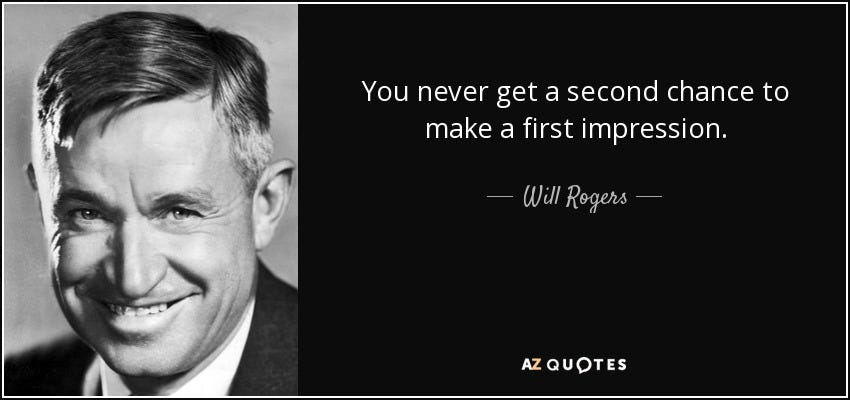
Introductions are always weird for everyone, I think, because there’s a need to make an impression. Or I guess that’s what I have been fed about the significance of introductions—the saying goes…

The perspective by Will Rogers—stresses the nature of firsts. The moment of first meetings is the first encounter in which one deduces whether the other is reliable, sharp, lousy, relatable or whatever judgement we choose based on our own personal values. Which is to say the qualities we cherish or reject within ourselves.

Personally, I find myself to be frequently in the position of arriving late to anything and everything—events, meetings, and a whole number of important things. Which is a trait I somewhat adore about myself at this point because if I hated myself for it I’d be a much more miserable person. Possibly on time—but still miserable. Nevertheless, I really try to manage my tardiness by setting up a preposterous amount of alarms and reminders.

Considering we never get a second chance to make a first impression—it’s worth understanding what it means to impress. To impress is to leave a taste in another person’s mouth—it could be sour, sweet, bitter or tangy—depending on the tongue of the other. Most of the time, we have no idea how we rub another person the wrong or right way because that is so deeply tied to the conscious and unconscious world of the person we are impressing upon. As well as the boundaries of the world in which we meet.

For instance, when a professor arrives late to a lecture—it sends a breath of fresh air through my lungs. ALAS, MY KIND!

Immediately, I find myself to be on their side in lectures and in conversations. In the presence of professors who find themselves late to class; I no longer feel the weight of anxiety about my tardiness. Consciously, I feel safe which altogether allows me to speak up more in class, to try harder, to get creative, to show up to office hours.

The conscious safety I feel towards a tardy professor opens the portal to my unconscious insecurity towards my own tardiness.

Tardiness in western society is often seen as disrespectful and irresponsible. Which makes sense, of course, when existence is preoccupied on supply and demand. We are all workers whose main duty is to be first and foremost efficient. Deadlines, due dates, and our responsibilities should come before being a child to our parents, a neighbour to our community members or a lover to our partners. Efficacy is the standard in which western capitalism demands each of us adhere to.

Efficacy is the standard in which I have spent the last five years or so trying to meet—with much success and a fair amount of failure.

So when I see a professor show up late, or even forget to respond to my email, it warms my heart. Because I see myself in them. Witnessing those who are tardy or whimsically inefficient is witnessing their sparkle of humanity. When I don’t hear back from a professor firstly, I assume they dislike me and once I get over myself—I imagine they’re watching a really good show. Or spending time with their loved ones. Or working on their own assignment. Or going through the kind of heartbreak that renders you incapable of doing anything besides laying in bed or on the bathroom floor.

If you never get a second chance to make a first impression—conversely, you get a chance every day to meet how the world is impressing upon you. Through what endears you to people as well as annoys you. Whether or not we see triumph in a tardy person’s existence usually depends on if we feel we are climbing the same mountain.

So considering the fact that I am late in writing this blog post. It’s nice to meet y’all!

harmela

Comments Off on Hello

Hello world!

Hello everyone. My name is "Perfect" [...] My parents gave me my name.
They said that when I was a baby, I looked like such a perfect child no matter which way they turned me.
But as I grew up, things changed.
My parents kept asking more of me; the school kept demanding better performance.
I am so tired. I just want to scream: "I am not perfect!"

My Little Perfect World. Jimmy Liao

I’m not perfect, that is true! And my name is not Perfect, that is true too. My name is Eliana, and the literature and reading were not always a perfect match for me. Firstly, I arrived late to it; perhaps reading was an attempt to find a space for me, a space where I can relax and imagine, more than just spend my free time, a free time that I don’t have. Reading was and is, in my case, a space to feel the world in other words and images. I talk about images because I arrive at literature through the wordless graphic novels, such as Arrivals (2006), by Shaun Tan, translated into Spanish under the title Emigrantes. When I read this book, I can feel what he feels; the images turned into a voice that told me a part of the story of a man. And a similar case was when I read Cigarra (2018) by the same artist.  I can remember some wordless books and graphic novels that I enjoy and love, like those mentioned and others like Los días raros (María Heredia & Roger Ycaza, 2015) and The sound of colors (Jimmy Liao, 2021).  También, I can remember some long books that I couldn’t finish, like War and Peace (Tolstoy).

Before this lovely encuentro for me, I had read some long books, but I don’t remember del todo. With some of them, I re-read, and it was an opportunity for me! Some of them were abandoned before the end or after a pair of chapters. Anyway, the images were a chance to read other literature and find other voices that let me experience other words and set up other images, other perspectives.

And the second reason for my imperfect reading is that I don’t have a lot of time to read, and additionally, I read slowly. 

My expectation for this course is to finish reading the long book that I have chosen: Nuestra parte de noche by Mariana Enriquez, a book that I selected since I want to start reading the work of this author.

Finally, I studied my undergraduate degree in Colombia, which was in Visual Arts and Education (Pedagogy).

Comments Off on Hello world!

Welcome to My Blog!

Hi everyone, welcome to my very first blog! My name is Ava, and I’m a 4th  year Political Science student.

Now, you might be wondering how I ended up in a Romance Studies seminar. Well…

A couple of months before I discovered this course, I realized that all I had been reading was journal articles and non-fiction books. I often hear my friends talk about the books they have been reading or recently picked up (usually fiction), and it made me think that I want to explore reading beyond what I have so far.

I have always enjoyed longer texts, and they seem more challenging to me than shorter texts, which is what drew me to this course in the first place, and I think this is the perfect opportunity to learn something new and to escape my comfort zone in a way.

You might have noticed the image on my blog. I chose this image as it connects partly to who I am. I’m originally from Iran, and with that comes my fondness for tea, pomegranate, Iranian poetry, art, and culture; hence why I thought this image captured that beautifully. This brings up another question as to why I am interested in Romance Studies in particular.

Around the same time last year, I took a course on the politics of Latin America, and since then, I have become more and more interested in the region, beyond its politics, and I thought this was a great opportunity to explore Latin America from a different lens: through forms of literature and language. I was particularly drawn to Peru, which is why I chose a book that, though it’s fiction, has history embedded within it and is quite political, and of course because the story takes place in Peru. My chosen long book is Conversation in the Cathedral by Mario Vargas Llosa. Another reason I chose this book is that I have read a shorter work by the author and wanted to read one of his longer pieces.

I hadn’t anticipated this, but I have already learned new things, even though we’ve only had one class so far. For the context of this course, I think the only way new ideas and thoughts can be shaped and I can truly allow myself to learn (and the only way I can finish these books) is to let go, pour some tea, sit down, and read, which is how I intend to read the two long books. From the first class, I can already tell we will have wonderful discussions throughout the term as we read our books and I am very much looking forward to it!

Comments Off on Welcome to My Blog!

My Introduction

Hello everyone!

My name is Carlina and I’m a student in the MA French Studies program. I grew up in Montreal, but I have lived in Vancouver for a while now. I am very much looking forward to this course, since it is a bit of a change from the French courses that I’ve been taking in my master’s program. I like variety, and so I was very pleased to find out that there was a Romance Studies course available for graduate students this semester.

I am a slow reader, so I know it will be a bit of a challenge for me to read as much as we will be reading for this course. When I was a child, I fell in love with reading. I would spend most of my free time reading. But I was bullied a lot and made fun of by my peers, not just for being nerdy, but for a few different reasons. For a few years, I didn’t have any friends at school, and I would spend most of my time alone, even at home. Eventually, when I was in grade 9, I completely stopped reading because I was tired of being made fun of and outcasted by everyone at school. After rejecting reading and all other nerdy stuff, I finally made friends. It is unfortunate that I had to give up one of my favourite hobbies and biggest passions in life in order to finally be accepted by my peers. For a few years, I refused to touch a book and didn’t bother reading the books that we were assigned to read in school. Finally, once I was done school and I entered the workforce, I started reading again. It honestly made me so happy.

In this course, I am very excited to delve into the world of long books. One of the topics that I am interested in, which we discussed during the first class, is how we are now in what can be referred to as a “culture of fragments”. I have noticed that most people I know spend much more time looking at content on social media rather than picking up a book. I think that the prevalence of social media has had a very negative impact on peoples’ attention spans. Many people I have spoken to have mentioned that they find reading fiction to be a “waste of time”. I am really hoping that reading novels will eventually become popular again, since there is so much that someone can experience when they are immersed in a story and transported to another world.

For the book of my choosing, I will be reading Les guerriers de l’hiver by Olivier Norek. I chose this novel because I love reading French literature (hence the reason why I’m in French Studies) and because it takes place during WWII, which I find to be a fascinating, although disturbing, period of history. I am excited to start reading this book, along with The Savage Detectives, which will be the first novel I’ve ever read by a Latin American author.

I am looking forward to reading all your blog posts throughout the semester!

Carlina

Comments Off on My Introduction

RMST 495 1 – Hello!

Hello everyone! My name is Annabelle, and I am a fourth-year French student. I was born in Vancouver, grew up speaking English, took French through high school, and started in FREN 301 at UBC four years ago. Being a French major is cool – I’ve gotten to try poutine downtown, analyse Québec culture through comics and even go on exchange to Paris and Lyon! Along my way, I have gotten involved beyond French with the FHIS department – and I recognised a few faces in class yesterday. I absolutely love reading; while the school year does slow me down and I do not read as much as I used to, I feel very grateful to have not “fallen out” of reading. I do find I have to be more deliberate to find time to read. Some favourites of mine last year were The Awakening by Kate Chopin and American Notebooks by Marie-Claire Blais. Some favourite French books of mine are Madame Bovary by Gustave Flaubert and The Tin Flute by Gabrielle Roy. My favourite author is either Joan Didion or John Steinbeck. Or Margaret Laurence…argh! Asides from books, I love exploring, trying new things, meeting new people and learning!

For RMST 495, I am excited to prioritise reading a book that I want to read, which is pretty unique for a course. I do like long books: they are a unique experience compared to shorter books, and perhaps due to the busyness of school, more intimidating to pick up – I fear I might not remember the beginning by the time I make it to the end. This summer I had the opportunity to read Anna Karenina (about 900 pages) which was the first long book I had read in a while. It became peaceful, in that I got into the rhythm of the characters, while at times I lost patience with the parts I didn’t find interesting…not much was left to the imagination! I like that long books are renown for their length, and while I don’t believe it adds to their “worth”, it does add a sort of visible gravitas; I certainly felt like the coolest kid in Grade 9 for toting around a copy of Stephen King’s It (alas I was not). I am excited about the challenge of reading a long book during the school year. I am also so excited to have a class in English! I am an anglophone, so it is much easier to express myself in an English-speaking classroom.

For my book, I chose the French classic Les Misérables by Victor Hugo. I’ve been meaning to read this for a while, and the Broadway show is coming to Vancouver this Spring, so I thought this would be a perfect opportunity to read it first (and say “umm, that wasn’t in the book” during the show…no lol don’t worry I won’t do that.) I am excited to finally read a book by Hugo and I feel like I can more confidently tell people I am a French major (this is a half joke). I picked up a copy at one of my favourite bookstores, Tanglewood Books, which I want to shoutout because it has an amazing selection of old and new as well as allies of shelves and creaky wooden floors! Plus right next door to a coffee shop? A perfect day.

Comments Off on RMST 495 1 – Hello!

A bit about everything.

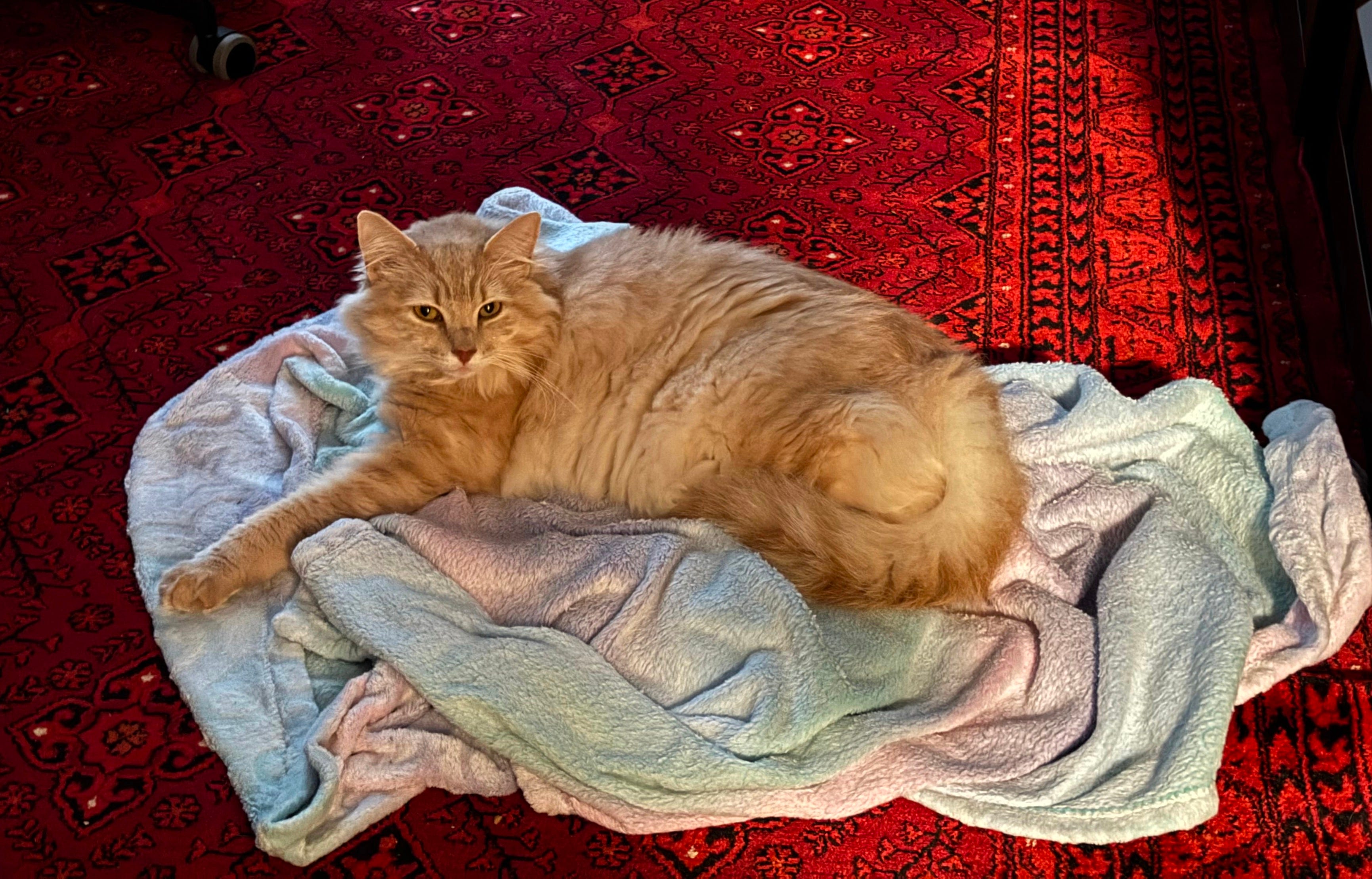
Hi everyone! My name is Valeria and this is my first semester in my graduate program (Hispanic studies). I am originally from El Salvador (Kūskatan) and have been residing as a guest in the land of the Coast Salish peoples for around six years now. I like to go on long walks, play boardgames, take pictures of mushrooms, and cook a good meal that can last an entire weekend (I would like to say reading a book but my lack of commitment is terrible, maybe that will change at the end of this class?). I live with my partner, Mobin, and my cat, Milky (attached picture):

I studied Political Science in my undergrad here at UBC, something that made me stay away a bit from any literature related courses after my first year of exploration. That’s why this class might be kind of a challenge for me, a challenge that I take with a lot of care as I want to start deflecting bit by bit into this area of study.

Thanks for reading! Subscribe for free to receive new posts and support my work.

I am passionate about historical memory in post-conflict Central American contexts and cultural sustaining pedagogies when teaching experiential education programs. One of my recent interests is the ways that family, memory, and educational systems interconnect, something that I think I want to explore more through my research. For this reason I want to have more expertise in family literature or contemporary Latin American family stories. I know I should finish Cien Años de Soledad but I am a bit rebellious and want to start from a different place.

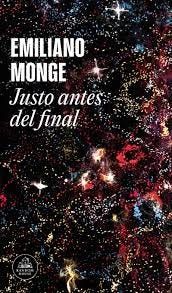
That is why I am choosing the book Justo Antes del Final by Emiliano Monge.

I am excited to be reading fiction for this course. I am a strong believer that the truth can be more easily understood through the eyes of fiction. I can’t wait to read Bolaño, specifically Los Detectives Salvajes, which has been in my to-read list for so long but could not get the courage to pick it up. I am excited to read all of your other books through your eyes too, through your blogs, and through your inputs in class.

Looking forward to read your posts :)

See you Thursday.

Thanks for reading! Subscribe for free to receive new posts and support my work.

Comments Off on A bit about everything.

Introduction

Hi everyone, my name is Simi Braich! I am currently in my fourth and final year of my degree in political science here at UBC. Even though I am a political science major, and I have a separate minor as well, I have taken a couple of other RMST courses as electives, as well as other literature focused courses in different departments. I have enjoyed reading throughout most of my life, so I always look for ways to incorporate it into my life or even school routine. Outside of school, I like to read (for myself), play and watch soccer and spend time with my friends and family. I also have a pet dog named Caesar and a gecko named Jeeto and they are best friends!

This course in particular really caught my eye based on the title and description of the course, which pertains to long books. It first made me try to remember all the books I have ever read and then think about how many of them were “long”. What constitutes a book being long, is debatable, likewise to what the elements of a story should be which I find really interesting. After attending the first seminar, it solidified what I had expected the course, but it also made me familiar with other topics we would be covering in the course. I have read for many years, but I am very excited for this course because we will also be learning about the practice of reading, as well as its importance and variations which I have never really considered before. Based on the format of the seminar, I am expecting to spend a lot of time on collaboration and discussion, similar to how we did in the first class.

For my self-selected book, I have chosen Zeno’s Conscience by Italo Svevo. I have been wanting to read this book for some time, so this course has now given me a specific reason as to why I should. Based on what I have heard of the book and its plot, it reminded me a little of a play called Hedda Gabler by Henrik Ibsen. I really enjoy works that follow one central, very eclectic and/or manic main character, so I think I have picked a good book for myself. The book was written originally in Italian and I have also not read too many books from Italy, so I am also looking forward to broadening my scope.

Thank you for reading my introduction post, I’m excited to work and learn with everyone this semester!


Comments Off on Introduction