Vengeance!

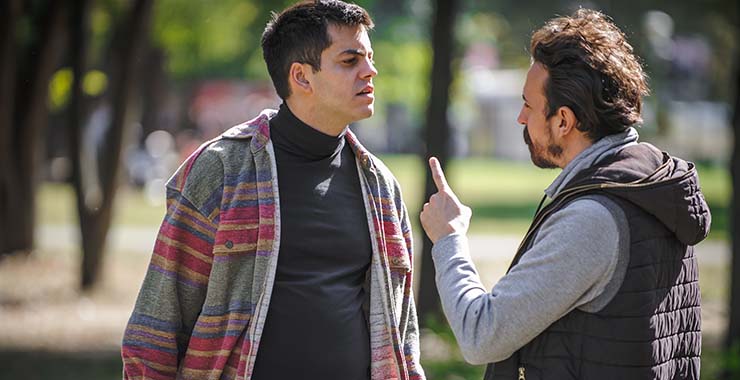
The fourth part of Les guerriers de l’hiver stood out to me more than the last two parts that I read, as it contributed to what I would describe to be a more human side of the story. In some ways, it reminded me a bit of the beginning of the novel, in which we are introduced to characters prior to and around the time of the start of the war. In the beginning, several characters are introduced to us. At the time, I envisioned a promising development of these characters throughout the narrative. Some of these characters were more interesting than others, or at least that’s my opinion. Nevertheless, the inclusion of different perspectives was compelling and I had high hopes. However in my last blog post, I emphasized my disappointment in the disappearance of two of them from the narrative; Azarov and Leena. But I am pleased to say that Leena has returned! And in this section of the novel, she does not just serve the role of the token girlfriend of a male main character, which is what I was worried she would become. Her boyfriend Toivo is shot and killed in combat. As a Lotta assigned to the infirmary, she is tasked with the duties of handling the bodies of fallen soldiers, one of which ends up being Toivo. Toivo’s death caught me completely by surprise. When I read the part of the narrative where he is shot and killed, I exclaimed aloud “Noooo! Toivo!”. I was sad. The three best friends that we are introduced to in the first chapter (Simo, Toivo and Onni) were inseparable. They were best friends in their adolescence. Once the war started, they fought in the same unit together. As readers, we witness these three young men growing together, as they go from spending meaningful moments together prior to the war, to facing the atrocities and horrors of the violent conflict that they are thrown into. However, once Toivo is killed, Simo develops a blood-thirsty rage and relentless desire for revenge. The first time Simo kills someone, he is disturbed and shaken up by the act of taking someone’s life. He has a lot of hesitation when it comes to committing this act. In order to be able to take human lives, he has to imagine that he is hunting animals in the forest, which he is in the habit of doing during hunting excursions with his father. After killing someone for the first time, he is portrayed as having a guilty conscience. He knows that the Soviet citizens are forced to fight in this war. Norek doesn’t shy away from depicting the human cost of war. Front-line soldiers are like pawns in a game of chess. They’re dispensable. At one point, Simo realizes that several Soviet soldiers were fighting while they were drunk, demonstrating how terrified they were, since they needed alcohol to be able to gain the courage to step foot out onto the battlefield. At times, Simo actually chooses to spare some of his enemies; those who he can tell are terrorized and absolutely terrified of death. However, as time goes on, he becomes desensitized to the taking of lives of Soviet soldiers. Simo essentially becomes a killing machine. He takes human lives in an automatic, mechanistic manner. And once Toivo is killed, he embarks on a vengeful mission for retribution. Killing becomes almost an obsession for him. The higher the kill count, the more satisfaction he gets. His transformation from the sweet boy, who we witness having tender moments with his family and friends at the beginning of the narrative, isn’t the same person that he used to be. He has become a monster. Perhaps “monster” is too harsh a word. I’ve never had one of my best friends killed in front of me. Who am I to comment on his blood-thirsty, vengeful reaction to the death of his friend?

War is ugly. It never paints a pretty picture. Instead, it paints a picture in blood—one where individuals are screaming in pain, but no one is listening to them.

Questions for the class: In your self-selected novel or in The Savage Detectives, how did you react when one of the characters died? Which aspect(s) of the narrative contributed to the formation of your attachment to that character, or to your lack of attachment to the character? Do you think that the death of a main character makes a novel more impactful?

Comments Off on Vengeance!

Conversation in the Cathedral: and the conversation continues

It’s funny (sad) what society, well, some characters in the book associate with “comfort” or being “privileged”. I believe these “hidden desires” reveal something deeper about society especially economic disparities where many things are defined by what you can influence with the money you have, what activities you can engage in and even who you can socialize with in hopes that it will add value to you or change how people perceive you.

I think that the place where Santiago works, La Crónica, functions more like a detective agency than a newspaper, solving murder mysteries at this point. It reminded me of Poirot novels I had read when I was younger. As they talk about their job, this one quote reminded me of The Savage Detectives. Carlitos says “this is where we confessed that we were failures as poets and as communists. Now we are a pair of newspapermen” (p. 355).

Back to Santiago’s family dynamics. It got me thinking of how sometimes distance is good.  In the sense that it makes you appreciate people’s presence and the value they add to your life by just being there. When they are always there, we seem not to notice that much, and we miss that because we think they will always be there. This is what happens to Santiago and his brother: even though they were constantly arguing and fighting, he does everything to get Santiago to come back home. He is begging him, he is excited, he is joyful about the idea that he is coming back to have lunch with them. I keep wondering whether this is where Santiago went wrong, separating from his family and wasting his opportunities. I think that fighting for something that you want to achieve is admirable, but I don’t see him fighting. He pretends to be in the ring but throws punches that are perhaps at himself or an imaginary opponent. Maybe that is a fight on its own, but a fight with himself to ruin his life. I’m not sure though maybe my interpretations will turn out to be wrong by the end.

See now, with this book, it simply doesn’t let the idea of skipping pages even cross your mind, whereas Savage Detectives… I don’t know…

In my last blog, I concluded by saying that Odría was able to save his status, and the coup had failed. But that is inaccurate since Manuel Prado is now president (backed by Odría). If you thought this changed the order, I am sad to disappoint you, but the puppeteers remain the same particularly Don Cayo Bermúdez. Santiago’s dad hilariously enough says that now that Prado is in power, the government is functioning like a mafia and because of this he might as well become a communist. The insability is written all over these characters and it is all about where they can make more money and gain more power. They use loyalty as an excuse, but once it doesn’t serve their interests (doesn’t pay enough), they don’t even know what loyalty means.

This book also makes me want to read Peru’s history in greater detail. I have questions about these characters because they are based on real people so most of them I don’t know but they seem to have more important roles even compared to the president. All they do is deceive one another and the nation. Every single day. Is that fulfilling? I don’t know. One of them claims that the demonstrations show that the new president, Manuel Prado, has a strong support base, and that people would elect him if there were an election. Don Cayo, in response, says that if he gives him the money, he can organize the same demonstrations for him, no problem.

They also hand out government positions like candy. They are planning to appoint Espina, who was behind the coup as Ambassador to Spain and also appoint a senator who helped the coup as the head of the senate, just to secure their deniability and stabilize the government. Wow!

Going back to earlier, I wonder what makes you want to skip pages (not that you do but still)? Or on the other hand, what makes you not skip?

Comments Off on Conversation in the Cathedral: and the conversation continues

…que no es vida y que no es tiempo… Reading takes time, too

When I read literature, I don’t usually count the pages or check the page numbers; the measure—my measure—of reading a novel or literary work depends more on the pleasure I find in the universe the work constructs, on the connection I form with that world which I can enter, walk through, listen to, see and even smell. And Mariana Enríquez’s Our Share of Night has been a novel I have enjoyed page by page, a world I have been exploring, one I draw close to to feel the words of Juan or Gaspar or Luis or Rosario, a world that does not belong to me, but which I nevertheless enjoy. And in this final chapter, Las flores negras que crecen en el cielo, 1987-1997 (The Black Flowers That Grow in the Sky, 1987–1997), I have journeyed page by page with Gaspar, a boy, a world, where the insane [was]—is—possible, just as in the house in Puerto Reyes. 

At this point in the novel, Gaspar encounters the world his father kept from him—the world of darkness that now claims him and leads him to meet his mother’s family; a family that he doesn’t know, one that exists only in memories of voices,  corridors of a house filled with disfigured faces, which fade away into the fog of a forest with no place; faces, men and women who embody the power—does the darkness perhaps hope to control Gaspar?

Reading the first five chapters of the novel, that I chose for this class, I made my way through the text whilst listening to the voices of four of the characters who make up Our Share of Night, without giving any thought to how the story might end. However, now that I’m nearing the final pages of the book, I am also piecing together an ending in my head; yet I prefer it when the ending doesn’t match the one I have been imagining for myself in advance… Now that I am just a few pages from the end, I noticed that I have skipped a chapter, so I have decided to stop, go back to the previous chapter, El pozo de Zañartú by Olga Gallardo, 1993, and for the moment just stick with the ending I’ve been making up for myself.

Finally, I would like to share with you a concern that has been on my mind while reading this book, during this course, and that is thinking of reading as an action that is taken for granted, which must happen simply because one knows how to read and because books exist to be read; however, reading involves, and has always involved, ways of life and time that initially marked social and gender differences; today, perhaps we no longer think about that, but in any case, I wonder if traces of these differences, still remain.

Comments Off on …que no es vida y que no es tiempo… Reading takes time, too

2666 – The Part About The Crimes (pp. 353-633)

We’ve finally reached Part IV – The Part About The Crimes, the supposed centerpiece to Bolano’s magnum opus, 2666, where we finally dive into the crimes that have been briefly sprinkled throughout the first three Parts. I’m not sure exactly where to start, I feel like I have a lot to say but I just don’t know how to structure my thoughts, so this blog post may come out (even) more “rambly” than my previous posts. I suppose I should start with a brief summary of what’s happened over this long Part stretching over nearly 300 pages. The good news is that it’s told in a very linear fashion, describing the events month-by-month. The bad news… well, we’ll get into the bad news…

The Part About The Crimes chronicles the many sexual femicides that take place in Santa Teresa each month from 1993 to 1997, from the first page to the very last. Each of these “reports” detailing the deaths read off as very monotonous and objective (maybe there are better words to describe them but what I mean to say is that they simply state things as matter of fact, completely impersonal), they each include the month, the name of the victim if it exists, the condition of the victim’s body, and how they were believed to die. Many were strangled to death (hyoid bone fractures), a lot of them stabbed as well, but above all, a disturbing amount of the victims were raped. And when I say a “disturbing amount,” I mean it, from a quick CTRL+F search on my pdf copy, the word “rape” or “raped” was used 89 times in The Part About The Crimes (of which ~15 were described as “vaginally and anally” or “anally and vaginally”, “strangle”/”strangled” was used ~25 times, “stabbed” was used ~20 times). I didn’t count an exact number, but if I had to guess, around 100 victims were described in this Part (at least it felt like damn near 100). Reading through them did in fact feel disturbing… obviously, right? But if I am to be completely and thoroughly honest with you my dear blog post readers (I’m really not withholding any of my thoughts), after a short while, I would feel less and less disturbed and more and more indifferent, simply reading the details and looking for the similarities/differences between each report. I firmly believe that this was Bolano’s intention. Why do you ask? Well I’m not the only one who feels indifferent to these murders, the people themselves of Santa Teresa appear to also be kind of numb to it all (not everyone though, there are still some people and groups that care)! One of the most spot on examples: “When the forensic report finally arrived (the cause of death probably some kind of stab wound), everyone had forgotten the case, even the media, and the body was tossed without further ado into the public grave.” (520) It reminded me of that one phrase that goes like “the death of one person is a tragedy, the death of a million is a statistic.” This phrase really rang true with me during my reading. The monotony and the sheer amount of the murders that Bolano describes over and over makes me feel like I’m being consumed by the very same apathy of the citizens of Santa Teresa that I would normally be condemning. I can’t help but move on from each murder because as I literally flip the page, another murder is being described (sometimes multiple on the very same page)! Maybe I’m not making myself clear enough and you’re thinking “wow, how can this guy feel so unsympathetic to these terrible deeds?” I don’t know, in that case, I’d recommend reading the book yourself to see (even then, maybe I’m still talking crazy).

Anyhow, amidst all the crimes, interleaved throughout this Part, we also go over several characters in Santa Teresa all connected to the crimes in one way or another. Some of the notable ones are: Inspector Juan de Dios Martinez investigating the murders (and “The Penitent”, weird guy who pees all over church items), Lalo Cura, a young police officer, Harry Magana, a sheriff from Huntsville, Klaus Haas, the very tall murder suspect from the previous Part, Sergio Gonzalez Rodriguez, a reporter from Mexico City, Florita Amada, a seer who appears on TV, Azucena Esquivel Plata, a congresswoman seeking her lost friend, and Albert Kessler, an ex-FBI agent. Now I could go into great depth about all these characters in my summary, but I’ll just do that ad-hoc in my following thoughts. What’s important to note is that by the end of The Part About The Crimes, the murders have still not actually been solved and will most likely continue for years to come, we also still don’t know how many people are committing the murders and if they’re even connected in some way. I also forgot to mention that technically a handful of the listed murders were solved, but the grand majority remain unsolved.

The Part About The Crimes feels very bleak in the sense that we’ll never get some typical mystery novel resolution like in the classic “whodunits” (no shade at Agatha Christie and others). Although, perhaps that’s just a reflection of real life like the real murders in Ciudad Juarez. Bolano definitely alludes to themes of police incompetence and corruption several times:

“Those f*cking judiciales never solve a case…Her name was Isabel Urrea. She was shot to death. No one ever figured out who the killer was. They tried to find him, but they couldn’t. Of course, it didn’t occur to anyone to look at Isabel Urrea’s appointment book…” (462-463)

“The capture of Bustos was relatively easy. He holed up in his house in Colonia Mancera…Bustos hid under his bed…Another cop, a man by the name of Cordero, famous at Precinct #3 for the size of his dick, began to urinate, aiming straight under the bed. Seeing the urine running along the floor toward him, Bustos started to sob. Finally Ortiz Rebolledo got tired of laughing and told him that if he didn’t come out they would kill him right there.” (518-519)

“The semen samples sent to Hermosillo were lost, whether on the way there or the way back it wasn’t clear.” (570)

“the police were unable to find this friend or failed to search for him as diligently as the case warranted.” (574)

“The man committed suicide, said Ortiz Rebolledo. Case closed. Later Lalo Cura would comment to Epifanio that it was strange there hadn’t been a lineup to identify the body. And it was strange, too, that the killer’s companions hadn’t come forward. And that the Smith & Wesson, once it was locked away in the police archives, had disappeared. And strangest of all was that a car thief should commit suicide.” (626)

Even the police chief, Pedro Negrete, has ties to narcos like Pedro Rengifo. In addition, pages 552-553 was a bunch of sexist jokes toward women made by cops, probably not people who’d you want investigating femicides, literally “a mental snapshot of the crooked cops and inspectors” (554). Government officials also try to push the narrative to the public that with Haas in jail, the murders have been solved, whether the reason be corruption or incompetence, nevertheless, they’re misleading the public and pretending like everything’s okay, normalizing the atrocities. It’s a cruel system where those supposed to solve the murders are instead complicit in its continuation. The Part About The Crimes isn’t about finding some mysterious killer, it’s a discomforting reflection about a world built on corruption, incompetence, and misogyny in which it’s impossible for the crimes to ever actually be solved.

For my discussion question this week, since we’re almost done our long books, I want to ask: “Do you think your long book could have been written as a shorter book without giving up anything in return? If not, why must it have been long?” In the case of 2666, I definitely think the buildup to the crimes in the first three Parts and the effect of the sheer amount of the crimes in Part IV justifies its length. Curious to hear your guys’ thoughts for your selected books. By the way though, now that I mention Parts I-III and Part IV, what in the world is going to happen in Part V – The Part About Archimboldi? How is 2666 actually going to end? I’m really not sure, but am looking forward to seeing. To be continued in two weeks!

P.S. The professor mentioned that there was surprisingly a reference to The Savage Detectives in this Part of 2666! But during my reading I thought I actually potentially found two of them, although I could be dead wrong here. The first one was when sheriff Harry Magana found (moreso stole) a notebook belonging to a prostitute. On that notebook there was a phone number attached to a “Lupe”:

“Then he called the number of the woman named Lupe and the conversation was even more chaotic than the one he’d just had with Elsa Fuentes’s mother. What he managed to get straight was that Lupe lived in Hermosillo, she didn’t want to have anything to do with Elsa Fuentes or Santa Teresa, she had indeed known Miguel Monies but she didn’t want to have anything to do with him either (if he was still alive), her life in Santa Teresa had been a mistake from start to finish and she didn’t plan to make the same mistake twice.” (447)

Could this be our Lupe in The Savage Detectives? Anyways, this next one might be more of a stretch, it happens when Lalo Cura is giving his strange family line of Maria Expositos (yes, there’s a chain of like five individuals named Maria Exposito):

“In 1976, the young Maria Exposito met two students from Mexico City in the desert who said they were lost but appeared to be fleeing something and who, after a dizzying week, she never saw again. The students lived in their car and one of them seemed to be sick. They looked as if they were high on something and they talked a lot and didn’t eat anything, although she brought them tortillas and beans that she snuck from home. They talked, for example, about a new revolution, an invisible revolution that was already brewing but wouldn’t hit the streets for at least fifty years. Or five hundred. Or five thousand. The students had been to Villaviciosa but what they wanted was to find the highway to Ures or Hermosillo. Each night they made love to her, in the car or on the warm desert sand, until one morning she came to meet them and they were gone.” (558)

Could these two be Belano and Lima?? Then that would mean Lalo Cura is actually the son of one of them. I’m not going to elaborate anymore because this postscript is wayyyy too long but let me know what you guys think though!

Comments Off on 2666 – The Part About The Crimes (pp. 353-633)

killing words and having heart; something about obscurity and (tragi)comedy. —[life a user’s manual by georges perec]

killing words and having heart; something about obscurity and (tragi)comedy. —[life a user’s manual by georges perec]

I sometimes think about how this book would look, on-screen perhaps. The only real answer that comes up for me is Wes Anderson. Something about how Perec can give you a thousand and one innumerably and seemingly worthless details, yet behind the façade of it all, (if you can even call it that), there is real heart to it. And the heart is often comedic, absurdist, a little surreal at times, but it remains tender. Perhaps, what really sends the heart home is the tragedy that always follows. “Everything that begins as comedy, ends as tragedy”… something like that… or ends as tragicomedy or some other variation of the inevitable.

However many weeks in, and I am beginning to understand my attachment not only to these characters but to the places, locations, mythology, and the pacing of the logic that Perec’s prose provides. Sentimentality is beginning to occur more and more. I am fearful(?).

One thing that I do feel more and more from each week is the differences between Bolaño and Perec. Yes, both have an overwhelming amount of characters. Yes, both have an astonishing amount of detail that we, as readers, don’t know if it is meant to be useful. Yes, both have a lot of lists. But, the difference is, (and here’s the kicker), I have never once really thought of Perec as being an asshole. Many times I have thought to myself, in some varying degree: “is/was Bolaño an asshole?”

There is a level of precision in Perec that I feel is not so sharp with Bolaño. It goes back to that passage that Perec wrote about the puzzle-maker, that no move that the reader/puzzler does hasn’t already been anticipated by the puzzle-maker. I think that for Perec, puzzling–and reading–is not taken to be a solitary activity at all.

Chaos in both Life a User’s Manual and Savage Detectives is utilized very differently. Chaos has its own volition in Bolaño’s work, it is a co-author. Whereas, for Perec, it feels like another tool.

There is one story in this section that I was very caught by. It is the first mention of a character named, Cinoc. No one knows how to pronounce his name, not even himself nor his family. After generations of rough migration and translation, his own pronunciation has been lost. Cinoc makes a living by eliminating ‘useless’ or ‘disused’ words, definitions, and meanings from dictionaries, whilst others find new ones. A “word-killer” by his own determination. Funnily enough, Cinoc also spends his free time and retirement perusing old and forgotten books, texts, and archives looking for rare and esoteric words that interest him, eventually compiling it all into his own dictionary.

… he had wiped dozens of islands, hundreds of cities and rivers, and thousands of townships off the map; he had returned to taxonomic anonymity hundreds of varieties of cattle, species of birds, insects, and snakes […]; cohorts of geographers, missionaries, entomologists, Church Fathers, men of letters, generals, Gods & Demons had been swept by his hand into eternal obscurity.

(327)


Cinoc read slowly and copied down rare words; gradually his plan began to take shape, and he decided to compile a great dictionary of forgotten words, not in order to perpetuate the memory […] but so as to rescue simple words which still appealed to him.

(329)

Again, everything that begins as comedy ends as […].

Something about Cinoc struck me. And then that damned line kept lurking in my head. There is heart in Cinoc’s story, surely. To be fated into obscurity in the way of not knowing your own name, to be tasked in career to wipe things from existence and do exactly what happened to your own name, and then to spend the rest of your life collecting the forgotten… I do not know. Fate is a funny thing, after all.


My question to you all is this:

What does it mean to ‘have heart’? What does heart feel like to you? In a story, in prose or poetry, or in anything else. How do you know that you feel heart? Can you feel it? Can you sense it?

Tagged , | Comments Off on killing words and having heart; something about obscurity and (tragi)comedy. —[life a user’s manual by georges perec]

RMST 495 – Week 10: Are we at the end yet? Quiet Chaos by Sandro Veronesi

Quiet Chaos: A Novel: Veronesi, Sandro: 9780061572944: Books - Amazon.ca Image of Sandro Veronesi, 2006 (photo) Sandro Veronesi: Libri in offerta

Reactions

Reading Quiet Chaos has been overwhelming! I have to say so much happens that it feels a relentless level of emotional trauma unpacking, yet I couldn’t stop turning pages. I felt heartbroken, empathetic, and at times frustrated, drawn into Pietro’s temporary world where grief isolates, disrupts, and transforms both him and those around him. As I get closer to finishing the book, Veronesi truly captures how mourning can be private yet socially tied to others. He writes so heartbreakingly, leaving me emotionally bothered and deeply reflective.

I Feel All The Emotions GIFs - Find & Share on GIPHY Emotional Unstable GIFs - Find & Share on GIPHY Have A Lot Of Feelings GIFs | Tenor

Commentary

For me, the most striking moment is when Pietro’s brother Carlo stays overnight. Their brotherly conversation is raw, vulnerable, and deeply affecting: Pietro confesses how much he misses his wife, while Carlo admits that he misses his brother (i.e., the man he once relied on, now emotionally unavailable since the accident).

Not Here GIFs | Tenor VS. Emotionally Unavailable GIFs - Find & Share on GIPHY

It is clear to me that this scene was about vulnerability. It resonated profoundly with me because it shows how grief is not self-contained. Pietro’s mourning ripples outward, affecting those who care about him. We see this more and more through each and every interaction since he started crying alone in his car. I’m starting to see how his personal loss can create unintended emotional voids for Pietro’s daughter and his brother. The quiet, yet almost masculine honesty of two men confessing their emotions felt painfully real and tender.

How to prevent harmful masculinity and violence

The narrative tension really heightens up when Eleonora, the woman Pietro saved at the beach, finally contacts him. Meeting at the park bench, she thanks him and recounts that day. Pietro recalls a man shouting at him in the chaos of the waves, warning him he wouldn’t make it in time. When Eleonora shows a photograph of that man, I felt a jolt of suspense and curiosity, realizing that a plot twist is about to happen!

29,900+ Man Woman Sitting On Bench Stock Photos, Pictures & Royalty-Free Images - iStock

The emotional weight peaks and the plot twist drops: As Eleonora leaves the park, Pietro sees her dropping a wedding ring into the gutter, revealing that the man who doubted him is her partner. Actually, we later learned that Eleonora is not married, but rather she is the mistress of the man who is sabotaging Pietro’s company. So !!! The man whom she loves told Pietro to not bother saving her was her fiancé – PLOT TWIST, OMG !! What is Veronesi writing, blending personal, quiet trauma with professional chaos?

Plot Twist GIFs | Tenor Plot Twist GIFs | Tenor Twist Ending GIFs - Find & Share on GIPHY

Anyways, Pietro’s sister-in-law suggests returning to the summer home in Roccamare, where his wife fell to her death, to help him and his daughter face the trauma, grieve and seek closure. Due to an unforeseen last-minute obligation, the sister-in-law could not make it, and only Pietro and his daughter made the journey. I am now curious to see what is going to happen once he is in Roccamare, because I am sensing that Pietro’s confrontation with the past would demand an emotional reckoning that is long, long overdue.

Happy Father and His Daughter Riding in a Car While Using Seat Belts Right Hand Drive Car Lifestyle

Discussion Question

You can answer the question in any way you like, whether related to literary works or personal experiences.

Pietro confesses that he misses his wife because of her absence from his and his daughter’s lives; his younger brother Carlo admits to him that he misses him because of his absence from his life. Both men clearly talk about absence, but in two different ways: one who passed away, the other who is stuck in grief and distances himself from others who are still in this world.

Hence, absence can be felt in two ways. How does grief or trauma change the way we act toward our loved ones, and how does our distance affect the people who care about us most?

Comments Off on RMST 495 – Week 10: Are we at the end yet? Quiet Chaos by Sandro Veronesi

2666 V: Narrative Necrosis

Drawing on narrative theory (Genette, Barthes, Todorov, Culler, etc.) Bede Scott argues that the fourth part of 2666, “The Part of the Crimes,” induces what he calls “‘narrative necrosis,’ whereby the tissue of the narrative itself undergoes a process of decomposition” such that “this necrosis fatally compromises the narrativity of Part Four, if not the entire novel, and thus serves as a discursive correlative for the decomposing bodies it describes” (“Roberto Bolaño’s 2666: Serial Murder and Narrative Necrosis” 309, 316). Bolaño’s repetitive, relentless catalogue of the discovery of murder victims in and around the city of Santa Teresa, whose cases are closed almost as soon as they are opened, puts an end to any attempt to craft a story out of the events it registers.

Part Four takes us from 1993 to 1997, and describes 110 murders (strictly, 109 murders and one suicide), of which only 10% are resolved. Moreover, as the text breaks off, there is no end in sight. We are told that the “The last case of 1997” involves a body found “by the dirt road that runs along the border and then forks and vanishes when it reaches the first mountains and steep passes. The victim, according to the medical examiners, had been dead for a long time. She was about eighteen, five foot two and a half or three. [. . .] Both this case and the previous case were closed after three days of generally halfhearted investigations” (632, 633). And yet life continues: The Christmas holidays in Santa Teresa were celebrated in the usual fashion” (633). As Scott puts it, by the time we reach this point, we may have “the (perfectly justified) impression” that between this case and the first documented one, back in 1993:

there has been no transformation whatsoever in the intervening four years and 280 pages. At the end of the section, the various detective figures—who scarcely require individuating—are either dead or no closer to solving the crimes than they were at the beginning. The women themselves are still being raped and murdered with the same metronomic regularity. [. . .] And this is also why we have an ending that merely replicates the beginning—because the dialectic of resemblance and difference that makes a genuine conclusion possible has been destroyed; because this is a narrative in which closure uncloses and nothing comes to anything; and because both the beginning and the end of Part Four are ultimately arbitrary, neither inaugurating nor concluding the “narrative” they ostensibly frame. (315)

It is no surprise therefore that the Part simply stops, rather abruptly. Life goes on in Santa Teresa, but so does the series of murders and deaths. We should not expect any satisfactory resolution. In so far as the causes of the femicide are social (and even this is not exactly a case that is conclusively made), Mexico remains the same: all the conditions that enable and give rise to the crimes (machismo, migration, maquiladoras, drug traffic) are still in place. Resolution was always destined to elude the police and other state authorities–even granted that they put their full effort into investigating the crimes, which to be fair they sometimes do. The frustrated investigation into the case of Kelly Rivera Parker (whose body in fact never turns up), instigated and funded by her childhood friend, who is now a congresswoman, shows that not even political clout or money can make much headway in providing clarity or identifying those who are responsible. We learn more about Rivera Parker’s secret life (organizing orgies at isolated ranches owned by cartel kingpins), but information in itself is no solution. Indeed, we hardly lack for information over the course of what are almost 300 pages in which we are simply deluged with it. What we lack are the tools to determine what is significant or not. This, of course, has been a problem to which the book has been pointing since page one.

So the crimes continue into an indeterminable future. What then can put an end to this catalogue if not the author’s own death? Here, the knowledge that 2666 is a posthumous book (a fact to which a brief prelude, a “Note from the Author’s Heirs,” has alerted us to at the outset) puts the body of the author at the center of this (non)narrative. Alongside the women’s bodies that the text describes, as well as the body of the text (as Scott argues), there is the ailing body of Roberto Bolaño, writing in the “realiz[ation] that death might be near.” No doubt we have this sense of authorial mortality in reading any posthumously published text, but perhaps especially so here. The prefatory note establishes that the novel has not been published exactly as Bolaño himself intended (above all, in that it has been published as a single volume, rather than five), but does not tell us much more about the state of (in)completion in which the author might have left the manuscript. Perhaps he pretty much wrapped everything up in time. Perhaps there were further editorial interventions by his family or his publisher. Still, it is only death (the very literal death of the author) that puts an end to a catalogue of deaths that otherwise knows no end. 

Tagged , , , , , , | Comments Off on 2666 V: Narrative Necrosis

The birth and the ghosts – Monje IV?

As we continue to transit through the life of Monje’s mother, we encounter an interesting collapse of narratives. In the year 1983, “tu madre’s” year, chapter 1983 for Monje, we encounter the moment in which Monje decides to write the book the way we are reading it now. The moment in which he decides how to tell his family story:

“Sólo habrá un personaje y ése serás tú, sólo puede haber un centro múltiple, madre, y ésa debes de ser tú, sólo hay un ojo de huracán, madre, y ése serás tú.” (p.314)

"There will be only one character, and that will be you; there can only be a multiple center, mother, and that must be you; there is only one eye of the hurricane, mother, and that will be you." (p.314)

What feels especially mind-blowing here is that, as readers, we are not just reading the story, we are also reading the exact moment in which the author decides how to tell it (crazy, please tell if you have encountered this before in another book). The narrative folds into itself, the time collapses, in a way that makes us aware of the process behind it, almost like we are being let into the decision-making (being let into something so personal and intimate), the hesitation, the need to structure something that is otherwise overwhelming.

There is something almost cathartic about this. Instead of presenting the story as already complete, Monje exposes the moment of its construction, as if writing becomes a way to process and hold together everything that cannot be told linearly. The mother becomes both the center of the story and the reason the story needs to be written in this fragmented way.

Monje’s mother becomes the ghost itself of the family trauma, the bridge.

She is not just a character, but a site where memory and absence accumulate and return. A kind of territory that calls on others to listen to what has not been fully said, to what never received closure. In this sense, her presence feels like a demand, almost a call for help, in trying to make sense of everything that happened to her.

Maybe before developing this idea further, I should explain a bit more the role of the ghost in the book.

As I wrote in my first blog for this book, I believe ghosts are a kind of unifying character in the book. Monje’s mother sees ghosts everywhere in her childhood home, in the house next door, in the office of her dad. Sometimes, it’s not only the dead who appear as ghosts. At times, the living also become ghost-like in specific situations, when they interrupt a conversation, when their presence feels out of place, or when they carry something that cannot be fully said outloud

Even objects can take on this shape. For instance, the testicle that Monje’s father lost in an accident is literally referred to as a “ghost testicle.” It is no longer physically there, but it continues to exist through a joke, through absence, through the way it shapes how the identity of a character and the story are understood. Naming things like a testicle a ghost gives its absence another meaning. In this case, the ghost testicle could point to a form of masculinity that is already fractured, a father figure who appears fragile, incomplete, and in some ways absent even while present.

There is a moment when Monje’s mother claims that:

“desde que empecé con esta mierda [..] he vuelto a ver a los fantasmas de mi infancia.”

"Ever since I started with this crap […] I’ve started seeing the ghosts of my childhood again."

* The crap meaning the informal interviews Monje conducts with her.

Here, the act of telling her stories brings the ghosts back. However, we can also understand how the ghosts are the ones allowing/pushing?/forcing? her to speak; they surface so she can confront, narrate, and transfer her stories to Monje. It is what makes it possible for her stories to move from private experience into narrative, and for Monje, and the reader, to encounter and hold them.

Comments Off on The birth and the ghosts – Monje IV?

the more I read, the more I find it to be delicious

Comments Off on the more I read, the more I find it to be delicious

Week 10: Artists and Their Problem with Mediocrity

Hi Ava, this may contain spoilers! I was going to divide this post in two, because I finished Conversation in the Cathedral. Then I thought I could write my final blog post on One Hundred Years of Solitude, so I’m putting everything here.

First, I promised to talk about more characters in my last post, so here’s a brief analysis of Queta and Hortensia. I thought they were both Cayo’s mistresses, while the two of them are a couple in secret — my guess wasn’t far off. In this section, we find out that Cayo uses them both almost as prostitutes to entertain his political friends. Cayo only bought Hortensia a house to use it as a private nightclub for the senators. But Hortensia thinks Cayo loves her (although she despises him), and that she’s found a reliable patron. Queta is more realistic and knows Cayo is using them, but she cares deeply about Hortensia, whether out of love, friendship, or pity — I’d say bit of each. In a way, Hortensia and Queta reflect two different mindsets among people who thrive under a dictatorship. One has faith in the strong political leader, she may not love him, but she believes him invincible, and believes herself completely safe under his protection. The other remains mistrustful to the leader and know that her fortune is only momentary.

My jaw dropped when this last part of the book revealed that Hortensia was blackmailing Santiago’s father Don Fermín, the government minister, not because she was his mistress (as I wrongly assumed), but because she knows that he and his chauffeur Ambrosio have a secret sexual relationship. Ambrosio has a strange admiration (certainly not love) for Fermín, he feels responsible for helping Fermín take care of the blackmailing, so he kills Hortensia. This final reveal was not climatic. It’s just sad. He leaves Fermín, gets married, loses his money to a bad business investment and his wife to childbirth. He returns to Lima with nothing, runs into Santiago, and they start drinking and talking in the Cathedral bar. The book ends where it began. We spent a few hours in a bar, but we also went through a dramatic 15 years (with a dictatorship thrown in there).

In the end, it just feels like everyone took a violent beating and then grew old. Is this the closure I want? The government ministers don’t get any consequences for fucking up Peru, but go on with their comfortable lives in their beautiful houses with pools. However, every plotline did get closure. The murder mystery was unveiled, though the truth was depressing, pathetic. The family drama ended when Fermín’s died and all his children established their nuclear families. The political drama ended with “Cayo Shithead” getting expelled. Ambrosio and Amalia’s romance soap-opera turned out a tragedy, and Santiago’s Bildungsroman too, in the worst way — no triumph, no growth, no romantic self-sacrifice…oh, I’ll give you that one, Zavalita, when you broke with your family to be independent, you sacrificed a life full of potential for your ideals. You threw your life away, but you did stick out with your decision to the end.

“The only things is that I really wasn’t the one who made the decision. It was imposed on me, just like the job, like everything that’s ever happened to me,” Santiago says this of his marriage and his whole life. In this book, I identify with Santiago the most: we are hesitant, we have vague ideals but are not brave enough to imagine them to the detail. We resist what we don’t like in a discreet and futile way, often failing make a statement against anything…

“Mediocre” is a word that appears repeatedly, mostly to describe Santiago. It seems like artists (and I consider novel-writers artists) have a problem with mediocrity, Vargas Llosa being no exception. They despise it. Who lives a more mediocre life in this book? Santiago? His petit bourgeois life, his wrinkled suit, weekend movies with the family… But there’s still a “small worm” gnawing at him from inside, a worm left over from his communism days. He never truly reconciles with his family. Or is it his siblings, Teté and Sparky — still holding up the family business, marrying the right people in their class? They never had ideals. Is that mediocre? What if they all are, in some way! And what if none of them deserve to be blamed for it! What is mediocrity anyway? Is it an observable lack of something in life, or is it something interior, related to our ideals, some kind of flame inside? Are we readers, most of us leading less exciting lives than the writer, just going to let the writer bully us into self-deprecation? I refuse to be. — look, another discreet, utterly useless resistance on my part.

Does your book talk about mediocrity? If so, how does the author define mediocrity? Is it criticized?

Or does your author criticize another quality?

Comments Off on Week 10: Artists and Their Problem with Mediocrity