I’ve had little involvement in assessment over the years. Library instruction is almost always non-credit — and, besides, usually too brief to accommodate assessment.
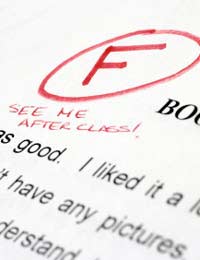 So the Gibbs & Simpson article has been a revelation for me, particularly the dynamic it explores between assessment and learning. I hadn’t considered before the ways in which assessment drives learning, rather than merely testing it; how it can be tweaked to increase the amount of study students do; how coursework is more valuable to learning — and how students perceive it so — than exam-driven study; and yet, how resource-strapped campuses have been drifting toward testing because it’s less resource-intensive.
I find myself a little confused by some terminology. Does assessment include both marking & grading and feedback, or is feedback a separate matter altogether? (The latter, I suspect.) (BTW, to my mind marking and grading are distinct — marking means the instructor writing his responses on the essay the student has submitted, whereas grading means assigning a grade.)
I was particularly fascinated by the observation that in contrast to a grade with feedback, “feedback on its own is more likely to be perceived as a comment on what has been learnt,” and thus students are more apt to read it on its own, and read it more carefully.
This is very good news. It speaks very strongly to the type of instruction libraries give. It doesn’t matter that it’s ungraded — in fact, grades only get in the way of students’ receptivity to feedback, Gibbs & Simpson suggest. Librarians can still give students tasks and provide feedback (orally during the learning session, or textually afterward, or even in the form of online quizzes, as I’ve done with e-learning tutorials), which the students will heed by & large. Due to time constraints (typical in all-too-brief library instruction sessions), students’ task-work can be submitted at the end of the session and the librarian can do the feedback in the 24 or 48 hours following the time-constrained session, so the assessment or feedback doesn’t bite into the session itself.
Gibbs, G., & Simpson, C. (2004-05). Conditions under which assessment
supports students' learning. Learning and Teaching in Higher Education,
(1), 3-31. Accessed online 1 March 2010
http://www.open.ac.uk/fast/pdfs/Gibbs%20and%20Simpson%202004-05.pdf.