Claire (Qing) Pan, MEL – Clean Energy Engineering, UBC
Industry Partner:UBC SEEDS program
Abstract
This research evaluates the embodied carbon of the Mechanical system in the Wordsworth Building at UBC, a 16-storey residential tower with a total floor area of 18,443 m² and a 60-year reference study period. The building receives heating, cooling, and domestic hot water from a district energy system.
Following the EN 15978 life-cycle framework, the study used input data from building drawings, shop submittals, and manufacturer information to quantify emissions and identify major embodied-carbon hotspots.
The analysis also assessed key uncertainties and methodological limitations and provides recommendations to improve future embodied-carbon assessment practices within UBC’s LCA framework.
Introduction
Why Mechanical Systems Matter
•Global buildings = 37% CO₂ emissions
•Embodied carbon = 10–14%
•As BC grid decarbonizes, MEP share becomes dominant
•Research show MEP can be 15–50% of complex buildings

Scope & Methods
Functional Unit
The complete set of mechanical equipment required to provide space heating, cooling, ventilation, and domestic hot water to the Wordsworth multi-unit residential building over a reference study period of 60 years.
System Boundary (EN 15978)
Included: A1–A3, A4, B4, C1–C4
Excluded: B2/B3/B6, refrigerant leakage, minor accessories
Tools & Data
One Click LCA
Equipment Covered (core groups)
Fluid cooler, fans, pumps, heat pumps, MAU, DHW tanks, exchangers, baseboards, ERV, grilles.
Results
Total Mechanical Embodied Carbon is 732,973 kg CO₂e Corresponds to 8.27% of total whole-building embodied carbon (Whole building EC = 8,860,315 kg CO₂e)

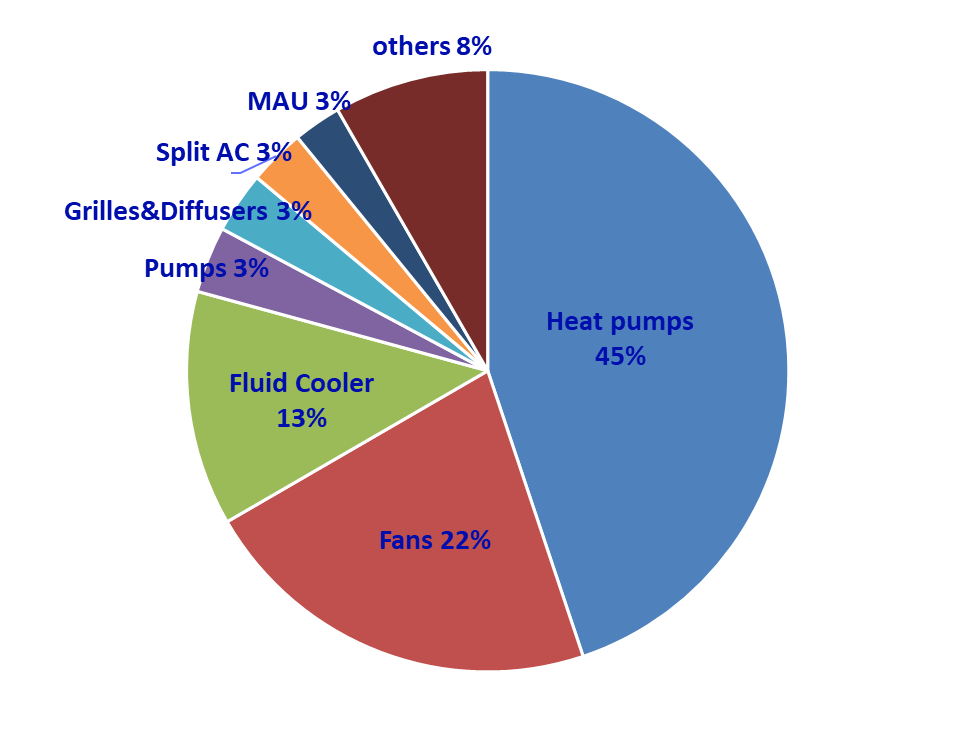
| Equipment | CO₂e. t |
| Heat pumps | 328.9 |
| Fans | 159.6 |
| Fluid Cooler | 92.4 |
| Pumps | 26.1 |
| Grilles & Diffusers | 24.0 |
| Split AC | 22.2 |
| Makeup Air Unit | 18.9 |
| Others | 60.9 |
Discussion
Mechanical EC profile of Wordsworth:
• Dominated by HVAC equipment and replacement cycles
• Minimal transport impacts
Why mechanical EC is lower (8.27%) than heavy-MEP buildings:
• District energy system eliminates high-carbon central plant equipment
• Small, decentralized residential-scale HVAC units
• Concrete high-rise structure makes mechanical share smaller
Next steps
• Improve data pathways by integrating as-built drawings, mechanical schedules, procurement records, and available EPDs into standard LCA workflow.
•Develop a campus-wide MEP embodied carbon database to establish system benchmarks across building types and support more consistent modelling for future UBC projects.
•Expand LCA scope to include ductwork, piping, insulation, and distribution components currently excluded.
Key Take-aways
•HVAC equipment and B4 replacements are the primary drivers of mechanical embodied carbon.
•Decentralized mechanical systems design significantly reduces embodied carbon relative to heavy-MEP systems