Categories
Environments and Sustainability

Land Value Tax Policy in Harrisburg, PA, U.S., Densification Policy

Harrisburg is the the capital city of Pennsylvania, U.S.  It has a population of 49,673 and it is the 9th largest city in Pennsylvania [1].  Harrisburg was rated as the 2nd best city in the U.S. to raise families by Forbes Magazine[1], an American business magazine well-known for its lists[2].   Before achieving this fame, Harrisburg, more than 20 years ago, was ranked as the most distressed city in the U.S[3].  The significant changes in the city’s development is largely attributed to the tax reform initiated by Mr. Stephen Reed back in 1980[4] as a member of the Pennsylvania House of Representatives, who later on became the Mayor of the city of Harrisburg from 1982 to 2010[5].

Harrisburg, PA, U.S
Source: ASPA National Weblog[9]

Two-tier tax rate policy

Before this tax reform,  the traditional property tax was used in Harrisburg with which both the land and the buildings / improvements on the land was charged at the same rate.  After the reform, the tax rate on the land was increased and the tax rate on the buildings /improvements was decreased.  The initial ratio was 2:1 when the two-tier tax rate (land tax rate : building tax rate) was introduced.  As the years passed by, the ratio has been adjusted and always been with a high rate on the land and a low rate on the buildings / improvements; in the recent years, the ratio has been increased to 3:1, 4:1, 5:1, 6:1 subsequently and stayed at 6:1 (0.024 : 0.004 in actual rates)[4][6]. They ultimately want to eliminate the tax on the buildings / improvements and turn the taxation into a pure land value tax.  Like before, the tax revenues will go to city development in infrastructures,  public facilities such as schools and hospitals, etc.

The Purposes of the Policy

It’s believed that the traditional property tax taxing both the land and the building the same discourages the land owners to invest in the development of the land or the construction on it. As the higher value of the buildings / improvements, the higher tax you will need to pay to keep them. You may just want to leave your old house as it is because you will be penalized by renovating  / improving it (higher value, higher tax to pay).  Likewise, such a property tax discourages vertical development and inevitably encourages urban sprawl. Land supply is limited, therefore the use of each unit of land should be maximized.  With the two-tier tax rate policy, it is aiming for city revitalization by incentivizing urban renewal and curbing urban sprawl, specifically as the follows according to Reed[4]:

  • induce the highest and the best use of the land
  • reward the better use of the land
  • discourage land being left vacant or unused
  • encourage vertical and high rise development
  • discourage spread and preserve natural areas and open space areas such as parks, historic sites, etc.

Historical Outcomes

The effect of this tax policy has been noticeable since 1982 and it’s described by Reed, up to 2010[4]:

  • 4.8 billion worth of investments occurred
  • taxable properties went from $212 million to $1.6 billion
  • residential units sharply increased
  • vacant structures fell by 80%
  • crime rate dropped by 28%
  • thousands of new jobs were created

Overall, the two-tier tax rate policy seems effective in encouraging development and population densification as well as achieving the stated purposes.  However, the coverage of the tax reduces the effectiveness of this policy where the land and properties owned by the state and non-profit bodies are exempted[3]. The exemption is the same as before the policy change. For example, the churches don’t need to pay this tax and, thus, there’s virtually not much  incentive for them to make their best use of the land, at least, compacted construction is not necessary.   Likewise, the state-owned land might just be left vacant as before.

Why It Works

It is logical that the two-tier tax rate policy can achieve the densification purpose. After the reform, the tax on land was increased and the tax on the buildings /improvements was decreased. With that in place, the opportunity cost to keep a vacant land becomes relatively high.  You will more likely to sell it or develop on it.  Likewise, it attracts investments.  If you decide to build on the land, now that the tax rate on the building is so low, you will want to maximize your return and building higher levels that is within your budget. When you rent out the units, because of the reduced costs from the taxes on the buildings, you can rent out the units for lower prices compared to when the traditional property tax was in place.   This would also help provide more affordable housing to the residents.  However, as more development comes in, the land values will be driven up, resulting in high taxes for the landowners. Therefore, the reduction in costs might eventually be cancelled out and the residents might still pay similar amount of rents as before.

On the other hand, the commercial investors might opt for the land in the rural areas where the land value is lower, thus a lower tax.  However, in this case, it is restricted. According to Pennsylvania’s zoning legislation[7], the rural ares are for (although not limited to) agriculture, timbering, mining, recreation, tourism etc. and the development of infrastructures are limited.  Together with such a zoning legislation, the intended effects of the policy can be and have been captured[8].

Conclusion

The two-tier rate tax on the land and the buildings / improvements in Harrisburg has been quite successful in achieving its purposes of urban revitalization in the City of Harrisburg. It has encourages the compact city development where buildings are  densely and vertically built in the city center to maximize the land use per capita and the increase in  population density follows.   Although the policy doesn’t aim to decrease crime rate, etc., the increasing tax revenues do in a way support the development of the public and social sectors of the city and improve the overall living standard of the city and benefit the residents.  The early investors, landowners  renters are probably much better off under the effect of the policy, as the land value increases and increases the amount of taxes, the benefits are diminishing. However, the city as whole is still better off.

References:

1. Wikipedia.  (Mar, 2013). Harrisburg, Pennsylvania. Retrieved from http://en.wikipedia.org/wiki/Harrisburg,_Pennsylvania

2. Wikipedia.  (Mar. 2013). Forbes. Retrieved from http://en.wikipedia.org/wiki/Forbes

3. Hartzok, Alanna. Earth Right Institue. (n.d.). Pennsylvania’s Success with Local Property Tax Reform: The Split Rate Tax. Retrieved from http://www.earthrights.net/docs/success.html

4. Commongroundorwa.org. (Dec. 2012). Land Value Taxation – The Harrisburg Experience. Retrieved from http://commongroundorwa.org/index.php/component/k2/item/373-land-value-taxation-%E2%80%93-the-harrisburg-experience

5. Wikipedia. (Dec. 2012). Stephen R. Reed. Retrieved from http://en.wikipedia.org/wiki/Stephen_R._Reed

6. Urbantoolsconsult.org. (2005). City of Harrisburg Two-Tier Tax Rate. Retrieved from http://www.urbantoolsconsult.org/upload/City%20of%20Harrisburg%202%20tier%20tax%20rate.pdf

7. Yarbrough, Robert J., (2000). PENNSYLVANIA’S ANTI-SPRAWL LEGISLATION. Retrieved from http://yarbroughlaw.com/Publications/pubs%20enviro1%20PA%20anti%20sprawl%20legislation.htm

8. Speirs, Mark. (Dec. 2010). Land Value Taxation: An Underutilized Complement to Smart Growth Policies. Retrieved from http://www.urbantoolsconsult.org/upload/MarkSpeirsFinalPaper12-20.pdf

9. ASAP National Weblog. (Jun, 2012). Living in Fear of Tomorrow – Harrisburg. PA. Retrieved from http://aspanational.wordpress.com/2012/06/26/living-in-fear-of-tomorrow-harrisburg-pa/
Categories
Environments and Sustainability

Milan’s Area C Congestion Pricing Scheme

Milan, the second largest city in Italy (next to the capital Rome),  has an area of 181.76km2 and a population of 1.35 million people[1].  It is the top fashion city in the world as well as a major financial and business center in both EU and the world[2].  It also has the top level of cars per capita (car concentration)  in the world, which was reported as 0.6 cars per resident[3] in 2011, according to the study by Rotarisa et al. With that being said, it is not hard to imagine, Milan is one of the most polluted and most congested cities in the world.


Political Origin and Objectives of Area C Congestion Pricing Scheme

In Jan. 2008, the administration under Mayor Mrs. Letizia Moratti introduced the Ecopass pollution pricing scheme to help curb pollution in the city. It set up the 8.2km2 restricted zone in the city center of Milan (the busiest area in the city) where vehicles need to pay a fee to enter between 7:30am and 7:30pm daily. Different types of vehicles pay a different charge, etc. [4].  According to Rotarisa et al., over the 3 years implementation of the Ecopass scheme, the air pollution had been reduced but the benefits appeared to be diminishing and came to be exhausted[3].  On the hand, Mayor Mrs. Moratti failed to be be reelected in 2011. Mr. Giuliano Pisapia, in June. 2011, became the new Mayor of Milan and needed to decide whether to extend Ecopass, replace it or change it some way. In the referendum around the same time period, 80% votes went to support converting the Ecopass pollution scheme to a more strict congestion scheme[5]. Thus, the congestion pricing scheme Area C came into effect in Jan. 2012 in Milan to replace Ecopass[6].  The Area C scheme has the following  aims:

  • Tackle congestion issues directly by reducing vehicle access to the city and improving public transit networks.
  • Reduce pollution caused by traffic.
  • Improve sustainable travel modes[5].
  • Overall, improve the life quality of those who have activities associated with the city[7].

How does Area C work?

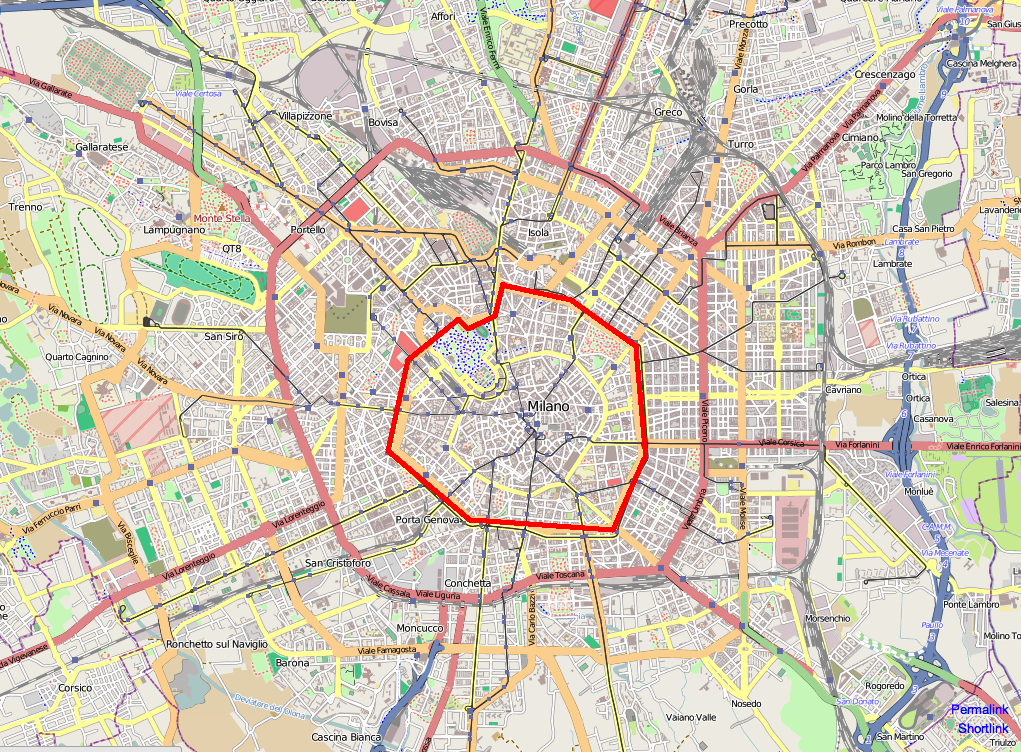
The Area C congestion pricing scheme is designated for the same area under Ecopass.  To enter this 8.2km2 zone  of the city center of Milan on the weekdays between 7:30am – 7:30pm (Thursdays’ changed to 7:30am – 6:00pm, since Sep. 2012 )[6]:

Milan Area C Area
Area C Restricted Zone, Milan, Italy;
Source: Wikipedia
  • Vehicles (with exceptions) are entitled for a flat fee of €5.
  • Vehicles that belong to the residents inside the area have 40 free entries annually and a flat fee of €2 after that. These vehicles must be registered.
  • Some types of vehicles are banned in this area, that include those with emissions at Euro level 0, gas engine, and Euro levels 0,1,2,3, diesel engine.  According the the EU emission standards, those high polluting vehicles[8].
  • Public transportation are free to enter which includes buses, emergency vehicles, taxis.
  • Hybrid, bi-fueled vehicles and scooters are free to enter.

The entrance tickets can be purchased by cash, debit or credit from various locations like meters, retailers, etc. They need be purchased and activated on the same day before entry.  Upon entry, the surveillance cameras at the access point will be able to identify the classification of the vehicles and the due charges[7].

The entire system seem pretty smart and the registration for resident vehicles is key to distinguish between the non-resident and resident vehicles. However, for residents, it might provide incentives for those who didn’t often use vehicles to drive in order to use up the free entries since they are free or use the free entries to give rides to non-residents for profits or not. On the other hand, the lower income residents who use vehicles often would be affected the most considering that they would have taken public transit which costs less, if not for a particular reason to use vehicles.

Although there’s no study publicly available to explain how the 40 free entries were decided, the government of Milan probably did research on it. A follow up study to assess the usage of the 40 free entries for resident might be worthwhile in improving the policy in the future.

Also, for allowing hybrid and bio fueled vehicles free access seems to be only on the consideration of pollution reduction. It will create incentives for people to switch to those types of exempted vehicles and at the end the number of vehicles accessing the city center will rebound.

Results after one year of implementation

According to official estimates reported by XinHua,China in Feb. 2013, the Area C scheme in the one year time “caused a reduction by more than 30 percent of vehicles inside the designated restricted zone and 7 percent outside it”[9].  In terms of pollution reduction, “PM10 and NOx emissions [were reduced by] 18% and CO2 emissions [were reduced by] by 35%”, according to a recent study[10]. The study also indicates that Area C has raised €20.3 million for the public transport  investment funds and the bike sharing system.  The funds then can be used to further improve the public transit and improve infrastructure to make biking a safer and more feasible way of transportation. Although the lower income group don’t directly benefit from the scheme, they will be benefited as the transit net work improves, since they are probably the most frequent users.

Conclusion

Overall, the Area C  through the charge to reduce the number of vehicles accessing the city center of Milan could be more effective and more lasting if the there’s no exemption on the hybrid or the bio fueled vehicles. This policy can work more effectively by focusing on one main goal which is the reduce congestion.  For pollution reduction, it should be addressed by a separated policy or scheme independent of Area C.


References:

1. Wikipedia. (2013, Mar.).  Milan. Retrieved from http://en.wikipedia.org/wiki/Milan

2. Wikepedia. (2013, Mar.). Economy of Milan. Retrieved from http://en.wikipedia.org/wiki/Economy_of_Milan

3. Danielisa,Romeo. Rotarisa, Lucia. Marcuccib, Edoardo. and Massianic, Jérôme. (2011, Nov.). An economic, environmental and transport evaluation of the Ecopass scheme in  Milan: three years later. Retrieved from http://www2.units.it/danielis/wp/Ecopass%20-%203%20years%20later,%20finale.pdf

4. Wikipedia. (2013,Mar.). Ecopass. Retrieved from  http://en.wikipedia.org/wiki/Ecopass

5. Di Bartolo, Caterina. (2012, Nov.). AREA C in Milan: from pollution charge to congestion charge (Italy). Retrieved from  http://www.eltis.org/index.php?id=13&study_id=3632

6. Wikipedia. (2013, Feb.).  Milan Area C. Retrieved from http://en.wikipedia.org/wiki/Milan_Area_C

7. Commu di Milano. (n.d.). Area C. Retrieved from

http://www.comune.milano.it/portale/wps/portal/CDM?WCM_GLOBAL_CONTEXT=/wps/wcm/connect/contentlibrary/elenco+siti+tematici/elenco+siti+tematici/Area+C/English/#par01

8.  Desiel Net. (2012, Sep.). EU Cars and Light Truks. Retrieved from http://www.dieselnet.com/standards/eu/ld.php

9. XinHua, China.org.cn. (2013, Feb.).Feature: The decade for Milan air pollution control. Retrieved from http://www.china.org.cn/world/Off_the_Wire/2013-02/01/content_27854057.htm

10 . CASCADE project. (2013, Mar.). Milan hosts first CASCADE study visit. Retrieved from http://www.eurocities.eu/eurocities/news/Milan-hosts-first-CASCADE-study-visit-WSPO-95RCLA

Categories
Environments and Sustainability

Plastic Shopping Bags Levy Scheme in HK

Hong Kong (HK), a city of 1,104 km² (less than half the size of Greater Vancouver) has a population of 7 million people1 (more than triple of the population in Greater Vancouver2). HK  is one of the most densely populated areas in the world. Like other affluent economies, HK is facing the challenges of waste management, among which municipal solid waste (MSW) management is of top concern. In a formal and comprehensive study done by  GHK Ltd. (a consulting company) in March 2007, it shows that if the municipal solid waste disposal rate were not controlled,  the existing landfills in HK was expected to reach  full by 20153.  It is only sensible for any government to take serious steps to deal with a pressing matter like this.


Brief of Plastic Shopping Bags (PSBs) Levy Scheme


Political Origin & Goals

Having sensed the crisis of MSW management as well as aligning with the world’s environmental protection initiatives, the Environmental Protection Department (EPD) of the Government of HK set out the Policy Framework for the management of MSW in 2005. The Policy Framework suggests introducing producer responsibility schemes (PRS) as a key policy tool based on the “polluter pays” principle as one of a series of initiatives to help achieve MSW objectives3. MSW objectives include the followings:

  • use sustainable practices in MSW management
  • reduce the amount of MSW generated
  • increase recycling of MSW
  • reduce the disposal of MSW at landfills

Under this Policy Framework, Plastic Shopping Bags (PSBs) Levy Scheme was proposed by EPD  in May 2007.   It aims to provide a direct economic incentive to encourage the public to reduce use of plastic shopping bags.  Although less than 2% of the waste sent to the landfills come from PSBs, the government also hope to use the opportunities through this scheme to raise awareness and educate the public to make environment-friendly choices in their daily life.


Pricing

The PSBs Levy Scheme was set out to charge consumers 50 cents HKD ($0.07 in CAD) per bag they ask for at the cashiers of the prescribed retailers (to be listed). This PSBs levy directly targets the pollutant itself and the polluters. It should reduce the generation of the pollutant being targeted meaning less PSBs being produced/imported and less ending up in the landfill.  For the price of the levy, it was supported and believed to be the sufficient rate to effectively reduce use of PSBs. That’s by the majority of about 1000 survey takers from the general public during the  public consultation from June to July 2007.   This 50 cents per bag pricing seems to base on the public opinion of their willingness to pay for the pollutant instead of the marginal damage of the pollutant, disposal of the PSB. This raises questions about the cost-effectiveness of the levy.


Enforcement

In late 2008, the Plastic Shopping Bags Levy Scheme was made into a Regulation/ Ordinance4). In July 2009, the scheme was put in effect and guarded by legislation. The prescribed retailers would be penalized if they failed to follow the scheme.  This is important to ensure the effectiveness of the levy in terms of enforcement, compared to a voluntary scheme.

Use of Levy Revenue

The retailers return all the levy collected to the government on a quarterly basis.  The levy will go to the environmental fund to support environmental projects5).


In general, the proposal received considerable public support despite the opposition from the plastic bag Manufacturers and retailers5). However,  the levy would inevitably increase the consumption of the substitutes / alternatives. This was anticipated but the effect was underestimated.

  • For the plastic bags inside the supermarkets used for produces and bakery goods, for hygiene purpose, consumers don’t need to pay for them. This would encourage the consumers to use more of these bags.
  • For paper bags or laminated bags, they  simply are not plastic bags and they aren’t levied. If possible, the retailers, for better competitiveness, would probably switch to those bags so that their customers won’t bear the cost of the bags .
  • Likewise, the consumption of plastic bags for non-shopping purpose such as plastic garbage bags is believably to be increased, as people will have to use some kinda of carrier for their household garbage if not the used-to-be-free PSBs. In fact, it’s shown that the use of garbage bags went up by 63% since the beginning of the scheme to 20116).

The lower income group under this scheme is believed to be most negatively impacted with the charge imposed. They probably used more free PSBs since they probably never had money for garbage bags and so forth.


Sector Coverage

When the scheme was introduced and in the first 2 years of implementation from 2009 to 2011,  it targeted only the retailers which are the major supermarkets and shops7):

  • offer all of the following categories of goods for sale:
    • any food or drink
    • any medicine or first-aid item
    • any personal hygiene or beauty product
  • have 5 or more retail outlets;
  • or at least one retail outlet that has a retail floor area of not less than 200 square meters

In 2012, the government decided to extend the coverage to all retailers8). Thus, the small medium enterprises/businesses would be affected as well.


Conclusion:

There are quite a bit of loopholes in this PSBs Levy Scheme in HK.   It does reduce the use of PSBs; the goal at this is reached.  However, it encourages use of other types of bags by a lot which are more polluting in terms of size and weight.  Therefore, the overall effectiveness of reducing MSW is minimal or could result in negative effect.  Also, the pricing and the coverage of the levy makes it less cost-effective. The marginal cost of damage from the pollutant PSBs is still unknown. Even though the levy is in place for all retailers, it’s not in place for all bags. It would lack of cost-effectiveness considering the waste of other types of bags would be (further) increased.


References:

1.Wikipedia. (Mar 7,2013). Hong Kong. Retrieved from http://en.wikipedia.org/wiki/Hong_Kong

2.Wikipedia. (Mar 6,2013). Greater Vancouver. Retrieved from http://en.wikipedia.org/wiki/Greater_Vancouver

3. GHK Ltd. (Mar, 2007).“Assessment of Benefits and Effects of the Plastic Shopping Bag Charging Scheme” by GHK (Hong Kong) Ltd.  Retrieved from http://www.epd.gov.hk/epd/english/environmentinhk/waste/prob_solutions/files/GHK_study.pdf

4. EPD of Government of Hong Kong. (Dec, 2008). PRODUCT ECO-RESPONSIBILITY (PLASTIC SHOPPING BAGS) REGULATION. Retrieved from http://www.epd.gov.hk/epd/english/news_events/legco/files/LegCo_Brief_Environmental_Levy_Scheme_eng.pdf

5. EPD of Government of Hong Kong. (Aug, 2007). Public Consultation Report on the Proposal on An Environmental Levy on Plastic Shopping Bags. Retrieved from  http://www.epd.gov.hk/epd/english/environmentinhk/waste/prob_solutions/files/Consultation_Report_Levy_Eng.pdf

6.Toloken, Steve. (Aug, 2011). Consumers buy heavier bags; plastics use rises after Hong Kong taxes bags. Retrieved from http://www.plasticsnews.com/article/20110805/NEWS/308059988/consumers-buy-heavier-bags-plastics-use-rises-after-hong-kong-taxes-bags#

7. EPD of Government of Hong Kong. (Feb, 2010). The Environmental Levy Scheme for Plastic Shopping Bags – Latest Levy Income. Retrieved from http://www.epd.gov.hk/epd/english/boards/advisory_council/files/wmsc0210.pdf

8. Tam, Stephanie. (Oct, 2012). Hong Kong Plastic Bag Levy. Retrieved from http://rso.cornell.edu/rooseveltinstitute/hong-kong-plastic-bag-levy.html


Categories
Environments and Sustainability

Carbon Tax System in Finland

Quick Facts

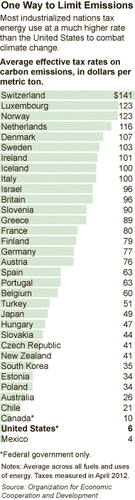
Finland was the first country to introduce carbon tax as an instrument for climate change mitigation.  The carbon tax was put into effect in January, 1990 in Finland, where they only contributed 0.3% to the worlds CO2 emissions1; the tax was based on the carbon content of the fossil fuels and charged at  €1.12 per tonne of CO2 ($1.51 CAD, using today’s exchange rate) when it was first started. The carbon tax was reformed in 1997 and 2011. Now, it’s evolved into a combined tax of carbon and energy tax charging €18.05 per tonne of CO2($32.82 CAD) and €66.2 per tonne of carbon ($89.08 CAD)2. In 2010, Finland’s CO2 emissions was ranked 59th among the countries in the world3.  Below is an overall picture of the current effective carbon tax rates among countries (the list is not exhausted but it gives you the significant ones). Finland’s is ranked 15th. To make a comparison with the countries we are more familiar with, Canada and the US are ranked 32th and 33th respectively in the world’s effective carbon tax rates. In 2010, their CO2 emissions were ranked 2nd and 9th in the world 3and there is probably no significant change in these 2 years considering the level of effort each has been putting in. 


Carbon Tax Rates


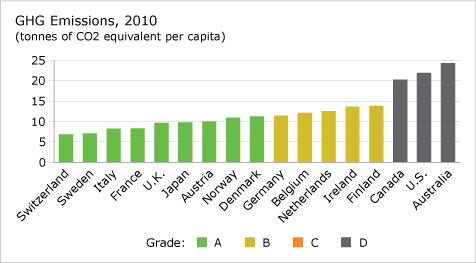
However, in terms of per capita greenhouse gas emissions and energy consumption, Finland was ranked among the highest countries in 2010 which is illustrated in the greenhouse gas emissions “report card”4 below.

Per capita GHG emission


Origin & Goals

Let’s now take a step back. How was the carbon tax originated?

More than 20 years ago, climate change already caught the global attention.  The first world climate conference was held at February 1978 in Geneva, where climate topics were identified,  studies and research on climate change were initiated.  Since then, the sustainable development issues have started to influence the policy-making in Finland5.  Also, it was foreseeable that the world would need to join in dealing with the climate change. It would allow a competitive advantage to start first even though the costs would be relatively higher due to the lack of experience.

The purpose of the carbon tax is to curb the emissions of greenhouse gases primarily CO2.  CO2 can remain in the atmosphere for 100 years; it absorbs heat rays (infrared radiation). With massive amount of CO2, it results in global warming and initiates anomalies in the ecosystem threatening the living beings.  The carbon tax is to create an incentive for reducing CO2 emitting human activities, from something small and everyone can do like the use of vehicles, to something big but not unattainable like adopting a cleaner technology in production.

Again, the carbon tax is based on the carbon content in the fossil fuels. The carbon content in every form of fossil fuels is precisely known, so is the amount of CO2 released into the atmosphere when the fuel is burned.  This is an important and necessary prerequisite for carbon tax to work because the measurement of the quantity of  pollution is based on it. As Dr. Ron Wasik said, “If you can’t measure it, you can’t control it.” Only with the accurate measurement can the efficiency and equity of carbon tax itself be ensured.


Coverage

When the tax was first initiated in Finland in 1990, there were few exemptions for specific fuels and sectors.

  • Peat and natural gas had a favorable tax treatment with a special deduction scheme in the sales taxation (the value added tax). Peat as an energy source might be relatively less known.  It is an accumulation of partially decayed vegetation which can be burned to generate heat and electricity. Peat is an abundant resource in Finland6. In 2005-2010, the tax on peat was exempted7 because it was considered biofuel different from fossil fuel,even though it emits CO2 during combustion. In fact, peat emits the same amount of CO2 as coal per unit of energy8. This probably works in favor for the energy demanding industries in Finland but not the environment and it should also bring up questions about the effectiveness of the carbon tax implemented in Finland.
  • On the other hand, wood industry was exempted from the carbon tax. The wood industry in Finland is an export-oriented industry which enjoys comparative advantage in the world.  It makes a logical sense why they allow the exemption for the wood industry; however,again, it raises questions about the effectiveness of the carbon tax.
  • In addition, fuels used in industrial production as a raw material or inputs in the manufacturing of goods (i.e. for non-energy purposes) were also exempted8. This is contradictory to the idea of taxing the “upstream” industries2.  It does seem like when the carbon tax was introduced in Finland, it was not used in the way as it was truly intended to be.

Finland has remained as an active supporter and implementer of carbon tax since the inception of it. Learning from the past experiences, there were adjustments to the carbon tax rates and coverage over the years.  The major reforms took place in 1997 and 2011.  In 1997, the rates were largely increased and the carbon tax was added with a tax on the consumption of electricity1. In 2011, the carbon tax was turned into a combination of carbon tax and energy tax7.  The tax rates were adjusted accordingly among the carbon component and the energy component and the peat was set to be reintroduced.


Distributional Effects

The carbon tax system is more than putting a levy on the fuels or energy and collecting money from those.  In Finland, they have a combination of  tax-shifting packages for making the carbon tax revenue-neutral9, by tax reduction such as reducing income taxes, etc. In fact, their earlier policies aiming at reducing income taxes just coincided with their initial climate change initiatives where the carbon tax was introduced.  The Finnish government seems to be using the tax cuts for income transfer from the higher income group to the lower income group.  For example, in the tax cuts proposed by Finnish government in 2009, the tax cuts would be distributed equally over all income levels, and would also apply to pensioners10.  Despite all, some industry representatives still think that carbon tax is just another way to increase government budget revenues.

Conclusion

It’s always not easy for the first timer.  Finland as the first timer of carbon tax in the world did put in hard effort in going after a sustainable and better future. It seems to me that due to some political reasons and maybe more of the short term economic considerations, Carbon tax in Finland hasn’t worked as effectively as it potentially can.  Without a comprehensive cost and benefit analysis, it’s hard to say what is the most appropriate scheme.  However, at the very least, we can see that the energy source and industry that generates the most CO2 are being treated with favors. This is against the motive of climate change mitigation.


References:

1. Economic Instrument in Environmental Policy. (2008, Dec). Economic Instruments – Charges and taxes. Retrieved from http://www.economicinstruments.com/index.php/climate-change/article/119-

2. Carbon Tax Center. (2013, Jan). Pricing carbon efficiently and equitably. Retrieved from http://www.carbontax.org/progress/where-carbon-is-taxed/

3. Rogers, Simon. (2012, June). World carbon emissions: the league table of every country. Retrieved from http://www.guardian.co.uk/environment/datablog/2012/jun/21/world-carbon-emissions-league-table-country

4. The Conference Board of Canada. Greenhouse Gas (GHG) Emissions. Retrieved from  http://www.conferenceboard.ca/hcp/details/environment/greenhouse-gas-emissions.aspx

5. Wikepedia. (2012, Oct). World Climate Conference. Retrieved from http://en.wikipedia.org/wiki/World_Climate_Conference

6. Wikipedia. (2013, Feb). Peat. Retrieved from http://en.wikipedia.org/wiki/Peat

7. Ministry of Evironment, Finland. (2012, Feb). Environmentally related energy taxation in Finland(2012). Retrieved from http://www.environment.fi/default.asp?contentid=147208&lan=en

8.  Vourc’h, Ann and Jimenez, Miguel . (2000, Jan). Enhancing environmentally sustainable growth in Finland. Retrieved from http://www.oecd.org/greengrowth/economicpoliciestofostergreengrowth/1880843.pdf

9 . Andersen, Mikael Skou. (2010, Mar).  Europe’s experience with carbon-energy taxation. Retrieved from http://sapiens.revues.org/1072

10. Jokivuori, Pertti. (2008, Sep). Tax cuts proposed under 2009 budget plan. Retrieved from http://www.eurofound.europa.eu/eiro/2008/08/articles/fi0808029i.htm

Categories
Environments and Sustainability Simple Life

Local Adaptation

"Think Global. Eat Local."

I am obviously not the first one to say this and won’t be the last one either.  There is too much to say about this topic / philosophy.  Here, let me share something personal and not so personal on it and focus on the “Eat Local”.

You probably know that my favorite food and thing is bread.  How does bread come into this picture of local adaptation when we talk about “Eat Local”?  First of all, what is the main ingredient of bread? No doubt. It is flour. Where does flour come from? It depends on the type of the four, and the flour people most of the time use in baking is milled from wheat. One of the most famous brands of flour (easily accessible from our local supermarkets) claims that their flour is all made from Canadian wheat.  This is no surprise since Canada is one of the leading producers of wheat in the world.  Is this local enough?

Have you ever thought of growing wheat in your backyard and making your own bread out of it?  Even if you knew how, it will take a lot of time and effort and it will be more expensive than simply go buy a loaf of bread from a bakery close by.  Thus, it is not really practical or realistic.  However, it’s never a bad idea to make this into a project for educational purpose or experience learning.  In fact, one of the elementary schools in UK put such a thought into an experiment where students grew wheat from seeds, harvested and milled it into flour which they used to make foccacia bread[1].  I think this is a great way of teaching the ideas of sustainable living and reducing food miles, etc, not to mention it’s put into action.  It does incur quite a lot of costs to pull off a project like this. However, the social benefits in the long run is not to be neglected, as the culture and the mindsets of people are among the key elements in dealing with environmental issues.


References:
1. Moody,Mark. (Nov, 2012). An experiment in making bread at school the sustainable way. Retrieved from http://www.guardian.co.uk/teacher-network/teacher-blog/2012/nov/30/sustainable-bread-making-school-experiment


Categories
Environments and Sustainability

Canadian price of crude oil would rise with the creation of Northern Gateway pipeline

Warm-up Assignment:

Listen to the first segment of Part 3 of CBC’s “As It Happens” for Tuesday, September 4th titled “Northern Gateway Hearings. The Alberta Federation of Labour says the Enbridge pipeline project will actually eliminate Canadian jobs”:

http://www.cbc.ca/asithappens/episode/2012/09/04/the‐tuesday‐edition‐45/

The Alberta Federation of Labour has two main criticisms of the Northern Gateway pipeline: (1) Canadian jobs would be created if the crude bitumen was refined in Canada and then exported rather than being exported directly; and (2) The pipeline will reduce the “Asian” premium, which means a higher price of oil in Canada and job loss due to the higher processing costs for Canadian refineries.

In about 200 words carefully explain why the creation of the Gateway pipeline from Alberta to Kitimat BC will raise the price of crude oil for Canadian refineries. Be sure to include proper references to your background material.


According to Gil McGowan (President of Alberta Federation of Labor), the creation of Northern Gateway pipeline will raise the price of crude oil for Canadian refineries. Oil refineries take crude oil as the raw material for production and convert it into consumable products like gasoline. Currently, the oil suppliers for Canadian refineries are primarily domestic, and the buyers/consumers of their refined products are primarily domestic as well.

With the pipeline in place, the expansion of Canadian crude oil industry to a world market would bid up the domestic price of crude oil to meet the world price (narrowing the gap between the domestic and the world price). This will be so as the result of a much higher demand from a worldwide refinery industry/oil market, particularly with access to the ones in Asia and West coast US.  Mr. McGowan mentioned that the Saudi Arabia (currently the main oil supplier to the Asian market) when facing the Canadian entering their Asian oil market could lower their oil price to keep their market share.  Thus, it would result in a reduced “Asian Premium”.  The “lowered” oil price in Asia market/world market would then still be higher than the current Canadian domestic price of crude oil because of the high demand. This would encourage Canadian crude oil export as long as it allows a higher margin of profit than selling the oil domestically.  The potential shrinking supply of crude oil domestically would cause the domestic oil price to rise.  In addition, the Canadian refineries’ bargaining power would be reduced as the Canadian crude oil industry is open to the world market which would probably be reflected on an increase of price of crude oil as well.

Spam prevention powered by Akismet