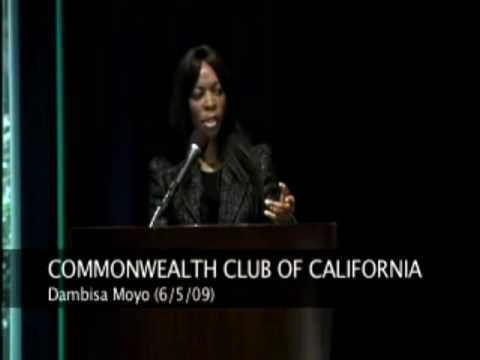
about Dambisa Moyo
| Dambisa Moyo was born and raised in Zambia, Southern Africa. She completed a PhD in Economics at Oxford University and holds a Masters from Harvard University. She completed a Bachelors degree in Chemistry and MBA in Finance at the American University in Washington D.C..
She worked at Goldman Sachs for 8 years in the debt capital markets, hedge fund coverage and in global macroeconomics teams. Previously she worked at the World Bank in Washington D.C.. Dambisa is a member of the Boards of Lundin Petroleum and SAB Miller. Dambisa is a Patron for Absolute Return for Kids (ARK), a hedge fund supported children’s charity. She serves on the Boards of the Lundin for Africa Foundation and Room to Read, an educational charity. |
 |
|
Dambisa argues for more innovative ways for Africa to finance development including trade with China, accessing the capital markets, and microfinance. Dambisa has also been offered a contract for another book, entitled How the West Was Lost, scheduled for publication with Penguin and Farrar, Straus & Giroux in 2010. This book examines the policy errors made in the US and other Western economies which culminated in the 2008 financial crisis. And discusses why financial and economic experts missed the signs of the credit crunch. It also explores the policy decisions that have placed the emerging world- China, Russia and the Middle East, in pole position to become the dominant economic players in the 21st century. |
|
source: Dambisa Moyo’s website <http://www.dambisamoyo.com/author.html>
about Dead Aid
Dead Aid: Why Aid Is Not Working and How There Is a Better Way for Africa
|
In the past fifty years, more than $1 trillion in development-related aid has been transferred from rich countries to Africa. Has this assistance improved the lives of Africans? No. In fact, across the continent, the recipients of this aid are not better off as a result of it, but worse—much worse. In Dead Aid, Dambisa Moyo describes the state of postwar development policy in Africa today and unflinchingly confronts one of the greatest myths of our time: that billions of dollars in aid sent from wealthy countries to developing African nations has helped to reduce poverty and increase growth. In fact, poverty levels continue to escalate and growth rates have steadily declined—and millions continue to suffer. Provocatively drawing a sharp contrast between African countries that have |
 |
rejected the aid route and prospered and others that have become aid-dependent and seen poverty increase, Moyo illuminates the way in which overreliance on aid has trapped developing nations in a vicious circle of aid dependency, corruption, market distortion, and further poverty, leaving them with nothing but the “need” for more aid.
Debunking the current model of international aid promoted by both Hollywood celebrities and policy makers, Moyo offers a bold new road map for financing development of the world’s poorest countries that guarantees economic growth and a significant decline in poverty—without reliance on foreign aid or aid-related assistance.
Dead Aid is an unsettling yet optimistic work, a powerful challenge to the assumptions and arguments that support a profoundly misguided development policy in Africa. And it is a clarion call to a new, more hopeful vision of how to address the desperate poverty that plagues millions.
source: Dambisa Moyo’s website <http://www.dambisamoyo.com/deadaid.html>
commentary
I grew interested in the debate around Dambisa Moyo’s book, because I had very strong opinions against relief development aid in Southern Africa in particular. It was refreshing to see an influential African speak out against aid, when surrounded by governments that will go through any means necessary to secure further aid inputs into the countries. But just as the cliché goes, give a man a fish and he will eat for a day, teach him to fish and he will eat for his lifetime, this is something that relief aid specifically doesn’t address. Other development in infrastructure and industry is less patronizing however at the end of the day; they don’t give the local the necessary tools to develop without the constant need for development intervention.
What I particularly identified with Moyo’s opinion was her critique of governments’ attitudes and practices in the development processes of developing countries. There are underlying deals that foster uneven development in almost every single development transaction in Southern Africa. And it is high time that government officials be held accountable for the active role they play in the uneven development of their countries. They are elected into to office (technically) under the premise that they are there to pursue the best interest of their constituents however this is rarely the case.
From my understanding Moyo advocates that we take the power out of their hands, by voicing that we don’t want them to keep lining their pockets with resources that are meant for the development of the nation, by whining off development aid altogether. However her proposed alternative is one that won’t necessarily change the order of things. I suppose it will be an improvement because the power will be redistributed through academics, experts, in other qualified elites, instead of dubious government officials. But it still relies on the neoliberal notions of the trickle down economy; which has to date to prove its effectiveness.
As pointed out in the comment above, FDI is what is hoped will be promoted in contemporary African political agendas, however I feel that this too has a set of destructive consequences at are being over-looked too lightly. FDI equal if not greater capabilities to undermine domestic economies unless managed under strongly regulated economies, something that unfortunately is not the case for many nations in the Global South.
I am currently reading the book Dead Aid and hope to comment again once I am done with it, maybe with a new/improved perspective.