
Last VIFF showing –> Tue, Oct 13th 12:40PM at Empire Granville
See also director Sandy Cioffi’s talk on Democracy Now –> Part 1 | Part 2
Summary
From VIFF Website
This is not the movie I intended to make, says director Sandy Cioffi, by way of introduction to her searing indictment of the politics of the global oil market. When the inauguration of a library in the Nigerian village of Oporoza was hijacked by a group of articulate and impassioned students, demanding an end to the environmental degradation of the Niger Delta, and a share of the astronomical oil profits ($700 billion) MEND (The Movement for the Emancipation of the Niger Delta) was born. Projected to supply a quarter of the US oil imports by 2015, the Niger Delta occupies an increasingly fraught position. Nowhere is this more explicitly clear than when Cioffi brokers a deal with ABC News for a Dateline story on the crisis in the Delta. As the spokesperson for MEND struggles to make himself understood, the corporate media agenda is clearly revealed in all its predatory hysteria. But even as members of MEND debate whether their struggle should remain nonviolent or take up arms against government forces, across the globe the then-Nigerian president was meeting with George W. Bush to secure a commitment from the US to back the Nigerian government (with American Marines if need be). The government policy of execution, intimidation, and rape extended even to Cioffi and her crew, who were arrested and detained, their film footage seized. The film reserves some of its most damning information for the very end when it is revealed that the Niger Delta, one of the most polluted places in the world, has suffered the equivalent of 50 Exxon Valdez spills (with no plans for a cleanup).
Background
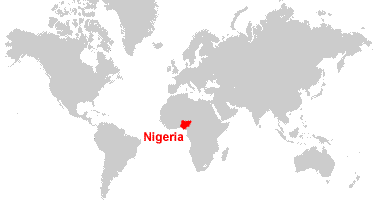
Nigeria, Africa’s most populous country, gained its independence from the British in 1960. The country is a “shaky rickety federation” of more than 300 ethnic groups coexisting within the national boundary drawn by the colonisers. Petro companies like Royal Dutch Shell and Chevron
 have been extracting oil from the Niger Delta since oil was discovered there in the 1950’s. This continued after country’s independence. After some 50 years of irresponsible operation by the oil companies and uneven distribution of this oil wealth, the Niger Delta is now in a state of extreme environment degradation and its some 20 million people living in poverty (see Wikipedia entry on Environmental issues in the Niger Delta).
The struggle of people living in the Delta against the social and environmental atrocities of the oil extracting companies and the Nigerian government dates back to the early days of independence. One of the important figures during this period fighting for a fairer share of the Niger Delta’s oil wealth is Isaac Adaka Boro. Later, the famous human right activist Ken Saro-Wiwa substituted Boro’s role and lead a nonviolent campaign to end the decades-long environment and social devastations in the delta region (see p117 in Victoria Lawson’s book on struggle of Ogoni People). The responses to Saro-Wiwa’s peaceful activism were violent. The Nigerian government ordered its Joint Task Force(JTF) armies to silence and slaughter communities involved in the campaign. More than 20 villages were wiped out since the 1990’s. And the multinational petro companies responded with a series of assassinations of Saro-Wiwa and his supporters (see Wiwa family lawsuits against Royal Dutch Shell of torturing and murdering Saro-Wiwa in Wikipedia). Oppressed and abused by the government and corporations, people of the Niger Delta started to deploy “stronger” measures in order to make their voice heard. Militancy of MEND, Movement for the Emancipation of the Niger Delta, whose objective is to achieve “resource control and self-determination” in the region emerged as the prominent group in the struggle (see Wikipedia entry of MEND for detailed accounts).
Despite the frequency of being depicted by the Western media as a “terrorist group who has links with al-Qaeda,” MEND has been calling for international intervention to hold a third-party peace talk with the oil companies and the Nigerian government. However, the international community has not done anything significant to improve in the situation in the Niger Delta. That is other than United States’ decision to send more troops to secure the routes to ship crude oil out of Nigeria (see AFRICOM in Wikipedia).
Recap of Q&A with the director Sandi Cioffi on Thu, Oct 8th, 2009
Q: As a documentary maker, how did you maintain neutrality while spending a long time with these villagers?
A: When I was in Northern Ireland people always asked “why are you on the side of the IRA?” When you are safely sleeping in a hotel room, you’ve already chosen your side with your feet. I think it is very difficult for a documentary maker to stay neutral. For the crew to travel safely on the creeks, we need to get permission and protection from MEND leaders and village elders. Then the next thing you know is that you’re spending a lot of your filming time with them and seeing things through their perspectives. In a world where the mainstream media goes for things that are sensational rather than complex, I think something showing an alternative way of thinking is indeed necessary.
Q: What was left out on the cutting room floor?
A: Several things. First, the footage of our forth trip to the delta last year (2008) was not included because the it was destroyed by the Nigerian government when the crew was captured and jailed. It includes interviews of young politicians who are pushing for a third-party peace talk with the UN and more generally a just and democratic political system. These interviews were to be the last chapter of the film. Second, interviews of Chevron spokespersons. I didn’t want to show you because some of the clips make the company look really bad. I thought you don’t need me to give a black and white picture of corporate giants taking advantages of small people. It’s that they are doing it. But I’m using oil, probably from Chevron and Shell. I am guilty too. That’s why I didn’t think it was necessary. One other thing I really wanted to show you but didn’t is a scene of woman screaming seeing her village was set on fire by the JTF and all her family killed. But I left it on the cutting room floor because I thought I shouldn’t show you things that are too emotional and out of context.
Q: You dedicated the whole film to show the struggles of the Ogoni people over their land and resources. But Nigeria is a huge country; The Niger Delta is just a small part of it. To me, political and social struggle in one place is inevitably linked to what is going on elsewhere in the country. Why didn’t you incorporate any of the social movements in other parts of Nigeria?
A: My primary aim is to give the audience a sense of what’s going in the delta. When I started filming, I watched everything available on the delta and they are all totally out of date. The latest one was made in 1994. And things have changed a lot since 1994. I don’t know about Canadians, but in the States, most people don’t know anything about Nigeria. If they know anything, they know that Fela Kuti’s music was cool. They might know there is oil there, too. I don’t know Nigeria outside of the Niger Delta or Oporoza, the village where most part of our filming is done. I’m more concerned about getting the stories of the villagers through. Besides, I wouldn’t do justice to anybody if I try to give you a glimpse of people’s lives all around Nigeria. I think for a defined scope is needed for any documentary.
Commentary
To make their voices audible
The movie tells the heartbreaking story of the people living in the Niger Delta who have had many practical solutions to the problem for many years and whose voice is constantly being ignored, if not deliberately distorted, by the international community. It comes to the idea discussed in the Sharp reading “Can the subaltern speak.” What we are seeing is a lack of media coverage when the movement to liberate the delta was undertaken in a peaceful fashion saying the region is dangerous. And now, when the MEND and other militant groups are fully armed, there is a literally a flood of foreign media to the area bring back images of masked men with guns swearing to expel the oil companies and their workers.
A vicious cycle of representations
It is a vicious cycle that no elite would listen and solve the problem in time unless the subaltern turn to violent measures. Then the elites would not let go of the opportunity to dehumanise and demonise the subaltern labelling them as “terrorists” and presenting the corporations as powerless victims under these “terrorist threats.” It is ironic to see the subaltern, who are glad that they had finally received some attention from the elites, in turn become even more militant and belligerent. In many aspects, the situation of MEND in the movie reminds of me of Frantz Fanon and his idea of violence as the last resort of the oppressed to make their voice audible and that violence is inevitable in decolonisation and years to come after that (see pp122-129 in Sharp).
However, I believe there are ways in which the subaltern can break out from this vicious circle of representations. One is through the justice system, which can be seen in the lawsuits of Saro-Wiwa’s death against Shell. Another way is to create an alternative space for the subaltern to present themselves, like what Sweet Crude did and what we’re doing here. One of most impressive parts of the movie is this meeting of the leaders of women’s rights group and MEND discussing how they want to be portrayed in the film. They explicitly state that they don’t want to be presented as “resource persons.”In other words, this alternative space for subaltern to speak needs to be constructed on an equal relation between the actor and producer so that the subaltern can decide how they would like to be represented.
Corporations as victims of “terrorist activities”
Another impressive and shocking part of the film is how ABC news report about the MEND’s activities in Nigeria. In the clip, a woman identified as a “global energy analyst” said when there are several attacks on petroleum producing facilities in the world, like what was going on in Nigeria, then the price of oil will be drastically increased. Later Sandy Cioffi told me that this so-called global energy analyst actually works for an oil company. I personally thought the comment is clever. Blame those people in the South struggling over their right over resources for making the oil prices high. Call what their fights “resource nationalism” and say that they post threats to free trade and property right. By channelling hatred towards people elsewhere, the investment bankers, hedge fund managers and speculators alike can escape from the responsibility of restlessly investing in the fuel market and creating pushing oil prices to record high. Just like how western empires and the drivers of the big D development have gone to the South to solve problems in the North, the states, corporations and media again find it effective to demonise the South to make the Wall Street financial capitalism seem legitimate. Of course, this statement exaggerates and simplifies the complex reality we’re experiencing now. Nonetheless, it helps us to reflect upon how the “terrorism” and “if we don’t give them anything the poor people are going to kill us” rhetoric has infiltrated our daily life.