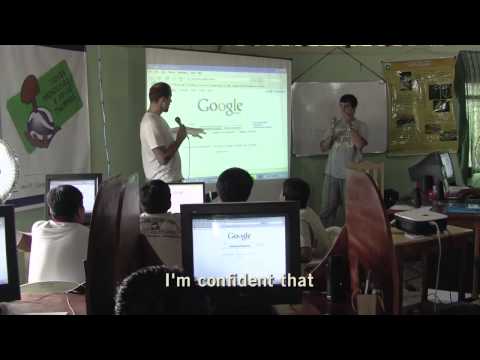
This video depicts one element in a web of new responses to Development and globalizing forces represented in social movements and activism around the world. In June of 2008 a group from the Google Earth Outreach program travelled into the Brazilian Amazon. Google Earth Outreach is a program which provides cartographical and visualization resources to non-profits and public benefit organizations. Visiting with several indigenous tribes in the forests of western Brazil, the team taught GPS mapping, video, photography and computer technology skills to groups of villagers. The goal of these instructional sessions was to assist the villagers in creating their own maps of their lands, sacred sites and resources, and thus to help to spatially situate knowledge that has previously existed as oral history, passed from generation to generation. These maps also represent important tools in the fight against intrusions by logging and ranching and may form a key piece of evidence when groups deal with local and federal governments. The satellite imagery associated with Google Earth may allow them to see encroachments on their land, such as deforestation or river discolouration. Thus the maps represent key tools to enhance communication, preserve cultural knowledge, maintain accountability from governments and organizations and empower indigenous groups.
This video address one of the central problems facing social movements across the world, that of how to effectively communicate the message. By using media tools like the internet and GPS groups throughout the Amazon are being connected with the tools to protect their rights and assert themselves as owners or caretakers of the land they live on. These tools allow “scale weaving” and transnational literacy that was previously limited by lack of contact. Groups in the Amazon are able to communicate with governments on their own terms but also with other social movements.
Central also to the power of this movement is its participatory nature. By making maps of their own cultural and ecological knowledge, and doing it themselves, this group has fundamentally made the process (and the results) theirs. Foucault identifies power/knowledge as a foundational element of understanding many of the relationships in the development discourse. Cartography has always been one of the tools of power (and a representation of knowledge), in early lectures we discussed its importance during colonization when the acts of naming and locating sites was part of a process of dominance and subjugation. By spatially situating themselves and their world, these groups in the Amazon are defining themselves and taking control across scales.
The first time I watched this video I was immediately sceptical of those involved; why were they there? how were they impacting the mapping? would this mean Google (in my mind a representation of the omnipotent Western corporation synonymous with Development) owned the rights to the maps? These are questions which I cannot answer but they deserve consideration. Regardless it represents a communication across scales and boundaries, made possible by the technology and knowledge of two very different realities. As we have discussed in class, it is not our place to talk of “giving voice” to Spivak’s subaltern, I prefer to think of this as instead teaching another language.
Check these sites out as well:
- http://www.wired.com/science/planetearth/magazine/15-11/ps_amazon#
- http://news.mongabay.com/2006/1114-google_earth-act.html
- http://www.amazonteam.org/index.php/193/Participatory_Ethnographic_Mapping_Mapping_Indigenous_Lands
- http://earth.google.com/outreach/index.html