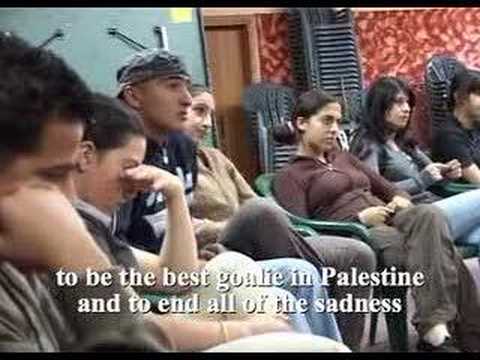
This video summarizes a workshop that was given for Palestinian youth at IBDAA (a grassroots cultural center located in the Dheisheh Refugee Camp in the West Bank). IBDAA is a local activist group that focuses on raising awareness and maintaining Palestinian culture within the camp. They began as a dance troupe that toured Palestinian children performing the traditional Debka dance and now function as a community or cultural center.
In this video Palestinian Youth are brainstorming as to their own identities. What are the things that define them? Do they have hope? What is their hope? The subtitles in the video demonstrate some of the words the youth use to describe themselves, as well as their hopes and dreams. The most obvious trend is that of “ending the sadness”, advocating for the oppressed, having the freedom of movement, and most importantly being free.
What is interesting about this video is how the youth’s identity seems to be extremely (but not completely) caught up in their political struggle. It is fascinating to see the way they express this through their hopes and dreams.
Are Palestinians Subaltern? Yes, I believe they are. They are an ethnic minority that have been removed from their property and remain as institutionalized second-rate citizens in a country that has pushed them behind walls. Can they speak? In contrast to some of what has been discussed in class they seem to speak very well for themselves. Not only the youth on this video who express their desire for freedom, but also those who made the video and the IBDAA Cultural Center, who put on the workshop. IBDAA, and the Palestinians as a whole, seem to have made their struggle very public to the world, with symbolic gestures as well as through the media. Although the Palestinians speak very well in this video it could be debated that they have come to the center in order to be heard. As you see parts of the workshop, and the video are done in English to be heard by the center. They also use a language of the west in their speech, dreams of studying political sciences and becoming a lawyer are common aspirations in youth of our own culture. Their discussions of freedom are easy for us to comprehend, as it is a value of our own country and constitution. What is not discussed in this video is the importance of the land to their heritage and forefathers. The cultural and religious identities that are also a part of their desire for freedom and the ‘right to return’ are not mentioned here, as they may be more foreign concepts for us at the center. More importantly, little is being done to solve the crises of the Palestinians. It is clear that the Palestinians are speaking, but as their situation worsens, one has to wonder: is anyone listening?
It is also interesting to note that the students define themselves as ‘Palestinian’ on what seems to be a national scale. This notion of their nationality has become a part of their identity. There is little evidence that there was any sense of belonging to a wider country among Palestinians case before the British mandate in Palestine and the Palestinians interaction with colonialism. This change of scale in their view of their own identity could be seen as an example of how the colonized begin to see themselves through the lens of the colonizer.
On a personal note, I spent some time in the Dheisheh camp and with some members of IBDAA last summer and was impressed by their work. If anyone is interested in more information, take a look at their website www.ibdaa194.org.