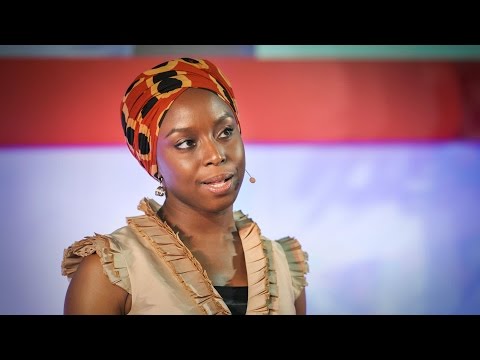
Chimamanda Ngozi Adichie was born and raised in Eastern Nigeria, and is today one of the most powerful young voices in African literature. In this talk she identifies how story telling has the power to influence our understanding of people and places. Chimamanda thoughtfully reveals the danger of a single story and how it creates vulnerability. She presents herself not only as a victim of a single story but also a “victimizer” of people she had had a single story about.
Chimamanda points out that a single story is created by showing the subject/people “as one and only one thing.” She suggests that the power of a story lies in how it is told, who tells it, when it is told and how many times the story is told. Based on the fact that a person is multi-faceted and is made up of many stories, having a single story creates stereotypes which as in Chimamanda’s definition, is not necessarily untrue but simply “incomplete.”
This presentation addresses the central pillar of the creation of “the other.” This is because, often (if not always), we use stories to acquire knowledge of places we have not been to, or people we have not met. It is therefore through stories that “orientalism” or – in Professor Edward Said’s own words – “the creation of an ideal other” (Edward Said; On Orientalism) becomes possible. Chimamanda points out that a story follows the principle of “Nkali”, an Igbo word meaning “to be greater than another”, and this is the principle of power. This same concept (of power of representation) is well obeyed in orientalism, that which guides the representation of the other. Chimamanda describes power not just as the ability to tell a story of another person, but to make that story the definitive one. She gives an example of how America’s cultural and economic power enabled stories written in the USA to be the dominant ones in literature. Even when we look beyond literature, we can still see the story of the West being regarded as the universal truth. We see this perceprtion very often in the development studies. The “Western” definition of development and civilization for example, has been hugely regarded as the accurate one and that the rest of the world ought to adapt to it. And as we have seen in class, new heated debates are rising to discuss whether the real cause of today’s inequality is the “underdevelopment” or “overdevelopment” of the “North.” But in the past it had always been presented to us that underdevelopment is the only problem that needed to be addressed.
Another thing that comes up in Chimamanda’s talk which is worthy pointing out and one that we have had class discussions over, is the ability of the subaltern (Africans in Chimamanda’s case) to speak for themselves. The subaltern is often seen as “unable to speak for themselves” and “waiting to be saved by a kind white foreigner.” This brings back the concept that people in the south are a “white man’s burden,” unable to develop without the white man’s pity. This is not just a single story, but a single and incomplete story because it lacks both cultural, historical and social sides of a “southern” man. The way to go about solving this could be to minimise (if not to completely remove) the mainstream’s dominance especially in the media, and allow the subaltern to tell their stories in their own “authentic” way. It has to be told in their own way because often the subaltern is bound to “speak with the elite’s tongue,” to present a story that the elite want them to present. This therefore leads to the audience hearing the same single story although might be by different presenters.
Therefore, I believe, what Chimamanda’s talk suggests is that, in order to counter orientalism, stereotyping or any other wrong representations of a people, multiple stories (and not only different versions of a similar story) must be heard.