One benefit of having time off is that I can feel wholly myself again. I can wake up at midnight and write until 4am and not feel terrible the next day because–ah, it’s so lovely–I can take a nap in the middle of the day! I can dream freely and re-discover my passions and possibilities.
Somehow such a firm understanding of who I am gets lost when I am working that 8-5 shift without respite. Now I realize (again) that I need to reinvent my world–to return to my roots, to my calling, to my loves: this realization is always what I discover after having a few days off!
Another benefit of vacation, though a less obvious one because it is also painstakingly slow-going and also very exhausting, is to have the time to clean our home really well, which–for me– means to rearrange all the furniture, to sort and donate and throw out tons of objects and papers room-by-room, and then to bask in the very liberating results: a simple life.
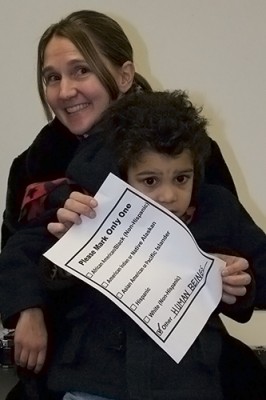
While sorting through my desk papers, I came across a postcard from an art opening at the U (which T-chan and I had gone to 3 years ago), where an artist called Mica took photos of people holding up cards on which they checked off their ethnicity/race.
Curious to see if the picture of us that she had taken was online, I looked her website up tonight–and there we were!
[See http://www.pleasemarkonlyone.com/Gallery.html for more folks.]
Human beings, I wrote on our form, and remarkably, this answer still holds true today, three years later, despite a lot of ups-and-downs in our life here in Minneapolis, or maybe because of a lot of ups-and-downs here. My son and I remain both card-carrying members of the homo sapiens clan here on planet earth.
Which reminds me of my dear (though now lost) friend, Ines, who lived in a Buddhist nunnery (that’s another story, folks!) with me many moons ago. She and I had very similar (read: emotionally gifted) dispositions. She told me, in her Belgian-French accent, “Ree-bay-kah, we may not be able to control our emotions so easily, staying calm and cool like Katja [another friend in the temple]. We feel so much, when we are crying, when we laughing. Given a choice? To be like Katja? Pffffffff!”, she concluded dismissively, shrugging her shoulders, “We feel everything more deeply, the good and the bad! We are more alive!”
True, Ines and I are not those people you know with steel-nerves, with dry eyes, with calm voices. Sometimes I can be in that neutral state for a while–say at staff meetings–but it’s not the best option for me for long-term sanity or well-being. I’d rather express myself and feel than stuff my feelings in wool socks and seal off the tops with wire. Now that’s a weird image–but let’s leave it be!
People like Ines and me, we are not Buddhists like the typical stereotypical Buddhist you hear about in magazines: we cannot be detached or neutral about life. We are instead the fringe Buddhists, like Santoka, or Ryokan, or Issa! We cry, we laugh, we get hurt, we dream, we love life very, very much.
And I’m not wishing to be anything else, either, even when it’s rather uncomfortable or embarrassing when I’m boo-hooing around people who are very serious, calm, or controlled. I do know that my passion for life is a good thing, the best thing for me, even if other people don’t always think so–those who don’t agree with me are those who like wiring their own wool socks shut all the time.
I know by staying true to who I am that I can inspire people–whether students or strangers–and having passion and an insatiable curiosity for this chaotic mud puddle called ‘life’ helps me become a better writer, a better mother, and a better human being.
So, in the end, my dear friend Ines is right: being fully alive, taking the blows, and crying, and getting back on my feet, not living in the middle (waking dead) zone all the time, is so much more interesting. Living without a muzzle or a societal straightjacket–and really, freely being in the moment and making god-awful mistakes is another–just as valid–way to be a Buddhist. And maybe our way is the more enjoyable adventure.
I don’t care for manicured lawns, for their need for large amounts of fertilizers and pesticides that kill off both the good and the bad insects. The chemical, unnatural perfection of such lawns frightens me and I want to wash my feet and not breathe deeply after walking past it. I feel the same way about overdosing on perfume and thick layers of makeup.
I prefer running around in the wild grass, letting a few dandelions bloom, even if it means I also get a few burrs on my clothes and shoelaces. At least for me, life feels damn good on my side of the fence! At least when I’m on vacation and I have no need to be anyone, to pretend to be anyone, but me. Messy, occasionally drive-to-despair and frequently confused, but overall ulcer-free me.