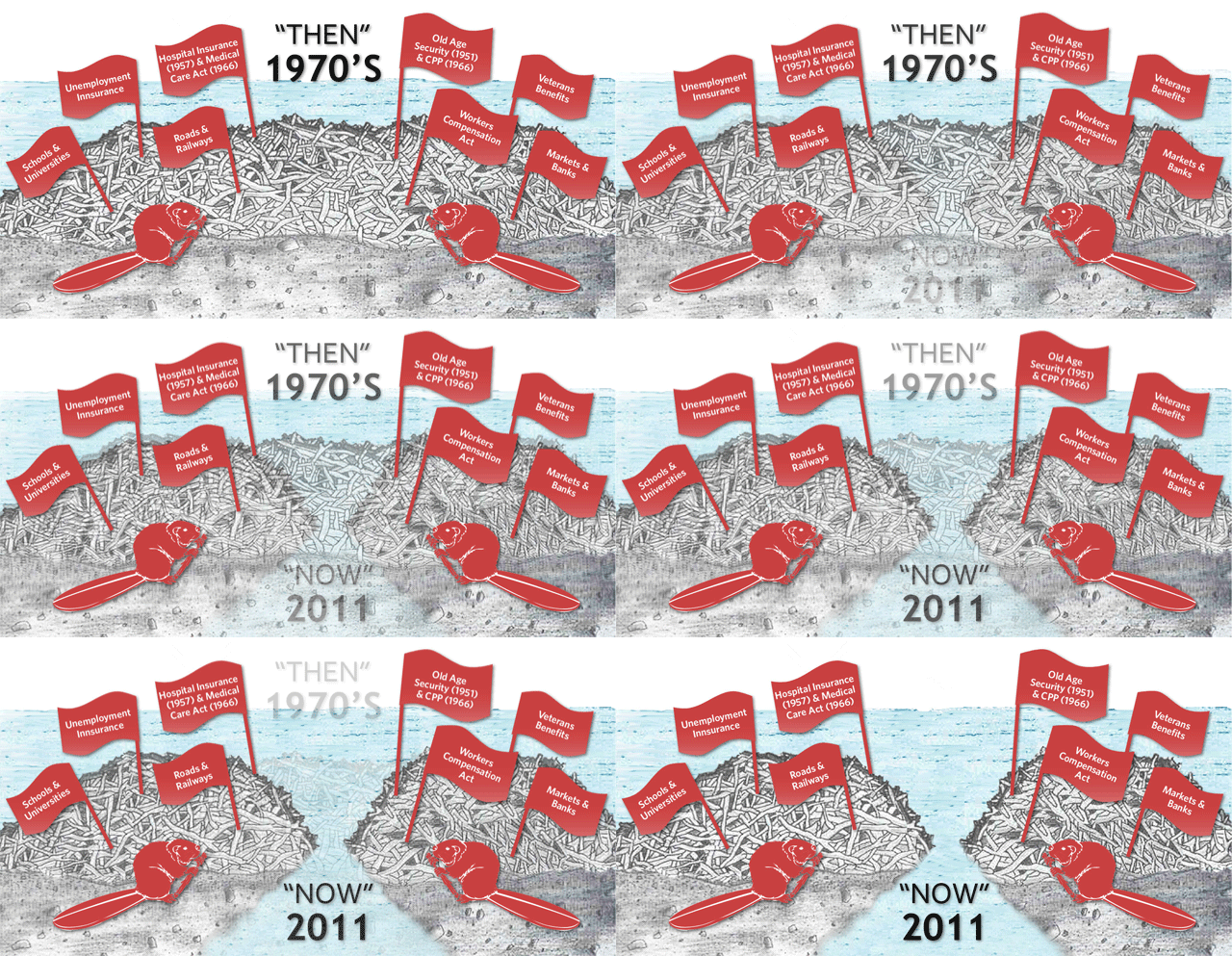
When should we retire? The case for longer work lives and shorter work years

What should be the retirement age? The Prime Minister deserves credit for provoking debate about a policy issue that is unlikely to help him electorally.

The fact is we are living longer.  Compared to 1970, women today live on average seven years more; men, an extra decade.  Given this change, it is hard to argue against adapting Old Age Security and Canada Public Pension policy by raising the retirement age beyond 65.   These systems weren’t designed for the reality that “70 is the new 60.”

But here’s the thing.  Any change in retirement age is not about today’s seniors.  It’s about the working lives of younger Canadians.  Government spokespeople have insisted, and rightly so, that any change wouldn’t affect those who are already age 65 or older.  Rhetoric to the contrary is misleading.

A change in the retirement age is an issue for Canadians who are currently planning their retirement based in part on the expectation that full OAS and CPP benefits will be available at age 65.  Policy reform must be phased-in so that those in this group have ample time to adapt their plans.  The need for adequate transition time means that we likely won’t see Canadians who are currently 55 or older feeling the effects of pending reforms.   The peak of the Baby Boom generation could slide into retirement before changes take effect – yet another example of that demographic group winning in the lottery of good timing.

What should younger Canadians think of later retirement?

As part of my national “Think like a Beaver” speaking tour, I encourage citizens under 45 to accept a later retirement age as a reasonable policy adaptation to demographic changes since the 70s.  But if we are to adapt policy in response to changes in life expectancy, we should also adapt policy to other, equally stark, demographic trends.  One example is the rise in dual-earner households.

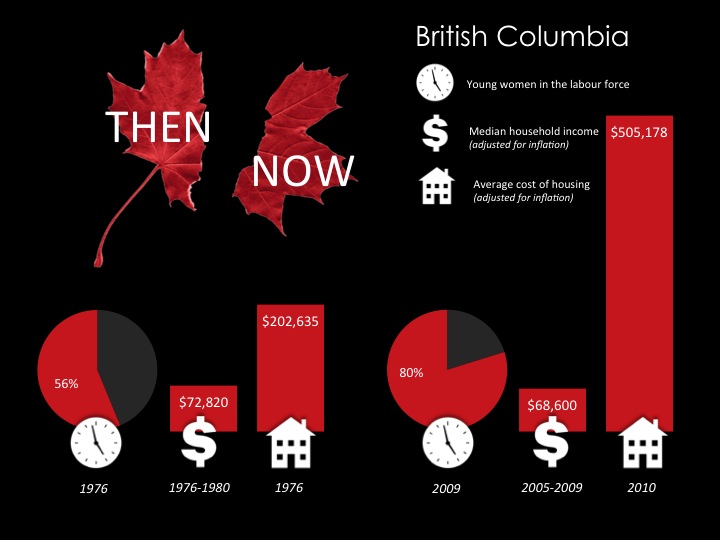
Employment standards defining full-time work still reflect the assumption that households will have one person specialize in breadwinning while the other specializes in caregiving and domestic work.  Most households no longer operate this way.  Feminism is one part of the reason, but so too is the fact that wages haven’t kept pace with the cost of living.  Household incomes for young couples have stalled since 1976 even though far more young women contribute employment income.   For Canadians under 45, two earners are generally required to carve out a standard of living that is falling behind what one earner could often achieve a generation ago.

Although the rise of dual earners is a reality, must it be that both earners work 40-plus hours per week, for 49 or 50 weeks a year – the norms that were established following World War II?  This trend contributes to a major time squeeze at home, especially for employees with young children.

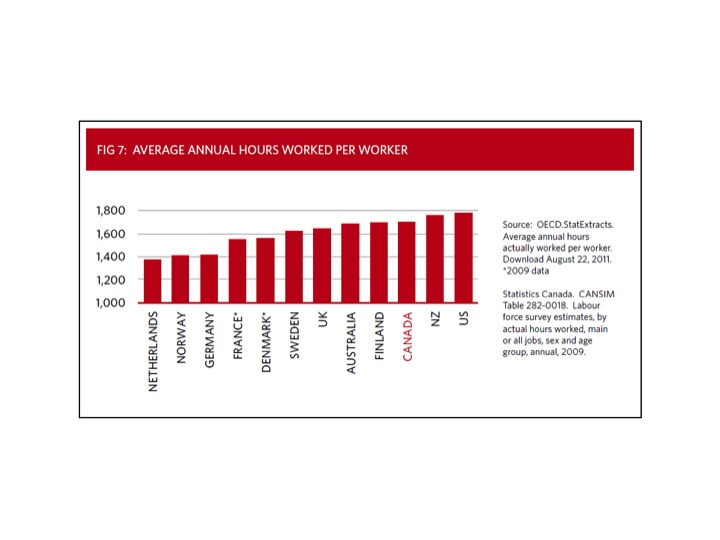
Although Canadians say we espouse family values, our workplace standards mean the typical Canadian employee works 300 hours per year more than the typical Dutch, Norwegian and German employee for about the same average income.  While higher housing prices make this commitment to the labour market understandable economically, all these extra hours of work erode the opportunity to be home with children or care for aging parents.  59 percent of Canadian men age 25-44 and 34 percent of women age 25-44 work 40 or more hours per week.

While Canadians under 45 may have to (begrudgingly) accept a later retirement, we should tolerate these extra years of work in return for employment norms that adapt to the reality of dual earner homes.  This would mean some tinkering with the definition of full-time work, adjusting it to 35 hours/week on average over a year, rather than 40-plus.  An extra 5 hours per week, and sometimes 10 for a two-earner household, can make a HUGE difference when it comes to mitigating the time squeeze.  And even with this change, we’d still be working almost 150 hours more per year than in the Netherlands, Norway and Germany.

There are ways to do this that are good for employers and employees alike.  We could adapt overtime and EI premiums paid by employers to make it less costly for businesses to use employees up to 35 hours per week, and more costly for hours thereafter.

For employers, there are productivity gains to be made from this switch.  Although typical Dutch, Norwegian and German citizens may work fewer hours than Canadians, their productivity per hour is higher.  When France shifted a decade ago to the 35 hour work week, it did so with the intention of reducing unemployment.  Data now show that shorter hours didn’t contribute much to this objective, because employers didn’t replace a very large share of the reduced hours with new workers.  It wasn’t necessary, because productivity per hour increased.

For the half of men and the third of women who currently work more than 40 hours per week, work hours would be reduced by an average of 3-5 hours per week.  In some cases, employees may trade a bit of after-tax income (or better yet, future wage increases) in order to gain four more weeks of time per year. In negotiation with employers, this time could be taken in chunks, or as earned hours away from work each week throughout the year.

Changes to the National Child Benefit Supplement could ensure any reduction in employment hours does not reduce income for low-earning families, which may be especially important for some lone parent households.   When combined with $10/day child care and New Mom and New Dad benefits, families with preschool age kids would generally have more disposable income.  Plus they would be enjoying the extra time at home when they really need it.

Shorter work years for longer work lives.  This trade-off merits serious discussion among younger Canadians as we adapt policy to longer lifespans and the tightening time squeeze at home.

Posted in Uncategorized | Leave a comment

BEAVER for Politicians: A Canadian sidekick for Stephen Colbert’s ‘Captain America’

Just ten percent of Canadians trust politicians, according to a recent Ipsos poll.  Canadians are more likely to trust new car sales people than elected officials, data from Leger Marketing tell us.

These facts may be good for a laugh.   But, really, we shouldn’t be amused.  The fact that Canadians are more likely to treat politicians as punch lines rather than persons to respect is a fundamental reason why we are tuning out politics.  Barely 60 per cent of Canadians voted in the last federal election.  And in Ontario’s fall provincial election, fewer than 50 per cent of eligible voters showed up at the ballot box.  Our largest province has not seen such low turnout since confederation in 1867.

Apathy is not a neutral force in our democracy.  Apathy helps to sustain the status quo.  And the status quo is not a friend of Canadians under 45.

The standard of living for the majority of those under age 45 is in decline.  Canadians under 45 inherit greater risks from climate change than did Canadians a generation ago.  They inherit larger government debts, bad family policy, a time squeeze, stagnant wages, student loans, and higher housing prices.  Yet none of these signals of declining living standards receive much attention in status quo political debates

It is now urgent for Canadians under 45 to marshal our political voices and give politicians reason to earn our trust by making positive policy change. That’s one reason why I love and fear how Stephen Colbert is covering the US Republican Primaries.

I love it because his show, The Colbert Report, engages younger audiences, using humour and satire to raise very serious questions about the excessive influence of wealth in election ads via ‘arms-length’ Super PACS (political action committees, which can raise and spend unlimited amounts of money for a candidate); to probe the status of corporations as persons; and to poke fun at the success of negative ads.  

I fear the satire, because I’m not sure it leaves many viewers with an alternate vision.  Now that may not be the job of the satirist.  But in a context where no one trusts politicians, it risks reinforcing the notion that politicians are punch lines, not persons to respect.

The quality of our democracy desperately needs for Canadians to show greater charity in interpreting the activities of our politicians.  So long as we don’t trust politicians in this country, we imply they can’t be trusted to help make positive change.  When we don’t think they can make change, we don’t bother to encourage it, or demand it.  This is especially true for Canadians under 45.

With very little fanfare, the vast majority of elected officials work very long hours – more hours than most of us.  This includes giving up a great deal of private time to attend community events and engage constituents.  Most politicians are drawn to public service because they genuinely want to make our communities and our country better.  Sure, we may disagree with some of their ideas about what constitutes improvement, but this doesn’t require that we disparage the person, or her or his commitment to the job.

There is no doubt we will always need auditors general, judges, the media and others to scrutinize what politicians do, and how they spend tax dollars on our behalf – just as we must scrutinize activities in the financial sector, among doctors, police officers, teachers, etc.  In any profession, the odd bad apple betrays our trust and the authority of their positions.

But more generally, let’s all acknowledge there’s a big difference between the armchair coach and the one actually standing on the bench.  It is easy to critique from the cheap seats where most of us sit, including me.  It’s far more challenging to interpret the actions of others, including politicians, with charity.  To approach them with a genuine interest in learning more about what constrains their legislating in ways you or I make may think makes common sense.

So as Stephen Colbert, Captain America, valiantly satirizes the insane degree to which money influences democratic dialogue in North America, I think he needs a trusty sidekick – someone devoted to renewing respect for politicians.  This is essential to restoring our beaver logic.

Readers may know by now that I celebrate our national animal – the beaver – as a true community builder. Beavers build dams to create a reservoir that benefits the whole beaver community.  When the reservoir is deep enough, beavers are efficient because they swim faster than they walk on land; they are safer out of the reach of predators; and they have ample room to build woodsy lodges as homes for their families.

Whenever the dam springs a leak, busy beavers fix the dam, renovating it to withstand the new challenges in their environment. Beavers adapt because they all depend on the dam to safeguard their shared standard of living.

Such beaver logic motivated me to start a new club on-line to complement Captain Colbert.  I call it BEAVER for Politicians – short for Because Every Adequate Voter Expresses Respect for Politicians, even when s/he dislikes the decisions of certain politicians at certain times.

Now, I don’t honestly expect this club will go viral.  In truth, I’ll be happy if I get even 10 comments in response to this post.

To get the ball rolling, I propose two reasons to trust politicians.

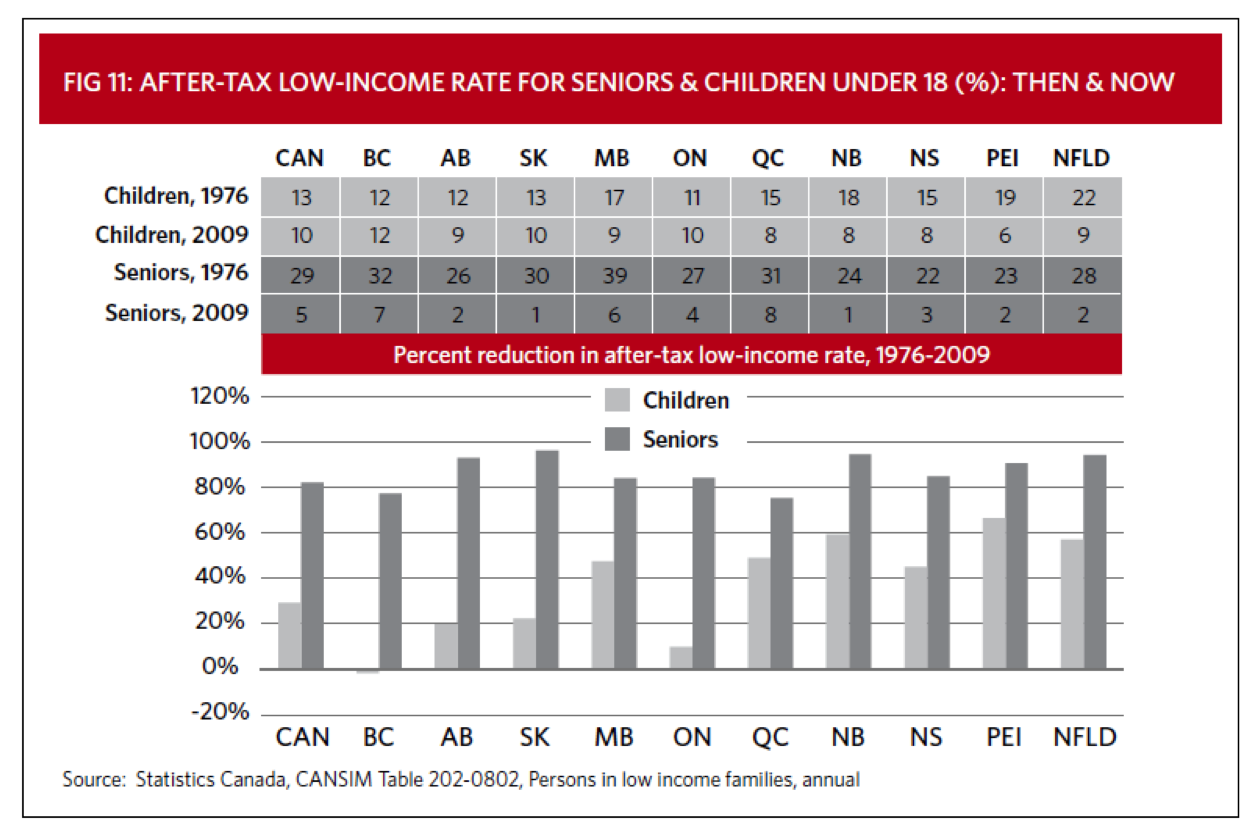
First, on our behalf, politicians have made a massive, positive difference for seniors in this country.  By implementing pension policy in combination with a strong economy, we have reduced poverty among seniors from 29 per cent in 1976 to less than 5 per cent today.  That is a remarkable achievement, one to be proud of, and to respect.  The achievement is so impressive, it should even motivate trust as Canadians renew debate about old age security, at least until specific policy proposals are tabled for evaluation.

Second, politicians could replicate this achievement for younger generations of Canadians, in order to make it far easier to raise a family.  But politicians are far less likely to do so, if no one shows it’s in their electoral interest.

Electoral interest?  It’s in far too short supply these days among voters.  So I hope Captain Colbert motivates many more in Generation Squeeze to have fun, even party, as part of tuning into the political process.  And I hope the BEAVER for Politicians can prove a trusty sidekick to instill renewed respect for those who devote themselves to public life.  Only then are we likely to get out to the ballot box alongside Boomers to vote for the political champions of a Canada that works for all generations – including citizens under age 45.

Posted in Uncategorized | 4 Comments

Women shortchanged in retirement income by bad policy deal for generation raising young kids

Media coverage in recent weeks confirms that when Canadians devote time to talking about social policy, we invariably focus on medical care and pensions – policies on which we depend disproportionately in our later decades.  These are vital policies because they safeguard our standard of living, especially as we age.  But when will Canadians devote the same number of TV hours, radio waves, newsprint and blog posts to policy issues that benefit younger generations?

At least recent pension discussions give some attention to intergenerational dynamics.  More media acknowledges that private pension coverage is in decline for generations that follow the Boomers.  Planning for this problem now makes good sense.  But such planning should not only treat symptoms without addressing root causes.

We all know that income in retirement reflects our earnings and employment decades before we turn 65.  If we want to support Canadians to save enough for retirement, then we need to address the barriers to earning and saving that people face far, far earlier.  Regrettably, Canada’s failing grade for family policy is a major barrier, especially for women.

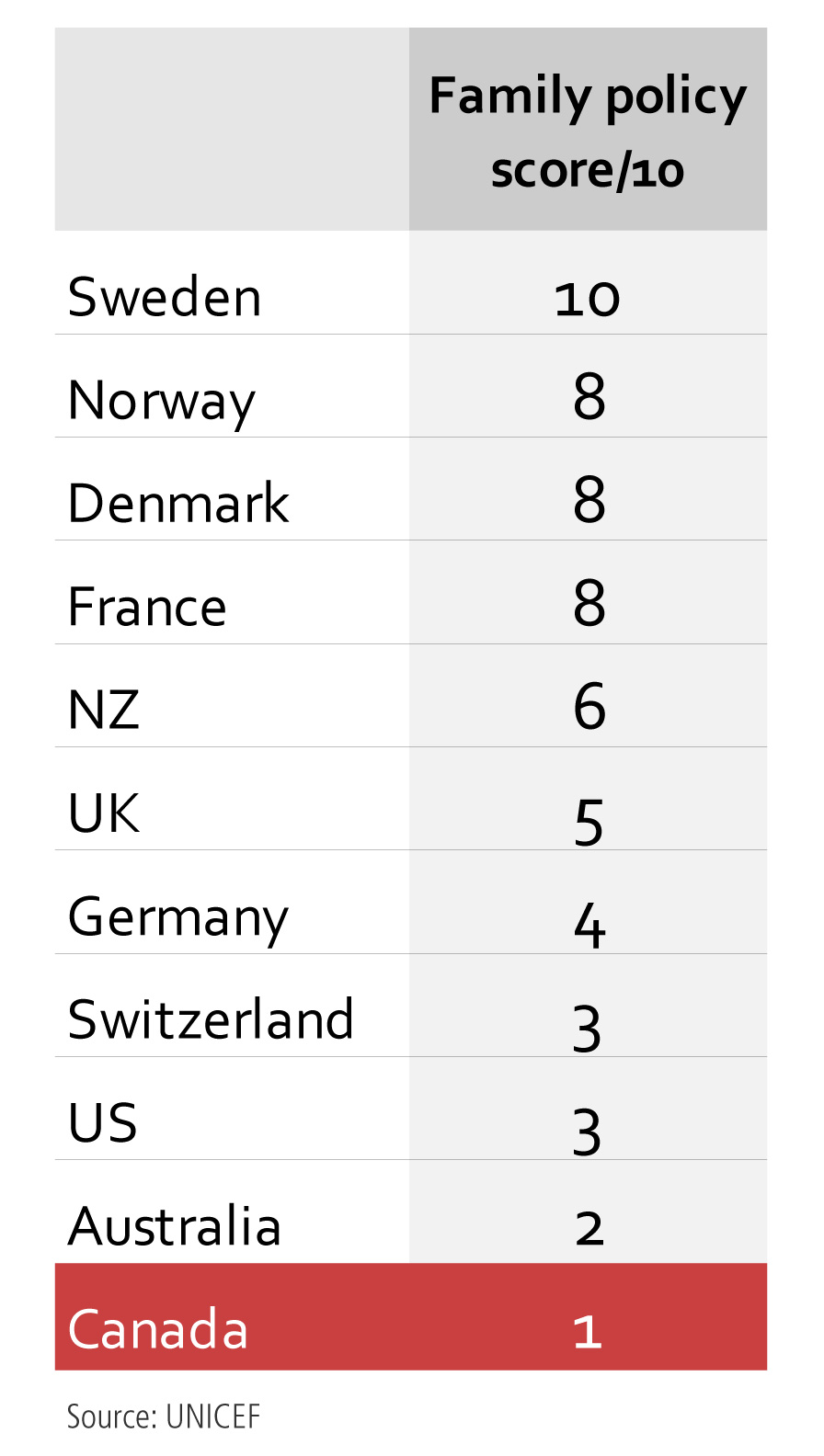
UNICEF reports that Canadian family policy falls among the worst industrialized countries because it invests little in families with children under age six.  The OECD agrees when measuring public investments in child care services.  Similarly, a UK Fairness in Families Index ranks Canada 15th out of 20 countries because our policy is weak in supporting men and women to share equally parenting and breadwinning.

Poor family policy rankings have tangible consequences in the day-to-day lives of Canadians, which result in lower retirement incomes for women.

Current parental leave policy provides the typical two-parent family with nearly $5,000 dollars in incentives for the lower-earning spouse to withdraw from employment to care for a newborn, rather than share a year of leave between parents.  Given that Canadian women age 25-44 continue to earn about 70 cents on the dollar compared to men’s earnings, the lower-earner is most often the mother.  The result is that Canadian leave policy encourages women to take on primary responsibility for child care, and discourages dads’ involvement.

Some may think this is ‘natural’ because women breastfeed.  But the disincentive for men to share responsibility for newborns sets in motion a gender division of labour that continues throughout their kids’ lives, well beyond breastfeeding.  The latest Statistics Canada data show that fathers still work longer hours than mothers, even in homes where both work full-time.  Men are far less likely than women to work shorter or part-time hours to accommodate child care.  Diverging employment patterns for mothers and fathers in turn explain why the glass ceiling persists in Canada (just 32% of senior managers are women), and why there remains so much occupational segregation with women in ‘pink collar’ sectors.

Fewer years of employment as adults, fewer employment hours per year, employment in occupations that pay lower wages, and in positions below senior management levels, all contribute directly to higher rates of economic insecurity for women in retirement compared to men.  While it is imperative to remember that poverty rates for seniors are half that of families with children, we must not ignore the fact that senior women are more likely to be poor than senior men.  In particular, women over 65 who live alone have a low-income rate that is 40 per cent higher than men who live alone.

Inadequate parental leave isn’t the only family policy barrier to women’s earnings and retirement security.  The fact that Canadian provinces typically have child care spaces for just one in five preschoolers is an equally significant obstacle, as is the high cost of the limited services that are available.

When a two-parent family with a toddler considers whether one parent (typically the mother) should stay home full-time, it is the cost of child care that is THE MAJOR economic disincentive to a return to work.  Child care costs dwarf the extra taxes the parent will pay on additional earnings.

In BC, Alberta or Ontario, child care services will cost more than $7,200 annually, even after deducting child care fees from income taxes owed.  This is 50 per cent higher than combined federal and provincial income taxes, EI and CPP premiums (around $4,800). Plus, when the family swallows high child care fees to enable both parents to pursue employment, the family will forgo federal and provincial tax breaks for one earner couples that tally up to nearly $2,000 a year.

Forgone tax breaks and high child care fees exacerbate the poor design of parental leave policy.  And as a package, our family policies interact with cultural expectations about gender roles in Canada to pressure women to shoulder the lion’s share of responsibility for child care at the expense of earning and saving for retirement.

A New Deal for Families could change all this.  Redesigning parental leave to add six months of benefits for dads would ensure that young families don’t see their after-tax incomes drop by the equivalent a second mortgage when parents split 18 months at home with a newborn.  $10/day child care services will ensure young families don’t spend the equivalent of a third mortgage when moms and dads devote enough time to employment to compensate for stagnant wages, pay for higher housing prices and save for retirement.  The outcomes will include a more secure retirement for both sexes.

These changes are particularly important for women. New Mom and New Dad benefits and $10/day child care in tandem with Flex-time revisions to employment standards will disrupt the gender division of labour more than Canadians have done in decades.  Indeed, these three policy proposals align closely with recommendations made in the 1970 Report of the Royal Commission on the Status of Women.  Canada’s failure to make much progress on these recommendations helps to explain why the World Economic Forum ranks Canada 18th on its international gender equality index – despite our formal commitments in Canada’s Charter of Rights and Freedoms.

It is no coincidence that our family policy and gender equality rankings converge near the bottom of OECD countries.  They emerge from a common cultural reality:  Canadians are content to ask young women to sacrifice their earnings, career ambitions and future retirement security to compensate for our national failure to prioritize family policy investments.

Given that nearly one in two Canadian marriages ends in divorce, what we ask of young women is very risky for their future retirement.  Adequate retirement policy must therefore broaden beyond narrow pension debates to address the root causes of insufficient retirement income.  For women, a major root cause remains Canada’s bad policy deal for the generation raising young kids.

Posted in Uncategorized | Leave a comment

Neglecting the risks of climate change: an intergenerational crime?

The vast majority of Canadians feel a reverence for the natural surroundings that make up our home and native land.  We celebrate our environment in song, stories…    even beer commercials.  I’ll fess up.  I ordered a Molson Canadian after its “Made from Canada” commercials aired during the Olympics, because they reminded us that we have “more square feet of awesomeness per person than any other nation on earth.”

Since we know we have “the best backyard in the world,” it is fundamental to monitor what we do to sustain it over time.  This is especially important when evaluating whether our country still works for all generations.  Regrettably, there may be no greater evidence of an intergenerational breach than our ineffective efforts to reduce carbon emissions in Canada.

In 1976 Canada was one of the worst three OECD countries for per capita carbon dioxide emissions.  According to data from the International Energy Association, on average, each Canadian produced nearly 17 tonnes of CO2 in that year.  Only citizens of the US and Luxembourg emitted more.

Since then, we have learned a great deal about climate change, and the risks associated with even a two degree increase in global temperatures – rising sea levels, extreme weather events, change in rainfall patterns and all the risks to human life, settlements, infrastructure, hydro power, crop yields, etc.   To illustrate what these risks could mean here, there are now maps showing that Richmond and Delta will be underwater if climate change results in a six meter rise in sea levels, along with one third of New Westminster.  There will also be serious flooding in Port Coquitlam, Surrey and Pitt Meadows.  (In the spirit of full disclosure, this will include my little farm at the confluence of the Pitt and Fraser Rivers!)

This knowledge has not caused us to change our energy consumption.  Canadians have failed to reduce our carbon dioxide emissions in over three decades.  As the 2008 recession began, average emissions remained 17 tonnes per person.  They have only dipped slightly since then because of the reduction in economic growth.   Not only do we remain among the worst fossil fuel dinosaurs internationally, the citizens of countries that already had smaller environmental footprints than we did in the 1970s have shrunk their footprints still further.

So it turns out that Canadians don’t just rank poorly by international standards on family policy, as I have discussed in previous columns.  We also rank very poorly in terms of our environmental record.  Multiple earths would be required if all global citizens were to consume resources at the same rate as Canadians.

I don’t think this is a coincidence.  Our poor showing on both fronts originates from a common cultural malaise in Canada – our public tendency to discount the future in favour of the present.

Although there is no doubt Canadians privately love their children and grandchildren, macro data about our public decisions make it very hard to deny that Canadians who became adults in the 1970s now approach retirement leaving larger fiscal and environmental debts than they inherited.  Yet little of their public consumption went to future-oriented investments in family policy, or policy to encourage sustainable development.

As a result, the generation of Canadians in their prime child rearing years inherits a very tough task.  Given that Canadians have not reduced emissions over decades, the need for change is now far more immediate.  Canadians under 45 must meet this challenge as they simultaneously struggle with time and income squeezes.  Young people’s household incomes are stagnant compared to the 1970s even though dual-earner households have become the norm.  And they enjoy less disposable income because of higher housing prices and child care services that absorb the equivalent of a second mortgage.

All the while, Baby Boomers are about to retire with higher incomes than retirees in the past, more wealth in housing, and a longer period of retirement.  Yes, they must stretch their pension and savings over this period, which will no doubt be a challenge for some.  But for many retirees longer retirements also mean more travel – and the expanding environmental footprint that accompanies so much vacationing.

Given the intergenerational breach implied by climate change, I decided to interview a Canadian who has been thinking about this issue far longer than most – Dr. David Suzuki.  The fact that Boomers retire leaving a larger environmental debt than they inherited cannot be denied, he indicates. “All you have to do is follow the curves of amount of pesticides used annually, number of species going extinct, number of watersheds polluted or ecosystems logged or developed and you can see that the ecological debt is obviously worse now than it was 30 years ago.”

Lamenting our country’s slow pace of adaptation to climate change, Suzuki has invoked the concept of “intergenerational crime.” Why?  Because failure to respond to the compelling science that shows global climate change poses a serious threat to human survival for the coming generations, in his view, legally constitutes either “criminal negligence” or “willful blindness.”

The legal veracity of this concept is not my interest.  But we would do well to heed Dr. Suzuki’s insight that one generation can harm another simply by maintaining the status quo instead of adapting policy to a deteriorating environment.  This is now the legacy with which Baby Boomers in Canada must grapple as a generation.

My hope is that generations following the Boomers will not repeat their intergenerational oversight.  But this hope may be misplaced, because younger generations don’t show many signs of diverging significantly from the patterns established by older role models.  Nor do we show much appetite to use our political voices effectively to push for change.  I’ve lamented in the past that Generation X seems more concerned with who is being voted off some island on TV than who is voted into our legislatures.  But since global climate change threatens to swamp islands, perhaps I shouldn’t be so quick to judge those who focus on island shenanigans!

As we search for solutions amid turbid intergenerational waters, tried and true Canadian family values provide a beacon by which to navigate.  Family values remind us that much of our wealth is not found in material goods, but in relationships, and the time we spend with them. I have therefore recommended in previous columns a New Deal for Families that would support Canadians to spend more time together, and potentially less on stuff.

Such a policy shift also has important ecological implications, inviting us to revisit our way of living on the planet. A growing environmental literature suggests that reducing Canada’s total greenhouse gas emissions will entail a significant redistribution in how we use our time.   The unemployed and working poor clearly need additional labour market opportunities, but the majority of Canadians work hundreds more hours per year than the typical German, Dutch and Norwegian employee.  When this is done primarily for consumption purposes – say to buy the next Ipad, outfit or holiday – Canada’s tradition of family values serves as a reminder that a simpler life may be the richer one.  Many of us, men as much as women (and myself included) therefore have good reason to pursue a better balance between paid work and a variety of important unpaid activities.  These include child care, elder care, and engagement in local activities, etc. that are essential to building a healthy, thriving and ecologically sustainable democracy and economy.

Now that we have rescinded our commitments under Kyoto, Canadians must contemplate more than ever whether our country still works for all generations.  Recommitting to this national aspiration will require that we finally innovate with green family policy – policy that adapts to the time, income and service squeeze that constrains Canadians under 45; and policy that adapts to the ecological squeeze we face because Canadians have chosen not to reduce our per capita carbon footprint for more than three decades.

Posted in Uncategorized | 1 Comment

80 per cent of Canadians 55+ tell generations that follow to “wait their turn.”

Since I started writing about a Canada that works for all generations, I have insisted that Boomers and seniors care about those who follow in their footsteps.  After all, we’re talking about their kids and grandkids.  But new national polling data raise concerns.

A McAllister Opinion Research survey recently examined Canadians’ priorities for public spending.  It turns out that 70 per cent of Canadians 55+ responded that seniors should either be the top, or high, priority.  By contrast, just 28 per cent of Canadians age 55+ think families with preschool age children should be a top or high priority, and just 16 per cent think young adults should receive this status.

You might think that this finding simply reflects that each generation looks out for its own interests.  But polling responses from other generations tell a different story.

Half of Canadians age 25-44 indicate seniors should be the top or high priority.  And these Canadians are also just as likely to rank seniors as a high priority as they are to accord this status to their own generations. Clearly, these poll results give strong reason to resist labeling younger Canadians as the ‘ME Generation’, and start asking if this moniker better describes others.

Canadians 55+ prioritize their needs above other generations even though Statistics Canada data show that incomes are up 18 per cent for those approaching retirement today compared to the incomes of near-retirees in the mid-1970s.  Plus private wealth has increased for Boomers because housing values nearly doubled over their adult lives.

Understandably, the economy is making those near or in their senior years nervous about whether their savings or pensions will stretch far enough.  This is especially true for those who have not enjoyed an increase in income and wealth.  But beyond the fact that Canadians age 55-64 on average enjoy stronger personal financial circumstances than did the generation approaching retirement around 1976, so public policy has also dramatically improved for seniors.  Pension and old age security policy has helped to reduce poverty among Canadian seniors from 29 per cent in 1976 to less than 5 per cent according to the latest data.   And the medical care spending on which we draw disproportionately in our senior years is $47 billion higher annually today than if we had maintained it at the same proportion of GDP back in 1975-80.

The same cannot be said for those under 45 in Canada.  On average, their standard of living is in decline compared to the same age cohort in the mid-70s, and there has been very little policy adaptation to help mitigate this decline.

What is especially alarming about the new poll results is that Canadians 55+ KNOW it has become harder to raise a young family, yet still do not consider younger generations as a priority for policy investment.  85 per cent of Canadians 55+ acknowledge that families are significantly more squeezed for time than in the 1970s when often just one parent worked.  65 per cent believe correctly that, after controlling for inflation, household incomes for young families today are barely higher than they were in the mid 1970s, despite the spread of dual income households.   With stalled household incomes and less time at home, 76 per cent of Canadians age 55+ concede that young families must shoulder housing costs that take up 2-3 times more family income than in the 1970s.  And 57 per cent recognize that child care services cost many families the equivalent of a second mortgage.

Although I’m not usually surprised by data, I have to confess that I didn’t expect these poll results.  I had assumed intergenerational inequities exist in Canada in part because citizens over 55 weren’t aware that the generation raising young kids is squeezed for time, income and services.  I naively thought my job as an academic was to share research with the public that shows the squeeze, and then hope that this new information would help Canadians re-evaluate priorities.

But the McAllister poll reveals a different reality.  Most older Canadians know about the squeeze faced by younger families.  It’s just not clear they care enough to respond to the squeeze through public policy, even when they call for more public resources to be devoted to their own life course stage.  Quite the opposite:  fully 80 per cent of Canadians 55+ align with the view that “Seniors and the Boomer generation earned their fair share of the wealth produced by the Canadian economy and deserve to enjoy the benefits; younger Canadians can wait their turn.”

Wait their turn? I can understand this sentiment from seniors who lived through the Great Depression, World War II, and then went on to pay down most of the war-time debt while also building important social programs like pensions and medical care.  Given their sacrifices, fiscal discipline and impressive foresight to build public policy, the parents of Baby Boomers may be appropriately positioned to claim they earned their prosperity, and can encourage those who follow to work equally hard.

But dare I say it takes some nerve for Canadians in their mid-50s to 60s to encourage others to ‘wait their turn’ for policy investment.  Although there is no doubt this age group also worked hard to raise their own families and build their businesses and communities, they did not earn the fact they started out as adults when wages were still on the rise and housing prices were modest by comparison.  That’s just lucky timing.

Nor does the Boomer generation generally share their parents’ record of national sacrifice, fiscal discipline nor public policy building. In fact, data give good reason to worry that the Boomer generation has mortgaged a substantial portion of ‘the turn’ from those who follow.  That is what it looks like when you retire leaving government debts that are larger than you inherited; a globe that is warmer despite the fact that the risks of climate change became far clearer over your adult lives; and public policy that has not adapted to the changing realities faced by families with young kids.

I’m hopeful the McAllister Opinion Research poll is an anomaly.  Perhaps it was conducted when 80 per cent of Canadians age 55+ were having a bad day? I know I personally have had the pleasure of speaking with a number of Boomers who support a better policy deal for their kids and grandkids.  I’m not yet willing to believe that this view is really in the minority among older Canadians.

However, since the poll casts doubt, the time has come for Canadians age 55+ to speak out in favour of a Canada that works for all generations – and not just for themselves as the poll suggests they are especially inclined to do.

Posted in Uncategorized | Leave a comment

Generations disagree on public funding priorities: new poll data

MEDIA RELEASE | DECEMBER 15, 2011

Generations disagree on public funding priorities: new poll data

Younger adults want Canada’s wealth invested more evenly across the generations, while Canadians older than 55 say they should ‘wait their turn,’ according to new polling data.

University of British Columbia professor Paul Kershaw and community partners at the Vancouver Foundation, the YWCA of Metro Vancouver, the YMCA of Greater Vancouver and the Saskatchewan Knowledge to Action Network for Early Child Development (KidSKAN) recently initiated a national dialogue asking: Does Canada Work for All Generations?  In response to growing public interest, McAllister Opinion Research conducted a national poll to examine public attitudes about our country’s shifting generational realities.

Canadians agree young families squeezed for time, income and services

The poll shows that a strong majority of Canadians in all regions of the country share the view that it is now harder to raise a family in Canada than in the past – 83 per cent agree that families are significantly more squeezed for time than in the 1970s when often just one parent worked, and 72 per cent concede that housing costs comprise two to three times more of the family income than in the 1970s, after adjusting for inflation.

Earlier this year, Kershaw and his colleague Lynell Anderson, researchers at the UBC Human Early Learning Partnership (HELP), released a study on ‘Generation Squeeze,’ showing that Canadians raising young families today are squeezed for time, income and services. Average household incomes have stalled for young couples even though young women increased their labour force participation from 54 per cent in 1976 to 82 per cent today. While household incomes have stalled, Generation Squeeze is simultaneously struggling with the costs of living because housing prices in Canada have increased 76 per cent since 1976.

“The new poll shows that Canadians from all walks of life and across generations recognize what is going on,” says McAllister Opinion Research CEO Angus McAllister.  “The economic facts that Prof. Kershaw reports in his studies translate into real lives and lived experience.”

Generational Disconnect

Although there is widespread agreement that it has become harder to raise a family, the generations diverge over how Canadians should respond.  With the Canadian economy having doubled in size since 1976, the poll shows that 65 per cent of 18-44 year olds believe “a greater share of wealth produced in Canada should be invested in the next generation of families and children.”

Canadians age 55 and older hold a different view. When asked how much of a priority it should be for Canadian governments to invest in programs and services that benefit different groups, 70 per cent of Canadians 55+ answered that seniors should be either a high or the top priority. By contrast, just 28 per cent of older Canadians think families with preschool age children should be a top or high priority, and just 16 per cent think young adults should receive high priority status.

“So far in the discussion about Canada working for all generations, I have insisted that Boomers and seniors care about those who follow in their footsteps. After all, we’re talking about their kids and grandkids, along with their legacy,” says Kershaw. “But these new poll data cast some doubt.”

“The poll results show more support among Boomers and seniors for programs that serve their own stage of life than for investments in kids and younger Canadians,” says Mark Gifford, director of grants and community initiatives at the Vancouver Foundation, one of several community organizations that provided funding for Kershaw’s research and public dialogue about family policy.

Canadians 55+ maintain these views even though Statistics Canada data show that incomes are up 18 per cent for those approaching retirement today compared to the incomes of near-retirees in the mid-1970s, and private wealth has increased for Boomers because housing values nearly doubled over their adult lives.

Statistics Canada data also show that poverty among seniors has declined from 29 per cent in 1976 to less than five per cent in 2009, while the poverty rate for families with children under the age of six is 15 per cent.

The McAllister poll reveals that 80 per cent of Canadians 55+ align with the view that “Seniors and the Boomer generation earned their fair share of the wealth produced by the Canadian economy and deserve to enjoy the benefits; younger Canadians can wait their turn.”

“Is there an intergenerational tension in Canada? You bet there is,” says Kershaw. “Canadians 55+ acknowledge that the standard of living has deteriorated for the generation raising young kids.  But knowing this obviously hasn’t changed their priorities.”

For more information about Kershaw and his research, visit: http://blogs.ubc.ca/newdealforfamilies

Click here for access to McAllister Opinion Research poll data.

Posted in Uncategorized | 2 Comments

Un-Canadian to Cap Medical Care?

Is it Un-Canadian to suggest medical care spending should not increase, at least not faster than our economy grows?  I fear many think it is.

During the last federal election, not a single Party challenged the idea that federal transfers for medical care should increase six per cent annually until 2014.  And as provincial, territorial and federal health Ministers met recently in Halifax to consider what will happen thereafter, I couldn’t track down a single mainstream media article that questioned the idea that medical care spending should grow.

Here’s a newsflash Canadians, especially to those on the centre-left of the political spectrum.  There is ample reason to worry that our current approach to medical care spending may be making us more sick and stupid.

When many Boomers came of age between 1975-1980, the Canadian Institute for Health Information shows that we spent 5.4 per cent of our gross domestic product (GDP) on publicly funded medical care.  By 2008, before the recession took hold, Canadians had increased spending to 7.6 per cent of GDP.  It’s now closer 8.4 per cent, in part because economic growth has been stagnant since.  This means we spend $47 billion more today on medical care than we would have had we maintained public spending at the same level as 1975-1980.

Over the same period, Canadian Tax Federation data show that total revenue collected by the federal, provincial/territorial and municipal governments declined from 39 per cent of GDP in 1980 to 33 per cent today.  The result?  Total government revenue is down more than $90 billion compared to what it would have been had we maintained revenue at 1980 levels.

When we choose to cut the total revenue pie by $90 billion, but increase the slice for medical care by $47 billion, we leave $137 billion less for other priorities.

Social service spending is chief among the casualties, as is education spending.  As a share of the economy, spending in BC on each of these areas fell 0.7 per cent of GDP.  This may not sound like much, but with similar declines across provinces, we’re talking about a combined $21 billion reduction – enough to pay for a New Deal for Families.

Behold further evidence of Canada’s bad intergenerational deal.  Reducing social service spending means limiting child welfare, child care and poverty reduction.  Reducing education spending clearly limits kids’ opportunities to learn.  By contrast, increasing medical care enriches a transfer disproportionately for older Canadians.

As the population ages and the risk of frailty and illness grow, we can all understand why medical care is a top priority.  But do we really think we can grow medical care spending indefinitely when Canadians have also engaged in a 30-plus year project of cutting government revenue?  So far, this plan has been sustainable only by compromising investment in programs and income supports for younger Canadians.

If Canadians aren’t interested in raising taxes, then let’s seriously consider capping medical care spending.

Even if we are open to raising new revenue, there is good reason to allocate it to things other than the status quo approach to health care in this country.  Medical care is yet another example of Canadians generally dealing with problems after the fact, rather than preventing them in the first place.  For instance, we know the time, income and service squeeze on the generation raising young kids increases work-life stress.  Linda Duxbury and Chris Higgins at the Sprott and Ivey Schools of Business show that work-life stress among Canadians accounts for 30 to 40 per cent of avoidable spending on prescription drugs, hospital accommodation and visits to health professionals like physiotherapists.

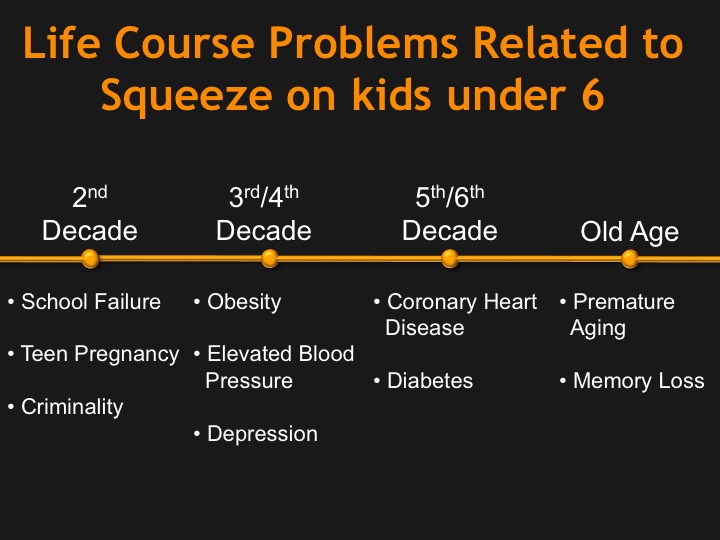
Equally important, the time, income and service squeeze explains why 30 per cent of young kids start school vulnerable.  In addition to doing worse in school, their vulnerability means they are more likely to become obese, have high blood pressure, struggle with mental illness, get diabetes, suffer coronary heart disease and premature memory loss.  If we have a disease fetish, then we are on the right track by ignoring Gen Squeeze.  But if we want to reduce medical care spending on their kids in the future, we need to eliminate the squeeze on parents now.

Trade-offs.  There’s no doubt that life is full of tough ones.  Presently, Canadians trade lower taxes for less investment in citizens under 45.  We choose more money for illness treatment instead of spending on health promotion through a New Deal for Families when citizens are younger.  It is important to be clear that we perpetuate these trade-offs by accepting the argument that the Canada Health Transfer ought to increase six per cent annually as Ministers head into 2014 Health Accord negotiations.

If you don’t like these trade-offs, the time for tough questions is now.  For instance: what medical care do well-intentioned, kind-hearted Canadians owe one another when our capacity to treat illness improves with increasingly costly technology and drugs?

Right now, it is electoral suicide for politicians to publicly contemplate this question, whether on the left or right of the spectrum.  We need to change this dynamic.

Tommy Douglas led Canadians toward our greatest social policy achievement.  The birth of medical care meant that Canadians no longer had to face bankruptcy when they lost out in the lottery of ill-health and wound up in hospital.  From coast to coast, his legacy is that Canadians will pay to go that extra mile to help those who become sick.  This is something for which we can all be proud.

But our greatest policy achievement is now a barrier to investing in new social policy, especially as government revenue declines relative to the size of our economy.  So long as we fail to question the value of increases in public medical care, we literally risk our health by failing to invest in its social determinants. Regrettably, it is the generations that follow the Boomers who bear the brunt of this problem.

Posted in Uncategorized | Leave a comment

Media Release: Harder for Albertans to raise a family but easier to retire: UBC Study

Even the good economic times over the last decade have not shielded Alberta’s families from a harsh Canadian reality: parents today have less money and less time to raise young children than the Baby Boomer generation before them.

See full Media Release

Posted in Uncategorized | Leave a comment

New Deal for Families Tough on Crime

The omnibus crime Bill C-10 is on its way back to the House of Commons for its final reading after a brief committee appearance last week.  Since the Bill was introduced last September, a number of Canadians have expressed concern about the federal government’s “tough on crime” stance.  They question why Canada would prioritize spending more now on crime, when crime rates are dropping.  A 2009 Statistics Canada study shows the crime rate dropped 15% between 1998 and 2007, and that the severity of crime dropped even faster over that period, down 21%.

Personally, I could be convinced that a “tough on crime” stance makes sense even when crime is in decline.  But the question for me is:  what do we mean by tough?  We now are engaged in debate about numbers of jails and length of sentences; but I don’t think such measures necessarily get tough on crime.  They do, however, reflect a growing tendency in Canada to wait for problems to occur, and then deal with the consequences after the fact.

If we really mean to be tough on crime, why don’t we work hard at preventing it?

Last week in a press release, federal Minister of Justice, Rob Nicholson, rightly said that “Canadians who have been the victim of a crime should not be re-victimized by the criminal justice system.”  I agree.  But we would treat the victims of crime with far more dignity by doing all we can to prevent crimes from occurring in the future, instead of working only to ensure that the criminal justice system works effectively to punish and rehabilitate.

We know a lot about crime prevention in Canada.  It has a lot to do with the socioeconomic squeeze on the generation raising young kids, as the Vancouver Board of Trade tells us.  In its 2010 “Kids N Crime” report, the Board of Trade concluded that “diverting children and youth from a life of crime achieves outstanding positive results in terms of both social and economic dimensions, including costs borne by governments.”  “Timing… is critical,” however, because “efforts to influence development are far more effective in early life than in later years.”

Research from UBC’s Human Early Learning Partnership (HELP) confirms this point.  My colleagues and I have a unique opportunity to learn from kindergarten teachers in all school districts across the province what it means for a generation raising young kids to be squeezed for time at home, squeezed for income after the cost of housing, and squeezed for services like child care.  One of the primary implications is that around 30 per cent of their kids arrive at kindergarten struggling to follow age-appropriate instructions, get along with peers, know 10 letters, or hold a pencil.  Since the squeeze impacts an entire generation of parents, it turns out that most of the kids who struggle with these kinds of activities live in middle- and upper-income households and neighbourhoods.

School achievement scores also let us follow the population of BC kids as they move from kindergarten to grade four, from grade four to grade seven, and from grade seven to graduation and/or into the criminal justice system.  By examining the population of BC kids, we take a lot of the guessing out of research, which often relies on far smaller samples of kids to observe.

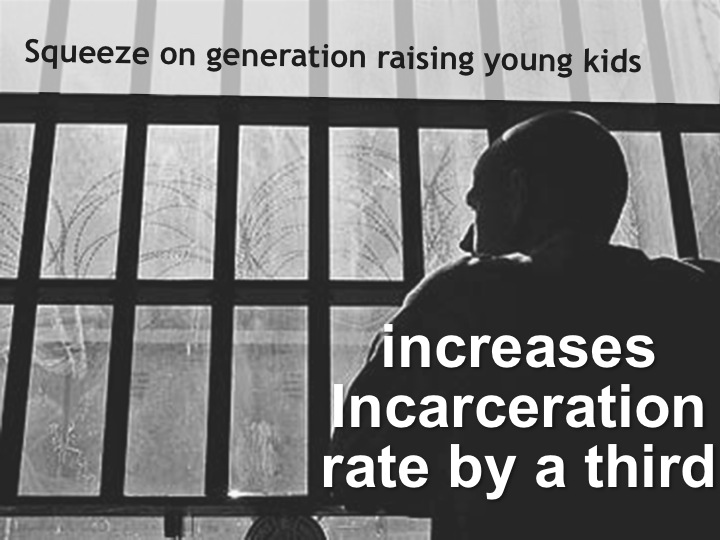
Here’s what we’ve found and published in recent reports for the Business Council of BC, and the Canadian Journal of Public Health.  So long as we tolerate the squeeze on the generation raising young kids, we condemn their kids to far higher incarceration rates than they would have if there were a New Deal for Families in place.  Specifically, policy investments that reduce the number of kindergarten kids who are vulnerable from 30 per cent to 10 per cent would reduce their crime rate as youth and young adults by ONE-THIRD.  Now that would be tough on crime, and show real respect for victims by preventing so many of them from becoming victims in the first place!

UBC researcher, Dr. Barry Forer, is examining the characteristics of kindergarten kids which predict later incarceration.  His preliminary research points to simple social and emotional issues.  Low self-confidence, inability to work independently or to complete work on time are social and emotional incompetencies that stand out as important predictors of later incarceration for both boys and girls.  So are inattention, impulsiveness and difficulties making age-appropriate decisions.

For many children, we could prevent these difficulties by remedying the time, income and service squeeze that plagues their parents.  More parental time is part of a common sense solution to kids’ early vulnerabilities.  This means addressing the socioeconomic realities that currently constrain time at home.  Right now, parents work on average far more employment hours than did Canadian parents in the 1970s, but households don’t bring home more money to show for it –  and what they do bring home has to stretch further to cover higher housing costs.

As I have discussed in recent weeks, the New Deal for Families could help change this.  New Mom and Dad benefits would increase the after-tax income of couples that split a year at home with their newborn by $15k.  Thereafter we could support more parental time at home without a major hit on income through a combination of Flex-Time and $10/day child care services.

The $10/day child care is a key way for the community to play a role in crime prevention.  Such services provide early care and learning opportunities that supplement, but never replace, what parents do at home.  Many analyses show one of the biggest paybacks for quality child care is through crime reduction.

The potential savings from crime reduction in Canada are enormous.  A 2011 study for the federal Department of Justice calculates that crime costs more than $99 billion a year:  $17.4 billion in government costs for policing, the justice system, health care for victims, and victims services; and $82.1 billion in costs to society because of stolen and damaged property, lost productivity, pain and suffering, and loss of life.

The New Deal for Families won’t reduce these costs much in the first few years, since 6, 7 and 8 year olds aren’t the most common criminals.  But crimes are disproportionately committed by young people, with half the accused age 23 or younger.  So it won’t take long for the savings to add up.  Within eight years of reducing the vulnerability of Gen Squeeze’s kindergarten kids from 30 per cent to 10 per cent, a New Deal for Families will save Canadians $10 billion in crime costs.  By the 14th year, we will be saving $10 billion annually, and the savings keep growing from there!

Are Canadians weak on crime?  Yes, so long as we have weak family policy.

Posted in Uncategorized | Leave a comment

Income Splitting is Inadequate for Generation Squeeze

As more people consider the challenges facing Generation Squeeze, some ask why I don’t recommend income splitting as part of the New Deal for Families.  My answer is simple.  Income splitting doesn’t provide tax breaks for the majority of families, and it doesn’t deliver enough help even to the minority who benefit.

The Green Party of Canada is the most avid proponent of this tax change, calling for “full income-splitting to reduce the tax burden on married couples and families.”  The Conservative Party of Canada echoes this sentiment on a smaller scale.  After his government balances the federal budget several years from now, Prime Minister Harper commits to establish “the Family Tax Cut” for couples with children under age 18.  If implemented, this policy change will give spouses the choice of sharing up to $50,000 of their household income for federal tax purposes.

Who gains from income splitting, and by how much?

According to the Prime Minister, 1.8 million families will benefit.  Since Statistics Canada shows there are more than 4.7 million families with children under 18, his plan only helps 38 per cent.

Income splitting does not benefit most families with kids because it offers no help to couples in which both parents earn similar amounts.  Nor does it help lone parents.  Instead, the Conservative plan benefits a minority of couples in which one parent earns less than $25,000, and the other earns quite a lot more.  This scenario is especially common for couples when one parent stays home – 18 per cent of Canadian families.

But even for families with a stay at home parent, income splitting is insufficient to remedy the time, income and service squeeze with which they struggle.  Consider a couple in which the breadwinner makes $54,330 – about the average income for full-time, full-year work in Canada.  Today, that family pays $4,041 in federal income tax.  Under the Conservative income splitting plan, the family will save $1,088 in taxes.

One earner couple, $54,330

Now

Conservative Plan

Basic federal income tax

$6,933

$4,227

  less Child amount

-$315

-$315

  less Spousal amount

-$1,377

-$0

  less Universal Child Care Benefit

-$1,200

-$959

Total federal income tax

$4,041

$2,953

Benefit from income splitting

$1,088

Will an extra $1,088 per year really make it affordable for a parent to remain home with a young child when faced with the decision to work less, or not at all?

The answer is No.  $1,088 doesn’t compensate for the fact that the typical young couple in 1976 earned $65,360 after adjusting for inflation, often on one salary.  Today, the median income for one earner couples with kids is around $42,000 when the earner is male, and $25,000 when the earner is female.  Clearly $1,088 will NOT come close to closing this gap — the only thing that will is a second income.  And second incomes generally require thousands of dollars in annual expenditures for child care services.

Behold the burdens of Gen Squeeze.  Compared to when Boomers were rearing their kids, parents today must give up time at home that is worth thousands in child care and domestic work, or give up thousands in employment income.  And having forgone these thousands of dollars from their standard of living regardless of which decision they make, Gen Squeeze families pay housing prices that are 76 per cent higher than a generation ago.

Income splitting simply is not an adequate solution for the squeeze confronted by today’s generation raising young kids, even for the minority of Canadian families who will benefit.  It is true that income splitting delivers perhaps the largest tax break we can devise for some families.  But the bottom line is that tax cuts cannot bridge the generational gap in the standard of living.

By contrast, the policy changes I propose as a New Deal for Families CAN bridge this gap.

During the first year of a child’s life, the New Mom and New Dad Benefits would inject around $15,000 of after-tax income into the home of an average one-earner couple.  Thereafter, the benefit plan gives the family more choices, offering the primary breadwinner (often the dad) the opportunity to afford six months at home when the child is 12 to 18 months.  When dads take advantage of this time, moms are more likely to re-establish their ties to the labour market.  Should a mom choose to remain in the labour force once her child is older than 18 months, even if just for a day or two a week, $10/day fees for quality child care services will mean that families keep more of this extra income.  Should the parent elect to pursue full-time employment, $10/day child care will literally save the family thousands of dollars.  In families that choose instead for a parent to remain home full-time until the child starts school, the extra $15,000 from the New Mom and Dad Benefits would deliver nearly triple what the federal Conservative income splitting plan will provide over those first five years.  And it will dramatically improve access to part-time preschool experiences for their kids at an affordable cost of $7/day.

For families that count on two earners, the New Mom and Dad benefits would inject approximately $15,000 after-tax when couples split a year at home with a child age 6 to18 months.  Thereafter, Flex-Time changes would invite dual-earner families to trade some earnings from about 4 weeks of employment to gain 22 additional days at home with their kids.  For most families, there will be little or no after-tax reduction in their disposable income because $10/day child care will save thousands in fee expenditures in order to compensate for the reduction in wages.

For low-income parents who cannot afford to trade any income for more time with their kids, the New Deal will triple the National Child Benefit Supplement.  This policy change in combination with a child care fee waiver for households with incomes below $40,000 and the New Mom and Dad Benefits would all but eliminate poverty among families with children under age 6.  In combination with Flex-Time, these changes would also enable families that are working-poor now, including many lone parents, to afford an additional four weeks of time per year at home while their kids are preschool age.

It is time for Canadians to acknowledge that we require bold policy change to address the decline in the standard of living for Gen Squeeze, to value the diverse choices families make as they wrestle with this decline, and to promote gender equality for moms and dads.  By contrast, income splitting dabbles with old-fashioned policy thinking, which will not address the seismic socioeconomic shift now confronting the generation raising young kids.

Posted in Uncategorized | Leave a comment

New Deal for Families Promotes Truth and Reconciliation

The Gen Why Media project recently held an intergenerational dialogue called “Bring your Boomers.”  One of the featured Boomers was Phil Fontaine, former Grand Chief of the Assembly of First Nations.  Fontaine focused on the harm imposed by the Indian Residential Schools.  His comments echoed many themes raised the week before at a meeting of the Truth and Reconciliation Commission in Halifax.

The Indian Residential Schools may represent the most harmful intergenerational policy in Canadian history.  Prime Minister Stephen Harper’s formal apology in 2008 conceded that “Two primary objectives of the Residential Schools system were to remove and isolate children from the influence of their homes, families, traditions and cultures, and to assimilate them into the dominant culture.  These objectives were based on the assumption Aboriginal cultures and spiritual beliefs were inferior and unequal.  Indeed, some sought, as it was infamously said, ‘to kill the Indian in the child’.”

I encounter many non-Aboriginal Canadians today who do not consider Truth and Reconciliation for Residential Schools a priority.  They claim that the Schools are part of our past, and doubt they have significance for the present.

Such sentiments underestimate what it meant to “kill the Indian in the child.”  It robbed Aboriginal parents of the time to rear their children as proud members of Indigenous communities; and robbed Aboriginal communities of the opportunity to instill in children cultural pride and knowledge.  In place of this family and community care, the Residential Schools ‘educated’ a generation of Aboriginal children to be far less aware of their Indigenous languages and cultures, and worse still, to be far less proud of them.

One result is that many Residential School students became parents who were less likely to teach their own kids about their Indigenous identities.

Tammy Harkey, Manager of Aboriginal HIPPY, explains that this intergenerational reality lingers for many Indigenous parents.  Aboriginal HIPPY (or Home Instruction for Parents of Preschool Youngsters) is a program delivered on and off-reserve.  Part of the support it offers families is the opportunity for parents to explore the lasting influence of the Residential Schools as they rear their own kids.

Harkey recounts the observations of Mable, a program participant.  Mable recalls how the Schools “ripped our parents out of their parents’ arms… My parents were tormented, and I know that has impacted me forever.  My dad knows so much about our culture.  But he stopped at a certain age teaching the kids.  Each child was stopped at elementary school… to protect us, so we would not be targeted, abused, or face racism.”

By forcibly isolating children from the influence of their families and cultures, Mable reminds all Canadians that the Residential Schools did not just target students.  They also targeted generations of Aboriginal people who would never attend – the children and grandchildren of school survivors.  The very future of Aboriginal communities.

Aboriginal HIPPY helps Indigenous parents to grapple with this reality.  As Rebecca explains, “I am working so hard for my kids to be proud.  But it is a tough job.  I am recovering from a system that beat us down as a people.  So, I do all that I can… But I can only teach what I know, and so many of us in here in my community are just learning the culture.  It’s so sad and painful.  To want to be proud.  To want to know.  To have to dig.”

Although the generation raising young children in Canada is generally squeezed for time, income and services, many Indigenous parents encounter another unique difficulty: they must teach their children about their culture while simultaneously working to rediscover that culture for themselves.  And Aboriginal parents must do so amid far higher rates of poverty than non-Aboriginal families with children.

With Residential Schools still reaching into the lives of today’s Indigenous parents, media coverage of the Truth and Reconciliation process misses the mark when it focuses only on the stories of students, and the compensation they received or are still owed.  Truth and Reconciliation also requires Canadians to acknowledge the ongoing legacy of Residential Schools for entire Indigenous communities regardless of who attended the Schools.

Our approach to Truth and Reconciliation should therefore focus more on what programs like Aboriginal HIPPY do to compensate for the harm that communities still suffer because of Residential Schools.  Under Harkey’s leadership, the program turns the table on the Schools by celebrating and strengthening what they historically obstructed:  parent and grandparent time with children in family and cultural settings they shape.  Residential Schools purposefully disrupted caregiving to undermine Indigenous cultures.  It makes sense that cultural rejuvenation will now be strengthened by policy to support the child care that Indigenous parents and communities provide.

The same logic informs the New Deal for Families that I have been proposing in this column in order to restore greater intergenerational equity. New Mom and Dad benefits would make parental time with newborns more affordable for all Canadian families, including Aboriginal families.  The proposed minimum benefit of $440/week will be especially important for Aboriginal parents on and off-reserve.  Higher rates of low-income among Aboriginal citizens mean they are less likely to qualify for existing parental leave benefits compared to other families, and less able to afford the reduction in income that comes with parental leave when they do qualify.  In response, New Mom and Dad benefits would eliminate poverty for all parents caring for children under 18 months.

While New Mom and Dad Benefits would invest in the family time that Residential Schools once obstructed, $10/day child care would help remedy how Schools once limited the opportunity for Indigenous communities to nurture their children.  Specifically, this child care recommendation would allocate funding for child care services to enhance Indigenous children’s exposure to languages and cultures of First Nations, the Métis and Inuit.  For households with annual incomes below $40k, child care fees would be waived.

By investing in additional family time that is supported with adequate funding for community services like Aboriginal HIPPY and culturally appropriate child care, a New Deal for Families could become an essential contribution to Truth and Reconciliation in Canada.  Essential because it responds directly to the harm Residential Schools imposed by removing children from their families and communities; and because it takes lessons learned from one of Canada’s most grievous historical policy decisions to build a better policy deal for an entire generation of Canadians – Aboriginal and Non-Aboriginal alike.

Posted in Uncategorized | Leave a comment

Some new additions to the Blog

2 new video links

Surrey Board of Trade videos Warren Beach, CFO Sierra Systems. Warren talks about the price Business pays for Generation Squeeze’s bad policy deal.

And Fanny Kiefer interviews Kershaw re the Beaver Logic required to support Generation Squeezed YouTube Preview Image

Since readers wanted a short printable version of the New Deal for Families that they could share with decision makers, I have also added a link to a Summary of the New Deal for Families 3 Policy Recommendations.

Posted in Uncategorized | Leave a comment

Not a “Boomer Hater”: Critique helps Kershaw refine conversation

Eight weeks ago I invited readers to envision a Canada that works for all generations.  The conversation gained momentum thanks to readers across the country.

Much of the feedback has been positive, suggesting the columns have helped to name what many in Generation Squeeze feel.  But there has also been criticism.

As an academic, I welcome critique.  It can signal where one may need to adjust thinking. I therefore wish to carry on the conversation this week by engaging directly with some of the concerns readers have shared.

Andrew Wister, SFU Professor of Gerontology, succinctly captured a common set of criticisms.  In an Oct 25 Op Ed, he wrote that “Pitting young families against older generation isn’t helpful.”  He worries that my columns blame Boomers and seniors for the squeeze on those that follow.

Professor Wister is correct that generational conflict is not helpful.  But let’s be clear about its origins.

The potential for conflict exists because social and economic trends over the last four decades have worked to increase average incomes and wealth for those approaching retirement, while squeezing the time, income and services for many in the following generations who now raise young kids (see 10 provincial Family Policy Reports, Does Canada Work for All Generations?).  If there is a tension, it is because there has been a slow seismic shift in the Canadian environment, and we didn’t change with it.  We abandoned our beaver logic, neglecting to build policy in response to the declining standard of living for Generation Squeeze..

Merely talking about data to illuminate intergenerational pressures need not create conflict.  Quite the opposite.  Until we showcase the information, Canadians have little impetus to make change.

The discussion of “blame” to which Professor Wister refers has arisen several times in response to my columns (see also the October 24 Op Ed from Robert Ages of Delta).  Blame is not a game for me.  I aim to be very careful about this issue, generally emphasizing personal responsibility.

For instance, I have argued that much responsibility for the bad intergenerational deal rests with Gen X-it – adults in their prime child rearing years who are less likely to use their political voice, especially during elections.  At the same time, I compliment the Boomer generation on their higher voter turnout, noticing that political parties respond accordingly when developing platforms.  And I observe that many of today’s older seniors – the parents of Boomers – were among our country’s greatest policy builders, who simultaneously paid down government debts from WWII.

More generally, I have directed much blame away from politicians to focus on all of us as Canadians, as citizens.  We have chosen not to prioritize social policy innovation in support of Generation Squeeze.  As a result, it is challenging for political leaders to campaign for what the electorate does not call.

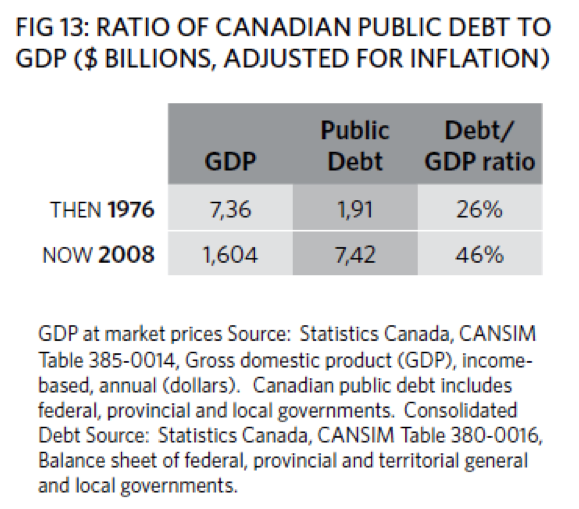
While Boomer blaming is not my interest, a Canadian commitment to personal responsibility does behoove us all to ask and answer the question:  Do I leave as much as I use over my lifetime?  The fact that Canada’s debt to GDP ratio was 26 per cent in 1976 and 46 per cent as of 2008 (before the recession) sounds some alarm bells.  Boomers leave larger public debts than they inherited from the previous generation, even though on average they have stronger financial situations than did near-retirees in the 1970s.  In addition, Canada’s environmental footprint has not improved over Boomer’s adult lives despite growing worries about climate change.


I do not promote ageism by sharing this information, as Kathleen Jamieson of Delta charges in an Op Ed on October 29.  Rather I hold out hope for Boomers and their legacy.  Because of their influence in our boardrooms, legislatures and as voters, Boomers are essential.  They could choose to become proponents of a better deal for their kids’ generation and grandchildren.  In so doing, they would restore greater equity between generations, and leave a more solid foundation from which Gen Squeeze can address looming fiscal and environmental debts.

As I speak about generations, I rely on averages to capture important trends.  Some have since critiqued that I wrongly portray all Boomers as affluent, and all in Gen Squeeze as worse off.  Let me acknowledge emphatically the diversity that exists underneath any average.  There is no doubt that some Boomers struggle economically, as many notice when talking with Greeters at Walmart.  I salute Angie, Harry O’Neil, Ruth John and many others who insisted on this point, sharing their personal stories by email.

In response, organizations like the United Way point the way forward when they identify isolated seniors AND families with young children as their priority areas for community investment.  The fact that Canada wrestled poverty among seniors down from 29 per cent in 1976 to less than 5 per cent today does not give reason to overlook that some seniors still struggle – especially women.  Nor does it give reason to ignore the risk of isolation as Canadians live longer, often at great distance from other family.

But addressing these risks can and should occur alongside learning the broader lesson revealed by income trends for seniors. We successfully used policy in the past to adapt our environment for the evolving needs of a generation.  Canada can now repeat this achievement for Generation Squeeze. 

Notice, the goal is to repeat the success, not replace it.  Although policy investments inevitably entail trade-offs, there is no reason to pit seniors or near-retirees against families with young kids, as Professor Wister fears.  Canadians are well positioned to choose other trade-offs, whether higher taxes, fewer prisons, re-examining what we include in medical care, or any of a range of alternatives.

However, I make no apologies for initiating a genuine discussion about trade-offs, because they are at the heart of our decisions.  Why do Canadians so far resist building policy that will support new moms and dads to have enough time with their young children?  Or $10/day child care services?  Or employment standards that facilitate balance between work and family?  Answer:  because we prioritize other goals.

Such trade-offs are no longer consistent with many Canadians’ aspirations to retain the family at the heart of our values.  I therefore take my hat off to Professor Wister for expressing his support for the New Deal for Families, and noting correctly that many Scandinavian countries develop policies for the generation raising young kids side-by-side with strong policy for seniors.

It will take many more Canadians to boldly echo the priority Professor Wister so eloquently proclaims before Canada once again works for all generations.

So let’s keep the conversation going.  Share your views in the Vancouver Sun, or at paul.kershaw@ubc.ca, blogs.ubc.ca/newdealforfamilies, or twitter.com/#!/newdealfamilies.

Posted in Uncategorized | 1 Comment

Seismic shift for Generation Squeeze costs $1.4 billion in employee turnover

Families First.  I sympathize with the BC Premier and other Canadian leaders who make this commitment, because it is a big task.  In many ways, it is akin to responding to an earthquake.  Earthquakes damage a community’s foundation.  Since they happen suddenly and violently, we all respond empathetically.

For families with kids today, the damage to their foundation occurred slowly, silently, over decades.  But a slow and steady change does not make the damage any less severe when we compare across generations.  Were the generation that raised young kids in the 1970s to time travel, they would suddenly have far less time at home because parents today collectively perform many more hours of employment than a generation ago.  Regrettably, this time poverty does not yield higher household incomes.  Instead, it is the price today’s parents pay to cope with wages that didn’t keep pace alongside skyrocketing real estate prices since 1976.

And yet… when political leaders propose even modest changes to address the seismic shift in the standard of living, many of us come up with reasons to forgo action.  Take Premier Clark’s ‘family day’ which, at best, restores one brick in the now shaky foundation for families with young kids. Even this minor change is postponed because some worry about cost constraints.

Since we too often delay supporting the generation raising young kids, I take heart that the Surrey Board of Trade hosted a Business and Families First dialogue last week.  Its CEO, Anita Huberman, explains “we need an action plan now for Surrey Families and Businesses. There is no time like the present to begin talking about strategic investments and initiatives in Surrey that will strengthen both our growing number of families with young children and our businesses now and for the future.”

The dialogue featured Warren Beach, CFO of Sierra Systems, speaking by video about the price paid by Canadian business because of the squeeze on the generation raising young kids.  As an employer, Warren spoke of his frustration at losing talented employees, many with multiple degrees and years of on the job training.  Why did they leave?  Because they can’t find or afford quality child care services to help them balance enough time at home.

Warren and two Chartered Accountants joined forces with my team to estimate what it costs companies when employees leave a job.  Their experience shows it’s expensive – between 115 and 154 per cent of the annual salary earned by the departing employee.

Truthfully, I was skeptical when we first explored these numbers.  But once you begin considering the range of costs, they add up fast.  For example, when a time and service squeezed employee resigns, employers must hire a temp or pay remaining staff to take on extra work while they recruit a replacement.  Those filling in inevitably are less productive than the previous incumbent, because they don’t know the job. Through all this, a manager must perform exit interviews to determine what work the departing employee leaves, and reallocate it accordingly.

And that’s just the cost of someone leaving.  There are also costs to fill the vacancy.  Advertising for one, along with time to develop a recruitment strategy, review resumes, conduct interviews, confer with colleagues about which candidates are the best fit, perform reference checks, make the offer and notify unsuccessful candidates.

Then the new hire has to be trained, which includes the employee’s salary along with the costs of delivering training and associated materials.  And most new hires will be on a learning curve, meaning their productivity will generally be lower than the departing employee, often for at least five months.  During this time, the productivity of other staff will also diminish as they help the new team member learn the ropes.  In some higher paid positions, lost productivity mean lost sales.

Bottom line:  it is not unusual for employers to pay more than $25,000 to fill a vacancy left by someone who earns $22k a year; or nearly $59,000 to fill the void left by someone earning $44k; and more than $135,000 to cope when someone earning $88k resigns.  No wonder Warren is worried that generation squeeze employees leave due to work-life conflict!

So how common is this problem?  One way to learn is to examine moms’ decisions about work inside and outside Quebec.  There are regulated child care and kindergarten spaces for 58 per cent of kids under age six in Quebec for a fee of $7/day.  In most other provinces, there are spaces for 21 to 36 per cent of children at a daily fee of $20-$40.  To be sure, the Quebec system is not perfect, and is critiqued for investing too much in services for very young children; and too little to ensure all services are high quality.

Nevertheless, economists who make these critiques at the Univesité du Québec in Montreal, UBC, U of T and MIT also provide strong evidence that BC would retain in the labour market an additional 17,000 women with young children if we had the child care services available in Quebec.  In Ontario, the figure is more than 50,000 women.

The costs of losing over 17,000 employees are staggering.  Given the expenses calculated in collaboration with Warren, the BC business community pays $1.03 billion to replace 17,000 moms who decide not to remain in their job because of the time and service squeeze.  This cost is amortized over roughly 4 years.

The resulting annual avoidable price paid by BC business is about $247 million – or one-sixth of all corporate taxes the province expects to collect this year.  Across the country, excluding Quebec, employers pay about $1.4 billion annually for avoidable turnover among generation squeeze.

One new holiday in rainy February isn’t going to solve this business problem.  But a substantial policy investment in New Mom and Dad benefits, $10/day Child Care services and Flex-Time can.

Hats off to Huberman and Beach.  They add an economic rationale for politicians to move beyond the ‘Families First’ rhetoric to budget for meaningful policy change that will restore families at the heart of Canadian values – and, as it turns out, to eliminate unnecessary business costs.


Posted in Uncategorized | Leave a comment

Bad Deal for Generation Squeeze costs Business $2.3 billion annually in Absenteeism

Last time I wrote about Occupy Wall Street, observing that the slogan “We are the 99%” frames the growing inequality in Canada as a few fat cat corporate leaders gorging on the cream produced by many mice churning milk.  While this insight rightly illuminates some systemic problems with the distribution of income in our country and around the globe, I think it wrongly caricatures many individual business leaders today.

As readers of this column will know, I’ve been calling for Canadians to rally behind policy changes in support of the generation raising young kids because it is squeezed for time at home, squeezed for income after housing, and squeezed for services like child care (see blogs.ubc.ca/newdealforfamilies).  A number of Canada’s business elite have lent their reputations to similar recommendations in the past, because they recognize the societal value of policy change, and because they can make a business case for such investments.

Take people like Warren Beach, CFO of Sierra Systems, Debi Hewson, CEO of Odlum Brown, Yuri Fulmer, CEO of FDC Capital Partners, and Catherine Warren, President of FanTrust Entertainment Strategies.  Far from caricatured fat cats, these corporate leaders are some of the hardest working CITIZENS I know, volunteering countless hours to a number of philanthropic boards and fundraising campaigns, including the United Way where I met them.  At the United Way of the Lower Mainland, they don’t just use their influence to raise money for programs that support families with kids and isolated seniors.  They also lend their voices, encouraging Canadians to prioritize public policy to prevent social problems, rather than treat problems after the fact.

Part of their motivation, I suspect, is the business community already pays a price for the status quo.  Employees with young kids bring their time and service squeeze to their jobs.  The result is higher absenteeism rates for this group of employees, greater turnover, and increased use of extended health benefits – all of which employers pay for.

For a couple of years, I’ve been using some of my research time at UBC to provide evidence that the squeeze on the generation raising young kids costs the Canadian business community billions.  After giving a number of presentations where business colleagues smiled, nodded gently, but resisted engaging, I approached Warren Beach at Sierra Systems, asking whether he believed my findings?”  A no BS kind of guy, Warren replied “As a CA, I’ve seen many people inflate estimates, so I’m skeptical.”  But as a stalwart citizen, remaining skeptical wasn’t an option for Warren.  Instead, he agreed to devote some of his time, and the time of two CA colleagues, to support my team in refining the estimates.

In the light of Warren’s analysis, he is now a believer, suggesting my research team is likely conservative when estimating that “work-life conflict among employees with preschool age children costs the Canadian business community in excess of $4 billion annually. These costs include absenteeism, employee turnover, and health care premiums.”

Take absenteeism as a starter.  Average full-time wages in Canada mean the typical employee earns $213 a day.  The employer is out this wage when an employee uses a sick day or is otherwise away from work because of work-life conflict.  On top of the wage, there is the daily cost for extended benefits that employers pay, which is conservatively another 10 per cent of salary, or $21.

When someone is absent, colleagues have to fill in, and supervisors take time from what they would have otherwise done in order to manage the unexpected HR gap.   Plus, the company forgoes the profits it expected to earn on whatever labour doesn’t get performed.  Together, colleagues’ lost productivity and the company’s lost return on investment in employee wages add up to another 60-65 per cent of the average daily wage, or $128-$138.

This means the total employer cost when an employee misses a day due to work-life conflict is around $370 on average ($213 + $21 + $128-$138).

So how often do people miss days because of work-life conflict?  265,000 BC employees have preschool children.  Their time, income and service squeeze means they miss 3 to 3.6 more days per year because of their high levels of work-life conflict compared to people who report less of a squeeze.  These data come from Statistics Canada and research from Linda Duxbury and Chris Higgins at the Sprott and Ivey Schools of Business respectively – both of whom are leading researchers about work-life balance.

265,000 employees multiplied by 3-3.6 days per year is between 795,000 and 954,000 days lost to absenteeism in our province annually.  At a cost of $370 per day, that adds up to between $300-$356 million annually – just in BC, and just for employees with kids under age six.

Given BC is only 13 per cent of the Canadian population, we’re talking about $2.3 billion nationally.  That’s the price paid by the Canadian business community for otherwise avoidable absenteeism among the generation raising young kids.  (And that’s before we consider other costs, like avoidable employee turnover and health care premiums, which I will consider in future columns).

To put this annual $2.3 billion price in context, the Government of Canada invested $2.2 billion in stimulus spending in the second year of its Economic Action Plan to support adjustment and secure job opportunities in regions and industries most affected by the economic downturn.  Clearly, the magnitude of the absenteeism price tag is a significant drain on our economy.

Rather than waste $2.3 billion each year on avoidable absenteeism, might the business community not spend this money more productively, both for its own profitability, and for the good of society?

I think so.  There is no doubt the New Mom and Dad Benefits, $10/day child care and Flex-Time that I propose as part of a New Deal for Families will impact employers.  But it’s less about new costs, and more about replacing unproductive expenditures for more productive HR practices and social policy investments.

The Surrey Board of Trade will host a Business Summit October 25 that focuses on the costs of work-life conflict.  As a member organization, it deserves credit for showing leadership on what it will take to put families first as part of our country’s social and economic strategy.  Such leadership is not the activity of corporate fat cats.  It’s sound thinking on the part of smart business people who are solid citizens.

Posted in Uncategorized | Leave a comment

Occupy Wall Street: Focus on Generations, not just Fat Cats

Fewer than 50% of Ontarians voted in this month’s provincial election, letting the state of Canadian democracy slip to a new low.  How can citizens be so quick to criticize politicians who labour far longer hours than do many Canadians, when a majority of citizens won’t even show up to cast a ballot once every several years?  If you don’t like Canadian politics, look in the mirror.  More and more, our critiques need to start with our individual apathy, especially in Generation X-it.

While voter turnout is dismal, Occupy Wall Street protests spread across North American cities, including in Canada this past weekend.  These demonstrations give hope to democracy, even if you don’t support the message.  With the general disinterest for politics in our country, we should take our hats off to any who raise their political voice in peaceful ways.

Occupy Wall Street groups have been criticized for not having a unified message, although corporate bailouts and growing inequality between the uber-rich and the rest are common themes.  “We are the 99%” is a powerful slogan.  Organizations as disparate as the Conference Board of Canada and the Canadian Centre for Policy Alternatives report that the richest 1% of Canadians make 14 percent of total income, and took home more than a third of the growth in incomes since 1998.

But here’s the problem.  “We’re the 99%” frames the issue as a select few fat cats gorging themselves on cream produced by many little mice churning the milk.  The story of Mouseland governed by cats is a metaphor that worked excellently for Tommy Douglas back in the day.  It’s less likely to move public opinion in Canada now.

Canadians are devoted to the value of personal responsibility.  There is more dignity at the end of a shovel than at the end of a handout, many of us think.  People reap what they sow, and deserve what they earn.  These beliefs underscore the amazing work ethic that Canadians demonstrate, ranking among the top countries for average employment hours.

One implication of a commitment to personal responsibility is that it works both ways:  if you are poor, you failed; if you are rich, you earned your success.  Plus, there is always the Canadian and American dream that we all can one day earn our way to super-rich status.

The fat cats focus overlooks important generational realities.  The Canadian economy grew more than 100% since 1976, producing an additional $35,000 of prosperity per household ON AVERAGE after controlling for inflation.  Averages are deceiving.  Household incomes have stalled for the generation raising young kids as they take on massive debt to keep up with real estate prices.  By contrast, those age 55-64 are doing far better:  their incomes grew by nearly $12,000 compared to near-retirees in 1976, they have far more wealth because housing prices nearly doubled over their adult lives, and they leave the planet hotter than they inherited it.

Occupy Wall Street may signal a growing concern about inequity between the rich and the rest, but we can only address these pressures by tackling the intergenerational tension.  The Boomer generation about to retire may be the richest our continent has ever seen, while young families struggle with a substantial decline in the standard of living.  This is a bad intergenerational deal.

To be clear, it’s not about Boomer-hating.  Quite the opposite:  it’s about inviting Boomers as allies.  Unlike fat cats who have no reason to care about struggling mice, Boomers have strong emotional ties to the generations that follow, and want their kids and grandchildren to succeed.  We’re far more likely to mobilize Boomers to support a Better Deal for young families than we are to move fat cats to share cream with hungry mice.

Speaking about generations helps to ensure we don’t get distracted by the language of personal responsibility.  There’s no doubt personal responsibility is a value to which all generations in this country subscribe, including those under 45 who work longer employment hours and perform more unpaid caregiving than others.  But talking about generations makes us also think about historical TIMING.

Those who came of age in the 1970s did so in housing markets that were going up after they already owned homes; in labour markets where wages were on the rise, especially in return for education; and in an environment where global warming was not yet a serious constraint.  Boomers didn’t earn these blessings.  They lucked out in the lottery of timing.  The generation raising young kids doesn’t enjoy this same good fortune, as wages are more stagnant, housing is unaffordable for many first-time buyers, and climate change occurs around us.

So Occupy Wall Street, as you evolve in Canada, here’s some unsolicited advice.  Talk less about fat cats and more about Boomers who abandoned their beavers.  Recall beavers adapt to changes in their environment by ensuring their dam does not leak.  Not because any beaver lives in the dam, but because the dam ensures there is a reservoir on which all in the beaver community depend.  If the reservoir is deep enough, beavers swim efficiently, far faster than they walk on land. If the reservoir is deep enough, beavers enjoy more security from predators.  If the reservoir is deep enough, there is space for beaver families to build their lodges.

Canadian Boomers did benefit, and continue to benefit, from the policy planks that make up our national dam – the public universities, unemployment insurance, workers compensation, public pensions and public medical care.  These national policies were in place before Boomers became adults.  As Boomers retire, the national dam is leaking – not because the same policies don’t exist, but because the environment has changed, and we have yet to adapt our national policy dam.  As the generation raising young kids tries to gain a foothold in the resulting flood, two questions become critical.

First, will the generation raising young kids find its voice, and use it to influence public policy decisions, including at election time?

Second, will Boomers help build new policy to address the growing inequality that makes many Boomers “the rich,” and many in the generations that follow, “the rest.”

Posted in Uncategorized | Leave a comment

WTF? Where’s the Family?

Saskatchewan goes to the polls today.  Newfoundland, the Yukon Territory, NWT, Ontario, Manitoba and PEI held provincial elections in the last couple of months.

I can’t help but ask, WTF?  Where’s The Family in all of these elections?  Where were the policy promises to remedy how young families now have less time together, less household income after housing, and insufficient services to balance work and young kids, compared to the previous generation.  If not in elections, when do we talk seriously about the higher housing prices and stalled household incomes with which Canadians age 25-44 struggle despite being more committed to the labour market than any other generation in recent memory?

Sure many candidates referred to families.  And many made sure their spouses and children appeared for photo ops to convey their commitment to family values.  But talk and photos are cheap.  Putting the family back in the core of Canadian values requires policy innovation and re-allocation of substantial resources.

Since political parties of all stripes across the country are slow to develop policy to resolve Canada’s bad intergenerational deal, I propose in this column a New Deal for Families, one informed by leading national and international research.  It’s then up to Gen X-it and Boomers who care about their kids and grand-kids to ensure the next elections give serious attention to proposals like these.

Given global economic turmoil, we are living in very complicated times.  But this complexity should not mean we forget that the Canadian economy grew 108% since 1976, even after adjusting for inflation.  On average, this means it produces an extra $35,000 per household.  Compared to a generation ago, our country has far more resources with which to address the ways in which it is harder to raise a family today – and do so as a part of our efforts to navigate the challenging economic waters.

A Time Dividend

Since the generation raising young kids is squeezed between the need for time at home and time to earn a living because wages lost ground as housing prices rose, a New Deal for Families should organize around the concept of a Time Dividend.  When talking about dividends, the stock market provides a reasonable benchmark for prosperity sharing.  Just as Dow Jones Industrial stocks paid an average annual dividend of 2.8% in 2010, a Time Dividend in Canada could use 2.8% of the economic prosperity produced today compared to the mid-1970s to alleviate the time, income and service pressures faced by Generation squeeze.

2.8% equals $22 billion annually – a national dividend for families to be financed either by (a) less public spending on other things; (b) higher taxes, or fewer tax write-offs; (c) new business investment; and/or (d) deficit financing – spend now, pay later.  Reasonable people will differ about which of these options to prioritize or combine.  But it is critical to recognize that these are the only options, save one:  accept the status quo by doing nothing to address the decline in the standard of living for the generation raising young kids.

A Time Dividend would get Canadians back to basics.  It would:

  • Put the family back into Canadian values, while acknowledging the diversity of households.
  • Spend more time together, and spend less on stuff.
  • Give real choices for women and men to contribute at home and on the job, rather than just talk about this balance being a possibility.
  • Enable and expect personal responsibility, because moms and dads alike will have enough time to raise their kids, and enough time to earn a living to pay for their kids.

To pay this Time Dividend, three policy changes are required:

New Mom and New Dad Benefits to ensure all moms and dads, including the self-employed, can afford to be at home with their newborns, at least until children are 18 months.

How?

Extend parental leave from 12 months to 18 months, generally reserving the extra six months for dads (with exceptions for lone-parents and same-sex couples).

During a child’s first 18 months, parents will enjoy increased access to healthy child check-ins and parenting support.

Details?

Caring at home would be made affordable by insuring 80% of parents’ income up to $60,000 a year. This increase will double the existing maximum benefit.

A new minimum $440 weekly benefit will be available to ALL parents, enough to eradicate child and family poverty for this age group.   Moms and dads who currently do not qualify for leave would see their after-tax household income increase by at least $13,500 in the 12 months following the birth of their child.

$10 a day child care services will ensure that parents can afford enough employment time to manage the rising cost of housing and stalled household incomes.

How?

Reduce child care service fees for children over 18 months to no more than $10/day (full-time) and $7/day (part-time), making it free for families earning less than $40,000/year.

Invest adequate funding for kids to spend their time in developmentally stimulating activities and play, including children with extra support needs.  Child care workers will have appropriate training in child development, and earn pay equity wages.

Details?

The services will supplement, but never replace, the care that families provide.  Families will be able to use the parenting support even if they do not choose to enrol their children in non-parental services.

Where numbers permit, families could choose programs that feature a language other than English or French in recognition that Canadian families speak many languages at home.  For Indigenous citizens, services will prioritize exposure to the languages and cultures of First Nations, Métis and Inuit as part of Canada’s commitments to Truth and Reconciliation.

Flex-time for employees and employers to remedy workplace standards that too often make it standard practice to ignore the family.

How?

Adapt overtime, Employment Insurance, and Canada Public Pension premiums paid by employers to make it less costly for businesses to use employees up to 35 hours per week, and more costly for hours thereafter.

Overtime will kick in at 35 hours a week (averaged over a year). Overtime premiums will be paid either as cash or earned time away from work.

Details?

With new incentives, employers would reduce the work week by 3-5 hours for the half of men and the third of women who currently work more than 40 hours/week.

These employees would trade some after-tax wages (or future wage increases) in order to gain around 4 more weeks of time per year. In negotiation with employers, this time could be taken in chunks, or as earned hours away from work each week.

Changes to the National Child Benefit Supplement will ensure any reduction in employment hours does not reduce income in low-earning families. For other families, the reductions in earnings will be offset because the $10/day child care plan will reduce households’ child care expenditures by thousands of dollars a year

Employees who currently work part-time hours would gain opportunities for more employment. Within two-parent homes, flex-time may not change the total hours that parents work, but redistribute them more evenly between dads and moms.

For each Canadian adult, the cost of this New Deal would be $1.67 per day in the first year, and cheaper thereafter as benefits to government, the business community and society increase over time.  $1.67 is less than a cup of coffee and doughnut at Tim Hortons.

$22 billion is less than one and a half percent of the Canadian economy.

It is about one-third of what Canadians currently pay for Old Age Security and RRSP subsidies, and 16% of medical care.

We know this price tag is doable.  Between 2007 and 2010, Canadians increased our public spending on medical care by more than $22 billion annually.  Clearly, $22 billion can be found for priorities.

The real question is:  Do Canadians prioritize a Canada that works for all generations?

Posted in Uncategorized | Leave a comment

Generation X-it

It has become harder to raise a young family today in Canada, while it has become easier to retire.  The generation raising young kids has less time at home because they work harder to compensate for stalled incomes that must now pay for housing prices that skyrocketed since 1976.  By contrast, poverty is down dramatically for seniors, earnings are higher for those about to retire, and housing prices that nearly doubled in value are a major source of wealth for those who owned a home back in the 1970s and 80s. There is no doubt that the Baby Boom generation worked hard as parents, employees and business owners – and they deserve credit for this hard work.  But Boomers also lucked out because their adult years coincided with wage returns for education, and wealth accumulation through home ownership, patterns that don’t continue nearly as much today for the generation raising young kids.

As a result, there now is a significant intergenerational tension in Canada.  But this doesn’t mean Boomers alone are responsible.  Pete McMartin writes in good humour about “The attack of the retired baby boomers… Run for your lives.”  Yet the reality is that much responsibility for the bad intergenerational deal rests with the very generation raising young kids.

This is not to suggest the generation raising young kids is generally lazy. Statistics Canada data show that Canadians age 25-44 work more hours and provide more unpaid care than Canadians over 44.

Nor is it to suggest that the generation raising young kids is more consumerist than previous generations. The additional time they devote to employment is as much about being stuck on a hamster wheel as it is anything else. Don’t forget that dual-earner Canadians age 25-44 make on average a household income that the Boomer generation often earned with one salary. Worse than that, far higher housing prices mean that when the generation raising young kids get in the real estate market, they aren’t buying granite countertops; they are buying fixer-uppers, often without yards.

The main problem with the generation raising young kids, as I see it, is that too many bought into the name Generation X, and ‘X-ited’ formal politics. It’s almost a badge of honour now to proclaim our political laziness, maintaining that “Politics aren’t about me” or “It doesn’t matter if I vote.”

And so we don’t. We’re a third less likely to vote compared with those older than 44. Indeed, we seem much more interested in who gets voted off some TV island than who gets voted to Victoria or Ottawa.

We may not worry about our X-it from politics. But will our children? Might they not someday question why we didn’t grow up politically to challenge the decline in the standard of living; to challenge the fact that an especially affluent generation of Canadians approaches retirement with some more intent on globe-trotting than on remedying the fiscal debt, the environmental debt, or the family policy debt they leave for those who follow?

The reality is that Boomer politicians play politics well for their generation, reducing seniors’ poverty, strengthening pensions and investing even more in medical care to treat illness at the end of life.

By contrast, the generation raising young kids doesn’t play politics well, and we get a bad deal as a result.

Our poor effort is partly a problem of X-haustion. Reality TV was bound to gain popularity when families are squeezed for time and income left after housing and services. When tired, who doesn’t want to veg on the couch watching some mindless program?

But we can’t let our X-haustion get in the way of the solution. It’s time to grow up politically. It’s time to start demanding a New Deal for families with young kids.

This means taking politics more seriously. We can’t keep treating politicians as punch lines more than persons who deserve respect. Presently, just 15 per cent of Canadians trust our elected officials. More of us trust new car salesmen! Reaching out to MPs and MLAs in all parties is imperative if we are to make progress on the New Deal. Tell them the facts about Canada’s untold story — the decline in the standard of living for the generation raising kids, which makes it far more difficult to raise a family.   Tell them job creation definitely matters when putting families first – but data also show that jobs aren’t what they used to be in terms of paying wages that keep up with the cost of living.  So putting families first now must also mean policy innovation to help moms and dads alike afford enough time at home, and enough time on the job to earn a living to pay for their family.

Championing a New Deal will be work.  But it also can be fun.  Many repeat Emma Goldman’s famous line:  “If I can’t dance, I don’t want any part of your revolution.”  So… it’s time to follow her lead and organize the serious business of politics around fun activities.  Let’s rekindle the politics that were pervasive in the Sex, Drugs and Rock & Roll of the 60s, and adapt it for our time – if we want Canada to work for all generations.


Posted in Uncategorized | Leave a comment

Intergenerational Breach

There is a growing intergenerational breach in Canada.  Consider three facts.

  1. Average household income for Canadian couples approaching retirement (Baby Boomers) increased 18% since the mid-1970s.  This increase is nearly four times greater than the increase reported for couples age 25-34 over the same period.
  2. In 1976, the low-income rate among seniors in Canada was 29%.  As of 2009, it is 5%.  By contrast, the low-income rate for families with children is 10% — twice as high.
  3. Boomers approach retirement with far greater private wealth than previous generations because they lucked out in a housing market that increased 76% over their adult lives.  With this additional wealth in housing, Boomers now transform expectations for retirement, making globetrotting and second homes more and more the norm. All the while, skyrocketing housing prices are the primary source of private debt for the generations that follow – the very people who must sustain the economy to pay for the pensions and medical care required by an aging population, and the very people who must invest in Canada’s future – their children, and Boomers’ grandchildren.

While Boomers approach retirement with more private income and wealth than previous generations of retirees, they leave far larger public debts than they inherited.

Although our economy doubled in size since 1976, our national debt nearly tripled.

There is also Canada’s environmental debt.  It remains among the very highest in the industrialized world, as measured by Carbon Dioxide emissions per person.  While we have made no progress reducing these emissions per person since 1976, many other countries have since decreased their environmental footprint significantly.

Growing public debts amid greater private wealth for those approaching retirement invites questions about an intergenerational tension.  Do Boomers care that other generations don’t share the standard of living they now enjoy?

There is absolutely no doubt that Boomers care.   But the last federal election paints a worrisome picture.  Political leaders of all major Parties prioritized:

×      Status quo increases to medical care spending, which generally overlook health promotion when citizens are younger.

×      Strengthening pensions and reducing seniors’ poverty, even though poverty among seniors is already less than half of the poverty rate for families with young children.

This last election shows that Boomers play politics well, and Boomer leaders responded accordingly.

By contrast, the generation raising young kids does not participate politically nearly as well, and they get a bad deal as a result.

We know they get a bad deal because national and international data show that Canadians have been slow to adapt public policy in response to the time, income and service squeeze with which the generation raising young kids struggles.  This is the case in all provinces, with some exceptions in Quebec.

Canadian policy expects parents to endure a major reduction in household income to care for a baby at home

 A typical Canadian couple outside of Quebec will forgo $13,000-$15,000 in after-tax income when parents share a year to be home with a newborn age 3-15 months, even after collecting parental leave benefits.  In Sweden and Germany, policy ensures the same couple does not lose any after-tax income.

Canadian policy provides parents with very limited access to quality child care services

Despite the need for parents to have sufficient time in the labour market to manage stalled incomes and rising housing costs, and despite evidence showing the importance of quality environments for child development, Canada allocates just 0.34% of GDP to child care and kindergarten services for children under age six (2008).  This is just over half of the UK and New Zealand; and barely one-third of what is allocated in France, Sweden and Denmark.

Canadian workplace standards mean employees have less time at home

 Although Canadians say we value the role of parenting, Canadian workplace standards mean the typical Canadian employee works 300 hours per year (over 8 weeks) more than the typical Dutch, Norwegian and German employee.  While higher housing prices make this commitment to the labour market understandable, it erodes the opportunity to be home with kids.

Canadian policy tolerates high rates of child poverty

Canada ranks among the industrialized countries with the highest rates of child poverty.  Child poverty in Canada is three to five times higher than the countries that make it a real priority to eliminate poverty among the generation raising young kids.

These poor policy realities beg an important question:  What kind of Canada do we want?  One that ignores the intergenerational breach?  Or a Canada that recommits to working for all generations?

Posted in Uncategorized | Leave a comment

Generation Squeeze

A lot has happened since 1976.  The Canadian economy has grown 108%, after controlling for inflation.  On average, it now produces an extra $35,000 per household.

Despite this additional prosperity, a silent generational crisis occurs in homes across the land, one we neglect because Canadians are stuck in stale political debates.  The crisis becomes clear when we consider a simple “Then and Now” story.  Picture it:  the mid-1970s in Canada.  Baby Boomers were moving beyond their sex, drugs and rock and roll phase to build families, communities and enterprises.  Then the average household income for a young couple was $65,160, adjusting for inflation and expressing in current dollars.  54% of young women contributed to this income.

Flash forward to the present.  82% of women now contribute income, while young men’s employment remains stable.  Despite all this extra adult time in the labour market, average household income for a young couple today is $68,300, just slightly higher than 35 years earlier.

It is worrisome for a country’s standard of living when we ask a generation to make do with household incomes that flat-lined despite a dramatic increase in adult time devoted to earning.  But the reality is bleaker still when we recognize that the primary cost of living – housing – has skyrocketed over the same period.  In 1976, the average price for Canadian housing was $192,390, again controlling for inflation and reporting in today’s currency.  Today, it is $339,045.  That’s an increase of 76%.

When housing costs nearly double at the same moment that household incomes stall for a group of adults who are more committed to the labour market than any previous generation, we’re talking about a massive social and economic change – one akin to a silent, but no less damaging, tectonic shift.

The generation raising kids today is squeezed for time at home; they are squeezed for income even if they are not ‘poor’ because of the cost of housing; and they are squeezed for services like childcare that will help them balance successfully raising a family with earning a living.  In short, this generation can no longer count on a market in which they earn and purchase a standard of living that approximates what their parents enjoyed, even though the economy has grown a rate that far outpaces (by 44%) the rate of population growth.

What accounts for the generational decline in the standard of living despite the rising Gross Domestic Product?  I explore this question throughout the blog, and suggest that Thinking like a beaver offers pragmatic solutions.

Posted in Uncategorized | Leave a comment

Think Like a Beaver

Canadian Senator, Nicole Eaton, recently recommended that Canada replace the beaver as our national animal.  She lamented that the beaver is a dentally deficient rodent, or toothy tyrant.  But such critiques are all wet.  Our national animal may not be as regal as the eagle to the south, but the beaver is a builder to be proud of.

Recall the last creek or river you passed by where beavers dutifully constructed a dam.  Ever wonder why they build it?

Nobody lives in the dam.  The dam does not provide shelter to a single beaver family.

Beavers build the dam, because the dam creates a reservoir.  When the reservoir is deep enough, the beavers are efficient, able to swim faster than they can walk on land.  When the reservoir is deep enough, the beavers gain security, further out of reach from bears and other predators.  When the reservoir is deep enough, it provides a safe home for beavers to build lodges for their families.

Whenever the dam springs a leak, whether from wear, heavy runoff or an earthquake, busy beavers adapt, just as all good managers do.  They fix the dam, renovating it to withstand the new challenges in their environment.  No individual beaver stands to gain alone.  Beavers adapt because they all depend on the dam to safeguard their shared standard of living.

Such logic guides this blog.  Throughout my posts, I will urge readers to think like a beaver:  to renew interest in our national dam – the policy on which citizens depend to safeguard our shared standard of living – and to ask some fundamental questions.  Who stands on guard for the dam?  When did we last renovate it?  What are the greatest challenges to which we must adapt?  How should we respond?

Thinking like a Beaver is important now, because in this era of economic uncertainty and global insecurity, so much attention is given to what constrains Canada, to what Canadians can’t do, or can’t afford.  This focus risks diminishing our national aspiration, and neglects our proud history of building and adapting.

Think back to the late nineteenth century, when we built public schools and universities, roads and railways, markets and banks.  We were so proud of these achievements, we sent soldiers overseas to defend them along with our values.  When they returned home injured, we adapted again, building veterans benefits.  We soon extended these to citizens generally as workers compensation and unemployment insurance.  And then the busiest policy beavers in Canada’s history – the parents of the Baby Boomers – set in motion Old Age Security and Hospital Insurance.  By 1966, in one single year, they capped their accomplishments by launching the Canada Public Pension plan and the Medical Care Act, which remain the cornerstones of our social commitments to one another as citizens.

This history is impressive, one we can all be proud of.  But we can only rest on our laurels for so long.  We must now ask:  What have we built since?

Sure we’ve continued to build roads and bridges (but not enough transit!).  We’ve expanded markets and strengthened our banks – achievements that helped us weather the global recession better than most countries, and position us as a strong member of the G-8 despite our small population.

On the other hand, history books make clear Canadians have been reticent to build new social policy since the 1970s.  This reticence is especially evident in our slow national response to a disturbing reality – that the generation raising young kids today is the first in a long time to struggle with a dramatically lower standard of living than their parents.  For the most part, this struggle remains an untold story in Canada.

It is now time to tell it.

Posted in Uncategorized | Leave a comment

Blogging about a Canada that Works for All Generations

As the challenges before Generation Squeeze gained greater media attention over recent weeks, a number have tweeted, emailed and written that I remain in the 20th century when it comes to communicating.

Sure, I have a blog, they observe.  But I treat it as a website.

Evidently, this is sooooo passé.  Websites are static, people tell me, and require a lot of work for readers to figure out what information may be newly posted.  Blogs, by contrast, are supposed to be dynamic, because they create a conversation through routine posts that offer others the opportunity to comment.

As a farmer morning and night, I have to say that I find some passé technology pretty handy.  I start and end each day cleaning manure from my barn with a pitchfork and wheelbarrow.  This back to basics approach works well.   My partner Andrea and I even had aspirations to harness our horses to old fashioned farm equipment to maintain our fields and spread our compost.

But it turns out that finding this old equipment is very difficult.  There is so little demand, and little supply.  As a result, a few years back, we modernized the farm by purchasing a little tractor.  I must confess, it is FANTASTIC, and very efficient.

So just as the farmer in me has embraced modern technology, so will the communicator in me.  With this post, I announce that I am formally transforming my website into the blog people want it to be.

I created the website over the summer to inform Canadians that our country risks no longer working for all generations.  My intention was to attach weekly observations as a result of my regular column in the Vancouver Sun, which started this past September.

As I transition from the website, I want to ensure the blog posts capture the narrative in its entirety.  I therefore start the blog by re-presenting the initial material in four introductory posts.  These are followed immediately by a re-printing of some of the initial Vancouver Sun articles, which I composed for the column “Think like a Beaver.” Thanks to the Postmedia group for granting me copyright to reproduce material digitally for my academic blog.For some, these introductory posts will be repetitive.  But any good teacher knows that the key to pedagogy is repetition, repetition, repetition.  Why else do advertisements repeat the same phrase as many as 7 times in 30 seconds?!

For those bored by repetition, there is no need to read the initial blog posts if you have either scanned the blogsite before, or been enthusiastic readers of my Vancouver sun columns.  The most recent posts will be new material, often featuring material I prepare for the Vancouver Sun column.

As I start the blog, I promise readers to shovel manure only morning and night at my farm in Pitt Meadows, which will remind me to refrain from spreading any BS through my writing.  Not all will agree with my commentary about Canada’s bad intergenerational deal, Gen Squeeze, or the New Deal for Families we require to make Canada once again work for all generations.  But I promise all of my ideas will be based on solid academic research.

I look forward to the conversation.  Regards,

Paul

Posted in Uncategorized | Leave a comment