Categories
Comm 464

1 Like for a $50 Million Jackpot

When it comes to incentives, nothing beats winning a $50,000,000 Lotto Max jackpot. When I stumbled across this particular post from Be Remarkable on my Facebook newsfeed I was struck with how simple, yet genius the idea was.  Within seconds of seeing my friend had liked the post, I followed suit and made a comment in the hopes of sharing in the prize.

The concept was simple: purchase a lottery ticket and if it happened to be the winning ticket the money would be shared with fans who engaged with the photo. But most importantly, the call to action was strong and beyond easy for users: just like and comment on the photo and you could share in part of the $50 million jackpot.
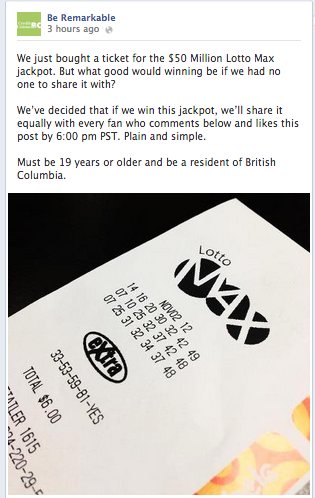
Sounds simple, but the results were pretty remarkable. Within a matter of three hours they had well over 6,000 likes, close to 4,000 comments and over 250 shares. Not only is that alone impressive, but what strikes me as the most strategic part of the campaign is how many people it has the potential to reach. I had never heard of Be Remarkable (a community for BC Credit Unions) before an old friend happened to like it and it appeared on my news feed, which I’m sure was the case among many diverse networks of people all across British Columbia and beyond.

It just go to show that overcoming the barrier to engagement on social media really comes down to appealing to consumers’ most basic desires. Generic calls to action may generate responses from a select few active “Creators”, however, in order to foster engagement within the broader community of social media “Spectators”, a good tactic is to ensure posts are simple, but with a clear incentive.

Although I never ended up getting a share in the jackpot, I can’t argue the fact that this was hugely beneficial for BC Credit Unions in terms of awareness and social media buzz. However, if the true aim of social media is to generate genuine engagement and develop meaningful relationships with their community of users, then this just seems like a cheap bribe.



Categories
Comm 464

A look into the future of social media

Never be afraid to put aside a good thing to achieve a great thing.”

After attending a presentation this past week by Alfredo Tan (Direct of Marketing Solutions at Facebook Canada), I left with my mind spinning with ideas, inspiration and a better understanding of the evolution of how we as humans connect online. It was absolutely fascinating to hear directly from an insider from the company at the forefront of digital innovation, and after a couple of days trying to digest it all here are my top 3 takeaways:

1.    Put people at the center

We are now in an era of online authenticity where people are open enough to create genuine identities online. It is these people who are the driving force of what we as marketers do online and therefore they should be at the heart of all of our decisions. Facebook fans are the most valuable customers and the power they now have to influence their friends is astounding.

2.    Tell a story

The web is built around people, and there is nothing that engages people more than compelling stories. This has always been the case in human interaction, and is no different online. Social media platforms simply provide the opportunities for brands to thrive, then it is up to marketers to communicate their stories effectively to captivate their audience.

3.    Move fast and break things

In the world of technology, staying one step ahead of the game is not enough. Facebook has certainly figured out how to be a leader in innovation and one of the key reasons is because of their ability to move quickly and learn quickly. To quote Zuckerberg himself, “if you never break anything, you’re probably not moving fast enough.”

There is so much potential in the digital space, if only we have the courage to put aside a good thing and take the leap of faith to achieve a truly great thing.

Categories
Comm 464

Clicks Don’t Matter

Are click-through-rates really a thing of the past? Just try convincing marketers of that.


Facebook’s new undertaking to convince marketers that click-through rates don’t matter is, in my opinion, quite bold. To most marketers CTR is presumably a standard measure of an online ad’s performance, or has been to date. However, with new research from Nielson showing only a 0.07% correlation between high click-through rates and actual sales I could just be convinced.

It’s hard not to be skeptical of this messaging, since Facebook’s display ads typically get fewer click-throughs, but it does certainly make sense to look beyond the click. According to a study from Datalogix, 99% of sales generated from online branding ad campaigns came from consumers viewing the ads, not necessarily interacting with them. Which if true, does seem to make the point that we should be looking at performance not solely in terms of click-through rates.

Facebook is now recommending marketers look at creating value through impressions, maximizing reach, and figuring out the right ad frequency, all of which supposedly create a “clear roadmap to success for digital marketers” according to Facebook’s head of measurement and insights, Brad Smallwood.

I would argue that when it comes to social media there is no such thing as a clear roadmap to success. I do think while click-through rates have their advantages in terms of measuring direct response to ads, it is important to look critically at advertising objectives to figure out if perhaps metrics should be looking at targeting upper funnel measures such as awareness and familiarity with the brand.


References: Facebook to Marketers: Clicks Don’t Matter, But Reach and Frequency Do, Facebook Says It’s Looking Beyond Click Throughs

Categories
Comm 464

Could Facebook Change The Way We Search?

As members of Gen Y, it is fair to say most of us have been conditioned to head straight to Google when we’re looking for specific information. But what if the next evolution of the search engine actually provided direct answers to our questions rather than just spitting out results?

That is exactly what Facebook’s Mark Zuckerberg has in mind and something which could eventually pose a significant threat to Google. Lucky for Facebook, Google has failed to create it’s own successful social network, leaving Facebook with the huge advantage of vast amounts of personal data (check-ins, photos, biographical data, stories published to friends, etc.) that could serve as the perfect means to answer specific questions rather than solely providing facts and links.

So what would this look like? While it seems doubtful that a separate Facebook search site will be launched anytime soon, it is certainly possible that Facebook’s current search bar could be improved to be able to include this added functionality. I mean how incredibly cool would it be if Facebook could provide answers to questions like, “What are the best restaurants my friend’s have visited in the past month?” or, “Which of my friends, or friends of friends knows that contact I met at an event last night?”

These are exactly the types of socially related searches that could be extremely relevant to people and something that Google is certainly missing at the moment. Investors and businesses are also particularly intrigued by the potential for increased ability for paid ads both in the search typeahead, as well as next to or above search results. And in my opinion, after quite the controversial IPO, this could be Facebook’s much needed solution to generate a totally new stream of revenues and help increase their stock price.

So what does this mean for marketers? This could be the perfect way to further tap into Facebook’s 845 million active user base by positioning ads at exactly the right time and place when people are hungry for answers and most likely to be influenced.

Reference:  http://techcrunch.com/2012/09/16/faceboogle/

Spam prevention powered by Akismet