Categories
Uncategorized

“This Little Light of Mine” — The 2011 Congregation

Perhaps the best part of being Dean is standing on the stage to congratulate our graduates as they wrap up their most recent educational journey. Someone who doesn’t understand the meaning of these events might imagine that shaking two thousand hands in eight different congregations (what some schools call “commencements”, “convocations” or simply “graduations”) might be some form of advanced drudgery. But for each of our congregations, I find it hard to wipe the smile off my face. This is a day that brings families together to mark a significant life cycle passage and to honour the transformations that have taken place in students lives and outlooks. It’s a day to thank the families for their sacrifices and also to celebrate the extraordinary fact of postsecondary education in the modern world, to be grateful for this mission and the opportunity to touch students’ lives. It’s a day of medieval pomp and ceremonial seriousness but also of improvisation and delightful accidents.

I take the few seconds afforded me with each student as they cross the stage to ask them a question or two. This is my chance not only to remind them that we appreciate the work and commitment of each and every one of them but also to take stock of the meaning of UBC and Arts to their lives and to sample the plans they have ahead, if any. And so I’ll commonly as about what’s next for them, or how they saw their years at UBC, or where they’re off to next, or really whatever I’m inspired to ask.

Let me share just a little very unscientific sample of their responses to “what’s next?” And what an amazing variety of responses there are to this. Some will put the question into the immediate present and respond with something like “a nap, and then rooting for the Canucks!” Many shrug their shoulders with a look of contentment and say, “Dunno” or “Whatever life holds” or even “unemployment”. Many have jobs already: accountant, bank receptionist and account reps, counselor, publicist, intern with an NGO, telecommunications in Afghanistan [!], work for StatsCan (I promised to get my census finished soon) and other government service and even the Liberal Party, and one will run a restaurant. Two that I talked to are preparing for the next Olympics (swimming and sailing) – good luck, we’re rooting for you! Some are starting businesses, such as one student opening up a yoga school, and others are looking for work. I talked to two that were going into flight school, two that were joining the RCMP, one who is training as a firefighter, and one becoming an air traffic controller (I asked him to go get some sleep and please stay awake).

A huge number of our students are off to travel, often for a whole year, with South America, Southeast Asia, China, India, and Europe (Switzerland, Italy, France, and Spain) as the most popular destinations. One student told me she’s off to sail around the Caribbean for a year. I have to say that I was often feeling equal amounts of pride and jealousy about these plans.

Perhaps a third of those I spoke with are looking at graduate school and second entry programs, either next year or the following year, and many are pursuing that abroad, although I think UBC seemed to be the favorite destination! A surprisingly large number of the Economics grads were headed to the London School of Economics). Law school was a favorite destination of the PoliSci grads, but also (surprising to me) of our Psychology grads. Students were determined to make films, to keep acting, to continue their social work, to be journalists, and as one put it, “do great things and travel the world.”

Honorary doctorate recipient Kenneth Lyotier, who founded the organization “United We Can” in Vancouver’s Lower East Side, shared lessons he had learned while searching bins for recyclable waste, including the importance of getting up early, digging deep, and sharing what you find. Singer, actor, and activist Leon Bibb, also an honorary doctorate, sang a lovely rendition of “This Little Light of Mine” in tribute to the graduates. I came out of each congregation more energized and inspired, and certainly renewed in my conviction of the importance of the work done here at UBC. My humble thanks to our students for this.
Categories
Uncategorized

The Buchanan Courtyards, A Place to Stir It Up

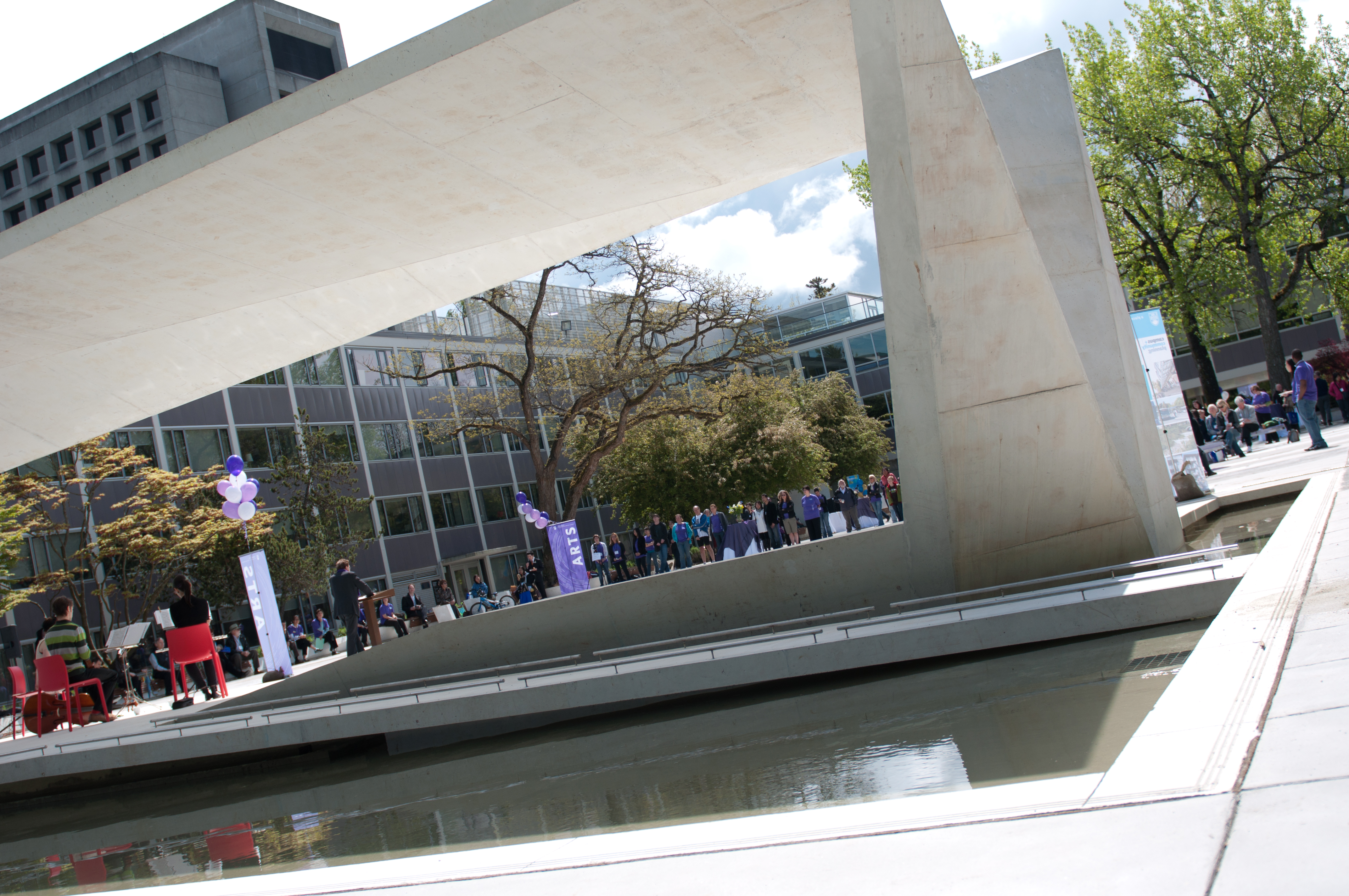
Addressing the attendees, string trio to my left, underneath the Pavilion.

Today, we got to celebrate the arrival of our newly designed Buchanan Courtyards, which will have a transformative effect on our use of the complex that’s at the centre of the Faculty of Arts. Below is a loose version of my speaking points on this occasion. It was great to see students, faculty, emeriti faculty, administrators, project personnel, our former Dean and so many others there to welcome the new spaces.  Check out the article about the Courtyards on the Arts webspace.  See: http://www.arts.ubc.ca/students/index.php?id=1231&home=casshomepage&index=1

I want to extend a warm welcome to our alumni, students, faculty, staff, friends and family as we celebrate the opening of Buchanan Courtyards. And we must have properly propitiated the gods of constant drizzle to have obtained this rare glimpse of sunshine.

Plans for this project began several years ago when Buchanan Buildings A, B, C and D were selected to be completely renovated under UBC Renew Phase 1, a program jointly funded by UBC and the Province of British Columbia. I’ll speak more of the transformations underway in the buildings, but it became clear that as the vision for a renewed Buchanan block came to fruition, we would have, at the heart of the Buchanan Complex, two decrepit spaces, underutilized, uncared for, and having decayed significantly from the original architectural and landscape vision that produced them. It was at that point that interested students, emeriti faculty who had long advocated for courtyard renewal, and the former Dean and her team began to work with Campus Planning, the Campus Architect and others to radically transform the courtyards.

Early this year we inaugurated two new spaces for musical performance: the Roy Barnett Recital Hall and the New Old Aud. The opening of the Aud was a moment for many alumni and faculty and staff to reminisce about experiences in the building years ago, a building that was a central icon in the academic lives of many. These courtyards too will bring back memories, and we are delighted that the renovation of the space might provoke this interaction of the old and the new, new experiences and old memories, a vital intersection of past and present.

You may have also noticed some images cropping up around Buchanan and the Faculty of Arts buildings as we play with new ways of representing the faculty. Let me talk a bit about the genesis of the design you see on our shirts, our signs, banners, bookmarks and beyond. As part of the design of the courtyard, this reflecting pool and pavilion were conceived. And within the pond, it was envisioned that great thoughts of humankind could be inscribed in the bottom of the pool. All of the Departments, Schools and programs in Arts were polled, and each contributed a quote (all before 1922 for copyright issues) and these will be, in the weeks ahead, etched into stone on the bottom of the pool in patterns that look like ripples, extending out in broken and partial concentric circles. Public Design, which designed the pavilion, worked with us to extract this image as a mark and a part of the identity system for the Faculty of Arts. And all throughout the Buchanan Buildings, you’ll see new signage and wayfinding systems that use this image, a color pallet, a bold modernist a font, and the proportions of the white bricks that help to give this complex its identity. In everything we touched, we hoped to reinforce and clarify the elegant modernist lines, proportions, colors, and textures of the Buchanan architecture.

These are part of a wholescape transformation of academic spaces to create a seamless academic and social experience for our students. Our classrooms will connect to the world, our spaces will be universally accessible, they will be interactive and engaging spaces, and the spaces outside of classrooms will be open for students to eat, study, work, discuss, relax. Throughout the buildings, screens add information and news, and signage points the way and orients the visitor. Getting lost in the Buchanan Complex is no longer a participant sport.

Every great city has some kind of great public gathering spot at its core. My favorites of these kinds of squares and plazas and parks offer a range of experiences – from broad and open hardscapes for public gatherings to naturalscapes for contemplation and relaxation and renewal, from open and inspiring vistas to cozy and intimate spaces for reading and napping, and they incorporate water and light and various textures, details and surfaces. The two Buchanan courtyards incorporate this diverse set of options and experiences for our students and guests. They are connected by a waterway, which will capture storm run-off and direct it into the marsh section of the North courtyard. We have no idea yet how our students will use these spaces, but we offer them up for generations of students to bring to them their own creativity.

We will of course animate the spaces in Buchanan Courtyard. We are deeply grateful for an anonymous gift of $250,000 from two UBC alumni to support programming in the courtyards, and I’m happy to say that Professor Ira Nadel has been engaged to schedule events and to animate the space in its first year. I understand that Arts Wednesday presentations are already coming to the Stir It Up Café and the Courtyards. Speaking of Stir It Up, I had an interesting moment last week. I was being interviewed by Jian Gomeshi for Q on CBC about the 30th anniversary of Bob Marley’s death and the impression that his legacy has been commercialized and diluted. As they got ready for my interview, they played “Stir It Up”, and I confessed first off that I too had been guilty of using Bob’s legacy for branding as I had just helped name a café “Stir It Up”, after the great Marley anthem. But I have to say that I think it’s a great name: not only does it pay tribute to Marley and serve as a sly pun about stirring up coffee, but it suggests that this will be a place for lively, transformative, provocative exploration, a place to truly stir it up.

The programming funds will support transform this new public space where the diversity and the interdisciplinary conversations of the Faculty of Arts will come alive; this will be a space perfectly suited to the creative and performing arts: music, theatre, poetry, outdoor films and visual and video art; a place where economists and philosophers can hang out debate; an outdoor home to creative writers and for discussions in foreign languages; a place for protest and activism; a place where scholars and learners connect with friends, and find ways to make a difference, a place to stir it up.

And now I want to acknowledge some of the people who have made this possible.

Acknowledge contribution

Conceptual Planning and Design (in addition to above)
Space2place Landscape Architects (produced original concept plans)
School of Architecture and Landscape Architecture (SALA)
Co-Design (facilitated workshops)

Consultants and project management
Landscape Architects – Phillips Farevaag Smallenberg (Prime Consultant), especially Andrew Robertson and Chris Phillips
Architects – Public Design, including Brian Wakelin, John Wall and Susan Mavor
Project Management – UBC Project Services staff, including Diane Foldi, and Building Operations Staff, Jeff Nolte, and Chris Skipper.

Architects and original landscape architect for Buchanan Renew Building Upgrades
Busby Perkins and Will (Prime Consultant)
Cornelia Hahn Oberlander
And our campus architect, Gerry McGeough

Construction
Contractor – Scott Construction

Faculty of Arts
I’m grateful to the faculty and staff for enduring the transformation and for participating in the many committees and sessions that helped create this design. Anne Marie Fenger has seen this project through for the Dean’s Office and we also want to thank Guillaume Houle and Dominique Lopez.

And especially my predecessor and friend, former Dean Nancy Gallini, whose energetic dedication to students helped to propel this project along, and who, when it ran short of funding, made the commitments that kept this project alive and intact.

I want to conclude by inviting you all back in September in Imagine week as we welcome our students into these courtyards and celebrate again. Thank you for coming out today.

Spam prevention powered by Akismet