Categories
Uncategorized

Luke, Come to the Dark Side: The Joys of Dean-ing

I was having lunch the other day with a former dean, and once again the conversation veered into the motivations for doing this job. My colleague missed being at the table and in charge. Why does someone become a dean? I do get asked this a lot, especially by colleagues in my own discipline who wonder why I would want to do less of everything that they’re trying to do more of? It is an oft-stated truism about deanship that no one starts out in academia wanting to be a dean, and essentially no one is trained to be one!

For my part, I think it’s related in the first instance to my background. In high school I directed plays and managed my town’s nature centre. By the time I went to graduate school, I had already run a tenant union and large music festivals. And from 1976 onward, I’m a little embarrassed to say, I’ve crafted six-month goals and objectives for work and all aspects of my life. So what we in academia call academic administration came more naturally to me than to some colleagues, for whom it’s akin to wearing a rough wool garment and flogging oneself. And let me be very honest: I like the responsibility of running things. I’ve said on a few occasions that if I’m going to have to put up with living inside a bureaucratic institution, I’d at least like to have a say in how it’s run.

I recall one particular interaction that crystallized my dissatisfaction with having no say. When I was an Assistant Professor, I was working with another professor to develop a long-range and encompassing fundraising plan for my Music Department, but it was scuttled when the Chair decided instead to approach our major donor for a piano. A major opportunity lost, I regretted that I was on the periphery of decision-making and had no effect on strategy. So a few weeks later, when another university came calling for a future Chair of a Music Department, I was primed to want to try my hand. I wanted to be in the conversation, not screaming from the periphery.

As a chair, I discovered an interesting thing about administration: when it works it can create the same kind of magic I used to think I could help to create as a musician, festival director, or teacher. At my own festivals, for example, I would go from stage to stage to sample how my programming was working with the audiences. After months of scheduling artists on particular stages and linking performance thematically, I could see if my imagination had been effective, and I would get a thrill if the audience was reacting as I had imagined, or even if moving and unpredictable interactions were occurring. My guiding principle was to create an event so well run that its architecture was invisible, and to all the world it looked like a great, spontaneous party.

Let’s extrapolate that to university administration! What if the machinery of recruitment, admissions, orientation, advising and course registration worked seamlessly for students, and they didn’t have to spend their lives standing in line and being bounced around from office to office? What if the process or recruiting faculty, mentoring them, assisting their teaching, enabling their research, and facilitating great interactions with colleagues were friction-free in terms of guidelines and approvals? What if we could achieve a truly diverse, intellectually challenging, collegial atmosphere for debate and the free flow of ideas? What results when some of this is in place can also be like magic. Students can be turned on by ideas and experiences, people innovate and work with others to solve intractable problems. This is idealist thinking, I recognize, but when we’re effective in solving the everyday problems and overcoming the irritants and frustrations of academic life, we get a little closer to the functioning of an ideal collegium. This part of the job I love, and it thrills me to every once in a while to see a bit of magic take place.
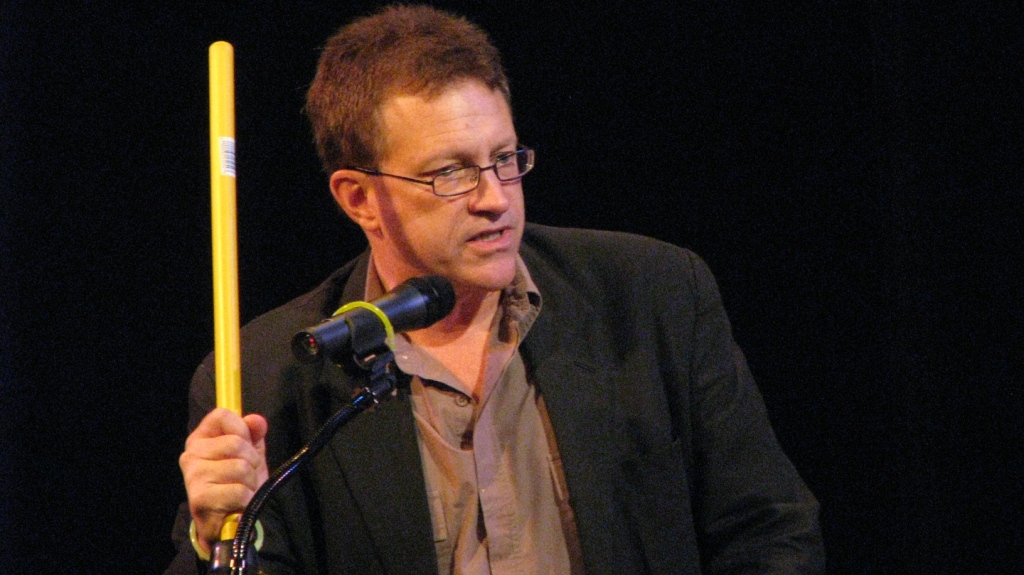
Speaking after I was given a toilet plunger by a department, a metaphor for the job of dean.

Let me raise another aspect of the job that’s immensely appealing to me. I had a particularly difficult time in coming to know what I wanted to “do with my life”, at least on a long-term basis, because I’m by nature an insatiably curious person. I was lucky growing up on a game farm where my parents indulged my curiosity with Time-Life Books and National Geographic Magazines and whatever they could get on astronomy, archeology, calligraphy, or, to cite my favorite: animal tracks and spore! As I’ve written previously, my early adult life was characterized by a string of very different jobs. In fact, one could describe my current job as “therapy for the insatiably curious”. On a given day, I might read cases or have conversations about tourism in the USSR, Shakespeare’s innovations with vengeance plays, Coast Salish language revitalization, sustainability in China, Aristotle’s philosophy of nature, the relationship between political parties and development in a village in Rajasthan, or the use of drone bombs in contemporary American warfare. And in a small way I get to contribute to sustaining the foundation for all of this great research and teaching to happen.

I’ve realized over the years that I’m a visual thinker and a systems thinker, and that I’ve always been attracted to the challenges of solving problems. In fact, I’m a sucker for challenges. As my wife is fond of reminding me, every academic job I’ve taken has been at a smaller effective salary than my last job, but they’ve always resulted in bigger challenges. And a deanship might be viewed as a succession of challenges, generally scores of them every day: structure a spousal hiring for retention of a faculty member; review and respond to an external review; figure out how to fund a construction project for a department; seek out donors for an endowed professorship; cancel a professorial search to reinforce the importance of diversity; determine the routing of a difficult tenure and promotion case; try to solve the long-term insolvency of a unit; consider a major new program with another Faculty; review appointment letters; review proposals to Senate; convince candidates to serve as Heads; see if we can assist in a retirement … that’s just culled from a portion of the docket on one day this week.

Every once in a while, I even get to teach a class, and thankfully I get to interact with students much the time. And if I’m ridiculously disciplined, or maybe selfish, I can eke out a little time to work on research and publication – I’m setting up a research lab/office, and I escape there whenever I can. In the most enjoyable moments of the job, I’m surrounded by and interacting with smart and creative people, I get to explore ideas and solutions and plan, maybe even laugh at some of the absurdities of institutional life, and I even get to help a little magic to happen. Being a part of the decision making, indulging my curiosity, helping some good things to happen that affect student’s lives and that can have a beneficial impact on society – these are the core attractions of the deanship for me. This is what makes putting up with the pace of the job and the stresses of having to make hard decisions and the constant strains on Faculty finances all tolerable. My lunch partner the other day talked about how much fun it had been to be a dean, and mentioned that in her current work she was having to find out how to influence the course of academic life and programs without having the authority to make it happen. I can relate — it is fun! It can also be incredibly stressful and consuming, and to use a word beloved of deans these days: relentless. But it is never boring.

I remember an article in the Chronicle of Higher Education many years ago that looked at what people do after serving as a dean. Less that a quarter of them went back into the classroom as full-time professors. Most have been too far removed from the literature and the changes in classroom technology and pedagogy to feel that they are the still the kinds of effective instructors that they looked for in their faculty. Most either retire or go onto other academic administrative positions. I have no idea what I will want to do when the time comes around, but it looks like I will once again have to ask myself the question: “What do I want to do when I grow up?”
Categories
Uncategorized

Thanks to serendipity

Given my job at this university, you might be forgiven for thinking that I have had an intentional and a planned life and career, although in reality, it was far from this. In thinking about the paths that our students will take into their unknown futures, I considered my own path from undergraduate student to becoming their dean. This is supposed to be a blog, and not the great Canadian novel, so I’m going to have to serve up the abridged version about how a former tenant organizer, tractor driver, and musician finds himself as dean of a leading Arts faculty.

This story should probably start when I dropped out of college. I was a forestry major at the University of Wisconsin, but had transferred into landscape architecture. Increasingly I found myself too energized to sit in class, too concerned about the state of the world to put off my interventions in it, and more and more in love with music and its ability to move people. And so I dropped out of school, determined to travel, devote myself to community organizing (I became the director of a statewide tenant’s union), kayaking, and most of all, music, which was now clearly an overriding passion. I joined a traditional and Irish rebel music with a band, launched a world music radio show on community radio, and started to organize festivals. After the unexpected death of my sister, I felt the need to regroup, I found myself working as a tractor driver and foreman of an apple orchard in New England. But a life of apple harvests wasn’t in my future either, because in tipping an apple bin one day, my back exploded in pain and I found myself incapable of physical labor or even of sitting for any length of time for some years until back surgery corrected the problem.

What was I to do as an ex tractor driver and tenant organizer with a bad back? First I tried selling Time Life Books. Let me describe the scene: I sat in a room full of telesales people with a call list and a script for selling, say, “The Wild, Wild West” series; and like others, I hoped to be called in front of the room to win a salesman of the week award. Instead my supervisor called me in to say that my verification callbacks had produced the lowest rate of confirmed sales in the history of the Seattle office. Fired from even this lowly job at the age of 28, I was already a failed Time Life Books salesman, which was a sobering proposition.

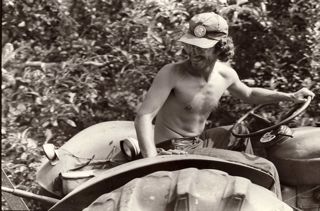
As a tractor driver and apple orchard foreman, age 27

I stumbled on another job possibility. A coffee shop in downtown Seattle, called Starbucks, was going to open a second branch – imagine that, a second branch of Starbucks – What were they thinking? — and they needed an assistant manager. Now, I had worked for a year in Wisconsin in a coffee house, so I brushed up on my knowledge of coffee and tea, but failed to be interviewed for the job.
But here, my chaotic narrative begins to take shape, because on the very next day in August, the Seattle Times newspaper carried a story about a shortfall in University of Washington admissions, noting that they would take applicants off the street for the semester that was going to start in two weeks. I headed down to admissions and signed up. As my finger ran down the list of possible majors to declare, it stopped at “ethnomusicologist”. Here was a term that seemed to resonate with my interests in world music, Irish and Caribbean music performance, and maybe even progressive internationalism. My finger kept coming back to this major, like a compass needle finding magnetic north. I had stumbled on my calling in life.
You have to understand that every conversation with my mom for the last ten years had come around to the question: “When are you going to go back to school?” So the first person I called was my mom to tell her that I was now enrolled to get a BA in ethnomusicology. After asking what that was, and what in the world I would do with a BA in it, she got around to the crux of her concern, “Aren’t you a little old to be in school?

Okay, perhaps I was. But I had committed just to the two years that it would take for me to finish a BA. However, my professors had other plans for me and nominated me for a Mellon Fellowship for graduate school. I hadn’t planned on graduate school, but the Mellon was a powerfully persuasive tool. And Mellon required a 5-year commitment to teaching. Five years of study and 5 years of teaching add up to a ten-year plan! I had never planned more than 6 months ahead in my life, so this kind of timeline was something new to me.

I wish I could say I planned any of it, but back injuries, university admissions cycles, and the failure to earn my fortune with Starbucks had led me to something about which I was passionate and to which I could devote myself fully and for the remainder of my life– this was a clear case of serendipity at work.
Allow me to take a quick digression concerning serendipity. It was in 1754 that Horace Walpole, the 4th Earl of Orford and cousin of celebrated Lord Nelson, wrote a letter in which he coined the term “serendipity”, from the Persian name (Serendip) for the island nation now called Sri Lanka. He wrote, “It was once when I read a silly fairy tale, called The Three Princes of Serendip: as their highnesses travelled, they were always making discoveries, by accidents and sagacity, of things which they were not in quest of.” The term has come into popular usage especially because so many revolutionary products, inventions, new pharmaceuticals, and scientific discoveries have occurred as a result of serendipity. Viagra, for instance, was being tested for the heart condition known as angina – it showed little efficacy in treating angina but had an odd and unanticipated side effect on male users that became the basis of an immensely profitable new industry.

My own dissertation topic? Well, again, accident and serendipity. I hoped to work on Cuban music, but couldn’t get a permit from the U.S. to study in Cuba. I designed a project to work on a processional music from Haiti called rara, learned Haitian Creole, and got a Fulbright grant, but then came a revolution in Haiti, which made the political and security situation unstable and Fulbright pulled back all of their grants to the country. I cast about and landed on another topic: a form of popular music in the French Caribbean islands of Martinique and Guadeloupe called zouk with an interesting relationship to the question of Afro-Caribbean vs. French identity. But a week before I left for Guadeloupe, I called a French Canadian colleague for travel tips, and she said, “I can’t believe this, but SSHRC has just given me a grant to pursue the same research project!” Catastrophe turned into serendipity when my colleague suggested I turn my attention back to Haiti and to collaborate with her on a book about popular music in the Francophone Caribbean, and I found myself embarked on a research project that was far more interesting and productive than any I had conceived of before.

Did I intend on becoming a music journalist on the side? No, but I complained once to the Miami New Times that they ignored Haitian music in Miami and they asked me to do a story. That story caught the eye of The Beat magazine, which asked for a single article and then, without consulting me, assigned me to be a regular columnist, writing a column called “Haitian Fascination”. And these columns caught the attention of record company executives, film directors like Jonathan Demme, and festival producers, and I found myself producing record compilations, writing liner notes, running festivals of Haitian music, and so on such that I developed a sideline career to my academic work. I later found out that this kind of work was being called applied and public ethnomusicology. I teach this now, and write on it, but it was, like most aspects of my career, something onto which I stumbled while I was pursuing something else.

My second major research project was perhaps more accidental than the first. As I visited my mother on the west coast of Florida before my first trip to Haiti, I was lugging a trunk full of research equipment with which I needed practice. So I set about trying to find a music group to record, but the pickings in the retirement villages on the west coast of Florida were slim. However, the Fort Myers Sun, a local paper, had an announcement for the opening the Thomas Edison Shopping Mall at which a local men’s barbershop chorus, the Caloosahatchee Chorus, was going to sing. They invited me afterwards to a party called an “afterglow” and that encounter with a barbershop group morphed into a 12-year research project on the social history of American barbershop harmony!

So, if any of our students are reading this blog, and thinking about the possibilities in your lives and careers, please don’t think that the Dean is telling you not to prepare well or to plan ahead, because luck and serendipity strike much more frequently for those who are prepared and who work hard. But also please recognize that many of the transformative moments in your lives, many of the opportunities that open up for you and paths that you travel down will be the ones not planned for; the serendipitous products of, as Horace Walpole said, “accidents and sagacity” while you are searching for something else.
When I was driving my tractor around the apple orchards 30 years ago, I didn’t have my current life in mind. Nevertheless, here I am, and I count myself immensely fortunate to serve as dean. So whether you call it luck, happenstance, accident, serendipity, fate, or the will of God, I hope that you too will be able to recognize and be open to taking advantage of the opportunities and chance encounters – that your life too will be the beneficiary of productive accidents and unexpected discoveries. (first conceived for a convocation speech, 2008, revised)

Spam prevention powered by Akismet