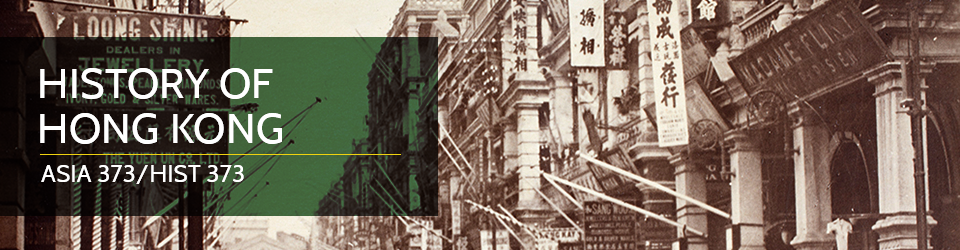
This course explores the history, culture, and identities of Hong Kong from the port’s origins on the edge of empire in the early nineteenth century, through more than 150 years of colonial rule and the 1997 handover to China, to its postcolonial present. Its goals are to help students develop the language and tools to understand the metamorphoses of this most unusual metropolis as well as to further their skills in historical analysis. Few territories of Hong Kong’s size have intersected so consistently with modern history’s major currents—empire, revolution, war, migration, capitalism, decolonization—and fewer still have played as outsized a part in shaping them. This course encourages students to critically consider the territory’s multifaceted identities as well as to take into account the local, national, and transnational contexts of its extraordinary transformations.
Course Structure
This course will be conducted in person, meeting twice weekly (Monday and Wednesday).
Students are expected to have reviewed and reflected on the assigned materials prior to each week’s Monday session. Readings will include both primary and secondary sources.
Monday sessions will consist primarily of lecture, introducing the week’s key themes. Wednesday sessions will build on this with further lecture and a tutorial component, in which we will discuss the assigned materials both as a class and in break-out groups.
Learning Objectives
The skills you build in this course—reading evidence critically, weighing competing accounts, and connecting a single place’s story to larger patterns—are the same ones historians, journalists, policy analysts, and researchers of every kind rely on. By the end of the term, you should be able to:
- construct evidence-based accounts of the changes, continuities, and challenges that have shaped Hong Kong society since the mid-nineteenth century;
- read and interpret primary sources—firsthand documents, images, and other traces of the past—with confidence;
- assess the strengths and weaknesses of competing historical claims and interpretations;
- situate Hong Kong’s transformations within broader regional and global patterns of historical change.
Assessment of Learning
This course follows the grading practices outlined in the Academic Calendar. For more details on the individual components, see the Assessment section.
| Quizzes | 10% |
| Discussion Posts | 15% |
| Attendance/Participation | 10% |
| Newspaper Column | 20% |
| Midterm Checkup | 5% |
| Annotated Bibliography | 20% |
| Final Exercise | 20% |
| Virtual Exhibition (optional) | 40% |
Important Dates
| Sept. 9 | First session |
| Sept. 21 | Last date to withdraw without the “W” standing |
| Sept. 30 | National Day for Truth and Reconciliation (No class) |
| Oct. 9 | Virtual Exhibition proposal (optional) due |
| Oct. 12 | Thanksgiving (No class) |
| Oct. 16 | Draft of Newspaper Column due |
| Oct. 19–23 | Midterm checkup |
| Oct. 30 | Newspaper Column due / Last date to withdraw with “W” |
| Nov. 9–11 | Midterm break |
| Nov. 13 | Annotated Bibliography checkpoint due |
| Dec. 4 | Annotated Bibliography due |
| Dec. 7 | Last session |
| Dec. 19 | Final Exercise/Virtual Exhibition due |
Learning Materials
- Carroll, John M. A Concise History of Hong Kong. Lanham, MD: Rowman & Littlefield, 2007.
- Other required readings are available online or through Canvas.
Office Hours/Learning Lounge
You will likely have questions over the course of the term. Please feel free to contact the instructor (preferred forms of address: Mr., Dr., or Prof. Shin) via email or through Canvas. The usual response time is within 24 hours, excluding weekends and holidays. Please use your UBC email address whenever possible.
Office hours are held by appointment (sign-ups).
A Learning Lounge is also available under Discussions in Canvas for students to post—and respond to—questions. Respectful and constructive netiquette is expected and appreciated.
Acknowledgment
UBC’s Point Grey Campus is located on the traditional, ancestral, and unceded territory of the xwməθkwəy̓əm (Musqueam) people. The land it is situated on has always been a place of learning for the Musqueam people, who for millennia have passed on their culture, history, and traditions from one generation to the next on this site.