Most of us remember, back in January 2010, the devastating earthquake occurred in Haiti which caused over 250,000 deaths. Then came the outbreak of cholera, which is an infection of the small intestine that causes severe diarrhea and vomiting. This outbreak is due to lack of sanitation and clean water and has caused over 400,000 Haitians became infected since the natural disaster.
It is not as if Haiti needed the earthquake to gain international attention; it had many problems even before. Two main problems were sanitation and agriculture. Currently, only 16% of rural Haitians and 50% of those in the cities have access to adequate sanitation facilities. Moreover, agricultural output is low due to poor soil fertility, soil erosion and lack of fertilizers.
Photo credit: CBC news
SOIL – Sustainable Organic Integrated Livelihood
Although it was amazing to see how much international attention Haiti received, there were a group of people long before 2010 that dedicated their hard work in improving the lives of Haitians. Please allow me to introduce the group SOIL – Sustainable Organic Integrated Livelihood.
Sasha Kramer, Executive Director and co-founder of SOIL, has been living and working in Haiti since 2004. She first came to Haiti as a human rights advocate, and in 2006 co-founded SOIL with Sarah Brownell. During that year she also received her Ph.D in Ecology from Stanford University.
Photo credit: http://www.oursoil.org/
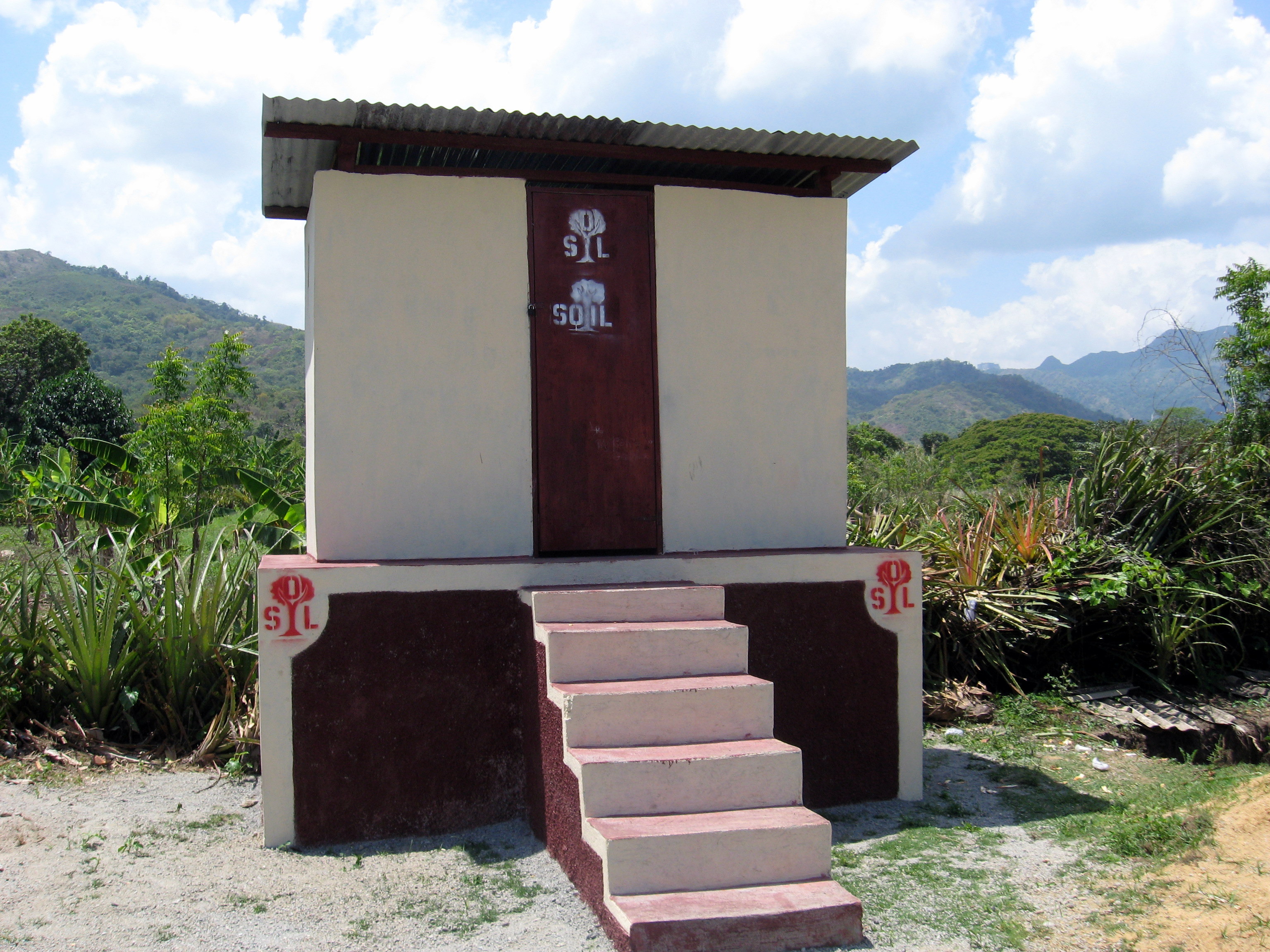
Dry Toilet
Together, they have transformed the idea of human waste into something more valuable than gold in Haiti. They started something called “ecological sanitation,” which is a low cost approach to sanitation where human wastes are collected, composted and recycled for use in agriculture and reforestation.
Within the toilet, called dry or composting toilet, the liquid and solid parts are separated. Then after a year of composting, it becomes a nutrient rich fertilizer, which can help the agriculture by doubling the yield. SOIL have already installed more than 50 public ecological toilets for schools and community group across Northern Haiti and they are planning on expanding their project throughout the country
Photo Credit: http://www.oursoil.org/
Since the earthquake, Sasha and her team relocated to Port-au-Price to assist in relief efforts there. After weeks of distributing emergency aid, SOIL began to set up an office in Port-au Prince in response to the outbreak of cholera and sanitation crisis.
People like Sasha and organizations like SOIL reminds us two things: one- that one person indeed have the power to make a different, and two- we have all the knowledge and resources to do so. Thanks to their hard work, a country with depleted resources is having a second chance to rebuild themselves through sustainable resources.
The capability that living creatures have to repair themselves is astounding. Imagine you accidentally cut yourself with a knife while you’re making dinner. It’s not a huge deal, a little inconvientent perhaps, but nothing your body can’t handle. Now imagine cutting a sheet of plastic with that same knife. The plastic does not have the same capability to re-heal itself like we do. Once it’s cut, it can’t spontaneously heal itself back into it’s original conformation.
However, this is a phenomenon scientists have been trying achieve for nearly a decade. By experimenting with plastics, metals and carbon composites, researchers are attempting to create self-healing materials.
Mediocre Microcapsules
Self-healing fluid and hardening agent in a cracked material. Source: The University of Illinois
For the past decade, self-healing technology involves microcapsules filled with a self-healing fluid embedded into the material that is to be repaired, say a plastic. The fluid in the capsules is a monomer of the polymer plastic. Accompanying the microcapsules are catalyst hardening agents that react with the healing fluid to solidify it.
When the crack in the plastic punctures the microcapsules, the healing fluid within is released into the crack. The fluid polymerizes when it comes into contact with the catalyst, and the mixture seals the crack.
This method is effective, but not very efficient. It can repair cracks between fifty and one hundred micrometers wide, but the fluids have to move through the material by diffusion, which can take a long time. Also, there is a limit to the number of capsules that can be put in the material without weakening it’s structural integrity.
Circulatory Channels
Pressurized self-healing channels. Source: The Journal of the Royal Society Interface. Hamilton et al. September 2011.
New research being conducted by scientists at the University of Illinois attempts to mimic an animal circulatory system by copying the blood vessels and heart. Instead of having the self-healing fluids in capsules, they have put it in channels in the material. Similar to the microcapsules, when the channels are punctured, the fluid within them is released into the crack.
In addition to this change, pressure is also applied at the inlets and outlets of the channel to force the fluid into the crack in the material. This added pressure acts like a heart does in a circulatory system. The heart forces blood to move all throughout an animal’s body. The pressure applied to the self-healing fluid has the same effect. This technique ensures that the entire crack can be effectively repaired. With the applied pressure method cracks up to one millimetre wide can be repaired.
Current Applications
This technology has innumerable applications in infrastructure and engineering. NASA is looking into self-healing materials particularly for their space stations. Cracks and damages on these structures could risk the safety of the entire mission. With self-healing materials, the lives of astronauts are more secure, and they can focus on exploration, rather than restoration.
For more information on NASA’s work on self-healing materials, check out this video.
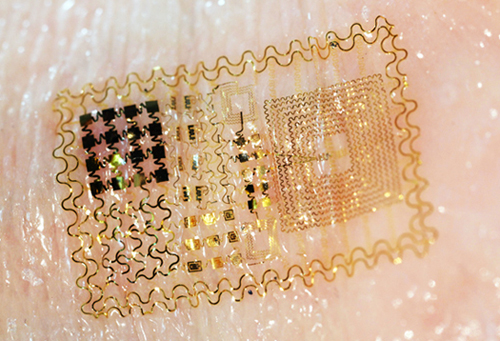
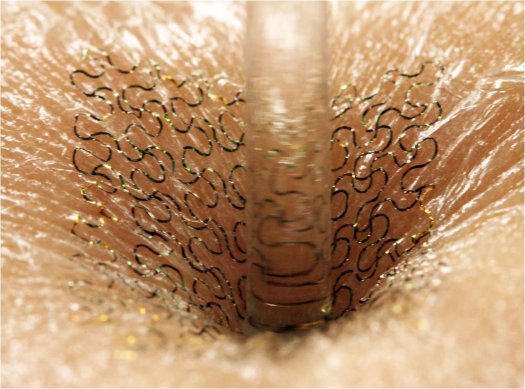
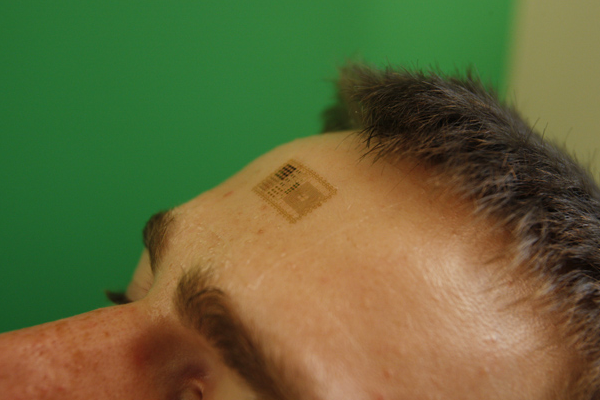
Researchers led by John Rogers from the University of Illinois at Urbana-Champaign have developed the world’s first flexible, stretchable, and skin-like monitor, which is capable of attaching to the epidermis of the skin by a process similar to applying a temporary tattoo. This wireless device can accurately collect data from the human body for up to 6 hours without irritating the skin.
Credit: John Rogers, University of Illinois
Inspired by the concept of telephone cords, this device features a netted S-shaped circuitry that can be greatly deformed without disturbing the function of the monitor. To make them even more durable, both sides are covered with protective layers of a polymer called polyimide. The device can be hidden under a tattoo to help it be concealed and remain attached longer. At the moment, long term use is limited because of surface skin cells sloughing off periodically.
Credit: John Rogers, University of Illinois
In its current form, the device would be most applicable in the medical field because of its ability to be seamlessly integrated into the skin of patients to monitor their activity constantly. By placing them in different locations on the body, medical staff could collect different electrical signals from the body such as brain waves, heart beats and skeletal muscle activity. This new technology is especially useful for premature babies because it could monitor their progress without any bulky electronics irritating their fragile skin.
Credit: John Rogers, University of Illinois
Aside from the medical community, security groups and intelligence agencies such as the CIA are also developing an interest in this technology; slight changes to this technology could enable agents to communicate silently with a patch hidden on their throats. This kind of patch would sense muscle movements in the throat and silently transmit the messages via wireless waves. With the initial prototype developed by Dr. Rogers’ team, many changes can be made to this technology to create a virtually infinite number of adaptations in the future.
Watch the Youtube video describing the epidermal electronic below:
No-one has come up with an explanation of why exactly some people are more comfortable using their left hand rather than right hand, but about 13% of the human population are.
Left-handedness is defined as the preference of left hand over the right hand in everyday activities such as writing. In ancient times, left-handedness was seen as a sign of the devil; everything “right” was good, everything “left” was bad. Such attitude towards left-handers is thought to have begun with the sun worshipers who lived in the far north. As they stood facing the sun, it appeared moving from left to right to them. Because the sun was moving towards the right, it was believed that right is always good, correct, or “right”. The Bible also contains references about left-handedness. In one of the Gospels, Jesus says that one day a man will sit on a throne and separate all nations, like sheep and goats are separates, and he will place “the sheep on this right hand, but goats on his left.” (Matthew 25:31-34, 41).
These beliefs were passed along to medieval times. Lefties were not trusted because they could shake other person’s hand with their left hand and they could carry a sword behind their back with their left hand. The word “left” came from Latin word sinister which means evil. The French word “gauche” means awkward or tactless.
Since we are science students, it’s time to look at this issue from scientific and, more interestingly, genetic point of view.
Left-handedness is a genetic trait widely investigated. In 2007, it was announced that alleles for this phenotype were found upstream of LRRTM1 gene. Twin theory suggests that left-handed people had a right-handed twin at the stage of pre-fetus development. This right-handed fetus failed to develop. Even though Australian researchers rejected this theory, it remains unknown why there is a high frequency of left-handedness/right-handedness in pair. A study by the Centers for Disease Control(CDC) suggest that pre-mature exposure to estrogen is likely to cause left-handedness.
Left-handed people also tend to be more creative and good at arts. Their right part of the brain, that is responsible for emotions, artistic vision and 3D thinking, is more active.
For now left-handed people are still a minority in this “right-minded” world and they often get discriminated against, especially in schools. However, genetic single-nucleotide polymorphism that causes left-handedness means that it is a common case and people with both phenotypes should co-exist in harmony.
So be proud to be different and remember:
– August 13th is the left-hander’s day!
– A number of famous people were/are left-handed, among them are Alexander the Great, Leonardo Da Vinci, Oscar De La Hoya, Albert Einstein and many others
References:
– Kilshaw, D. and Annett, M. (1983), Right- and left-hand skill I: Effects of age, sex and hand preference showing superior skill in left-handers. British Journal of Psychology, 74: 253–268. doi: 10.1111/j.2044-8295.1983.tb01861.x
– Corballis, Michael C., Laterality and myth, American Psychologist, Vol 35(3), Mar 1980, 284-295. doi: 10.1037/0003-066X.35.3.284
You may have heard of the “double rainbow song,” in which a man named Paul Vasquez ecstatically reacts to seeing a double rainbow. Now imagine Vasquez’s excitement when he finds out that a quadruple rainbow does indeed exist, and was just recently captured on camera for the first time by German meteorologist Michael Theusner. His findings were published in the October 1, 2011 issue of the Applied Optics journal.
Rainbows form from the refraction of light. Source:Wikimedia Commons
Rainbows are formed by the refraction of light through water droplets in the air. This refraction sometimes occurs a second time after being reflected once in the droplet to form a double rainbow. Rarely does the process occur inside the water droplet a third or fourth time for a triple or quadruple rainbow.
Sightings of triple and quadruple rainbows are extremely rare, as the conditions needed for them to form are increasingly more difficult (only a small portion of the light rays are reflected for a second refraction, and even smaller for the third and fourth refraction). Due to the drastic decrease in intensity, triple and quadruple rainbows are nearly invisible to the naked eye, and require image editing to be able to be seen. Additionally, the third and fourth rainbows can be easily missed because they are located away from the first and second rainbows.
Original and digitally enhanced pictures of the triple and quadruple rainbow. Source: Michael Theusner
The discovery and photography of triple and quadruple rainbows contributes to more than just another Internet meme. In addition to being a scientific breakthrough, it is also a reminder for all scientists to be meticulous and detailed when making and recording observations, as there can be more contributing factors and things going on in a particular experiment than what’s immediately visible. Much like how a series of image manipulations was required to see the additional rainbows, a detailed and thorough analysis of data could lead to discoveries that might not otherwise be found.
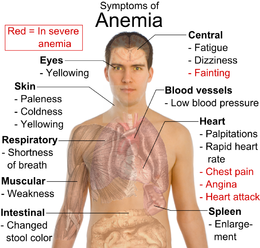
Anemia is a common condition exhibited in one in four people around the world. In fact, 50 percent of all patients that visit hospitals for surgery are anemic. The condition has a multitude of causes, ranging from malnutrition, genetic mutation, pregnancy, infection and blood loss. All of the above listed causes inhibit red blood cell (RBC) production, increase RBC destruction, cause blood loss and cause hypervolemia (a condition in which the blood contains too much fluid).
The lack of RBC or hemoglobin resulting from this causes a problem for body tissue; all cells need oxygen for survival and energy to continue functioning, and without sufficient hemoglobin to deliver it, anemia can be a deadly condition to the bodily tissues.
There is good news for people afflicted by anemia, as researchers at St. Michael’s Hospital have discovered a new use for a previously known enzyme that has an additional function should the host be anemic. Neuronal nitric oxide synthase (nNOS), an enzyme present in the nerve cells of the brain, produces nitric oxide, which increases bodily response and improves adaptation to low levels of oxygen, increasing the body’s efficiency in oxygen delivery to the body.
“Identifying this mechanism may lead to new therapies and approaches to improving outcomes for anemic patients,” said Dr. Greg Hare, a researcher at the Li Ka Shing Knowledge Institute of the hospital and one of the lead investigators of the study.
The researchers at St. Michael’s Hospital monitored the nNOS levels in anemic mice. They found that the nNOS present in the brains of anemic mice was increased, and these mice outlived the mice without nNOS. This result proves most curious, as people that are afflicted by anemia are often associated with weakness and low energy, contrasting with the longevity of the anemic mice.
“This research will help us identify when an anemic patient is at greatest risk for injury and death when undergoing surgery,” said Dr. Hare. “Research is underway to test these findings in humans.”
Should this new discovery be introduced into surgical procedures of anemic patients, the nNOS levels can be monitored, which will serve as a warning signal to the surgical team should the anemic patient’s body encounter any complications. The effect of this finding is especially pronounced when the above statistic, 50 percent of all surgical patients suffer from anemia, and the fact that anemia can stem from a great variety of causes, is put in mind. The discovery of this new function of an enzyme only present in people suffering from anemia begs the question: Are there any other diseases or conditions that have enzymes and yield similar beneficial results? Can being afflicted by a disease or condition result in any advantages that are not yet discovered?
References:
“Anemia – Wikipedia, the free encyclopedia.” Wikipedia, the free encyclopedia. N.p., n.d. Web. 3 Oct. 2011. <http://en.wikipedia.org/wiki/Anemia
Taylor, Kate. “Our Stories – What’s New – Who We Are – St. Michael’s.” St. Michael’s. N.p., n.d. Web. 3 Oct. 2011. <http://www.stmichaelshospital.com/media/detail.php?source=hospital_news/2011/20111003b_hn>.
St. Michael’s Hospital (2011, October 3). Researchers discover new enzyme function for anemia. ScienceDaily. Retrieved October 3, 2011, from http://www.sciencedaily.com/releases/2011/10/111003151832.htm
In our society, people probably have wondered about what is in one’s mind. We are always curious about what others think; but we cannot just dissect their brains to figure out. Now there is an alternate way to do this. The ‘mind-reading machines’ have been developed. Scientists have developed a computerized mind-reading technique which lets them accurately predict the images that people are looking at by monitoring brain activity.
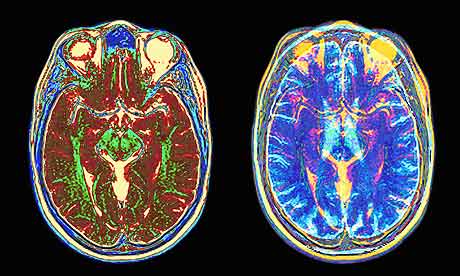
Scientists at the University of California have developed a computational model that uses functional MRI (fMRI) data to decode information from an individual’s visual cortex – the part of the brain responsible for processing visual stimuli.
The scientists have tested three of their members in fMRI to watch videos and they have figured out that blood is gathered at a certain part of the brain when members watched a specific video. For example, the scientists compare the different signals of brain when two different images of a hammer and ball are watched. Based on the database, they have developed a computer program that selects the most similar image of the actual image. This computer program also selects number of the most similar videos and engrafts them into one video. The scientists say that the study raises the possibility in the future of the technology being harnessed to visualize scenes from a person’s dreams or memory.
Furthermore, there is a similar machine developed in Korea in 2009. The team has made a motion detecting system that expresses a delicate face expression into an exaggerated face motion. This technology allows a machine to read a very detail change on face and possibly detect expressions of people. This technology is similar to a recent digital camera mode which automatically takes picture once people smile. There has been 88% of successful reading of the face when Dr. Kim’s team has tested on 20 people.
Moreover, United States also has a system that is much like a movie, “Minority report” which introduces a system that predicts crimes and prevents them beforehand. The cameras and sensors check people’s heart rate, respiratory rate, and body temperature to find out people with intention of committing crimes.
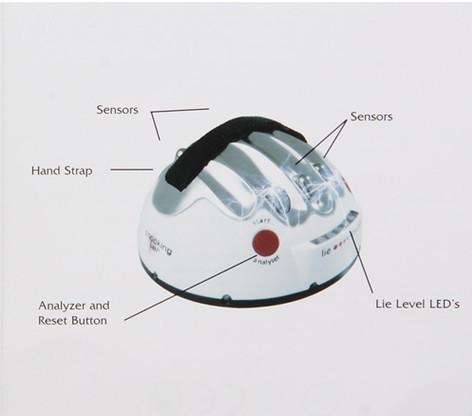
There have been different approaches to sort out liars through lie-detecting machine. Even though this machine is not reading one’s mind, it could be seen as application of detecting a change in mind state; breathing rate, blood pressure, and heartbeat will likely be different if one is telling a lie, and feel nervous.
Unfortunately, we cannot just accept and apply this continuous development of new techniques to our lives. Even though these machines could make our lives convenient, there is a risk. It has potential to disrupt individual’s private rights and result in moral violation. We should be aware that there is no scientific evidence about the accuracy of machines. Therefore, communicating skills to deal with this dilemma, further supports to provide evidences, and enough discussion on pros and cons of ‘the new’ are required for accepting new technology in science.
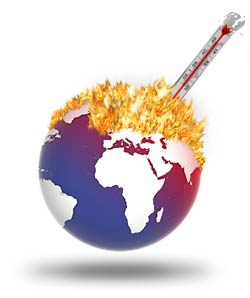
Scientists from universities across the United Kingdom are hoping to test one of their solutions to the worldwide issue of global warming. To understand the mechanism of the project, however, one must first be familiar with the process of global warming.
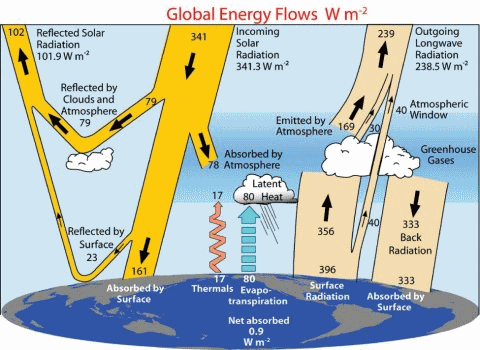
Global warming is based on the imbalance of infrared radiation (IR) entering and leaving the planet. This imbalance is caused by gases in the atmosphere, commonly referred to as greenhouse gases, which absorb the IR and emit it back towards the Earth’s surface instead of allowing it to travel back out into space. This process means more energy in the form of heat is being stored in the atmosphere and is consistently increasing Earth’s average temperature each year. Most of the greenhouse gases that are accumulating in the atmosphere are released through aspects of human activity such as farming, transportation, and electricity. Stopping all of these aspects isn’t going to stop the problem, as some of these harmful gases that have already been released will remain in the atmosphere for thousands of years. This gives scientists the opportunity to devise a system to cool the planet.
Global energy overview of radiation flow
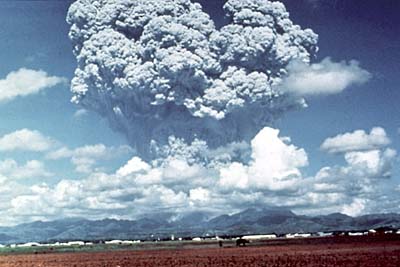
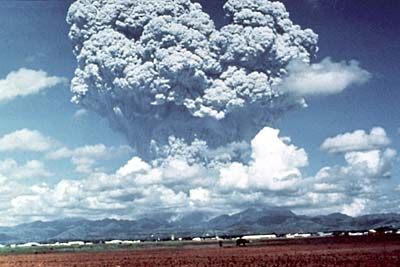
The SPICE project (Stratospheric Particle Injection for Climate Engineering) aim is to discover the best particle to introduce into the top of the atmosphere that will decrease the amount of IR entering the atmosphere. Their plan is to inject reflective aerosol particles into the atmosphere in hopes that they reflect the incoming radiation before it can enter the atmosphere. They based this idea on volcanic eruption effects on global temperature. Large eruptions release multiple cubic kilometers of ash and gas that then disperses across the globe creating a layer or reflective particles. Two years following the Mount Pinatubo eruption the global temperature dropped by 0.5 degrees Celsius.
Ash cloud produced from Mount Pinatubo eruption
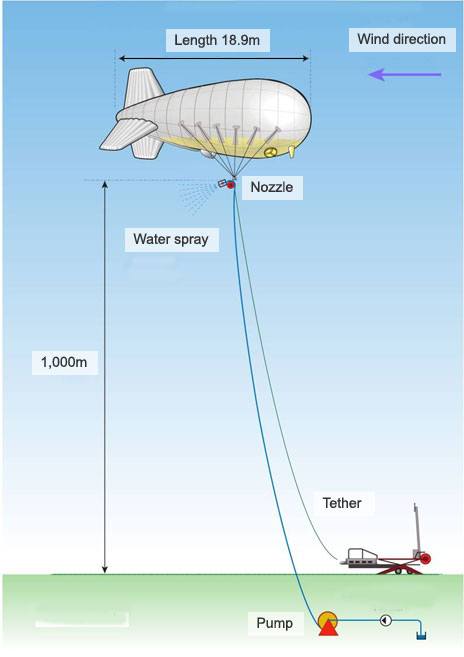
Scientists want to mimic this effect in their tests by spraying reflective particles from a hose at a rate of 100 liters per hour from a 20 m long balloon at a height of 1 km. The balloons success in launch and recovery and its tolerance to high winds will be monitored and help in planning the final result of a colossal balloon at a 20 km altitude. Projections indicate we could lower the global temperature by 2 degrees Celius by spreading 10 – 20 of these balloon mechanisms set at a 20 km altitude around the world.
I think that though global warming isn’t showing how devastating it can be quite yet but will prove a difficult problem in the near future. The problem scientists are facing is either trying to convince people that global warming is real or that it is an urgent issue we should address. To accomplish this they have to be able to convey their message effectively to their specific audiences. This is where Science 300 concepts apply as we are learning how to use wording, diagrams, and presentation to entice and convince our audience. These skills need to be utilized by scientists to explain the necessity of their research to the public.
Sources:
Note from EOSC 340-Global Climate Change Class
Archer, David. Global warming: understanding the forecast. USA: Blackwell Pub., 2007. Print.
Battison, Leila. “Giant balloon to be launched to test climate fix hope.” BBC News: Science and Environment. BBC, 14 Sept. 2011. Web. 29 Sept. 2011. <www.bbc.co.uk/news/science-environment-14916451 >.
“Global warming – Wikipedia, the free encyclopedia.”Wikipedia, the free encyclopedia. N.p., n.d. Web. 2 Oct. 2011. <http://en.wikipedia.org/wiki/Global_warming>.
“Greenhouse gas – Wikipedia, the free encyclopedia.” Wikipedia, the free encyclopedia. N.p., n.d. Web. 2 Oct. 2011. <http://en.wikipedia.org/wiki/Greenhouse_gas>
“The SPICE project: a geoengineering feasibility study .” NERC. N.p., 14 Sept. 2011. Web. 30 Sept. 2011. <www.nerc.ac.uk/press/releases/2011/22-spice.asp>.
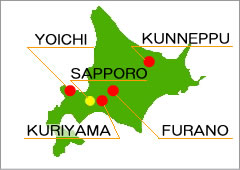
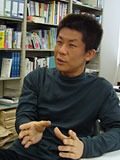
There is a communications in science course that I would like to share. This past summer, I heard about a Japanese researcher named Dr. Gensei Ishimura, and I found through his website that he is one of the leading members of a program for training effective science communicators. This program is called CoSTEP, or Communicators in Science and Technology Education Program. This effort started out in Hokkaido University in northern Japan. It also received international attention through the American Association for the Advancement of Science (AAAS) held in Boston in 2008.
In an interview, Dr. Ishimura shared some methods of getting people involved in science communication.
Sapporo Kanko Science Map (Sapporo Tourism Science Map)—This project explored how to use the web to communicate information, a similar aim to this SCIE300 course blog assignment. The CoSTEP teaching team preferred blogs as a blog format offers a simple method of updating information on the web. Dr. Ishimura reasoned that since there is so much information on the web, he must make his blog stand out by emphasizing the aspects unique to CoSTEP. Students enrolled in CoSTEP are mostly residents of Sapporo city with a science background, so they were asked to write feature articles on aspects of science found in various locations around Sapporo and to organize them into a map. As a final assessment, they compiled a manual for creating the science map and made it accessible to the public.
This shows that the content of the blogs as well as the method of creating it is important to learn about communication.
Newspaper publication—In this component of the CoSTEP course, students learned how to write and publish newspaper articles. There were four workshops in total to understand and expand on the publishers’ ability to communicate to readers through newspapers. An example of the questions explored was “where do people pay attention to on a newspaper?” This type of data turned out to be a novel finding even for the publishers. Students also modeled a grocery store management group and presented on the advantages of posting an advertisement in a high school newspaper. This aimed to connect high school students and the publishers.
Newspapers are another popular mode of communication. This activity seems to address important ideas such as layout and targeting a specific audience.
Dr. Ishimura himself is a science communicator. His previous experience in the management of science museum exhibits shows a career where science communication skills directly apply to the aims of the institution.
One of the most deadly killers in our modern day world is an invisible one. It is clear, scentless and tasteless and goes by the common name: water. In Canada, we are fortunate enough to be able to grab a quick glass of water from the kitchen sink and trust that it comes from a safe source. However, we are one of the few countries in the world that can boast about such a luxury.
Some statistics about dirty water
884 million people in the world do not have access to safe water (approximately 1/8th of the worlds population)
2.6 billion people in the world do not have access to adequate sanitation (approximately 2/5th of the worlds population)
1.4 million children die every year from diarrhea caused by unclean water and poor sanitation (approximately 4,000 child deaths a day)
50 percent of people are affected by diarrhea from dirty water
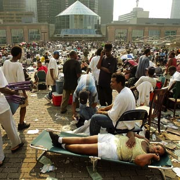
In many third world countries, when disasters such as tsunamis hit, people are forced to flee their homes for higher ground and drink contaminated water. Yet when hurricane Katrina hit New Orleans, in 2005, it took five days to get water to the superdome despite the fact that it occurred in the United States, a first world country. It seems as though there hasn’t been any improvements in the way governments handle these disasters, no matter if it is a poor or rich region.
Thousands of people gather at the Super Dome in New Orleans after the city was destroyed by Hurricane Katrina: August 2005
Normally in a crisis, governments and aid relief workers are able to ship water and set up camps for people in approximately a few weeks following a disaster. This means that people are forced to come to the camps for safe drinking water. Unfortunately, when so many people are clumped together, disease is spread, more resources are needed and the problem inflates.When faced with such a problem, it sometimes seems too huge to be able to deal with. Governments and society, as a whole, think that it is an impossible situation. However, one man decided to think differently and change our way of dealing with this problem.
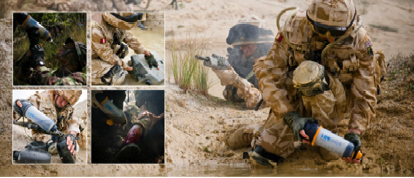
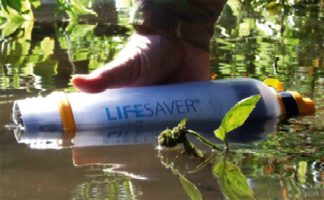
The LifeSaver Bottle has many applications including use in the military.
A scientist by the name of Micheal Pritchard has created a water filtration system that by far out-competes the old designs. Until now, the best hand filters available on the market were able to filter down to 200nm material. However, Mr. Pritchard realized that the smallest bacteria are 200nm and the smallest viruses are 25nm. As such, these filtration systems are not nearly good enough to completely sterilize dirty water.
As a result, Micheal Pritchard created his ‘Life saver bottle.’ His design utilizes 15nm-filtering pores, which means that absolutely no impurities will get through and potentially infect the consumer. The bottles last for up to 6000L and the 25000L Jerrycan is enough for a family of 4 for 3 years, with a total cost of half a cent per day to run. Each comes with fail-safe technology that automatically shuts off the system when it reaches this amount to protect the user.
The LifeSaver Bottle can take water from any source and quickly sterilize it. (Image taken from lifesaversystems.com)
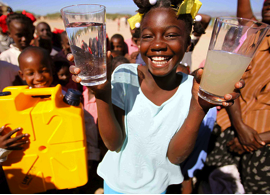
What this means, is that people can stay put and get their own water, and governments won’t have to ship water for copious amounts of money to aid masses of affected people. They will never again need to walk miles to get to the nearest clean water source. It is as simple as filing up the bottle with whatever water source is available, whether that’s a dirty river or a nearby pond, giving the pump handle a few pushes, and in seconds sterile, clean drinking water is produced.
LifeSaver Bottles were taken to a small village in Haiti to solve their dirty water problem.
For just $8 billion, we can obtain the worlds ‘millennium goal’ and halve the amount of people without access to safe drinking water. However, for only $20 billion, everyone in the world can have access to safe drinking water. This means that the 3.5 billion people that suffer every year and the 2 million children that die every year will now live.
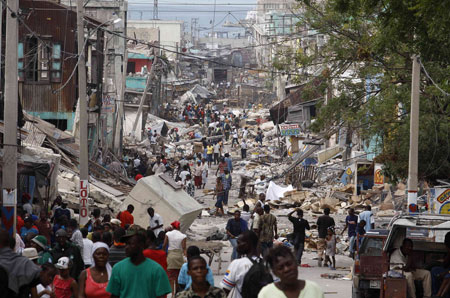 Photo credit: CBC news