Categories
Environment New and innovative science Science in the News

Double (Double) Rainbow, all the way (all the way)

Double Rainbow Song by Paul Vasquez and the Gregory Brothers.
Source: Youtube channel (schmoyoho)

You may have heard of the “double rainbow song,” in which a man named Paul Vasquez ecstatically reacts to seeing a double rainbow. Now imagine Vasquez’s excitement when he finds out that a quadruple rainbow does indeed exist, and was just recently captured on camera for the first time by German meteorologist Michael Theusner. His findings were published in the October 1, 2011 issue of the Applied Optics journal.

Rainbows form from the refraction of light. Source: Wikimedia Commons

Rainbows are formed by the refraction of light through water droplets in the air. This refraction sometimes occurs a second time after being reflected once in the droplet to form a double rainbow. Rarely does the process occur inside the water droplet a third or fourth time for a triple or quadruple rainbow.

Sightings of triple and quadruple rainbows are extremely rare, as the conditions needed for them to form are increasingly more difficult (only a small portion of the light rays are reflected for a second refraction, and even smaller for the third and fourth refraction). Due to the drastic decrease in intensity, triple and quadruple rainbows are nearly invisible to the naked eye, and require image editing to be able to be seen. Additionally, the third and fourth rainbows can be easily missed because they are located away from the first and second rainbows.

Original and digitally enhanced pictures of the triple and quadruple rainbow. Source: Michael Theusner

The discovery and photography of triple and quadruple rainbows contributes to more than just another Internet meme. In addition to being a scientific breakthrough, it is also a reminder for all scientists to be meticulous and detailed when making and recording observations, as there can be more contributing factors and things going on in a particular experiment than what’s immediately visible. Much like how a series of image manipulations was required to see the additional rainbows, a detailed and thorough analysis of data could lead to discoveries that might not otherwise be found.
Categories
Environment Issues in Science New and innovative science Science in the News

SPICE Up Your Life


Scientists from universities across the United Kingdom are hoping to test one of their solutions to the worldwide issue of global warming. To understand the mechanism of the project, however, one must first be familiar with the process of global warming.

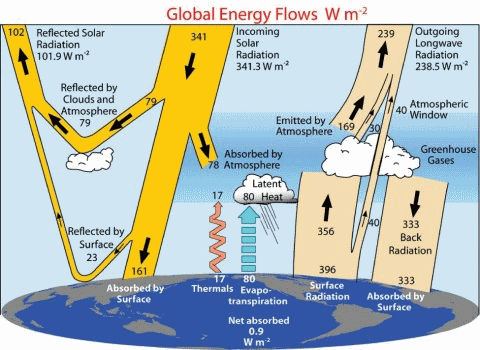
Global warming is based on the imbalance of infrared radiation (IR) entering and leaving the planet. This imbalance is caused by gases in the atmosphere, commonly referred to as greenhouse gases, which absorb the IR and emit it back towards the Earth’s surface instead of allowing it to travel back out into space. This process means more energy in the form of heat is being stored in the atmosphere and is consistently increasing Earth’s average temperature each year. Most of the greenhouse gases that are accumulating in the atmosphere are released through aspects of human activity such as   farming, transportation, and electricity. Stopping all of these aspects isn’t going to stop the problem, as some of these harmful gases that have already been released will remain in the atmosphere for thousands of years. This gives scientists the opportunity to devise a system to cool the planet.


Global energy overview of radiation flow

The SPICE project (Stratospheric Particle Injection for Climate Engineering) aim is to discover the best particle to introduce into the
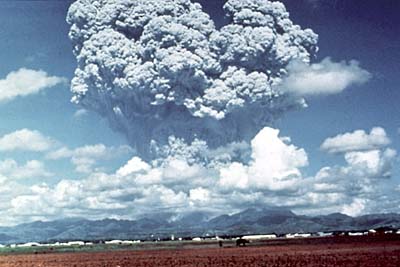
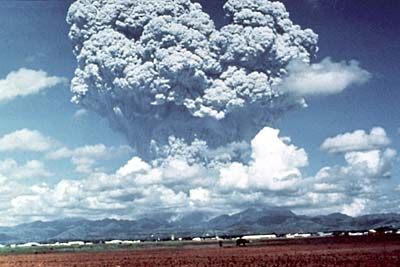
top of the atmosphere that will decrease the amount of IR entering the atmosphere. Their plan is to inject reflective aerosol particles into the atmosphere in hopes that they reflect the incoming radiation before it can enter the atmosphere. They based this idea on volcanic eruption effects on global temperature. Large eruptions release multiple cubic kilometers of ash and gas that then disperses across the globe creating a layer or reflective particles. Two years following the Mount Pinatubo eruption the global temperature dropped by 0.5 degrees Celsius.

Ash cloud produced from Mount Pinatubo eruption

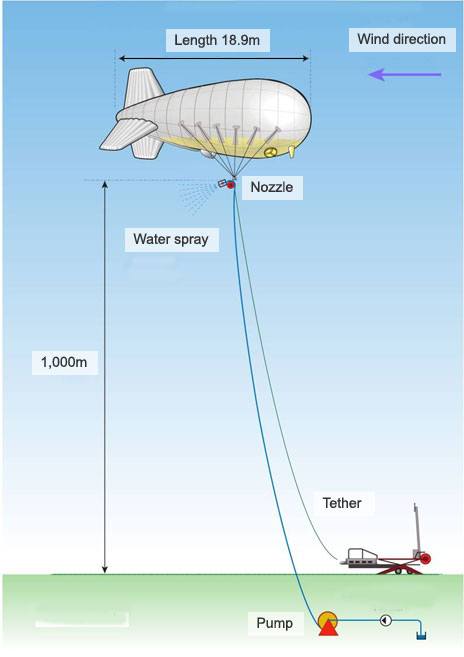
Scientists want to mimic this effect in their tests by spraying reflective particles from a hose at a rate of 100 liters per hour from a 20 m long balloon at a height of 1 km. The balloons success in launch and recovery and its tolerance to high winds will be monitored and help in planning the final result of a colossal balloon at a 20 km altitude. Projections indicate we could lower the global temperature by 2 degrees Celius by spreading 10 – 20 of these balloon mechanisms set at a 20 km altitude around the world.


Demonstrating the SPICE project

SPICE project set-up

I think that though global warming isn’t showing how devastating it can be quite yet but will prove a difficult problem in the near future. The problem scientists are facing is either trying to convince people that global warming is real or that it is an urgent issue we should address. To accomplish this they have to be able to convey their message effectively to their specific audiences. This is where Science 300 concepts apply as we are learning how to use wording, diagrams, and presentation to entice and convince our audience. These skills need to be utilized by scientists to explain the necessity of their research to the public.

Sources:

Note from EOSC 340-Global Climate Change Class

Archer, David. Global warming: understanding the forecast. USA: Blackwell Pub., 2007. Print.

Battison, Leila. “Giant balloon to be launched to test climate fix hope.” BBC News: Science and Environment. BBC, 14 Sept. 2011. Web. 29 Sept. 2011. <www.bbc.co.uk/news/science-environment-14916451 >.

“Global warming – Wikipedia, the free encyclopedia.”Wikipedia, the free encyclopedia. N.p., n.d. Web. 2 Oct. 2011. <http://en.wikipedia.org/wiki/Global_warming>.

“Greenhouse gas – Wikipedia, the free encyclopedia.” Wikipedia, the free encyclopedia. N.p., n.d. Web. 2 Oct. 2011. <http://en.wikipedia.org/wiki/Greenhouse_gas>

“The SPICE project: a geoengineering feasibility study .” NERC. N.p., 14 Sept. 2011. Web. 30 Sept. 2011. <www.nerc.ac.uk/press/releases/2011/22-spice.asp>.

Categories
Environment Issues in Science

The Green Car Trophy: Did Hybrids Cheat to Win?

Whether you sincerely care about the environment or not you have probably heard about the Toyota Prius. As the icon of ‘green cars,’ the Prius provides spectacular fuel economy and most importantly, outputs less environmentally harmful carbon emissions. The Prius is able to achieve these feats because of its innovative hybrid drive-train, which combines a small gasoline engine with an electric motor. The electric motor generally powers the vehicle using a large battery pack at slow speeds, while the gasoline engine kicks in at higher speeds or whenever power is needed.

Photo by: Robert Scoble

Sure, as test figures reveal, the Prius indeed uses less gasoline when being driven, but do the Prius and similar hybrid electric vehicles really reduce the negative impact on our environment? Delving into the manufacturing process of hybrid vehicles will surely make you think otherwise.

Research suggests that the manufacturing process of a Prius contributes more negatively to the environment than driving several gas guzzling sport-utility vehicles, for a distance triple its lifetime mileage ever could. The culprit which taints the Prius’ beloved reputation is its main component, the battery. The amount of effort required to make this Nickel-based battery is absolutely staggering.

A hybrid car’s battery production starts with mining and smelting nickel. The factories which carry out this process are dangerously damaging to the environment. They let out copious amounts of Sulphur Dioxide, the major cause of acid rain. Energy coordinator David Martin of Canadian Greenpeace spoke about the impact of such a factory on its city saying, “The acid rain around Sudbury was so bad it destroyed all the plants and the soil slid down off the hillside”.


‘each container ship is as polluting as fifty million cars combined’


The next process required to create the battery is refining of the nickel, which is done in a select few specialized places across the globe. As a result the nickel must be transported to this specialized location. Ensuing refinement, the nickel must then be transported again to another place for further modifications to be able to incorporate it into the battery. Finally, it must be shipped back to the manufacturer for assembly. In the Prius’ case, the nickel must be shipped from Canada, to Europe, China, and back to Japan. All this shipping is no simple task. It requires the use of massive container ships. Regarding these container ships, a study by the Danish government’s environmental agency revealed that each container ship is as polluting as fifty million cars combined.

The issues discussed so far are only about 75% of the problem. As with other batteries, the batteries used in hybrid cars have the inherent flaw of a limited lifetime. After this lifetime, the cars will become impractical to use. At this stage, the batteries will require special attention for disposal, as they contain environmentally harmful electrolytes.

It can be attracting for consumers to buy into hybrid electric vehicles, given they are at the pinnacle of fuel efficiency. However, consumers need to ask themselves whether the environmental impact of manufacturing and disposing of the batteries in hybrid cars is outweighed by the lower lifetime carbon emissions produced by driving the vehicle itself.

Until science figures out eco-friendly manufacturing processes, we should probably focus on carpooling, using public transport, and other alternatives to hybrid vehicles!


watch?v=YGT6alnrg7I

Categories
Environment Issues in Science Science Communication

True or False? Presenting Scientific Data Without Evidence

Over the course of Earth’s history there have been many mass extinctions. After each one there is the devastation of a world rid of many forms of life.  Barren and bleak, it must be a hard place to live.  Nevertheless, each mass extinction allows space for new life to grow and develop, such as dinosaurs and humans.  The uprisings, life spans and demises of several creatures have been well documented by scientists throughout history.

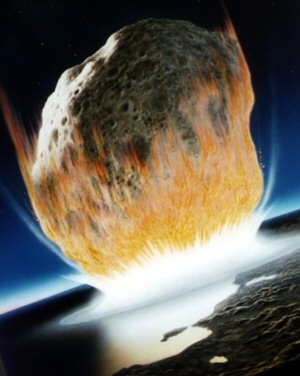
It is well known that mass extinctions do occur, but their exact mechanism is often unknown, or speculated at best.  For example, one of history’s greatest mysteries is what caused the massive Permian-Triassic extinction. Caused by a large volcano eruption or a meteor strike resulting in a severe lack of oxygen in the atmosphere and ocean, this extinction is estimated to have killed 85% of all living organisms on the planet. However, a recent Vancouver Sun article cites rising ocean acidity levels as the culprit for the P-T extinction, not a lack of oxygen.


A large meteor strike is one of the possible causes of the Permian-Triassic extinction.

While this article raises interesting points, there is a complete lack of evidence for the ocean acidity hypothesis.  As scientists it is important to remember that we haven’t found out everything there is to know about the world, and that new discoveries are being made on a daily basis.  However, each new discovery needs to have accompanying evidence to confirm the finding.  While most scientists are aware of this, and are wary of research presented without evidence, members of the public may not be so cognizant.  Thus, when new information is presented without evidence it can be misleading to people outside the scientific community.  It is therefore important that as scholars we communicate clearly with both the public and the media who will be translating our information.  This will ensure that there is no room for misinterpretation or deceptive statements.  By keeping the language we use to communicate science clear and simple, it will make it easier to convey our ideas to the general public and thereby bolster an interest in the field.


Spam prevention powered by Akismet