“Music relates to many brain functions like perception, action, cognition, emotion, learning and memory and therefore music is an ideal tool to investigate how the human brain is working and how different brain functions interact.”
Music is a research area for neuroscientists – scientists who study nervous system – because of its relation to various brain functions mentioned above. I came across a very interesting video on YouTube on Music Processing. The video demonstrates the basic knowledge of the processing of music in the brain.
About Neuroplasticity and Means to Investigate
The brain develop much quickly at early childhood of a person’s life; however, the development of the brain does not stop at early childhood. The brain continues developing and being modified by experiences. To investigate and observe the changes within the brain, non-invasive scientific methods are developed, such as electroencephalography (EEG) and magnetoencephalography (MEG).
Music and Plasticity
Both long-term and short-term music trainings have effects on brain plasticity. Experiments were done on musicians and non-musicians. Some interesting findings are:
Musicians are generally better in recognition of tones, especially in instrumental tones (piano), than non-musicians. The longer the music training, the large the difference in representation between pure tones and piano tones.
Musicians can much readily distinguish the timbre from their trained instruments than from an untrained instrument.
When non-musicians were exposed to short-term music training, the ones that had practiced on piano performed better than the ones that only had auditory training.
etc.
Those are wonderful things associated with music on the topic of neuroplasticity. Nonetheless, there is a “dark side” to it, because maladaptive reorganization in auditory nervous system can result tinnitus. This condition can severely affect people’s quality of life in a negative way. Through music training, the effects of tinnitus on subjects can be dramatically decreased.
“The effects of training on cortical plasticity involving music hold promising prospects for neuronal rehabilitation, as shown in the last tinnitus study”.
——————————————————————————————————–
Further Reading:
Pantev, Christo; Herholz, Sibylle C. Plasticity of the human auditory cortex related to musical training. Elsevier. Neuroscience & Biobehaviroral Review. November 2011.
30 years after the first reported cases of AIDS we still do not have a cure for a disease that has killed 25 million people.
Source: Wikipedia
The World Health Organization currently estimates at least 33 million people are currently infected worldwide and approximately 2 million deaths are attributed to the disease each year. While in most western countries the impact of HIV is limited due to the use of Antiretroviral drugs with HIV+ patients sometimes having life expectancies close to the average uninfected individual. However in less affluent countries AIDS is a serious problem.
Now to explain how HIV/AIDS infects an individual and how the current treatments work. The HIV virus replicates in the human body by inserting it’s genetic code into human cells, most commonly a type called CD4 cells, which then produce a large amount of HIV particles before dying soon afterwards. Antiretroviral drugs interfere with this replication process of the HIV virus in the human body and reduce the amount of HIV to extremely low levels (so low that sometimes the presence of HIV can’t even be detected by a standard test). However a problem lies with ‘resting’ CD4 cells that can lie dormant for years and keep HIV’s genetic material in the body. Then when the patient stops receiving the treatment the “HIV can re-establish itself by leaking out of these “viral resevoirs”” (avert.org). So there is 2 potential paths for HIV cures:
A Sterilising Cure – A cure that would remove all infected cells.
A Functional Cure – A cure that will keep the virus dormant and prevent it from replicating after the discontinuation of antiretroviral drug treatment. (Further reading on potential functional cure)
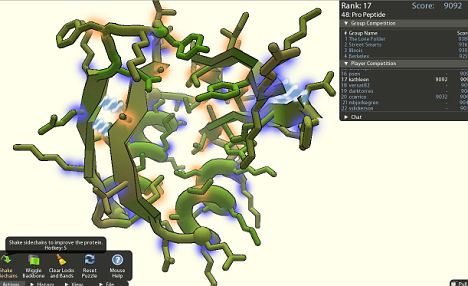
AIDS related discoveries have been in the news regularly in recent months. The first of these stories was published in the journal Nature Structural and Molecular Biology and acknowledged an unprecented number of people as helping to make the discovery. Scientists had been trying to work out the structure of “M-PMV retroviral protease – an enzyme that plays a key role in the development of a virus similar to HIV” (http://www.bbc.co.uk/news/technology-14986013), for over a decade without success. Amazingly when the protein was given to players of an online game called Foldit it only took 10 days for the 57,000 players (that were acknowledged in the paper) to work out the lowest energy configuration of the protein. “This result could be an important step forwards in the development of anti-Aids drugs”. MSNBC Video on Foldit Discovery
Source: dailymail.co.uk
Another recent lead in the hunt for a cure is the discovery that removing cholesterol from the membrane of HIV can stop it from damaging the immune system. Cholesterol is necessary to keep the outer membrane fluid and the virus picks it up from the first immune cells it infects. When the cholesterol is removed, HIV can no longer communicate and disrupt the immune system. These findings were published in journal Blood and scientists are now working on seeing if they can turn the inactivated virus (that no longer contains cholesterol) into a vaccine. (Further reading on cholesterol discovery)
A third paper published recently in the journals Vaccine and Journal of Virology by researchers in Spain details a new vaccine called MVA-B that has demonstrated promising results. The vaccine is “made with bits of non-infectious HIV genetic material and is designed to train the body’s immune system over time to detect and fight different components of the virus”. The vaccine has been tested on healthy volunteers (without HIV infection) and achieved an immunological response against HIV in 92% with 85% of them maintaining immunity for 12 months. The next stage is to test the vaccine on HIV positive individuals and if these trials go well “the scientists believe they may well have found a vaccine that could turn HIV into a minor chronic infection, similar to Herpes” and would therefore only be a problem for people with compromised immune systems. (Articles for further reading on MVA-B vaccine here and here)
With these recent discoveries this elusive cure may not be far away and it is exciting to think that we may live to see major diseases cured in the very near future.
Imagine yourself walking on the street, surrounded by mirrors. You would be seeing myriad of yourself straying alongside and pass you. That may be how the world would be like if cloning is to be successful and legal.
Image: The Roslin Institute
The most renowned successful case of cloning is undoubtedly Dolly the sheep. Born in 1996, Dolly was a shock to the scientific world. However, it raises ethical concerns. Should we be cloning animals?
May it be to bring back the dead to live, to preserve the looks of a being, or for whatever other reasons, cloning is still considered unethical, illegal or both in most countries.
Image: Yorgos Nikas/Getty
Dr. Panayiotis Zavos had been continuously attempting to clone the first human being, working in a surreptitious lab in the Middle East. Over the past 10 years, he had been implanted numerous embryos into anonymous surrogates, though none of the women had become pregnant or gave birth to any infants. As Sample mentioned in his article, “almost every attempt to clone a new animal species has been married with birth defects or worse.”
Cloning animals could give rise to many other problems too. Debates had been carried out on whether we should clone Neanderthals, or resurrecting mammoth from the ice age. Bringing these back to life may be chaotic and cause disorders in the nature’s ecosystem. The food chain could be stressed and scrambled, with new species being re-introduced. Organisms could become extinct, while many others would have to strive for survival.
Image: Action Press /Rex Features
If it does happen that we clone the extinct species from their DNA, we have to be responsible for any difficulties caused. It is difficult to map the whole DNA sequence of a species to clone it without any deficiencies especially if no live specimen is present for comparison.
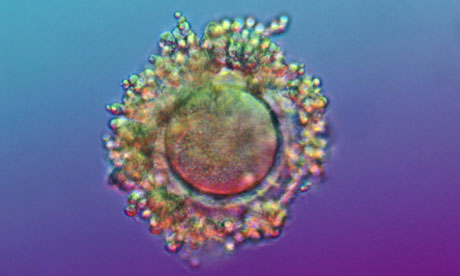
Despite the arguments over cloning an individual, extensive effort had been put into the researches of therapeutic cloning. Therapeutic cloning, also called “embryo cloning” is the use of embryos and stem cells to generate specialized cell in the human body. This technique is still under research for improvements in human development and disease treatment.
When the technology is mastered, whole healthy organs can be produced from a single cell to replace the damaged ones, and treat diseases and disorders that normally require transplants or other complicated procedures.
Nonetheless, cloning still remains as one of the biggest controversies in the society and will carry on regardless of whether the technology of cloning is improving or not.
The Tasmanian devil is a resilient and notoriously fiendish predator. Weighing up to 26 pounds, this carnivorous marsupial may not seem like a threat. However, pound for pound, its muscular jaws and sharp teeth add up to one of the most powerful bites of any mammal. To this end, it is hard to believe that the species is facing a rapidly declining population – over 60% in the last decade.
Provided that humans have an exceedingly influential role in the ecosystem, it is surprising to find that human-induced climate change, water pollution or land development isn’t the culprit behind this population decline. Rather, cancer (a disease that also targets humans) is the disease that has taken this species by the thousands.
Specifically, this rare and highly parasitic cancer has been named the Devil Facial Tumor Disease (DFTD). Characterized by lesions on and around the mouth, these tumors have been known to spread from the face to the entire body within months. These tumors also interfere with feeding and lead to starvation – the primary cause of death.
Source: Australian Geographic, Getty Images
An illustration of DFTD in a Tasmanian Devil. Based on the size and texture of the tumor, it is easy to imagine how detrimental DFTD is to the survival of the Tasmanian Devil.
One of the reasons why DFTD is so transmissible is because of the devil’s behaviour: frequently biting each other’s faces while fighting for food or mates. Scientists studying the disease have also found that the cancer cells in these tumors shed, and take root in the wounds of bitten Tasmanian devils. Further analysis has shown that the tumors have a remarkably similar genetic makeup to Schwann cells (cells that cushion nerve fibers in the nervous system). For this reason, the Tasmanian devil’s immune system is unable to detect the cancer cell as a foreign cell, and will not take the necessary steps to mount an immune defense against the disease. As a result, DFTD is able to develop and proliferate throughout the entire body.
A video by Al Jazeera English (News Network) demonstrating the preliminary experimental method used to study DFTD. It also illustrates the physical features of DFTD in the Tasmanian devil.
Because the severity of DFTD has scientists predicting that the species could be lost within the next 25 years, it is commendable that humans are making great strides to prevent the extinction of the Tasmanian devil. Not only have scientists been able to receive grants to aid in DFTD research, but also, the Australian government has now listed Tasmanian devils as vulnerable and is drawing up captive breeding programs to save the species from extinction. To this end, we have simultaneously added to the existing knowledge of cancer as a multi-faceted tumor disease and are taking the steps to further study, isolate and find a vaccination. Ultimately, researching cancers in different mammals may help us find a cure in the future for cancers that plague the human race.
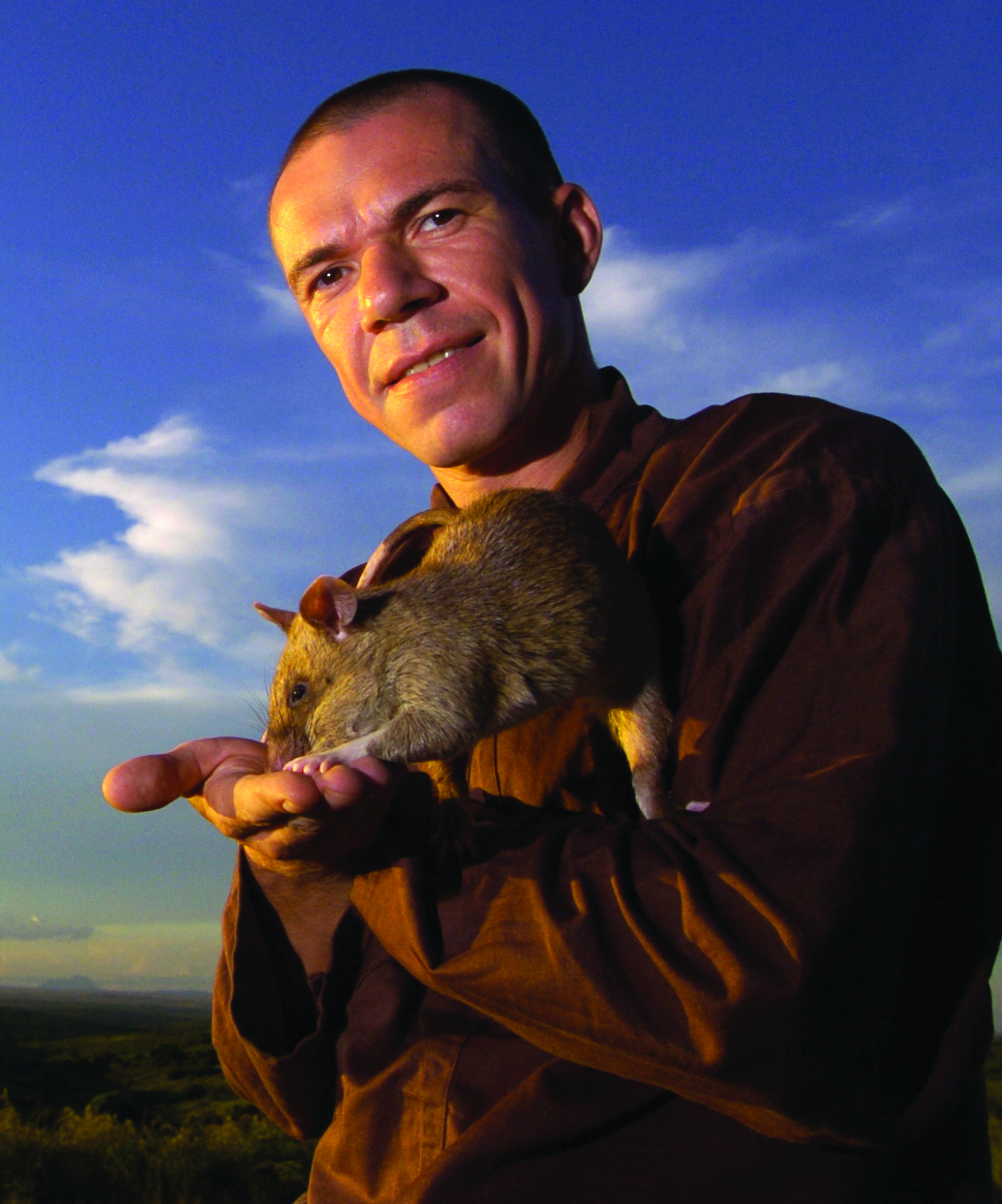
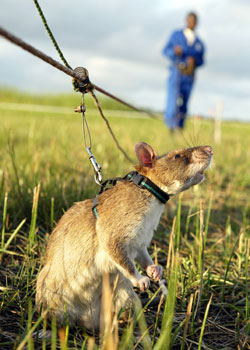
All it takes is one more step, a resounding click for it to be your last. In Africa last year, 6000 people walked on landmines. Sadly, there was no way of knowing what was below the surface. A simple and sustainable solution for Africa’s real world problem has now been found. Bart Weetjens, a Buddhist monk, developed a program called APOPO (Anti-Personnel LandMines Detection Product Development). This program trains African Giant Pouched Rats, Cricetomys Gambianus, to detect landmines to save human lives.
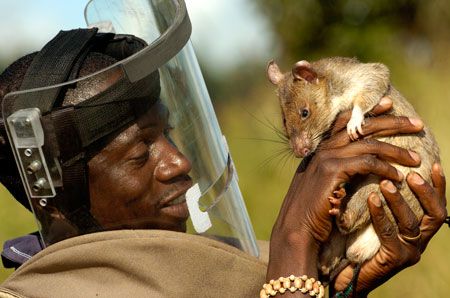
Bart Weetjens holding an African Giant Pouched Rat. Source: APOPO's website
Why rats?
It is true that dogs have already been trained to detect landmines; but, it costs five times more to train demining dogs than rats. This significant difference allows APOPO to use the remaining money to expand training programs. Also, like dogs, these animals are highly sociable with humans. However, unlike dogs, rats have more genetic material allotted to olfaction (sense of smell). They have an amazing capability to map smells and communicate them to us. In addition, African Giant Pouched Rats are a native species to sub-Saharan Africa, which allows them to be easily caught and trained. Additionally, they are smaller in size, thus they do not activate the landmines; whereas large dogs may be at risk. Furthermore, rats differ from dogs because they do not get emotionally attached to a specific trainer. This is important because it allows for multiple trainers to handle the rats.
The Training Begins
Around four weeks of age, the rats are weaned, handled by trainers, and exposed to many different surroundings. The purpose of this is to reduce the rats’ easily startled instincts to run and hide.
Training then proceeds by teaching the rats to recognize a specific clicking sound followed by a food reward. This process is known as Classical Conditioning Methodology. Once the rat automatically associates the click sound with the food reward (a mixture of peanuts and mashed bananas) they move on to the next stage of training.
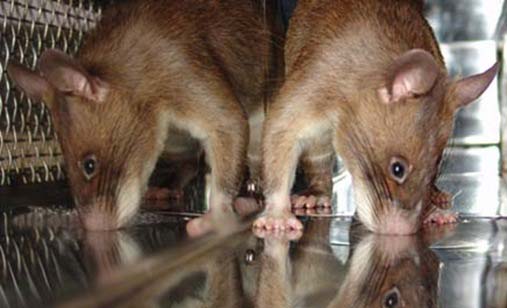
Next, the rat is placed into a cage with a single hole in the bottom. Directly below this hole, a target sense is placed. The target sense consists of five drops of aqueous TNT, trinitrotoluene, solution. The rat’s goal is to learn to put its nose in the hole for five seconds until it can receive a food reward. Once this task is achieved, the rat moves on to the next level.
APOPO rats sniffing out the target sense in the cage's holes. Source: APOPO's website.
The subsequent step places the rat in a cage with ten holes, with only one containing the target sense. If the rat can continuously locate the target sense and hold its nose in the hole for five seconds, it can move on to conquer the next task.
As the undertakings get gradually more difficult, the rat usually accomplishes them more quickly. It must now face the job of learning to walk on a leash in the fields and find targets. They must learn to systematically move up and down on an axle and search the land. They are strapped to a harness and are gently directed in the correct direction by two trainers. Once this is accomplished they must discover real mines in real mine fields. The trainers know the rat has discovered a mine because they dig, bite and sniff at the ground for five consecutive seconds.
On average, it takes 252 days of training in the cages and fields to ready a rat for the final test.
The Test
Finally, once the rat has passed all its training stages, it is sent to The International Mine Action Standards. This test consists of 400 m² and 5-7 mines placed blindly under the surface. The team of trainer and rat must detect all the mines to get licensed and once this is accomplished the rat becomes an accreted animal to the operation in the field. If the rat fails this test, they must start their training again.
APOPO's rat detecting landmines in the field. Source: APOPO's website.
Why is this important?
Currently, the rats are being trained in Morogoro and Tanzania. They are then shipped, along with their trainers, to Mozambique where more people are recruited to become trainers. For safety purposes, trainers are fully equipped with protective gear and two different rats always examine the same area to guarantee accuracy. Moreover, once the rats have indicated the same spot contains a mine, the area is further checked by a metal detector. The landmines are then disposed of by trained de-miners. In 2009 within nine months, APOPO’s team cleared 199,317 m² in Mozambique and discovered 75 landmines and 62 other explosive remnants of war. From this, 750 families were allowed to return to their land, to their home.
Already 11 African countries have adopted this skill. It allows them to be less dependent on foreign aid. In conclusion, these hero rats are saving many people’s lives. They empower vulnerable communities to tackle difficult and dangerous tasks at a feasible price.
Source: APOPO's website.
Fun Fact:
Weetjens and APOPO have also trained rats to detect tuberculosis and they are in the process of training them to detect victims of earthquakes.
How cool would it be to track your ancestors back over 650 years? Well, if you are a Yersinia pestis, you are lucky because recently a group of Canadian scientists mapped the entire genetic makeup that will allow researchers to track your ancestor’s evolution and virulence over the centuries.
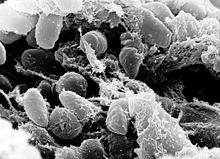
A scanning electron microscope micrograph depicting a mass of Yersinia pestis bacteria. Source: Wikipedia
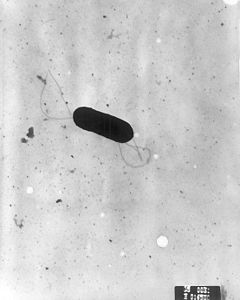
So you may ask, what is a Yersinia pestis? Yersinia pestis is the bacteria that caused the Black Death in Europe. The epidemic caused by the bacteria was so great that it is estimated to have killed 30-60% of the population of Europe, in a span of two years. Due to their high virulence, when left untreated with antibiotics, two-thirds of those that get infected die usually within four days.
Source: WikipediaSource: Vancouver Sun
To gather data on the bacterium, the scientists took the remains of bones and teeth samples, carefully went through each piece to get all the different DNA’s found on the body. Then they filtered through all the DNA’s to find the one that belonged to Yersinia pestis. This “fishing” method of DNA could be used to study and reconstruct other ancient pathogens that turned into deadly killers, according to one of the researchers.
The Canadian scientists found that while comparing their reconstructed plasmid against the modern Y. pestis, it was found that the varient of Y. pestis maybe no longer be existing today. However, their study shows that Y. pestis DNA was found in the medieval dental tissues from the victims of the Black Death. This is another support that strengths the hypothesis that this bacterium was the organism that caused the medieval plague.
So, the mapping of Y. pestis may just be the start of genetic mapping of bacterial species. I wonder which virulent bacterium will be mapped next, revealing its stories of mutations and evolution through time.
It is apparent that the trend of products today is to become smaller and smaller. We use many products today that achieve the same uses as its much bulkier predecessors. Just think back to the days of primitive cell phones. To say they were ‘big’ would be an understatement. While most would say that having small and compact devices are a matter of convenience, there are other compelling reason for us to look as deep as nanotechnology. One of these reasons includes potential medical applications.
Source: Wall Street Journal
In fact, medical researchers have been trying to devise useful nano-machines or nano-robots for quite some time. A barrier they had in successfully applying them to medical treatments was the lack of a means of propulsion. This is crucial for maneuvering these machines through areas of the body such as the bloodstream.
Source: University of South Caroline Beaufort
Until recently, there had been no viable motor to accomplish this task. Researchers have now discovered a means to make motors at the nano-level, which spin at 600 revolutions per minute and can move things 2,000 times their weight. What is the secret to such magnificent specifications? Carbon.
Source: BBC News
Carbon is one of the most abundant elements in the universe. However, it is often overlooked in materials manufacturing in favor of metals. Interestingly, carbon is convenient to work with and has suitable properties for nanotechnology. Nano-tubes composed entirely of carbon atoms arranged in hexagons can be made into a yarn that can be used as a type of electric motor.
These carbon fibers, which are 100 times stronger than steel of the same dimensions, are coated in an electrolyte. This allows the fibers to expand when voltage is applied. The expansion can produce a torque on par with much larger conventional electric motors.
Researchers propose that this type of motor can be used to produce ‘flagella’ for nano-robots. These nano-robots can then be used to deliver drugs, fight diseases, and remove parasites. The applications do not end there. Scientists can apply this technology in several other ways to treat the body’s problems.
I am awestruck as to how ideas which were once science fiction are now commonplace. In the future we can perhaps expect to see nano-machines populating our bodies, constantly monitoring and regulating it, defeating disease once and for all. Nanotechnology may give us the ultimate bond between man and machine.
Source: BBC News
Readers may be interested to note that researchers from UBC were involved in this collaboration with researchers from other countries.
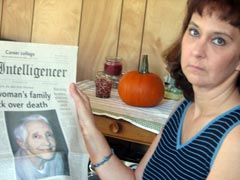
If you think back of the summer in 2008, remember the contamination found in Maple Leaf Products? Yes that’s right, it was Listeriosis. The Listeriosis victims and families are now waiting for compensation after they have been sick from eating tainted meat. This largest food recall outbreak in Canada happened three years ago killing about 23 people and injuring many more. The victims were contaminated with the bacterium Listeria. One of the victim’s daughters, Francis Clark, reported viewing her mother became short of breath and suffering from the illness. The settlement for these victims was out-of-court and was declared in January 2009. Michael McCain, CEP and president of Maple Leaf, payed about up to $27 million to the victims suffering from Listeriosis in the summer of 2008. None of the victims have received the money yet due the to the wait for Court approval.
Source from CBC News
“The reason for the settlement was two-fold: the families didn’t want to go through a long, drawn-out court case, which only increases the hurt and the agony and pain as the result of somebody’s death.
“And in fairness to the company involved, it didn’t want to go through a long, drawn-out court case that’s going to be bad for its reputation and costly. So you come to a settlement — but a settlement so that the money can get out there in a timely way. And this long after the fact is not timely at all.”
Source from The Vancouver Sun
The symptoms of Listeriosis would commonly appear after two to 30 days after the consumption of the product. However, it can also take up to 90 days for the symptoms to show. The average age of the people who were diagnosed with Listeriosis was 67. The Maple Leaf products is served widely among residential homes or elderlies. Young children, pregnant women, and elders are most vulnerable to getting sick due to their weak immune system.
McCain apologized to those victims and families. The company took full responsibility of their actions and this has saved their reputation as they confronted the situation heads-on rather than putting blames on others.
Source from The Globe and Mail
Listeriosis is the disease caused by Listeria monocytogenese. This bacterium exists in natural environment. The products that are contaminated with Listeria are hard to be detected. Thus to prevent the disease from further harming people, food product including farm products must be carefully detected by food inspection.
Source from Wikipedia
I believe we have to watch out for what we eat and beware there are more bacteria out there that could harm or even lead to severe illnesses. The best way to prevent any contaminations is to simply wash the raw food material thoroughly with water and avoid eating raw meat. Keeping up with the current events will also help us stay alert.
Dr. Kevorkian dies at the age of 83 on June 3rd, 2011. (CNN blog-reports “Dr. Jack Kevorkian dead at 83”)
Dr. Death is the name given to a pathologist Jack Kevorkian. He made the headlines of national news in early 1990s for his legislation of a “right-to-die”. Is Dr. Death a murderer?
Early life
Jacob “Jack” Kevorkian, or Hagop Kevorkian, was born in Pontiac, Michigan, to a family of immigrants from Armenia. His mother Satenig and her family escaped Armenian genocide in 1915 and eventually immigrated to Pontiac where she met his father Levon. The couple had a daughter, Margaret, son Jacob, and lastly, daughter, Flora.
Kevorkian, who taught himself German and Japanese, graduated from Pontiac Central High School with honours in 1945, at the age of 17. In 1952, he graduated from the University of Michigan Medical School.
Career
Kevorkian’s career begins in 1980s with a series of articles written for the German journal Medicine and Law capturing his views on euthanasia. He started advertising in newspapers as a physician consultant for “death-counselling”. His first assisted suicide was of Janet Adkins who suffered from Alzheimer’s disease. He was charged of murder, but charges were dropped because of no law in Michigan regarding assisted suicides. However, a year later his medical licence was taken away and he was no longer allowed to work with patients. This did not stop Dr. Kevorkian from assistance of over 130 deaths from 1990 to 1998.
Methods
In each of the cases, when patient agreed to death, Kevorkian assisted by attaching them to a euthanasia device that he made. The individual then pressed a button that would end their own life. Two people were assisted by “Thanatron” (death machine), others with “Mercitron” that had a gas mask filler with carbon monoxide.
Later career, imprisonment
In 2010 interview with Sanjay Gupta, Kevorkian stated “what difference does it make if someone is terminal? We are all terminal”. He also mentioned that he declined four out of five requests, on the grounds of possible treatment.
On November 22, 1998 Kevorkian allowed videotaping Thomas Youk’s,52, voluntary euthanasia, who was in final stage of lateral sclerosis. In this act Kevorkian injected Youk. During the videotape, Kevorkian dared the authorities to try and stop him from carrying mercy killing. After that incident going on public, Kevorkian was charged with second-degree murder and sentenced to serve 10-25 year in prison. He spent eight years and 2.5 months in prison before he was paroled for good behaviour in 2007. He was paroled under the conditions that he cannot practice medicine or provide care to anyone older than 62 or disabled. He was also forbidden from making comments about his assisted suicides.
Death
Kevorkian suffered from kidney problems for years and had been diagnosed with liver cancer. He was hospitalized in May, 2011 and died in June of the same year.
Dr. Kevorkian was a jazz musician, composer and an oil painter. He sometimes painted with his own blood. Of his known works, six were made available in the 1990s for print release.
Most of us remember, back in January 2010, the devastating earthquake occurred in Haiti which caused over 250,000 deaths. Then came the outbreak of cholera, which is an infection of the small intestine that causes severe diarrhea and vomiting. This outbreak is due to lack of sanitation and clean water and has caused over 400,000 Haitians became infected since the natural disaster.
It is not as if Haiti needed the earthquake to gain international attention; it had many problems even before. Two main problems were sanitation and agriculture. Currently, only 16% of rural Haitians and 50% of those in the cities have access to adequate sanitation facilities. Moreover, agricultural output is low due to poor soil fertility, soil erosion and lack of fertilizers.
Photo credit: CBC news
SOIL – Sustainable Organic Integrated Livelihood
Although it was amazing to see how much international attention Haiti received, there were a group of people long before 2010 that dedicated their hard work in improving the lives of Haitians. Please allow me to introduce the group SOIL – Sustainable Organic Integrated Livelihood.
Sasha Kramer, Executive Director and co-founder of SOIL, has been living and working in Haiti since 2004. She first came to Haiti as a human rights advocate, and in 2006 co-founded SOIL with Sarah Brownell. During that year she also received her Ph.D in Ecology from Stanford University.
Photo credit: http://www.oursoil.org/
Dry Toilet
Together, they have transformed the idea of human waste into something more valuable than gold in Haiti. They started something called “ecological sanitation,” which is a low cost approach to sanitation where human wastes are collected, composted and recycled for use in agriculture and reforestation.
Within the toilet, called dry or composting toilet, the liquid and solid parts are separated. Then after a year of composting, it becomes a nutrient rich fertilizer, which can help the agriculture by doubling the yield. SOIL have already installed more than 50 public ecological toilets for schools and community group across Northern Haiti and they are planning on expanding their project throughout the country
Photo Credit: http://www.oursoil.org/
Since the earthquake, Sasha and her team relocated to Port-au-Price to assist in relief efforts there. After weeks of distributing emergency aid, SOIL began to set up an office in Port-au Prince in response to the outbreak of cholera and sanitation crisis.
People like Sasha and organizations like SOIL reminds us two things: one- that one person indeed have the power to make a different, and two- we have all the knowledge and resources to do so. Thanks to their hard work, a country with depleted resources is having a second chance to rebuild themselves through sustainable resources.