Categories
Biological Sciences Issues in Science Science in the News

Time to Wear Long-Sleeves: Flesh-Eating Disease on the Rise

Warning: Blog Post contains graphic images and video which may offend or disturb some viewers. Blogger does not take responsibility for any sudden onsets of nausea. Viewer discretion is advised.

What Is It?

Flesh-eating disease, or Necrotizing fasciitis as it is formally known, is actually a bacterial infection caused by several types of bacteria but most commonly, Streptococcus pyogenes. Invading by a very small wound, the bacteria will produce chemical toxins which begin to destroy tissues and muscles. Within a day, symptoms will begin to appear but they are mild at first and often mistaken as the flu with fever, nausea, and vomiting common. Eventually, the wound area will begin to swell and pain will increase. In the picture below, you can see the presence of gangrene or dead tissue in a leg with the disease.
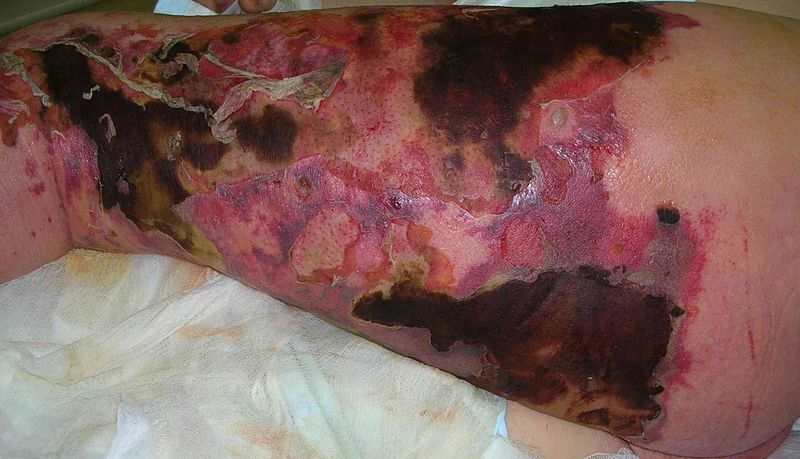
Image from Wikipedia.

Necrotizing fasciitities left leg. Image from Wikipedia.

Now, antibiotics will treat the disease in its early state but all too often, the disease is discovered too late in its progression. In that case, the only treatment is to remove the infected body parts. A few patients have gone to the hospital, only to wake up a few days later out of a medical coma to find themselves missing their limbs. About 20-30% of cases are fatal.

Check out this compelling video of a woman who was lucky enough to survive the disease but was not lucky enough to keep all her limbs.

“Flesh-eating disease took her arms and legs, but not her spirit.” Video posted by YouTube user druidhills2005.

Where Is It Today?

In New Zealand, cases of flesh-eating disease have actually been on the rise according to the Ministry of Health of New Zealand. In 1990, there were only about 10 cases of the disease but in 2006, there were more than 70 cases. New Zealand is a first world country just like Canada and the United States so this is some surprising news that should hit close to home.

Whoa! What Should I Do?

Don’t panic yet! The disease is still very rare and in Canada (with a population almost 8 times larger than New Zealand), only 90-200 cases are reported each year. However, it is still probably a pretty good idea to avoid it. To minimize your risk, Health Canada advises you to “take care of minor wounds and cuts” making sure to “wash the affected area in warm soapy water.” Additionally, if you do come in contact with someone you know that has been inflicted with the disease, see a doctor immediately. In general, take care of yourself. Those with a weakened immune system or with chronic diseases are particularly vulnerable.

References

Greenfield, R. & Shehnaz, S. (2008). Gangrene. emedicinehealth. Retrieved from http://www.emedicinehealth.com/gangrene/article_em.htm.

Health Canada. (2006). Flesh-eating Disease. Health Canada. Retrieved from http://www.hc-sc.gc.ca/hl-vs/iyh-vsv/diseases-maladies/flesh-chair-eng.php#mi.

Kirk, S. (2011). Fleash eating disease on the rise. stuff.co.nz. Retrieved from http://www.stuff.co.nz/manawatu-standard/5690711/Flesh-eating-disease-on-the-rise.

Ministry of Health, New Zealand. (2011). Retrieved from http://www.moh.govt.nz/moh.nsf.

Nationsonline. (2005). Countries of the First World. NationsOnline. Retrieved from http://www.nationsonline.org/oneworld/first_world.htm.

Stoppler, M. (2008). What Is a “Flesh-Eating” Bacterial Infection? MedicineNet.com.  Retrieved from http://www.medicinenet.com/script/main/art.asp?articlekey=61933.

Worldatlas. (2010). Countries of the World. Worldatlas.Retrieved from http://www.worldatlas.com/aatlas/populations/ctypopls.htm.


Categories
Biological Sciences New and innovative science Science in the News

A Bond Betwen Man and Machine?

It is apparent that the trend of products today is to become smaller and smaller. We use many products today that achieve the same uses as its much bulkier predecessors. Just think back to the days of primitive cell phones. To say they were ‘big’ would be an understatement. While most would say that having small and compact devices are a matter of convenience, there are other compelling reason for us to look as deep as nanotechnology. One of these reasons includes potential medical applications.

Source: Wall Street Journal

In fact, medical researchers have been trying to devise useful nano-machines or nano-robots for quite some time. A barrier they had in successfully applying them to medical treatments was the lack of a means of propulsion. This is crucial for maneuvering these machines through areas of the body such as the bloodstream.

Source: University of South Caroline Beaufort

Until recently, there had been no viable motor to accomplish this task. Researchers have now discovered a means to make motors at the nano-level, which spin at 600 revolutions per minute and can move things 2,000 times their weight. What is the secret to such magnificent specifications? Carbon.

Source: BBC News

Carbon is one of the most abundant elements in the universe. However, it is often overlooked in materials manufacturing in favor of metals. Interestingly, carbon is convenient to work with and has suitable properties for nanotechnology. Nano-tubes composed entirely of carbon atoms arranged in hexagons can be made into a yarn that can be used as a type of electric motor.

These carbon fibers, which are 100 times stronger than steel of the same dimensions, are coated in an electrolyte. This allows the fibers to expand when voltage is applied. The expansion can produce a torque on par with much larger conventional electric motors.

Researchers propose that this type of motor can be used to produce ‘flagella’ for nano-robots. These nano-robots can then be used to deliver drugs, fight diseases, and remove parasites. The applications do not end there. Scientists can apply this technology in several other ways to treat the body’s problems.

I am awestruck as to how ideas which were once science fiction are now commonplace. In the future we can perhaps expect to see nano-machines populating our bodies, constantly monitoring and regulating it, defeating disease once and for all. Nanotechnology may give us the ultimate bond between man and machine.

Source: BBC News

Readers may be interested to note that researchers from UBC were involved in this collaboration with researchers from other countries.

For more information

See article:

http://www.sciencemag.org/content/early/2011/10/12/science.1211220.abstract

Categories
Biological Sciences Issues in Science Science in the News

Who’s Your Mama?!


While most of us don’t remember much of anything about our 9 months in the uterus, you would probably be just a little freaked out if you found out that those 9 months weren’t spent in a uterus at all… but in a man-made artificial uterus with several scientists devoted to bringing you to full term.


This is exactly what happened to 6 lucky grey nurse sharks.


The grey nurse shark or sand tiger shark, as it is also known, is one of Australia’s most endangered marine species and is considered by the International Union for Conservation of Nature to be under threat of endangerment on a worldwide basis. How could this be? Weighing in at over 200 pounds and reaching over 11 feet, the grey nurse shark  is a powerful beast, one you wouldn’t expect of being vulnerable to predators.


Grey Nurse Shark. Photo by Richard Ling


However, they are… and that predator is man. Despite their rather intimidating appearance, they are completely harmless to humans unless provoked; yet humans have been killing the sharks for decades. Most of the time the deaths are accidents as the sharks are caught in commercial and recreational fishing equipment. But several of the deaths are  intentional as the sharks are considered a delicacy in Japan.

To make matters even worse for the shark, they are only capable of producing two pups per year. The mother shark actually starts her pregnancy with about forty fertilized embryos separated in two separate uteri, but as they mature, the embryos undergo adelphophagy where they attack and eat one another. Eventually, only the two toughest embryos are left to mature. Talk about sibling rivalry!


Video posted by youtube user Megabeeach.


Scientists Nick Otway and Megan Ellis think they have found a way to prevent this.

In a lab at the Port Stephens Fisheries Institute, in New South Wales of Australia, these scientists have made an artificial uterus, which is basically a very complex aquarium.

From a euthanized pregnant female, 6 embryos were extracted and all six were brought to full-term in this artificial uterus. The pups were born to a length of about three feet, an average size for a grey nurse shark pup. After only three months, they were released into the wild.

Whether or not they will suffer a mommy complex has yet to be seen but already, we can conclude these results are amazing.

If we can figure out a way to keep the mother alive, we have the potential to save an endangered species by literally tripling its birthing capacity. Furthermore, if we can extract the embryos even earlier on, we could do a lot more than just tripling it.


Pregnancy, Image from Microsoft Word 2000

Now, this brings up an interesting thought for the future of the human race…

Will the exhausting task of carrying a baby for nine months become an event of the past? Will you and your partner simply drop off your eggs and sperm at a lab and a few months later, pick up our baby without ever gaining a pound?

Certainly, this won’t be happening any time soon but it is definitely interesting to think about in a society where convenience is king.


Works Cited

Froese, Rainer, & Daniel Pauly, eds. (2005). Carcharias taurus. Fish Base 09 2005 version. Retrieved from http://www.fishbase.org/summary/Carcharias-taurus.html.

Otway, N. & Ellis, M. (2011). Construction and test of an artificial uterus for ex situ development of shark embryos. Zoo Biology. doi: 10.1002/zoo.20422

Pollard, D. & Smith, A. (2005). Carcharias taurus. IUCN Red List of Threatened Species: Version 2011.1. Retrieved from  www.iucnredlist.org.

Venton, D. (2011, September 29) Baby Sharks Birthed in Artificial Uterus. Weird Science Retrieved from http://www.wired.com/wiredscience/2011/09/artificial-shark-uterus/

Spam prevention powered by Akismet