Categories
Environment Issues in Science

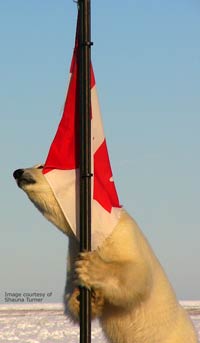
Will the Polar Bear be our new national animal?

We are all familiar with the increasing global temperatures that encourage the melting of arctic ice but we don’t really think too much about how this will effect species other then ourselves. “Canada is home to two-thirds of the world’s polar bear population and we have a unique conservation responsibility to effectively care for them,” said Environment Minister Peter Kent. Best estimates suggest the polar bear population is approximately 15,000 in Canada. Polar bears have an important effect on the animal populations in the arctic. They provide food for animals lower on the food chain by leaving behind animals they have killed and not fully finished eating in addition to their bodies being food for animals once they have died.


CBC News Report
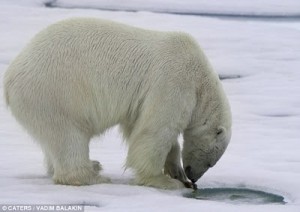


Polar bear waiting for a seal at the edge of a hole in the ice
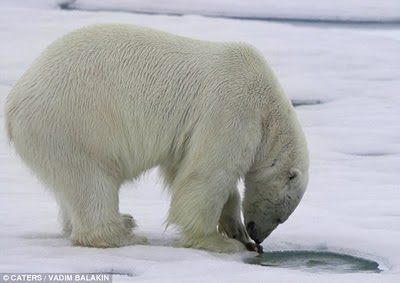
 

Polar bears are the worlds largest carnivores and are also tied for the largest bears on Earth. Being carnivores in the arctic, their main diet consists of bearded and ringed seals.The polar bears hunt the seas in a very specific way. They find holes in the ice sheet where the seals would come up to breath. When a seal surfaces the polar bear can easily attack from above and haul the seal onto the sheet. Climate change is therefore causing the ice  area to shrink therefore causing a decrease in hunting ground for polar bears. The population is therefore decreasing as many polar bears cannot find enough food to survive or reproduce.
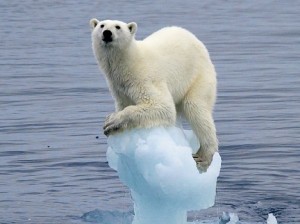
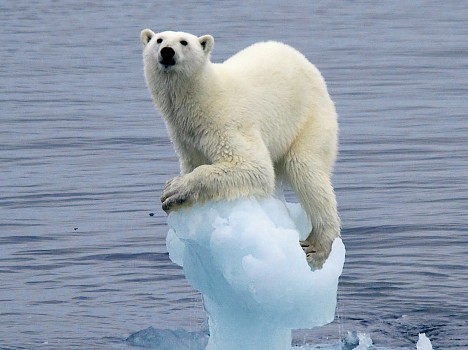
Polar bear perched on shrinking ice sheet
On Thursday November 10,2011, Environment Canada formally declared that polar bears were to be considered a “species of concern”. This decision was made through consultation with provincial and territorial governments, regional wildlife management boards, aboriginals and other stakeholders. The classification of “species of concern” is one level below a  threatened classification and two levels below an endangered classification under Canada’s Species at Risk Act. Peter Kent continued to say, “Our government is demonstrating leadership in protecting this iconic species. Listing the polar bear under the Species at Risk Act represents an important contribution to protecting our environment and the animals that live in it.”
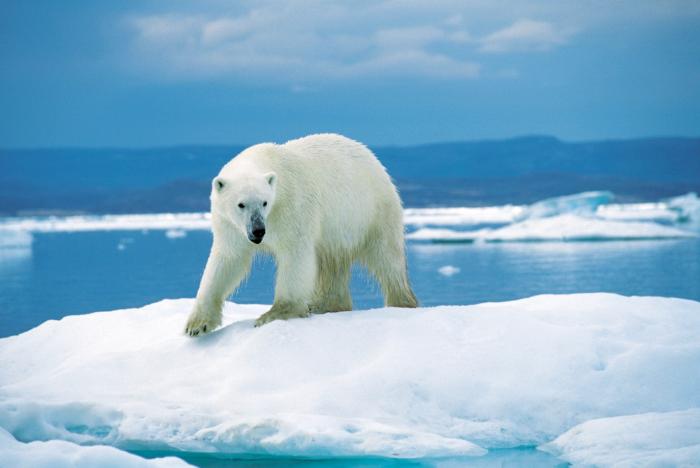
 

There is some controversy around this issue as not all were in favour of labelling the polar bears a “species of concern”. One argument is that there has not been enough surveying done to make these claims as the surveys conducted were both too infrequent and too limited.  Others feel that climate change is impacting many animal species but polar bears are very good at adapting so it may not be as large an impact as they’re predicting. Some claim the polar bear population is actually increasing but is simply changing location.
 

Aboriginal hunting polar bear

The government will be taking action by setting strict quotas on polar bear hunting. To exercise traditional rights aboriginals will be allowed to continue hunting the bears. Currently about 534 polar bears are killed annually in Canada, 325 of them by Inuit in Nunavut. To increase awareness of this issue a Conservative senator recently proposed that we replace the beaver with a polar bear as Canada’s national animal. I think that would be a simple way to get the issue out there and also polar bears make a much cooler national animal!


References:


CBC National News:

http://www.cbc.ca/news/technology/story/2011/11/10/environment-polar-bear-listing.html


Wikipedia:

http://en.wikipedia.org/wiki/Polar_bear


Photos:

http://dailyanimalfwd.blogspot.com/2011/09/maybe-i-should-have-brought-some-bait.html

http://donate.cwf-fcf.org/site/MessageViewer?dlv_id=6101&em_id=3401.0

http://www.second-opinions.co.uk/should-all-animals-eat-a-high-fat-low-carb-diet-2.html

http://www.humanevents.com/article.php?id=45447
Categories
Environment Issues in Science Public Engagement Science Communication Science in the News

So is it too late?! Just ask David Suzuki…

On November 3rd, I witnessed one of the greatest examples of communicating science that I have ever seen. That evening, the University of British Columbia (UBC) was the lucky host to one of the most influential Canadians of our time: David Suzuki. He presented a lecture entitled “The Global Eco-crisis: Is it too late?”


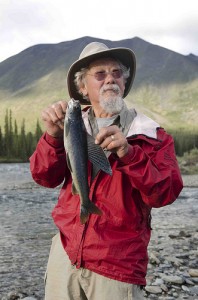
David Suzuki, with a grayling from the Hart River, 2011. Photo by peelwatershed.

Who is David Suzuki?

If you have been living under a rock for the past few decades, you wouldn’t know that David Suzuki is one of the most well-known activists for reversing climate change, writing many books and hosting several TV shows on the subject. Most notably, he hosted the Canadian TV series, “The Nature of Things.” In 1990, David Suzuki co-founded the “David Suzuki Foundation,” a non-profit organization, which focuses on sustainability and climate change.


As David Suzuki braced the speaking podium, I prepared myself to be changed.


Humans are unique

David Suzuki began to trace the origin of humans from our common ancestors in Africa to today. What made   humans unique, he claimed, was their foresight. That is, our innate ability to predict or plan the future. He   explained that humans moved from Africa to eventually cover the world. Using our foresight, we exploited the resources of every location, only to move on when those resources were depleted.


Laws that we CAN change

Dr. Suzuki went on to describe the so-called “laws” that we have imposed on society today, specifically, a “law” called capitalism. But, he said, “laws” like capitalism aren’t really laws at all but they are “nuts!” because we can change them. With capitalism, economists rule the world and they just don’t give a “shit” about our environment and what we do to it. It is time that we change these laws and take control back from the economists. To do so, we have to take back our government and make it more representative. Vote.


Stop the excuses!

Moving on to current efforts being made, David Suzuki claimed that our government is full of excuses. As an example, he discussed the carbon tax. In Canada, we claimed that our businesses couldn’t survive a $15/ton carbon tax. But in Sweden, their business are doing just fine with a $120/ton carbon tax. It is time that we stop making excuses and get to work.


Never too late

Drop in the bucket. Photo by theilr.


Inspiring us, David Suzuki concluded that it isn’t too late. We can save our environment but first, we have to take back our government and the only way to do that is to vote. You may just feel like a drop in a bucket but he reminded us, with enough drops, we can fill the bucket.

From this lecture, I didn’t just learn that we need to change our environment but I also learned how to connect with your audience. David Suzuki kept the science basic and used language that was not only fun (there were more than a few swear words…) but easy to understand.

David Suzuki left me stirred.

Categories
Environment Issues in Science Science Communication

True or False? Presenting Scientific Data Without Evidence

Over the course of Earth’s history there have been many mass extinctions. After each one there is the devastation of a world rid of many forms of life.  Barren and bleak, it must be a hard place to live.  Nevertheless, each mass extinction allows space for new life to grow and develop, such as dinosaurs and humans.  The uprisings, life spans and demises of several creatures have been well documented by scientists throughout history.

It is well known that mass extinctions do occur, but their exact mechanism is often unknown, or speculated at best.  For example, one of history’s greatest mysteries is what caused the massive Permian-Triassic extinction. Caused by a large volcano eruption or a meteor strike resulting in a severe lack of oxygen in the atmosphere and ocean, this extinction is estimated to have killed 85% of all living organisms on the planet. However, a recent Vancouver Sun article cites rising ocean acidity levels as the culprit for the P-T extinction, not a lack of oxygen.


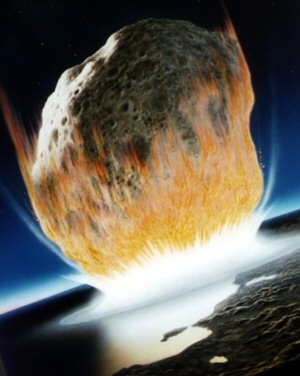
A large meteor strike is one of the possible causes of the Permian-Triassic extinction.

While this article raises interesting points, there is a complete lack of evidence for the ocean acidity hypothesis.  As scientists it is important to remember that we haven’t found out everything there is to know about the world, and that new discoveries are being made on a daily basis.  However, each new discovery needs to have accompanying evidence to confirm the finding.  While most scientists are aware of this, and are wary of research presented without evidence, members of the public may not be so cognizant.  Thus, when new information is presented without evidence it can be misleading to people outside the scientific community.  It is therefore important that as scholars we communicate clearly with both the public and the media who will be translating our information.  This will ensure that there is no room for misinterpretation or deceptive statements.  By keeping the language we use to communicate science clear and simple, it will make it easier to convey our ideas to the general public and thereby bolster an interest in the field.


Spam prevention powered by Akismet