Categories
Final Project Interview Project

Steller Sea Lions: How can we help?


Steller Sea Lions live in the Pacific Rim from Japan to California with 70% living in Alaska. Sadly, their population has been drastically declining since the 1970s due to many reasons:

  • predation by killer whales,
  • increase in parasites and diseases
  • nutritional stress due to competition for food with humans.

Some fishing companies even deliberately kill these animals since they view them as competition and a threat to fish stocks. Currently, the western stock is endangered and the eastern stock is listed as threatened.

Check out our video below for what Beth Young and her colleagues are doing now to save the Steller sea lions and to meet these friendly animals!

https://www.youtube.com/watch?v=pcueT8-PTPE


What is the government doing?

Because Steller sea lions are endangered, several laws have been implemented to protect their survival.

  • Fisheries Act: a license is required to operate a fishery, and records of transactions and operations must be produced on demand of a fishery inspector or conservation officer.  This practice keeps fisheries from over harvesting, which would harm the Steller sea lion population.
  • Endangered Species Act: ensures that federal agencies do not harm any listed species which includes the Steller sea lion. Habitats where the listed animals are found are protected by the Habitat Conservation Plan.
  • Marine Mammal Protection Act:  provides population censuses, health assessments, development of conservation plans, and protection regulations.  This act also appoints staff to conserve and manage the populations of marine mammals that are at risk.


What about other animals?

Steller sea lions aren’t the only animals that can benefit from Beth’s research…


California Sea Lion (Zalophus californianus) on Morro Strand State Beach, Morro Bay, CA. Photo by Mike Baird.


The California sea lion is a close cousin to the Steller sea lion. Currently classified as low risk concern on the IUCN endangered species red list, with time, they may become just as threatened as the Steller sea lion.


Northern fur seal at the New England Aquarium, Boston, Massachusetts. Photo by flickr user cphoffman42.


Another species that could benefit from Beth’s findings is a much smaller second cousin: The Northern Fur Seal. Currently listed as at risk for endangerment on the IUCN list, they are experiencing a downward population trend.


With Beth’s results, we could ensure the food requirements of these species are met so they don’t become a forgotten fossil.


Check out the SCIE 300 communicating science podcast for more information on the Steller sea lion species, how Beth believes her findings could be applied to other species, and potential sources of error in her experiment.

Audio clip: Adobe Flash Player (version 9 or above) is required to play this audio clip. Download the latest version here. You also need to have JavaScript enabled in your browser.

Interview with Beth Young


In Conclusion…

The Steller sea lion plays an important part in the delicate balance of the ecosystem. Every species of life that it interacts with, from the food it eats, to its natural predators, will be greatly affected if the Steller sea lion population continues to decrease. We hope that our various media (the above video, podcast, and this blog post) are able to convey some of the latest research findings on Steller sea lions in a clear and understandable manner, and bring more attention of this matter to the public eye.

More information on why Steller sea lions are endangered, as well as summaries of the latest research findings made at the Open Water Research Lab can be found at the Vancouver Aquarium website.
 

Categories
New and innovative science Science in the News

A new ‘Sixth-Sense’


A clip from the movie ‘Minority Report’ starring Tom Cruise. From YouTube


Have you ever seem the movie The Minority Report starring Tom Cruise? In the movie, he plays Chief John Anderton who uses out-of–this world technology to find criminals and solve ‘pre-crimes.’ Well, modern science is not that far off from making Chief Anderton’s technology a reality.


Human Interface?

Scientists are working hard on creating a ‘seamless’ sixth-sense connection with the world around us. Sound crazy? Well it’s not that far fetched. Science is actually on the verge of making it a reality; in fact it’s so close you can touch it, literally. The goal of this sixth-sense technology is to provide the user with easy access to relevant information from the user’s environment and allow him or her to interact with the data by the touch of a finger.  And the best part of this technology is that when it is fully operational it will cost no more than your average cell phone.


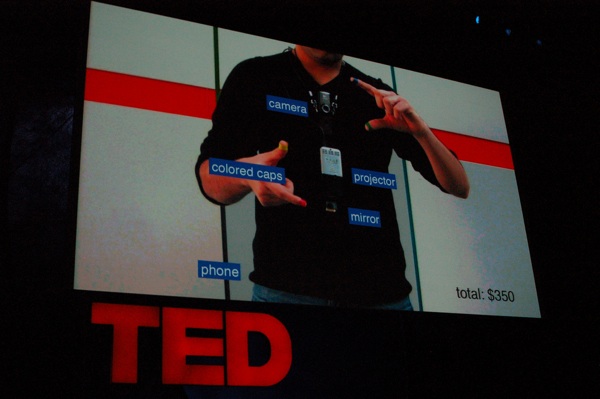
The system being demonstrated at a TED conference in 2009. (Eaton 2009)


Now, we’re not talking about a 50-year time schedule.  No, scientists are only a few years away from making this ‘movie dream’ a reality. Already, Microsoft has created surface-interface display technology that’s able to project information onto a surface for the user to interact with via their hands.


MIT student demonstrating the capabilities of their device. (Eaton 2009)


A recipe for success

Sounds pretty cool right? However, this still isn’t quite up to our ‘Tom Cruise’ standard.  At MIT, the fluid interface group at the University’s Media Lab is in the process of completing their version of this ‘sixth-sense’ technology. It combines a GPS-capable cell phone that gathers data from the environment, searches the Internet, collects the results and projects the information back to the user. It really is a “metadata system for real life” (Eaton 2009). The model includes a webcam, mirrors, a Smartphone and a pico-projector all hung together on a lanyard, and all available for a combined price of $350. Which makes this technology portable and able to work on any available surface, including your hands!

At MIT, the fluid interface group at the University’s Media Lab is in the process of completing their version of this ‘sixth-sense’ technology. It combines a GPS-capable cell phone that gathers data from the environment, searches the Internet, collects the results and projects the information back to the user. It really is a “metadata system for real life” (Eaton 2009). The model includes a webcam, mirrors, a Smartphone and a pico-projector all hung together on a lanyard, and all available for a combined price of $350. Therefore this technology is not only portable, but also able to work on any available surface, including your hands, and best of all it is affordable!


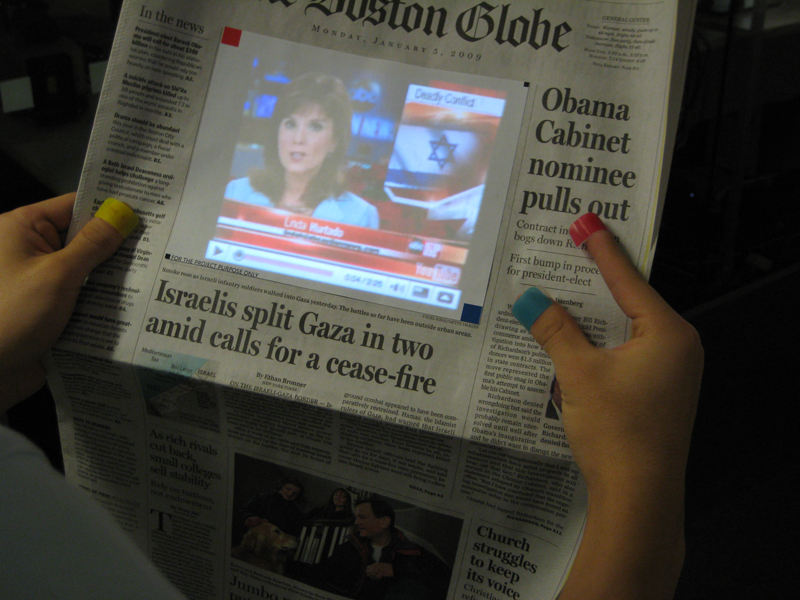
Demonstration on how the 'sixth-sense' can be used to view video clips related to certain newspaper articles. (photo credit: Sam Ogden)
'Sixth-sense' being used to sort and resize photos. (photo credit: Sam Ogden)


What does it do?

The system recognizes colored caps on the thumbs and index fingers via a webcam, and tracks their movements as a way of interacting with the projections. If this isn’t quite stylish enough for you, you could instead paint your nails in the same colors as the caps. Sounds all very techie, but what can it actually do? Well let’s say you’re taking a walk and want to take a photo, instead of taking out your camera, it’s as simple as making that iconic photo gesture with your hands and the interface will take the picture for you. Or, what if you want information on a book? A quick glance at the cover will give you a rating and a flip to the inside page will give you comments by critics. Even reading the newspaper becomes more exciting, with relevant video clips on the articles.

It’s even able to take social networking to the real world, literally. When meeting new people, the phone will look-up and project relevant information on them, including their name, contact details and tags associated with them from blog posts like this one. And it doesn’t stop there, how about finding out the time by simply drawing a circle on your wrist and having a watch projected? There are many more uses and applications for this sixth-sense technology and in a few years for the cost of a cell phone, we could all be as cool as Chief Anderton.


References and Further Reading:

Dr. Pattie Maes talks about the technology during TED talks

previous review made by Kit Eaton on Feb 5, 2009

More photos and video\’s on MIT\’s Sixth-Sense technology

Video on more applications of \’Sixth-Sense\’ (Really Worth A Look)


Categories
Admin Interview Project

Video creation tutorials

As you start thinking about your video and podcast projects, I thought I would post a couple tutorials about making videos from the Vimeo Video School. There are a lot more to be found if you follow the link, but here are a couple embedded right here on the blog that I think I particularly important. The first one includes some shooting basics and the second one discusses general video editing. Depending on which piece of software you are using for the editing, you can watch a more detailed video about using Microsoft Movie Maker (on a PC) or iMovie (on a Mac).

Video 101: Editing Basics from Vimeo Staff on Vimeo.

It seems to be a little more advanced, but Lifehacker also has a series of tutorials about video editing.

Finally, there is also a page on the UBC Wiki about video production that includes tutorials and a whole bunch of links to other resources.

Happy shooting!

Spam prevention powered by Akismet