Categories
Uncategorized

Don’t Get too Close to the Edge

Since the economic downturn in 2008, the U.S. Federal Reserve has been helping the market with stimulus that is injected into the open market each month. More recently, the Federal Reserve and Ben Bernanke have created a monetary policy called quantitative easing. This policy injects money into mortgage backed securities, with QE3 allocating an additional $50 billion per month into MBS.

Now that 2013 is fast approaching, the theory of a Fiscal Cliff is emerging. The start of the new year will mark the reduction in the budget deficit, tax increases and spending cuts. Many economists including Michael Aneiro, a blogger for Barron’s, believes investors are sitting on this cliff unsure of what the actual effects will be. Hedge fund and investment managers have stated to their clients, accounts should be liquidated in order to prepare for the implementations of new policies if President Obama is re-elected.

Not only will this potential cliff have an effect on investments into the financial markets from within the U.S., but it is also believed the cliff will have an impact on the U.S. dollar; therefore, foreign investments have also slowed in the last month. The total effect of the cliff will be anyone’s guess.

Categories
Uncategorized

Don’t Kick Them, They Aren’t Down!

Often there is a misconception about the relationship between the status and health of a particular company and its’ share price. Ryan Un in his blog recently noted that as Facebook’s share price has nearly halved since its IPO, the company’s revenue’s have also fallen. This could be farther from the truth. Investors had difficulty valuing Facebook, because simply another company of its size, and in this sector of the market does not exist.  P/E ratios and profit margins are difficult to compare with other technology companies such as Google and Apple, as they are entirely different.

Facebook’s marketing customers have re-evaluated the relationship, and company’s including General Motors dropped Facebook. General Motors has now come back to Facebook to negotiate a new deal. Since the IPO Facebook has actually increased revenue, and better positioned itself to grow in the future. A new mobile app platform has allowed Facebook to tap into mobile advertising revenue. As well, Facebook most recently launched a gift service that allows users to send items to others users. This service allows Facebook to compete with Amazon and others. Facebook does not need to recover, the company has only bettered itself internally since the IPO!

Categories
Uncategorized

Small World, Huge Consequences

Questcor Pharmaceuticals Inc. (QCOR) dropped as much as 48% in intraday trading on Wednesday. Health insurance provider Aetna, decided to stop covering Questcor’s Acthar Gel, that makes up all of the company’s revenue. After the dust settled, Questcor revealed Aetna’s coverage of its only drug, accounted for only 5% of its’ overall revenue; however, Questcor lost nearly half of its market capitalization in one day!

Traders in today’s market have the ability to demolish a company in nearly minutes. No longer do investment firms conduct research and create long term positions; instead, a new era of high frequency trading incorporates programs that run algorithms to react to changes in the market and automatically make corresponding trades. The power of this technology has created an unfair playing field for other traders, both professionals and amateurs. Executives from these firms have confirmed that they would like to see the U.S. Securities and Exchange Commission regulate the practice, which as of now is completely unregulated. Until the Commission does something to minimize the effects of high frequency trading, drops of 40% or more in a trading day, may become regularities in the markets of today.

CNBC Jim Cramer: Questcor Has Had An Incredible Run


Categories
Uncategorized

Success Story Turned Insider Trader


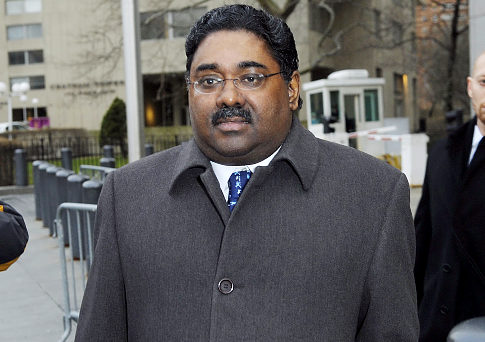
Raj Rajaratnam, the American Dream success story. Working his way up as an immigrant from Sri Lanka, Rajaratnam fought his way into the ruthless finance industry, and eventually became one of America’s most successful hedge fund executives; however, the billionaire soon became caught up in greed. At the forefront of many securities fraud related issues concerning Rajaratnam, leaked information about an investment by Warren Buffet into Goldman Sachs during the peak of the 2008 financial crisis, captured the attention of media across the world.

Working as an analyst during the 1990’s, and eventually making a majority of his wealth during the 2000 technology bubble, Rajaratnam made many connections that would ultimately lead him into the insider trading scandal. During the investigation, phone conversations, text messages and in person meetings were documented by the FBI. Rajaratnam paid handsomely for tips, ranging upwards of two million dollars, but in the end some of his most trusted colleagues including Galleon Group hedge fund partner, Rajat Gupta, testified against him. Rajaratnam was sentenced to eleven years in a federal prison.

The Wall Street Journal Article – Trader Draws Record Sentence: http://online.wsj.com/article/SB10001424052970203914304576627191081876286.html

The entire Rajaratnam story documented in depth by American Greed featured on CNBC: https://www.youtube.com/watch?v=DQCb5hV7idk

Spam prevention powered by Akismet