Categories
1.3 Motor Development: Fine Motor

Fine Motor Skills

Motor Development: Fine Motor Skills1

Fine motor skills involve the small muscles of the body, usually located in the hands. Eye/hand coordination (see full Glossary) is essential in developing fine motor skills. Fine motor development involves skills that we will need for most things we do through our life.

Motor development also includes the oral/motor area that surrounds the child’s mouth. In order for children to be able to swallow and eat properly, or to pronounce words the right way, they need to have good control over their oral/motor muscles. A child whose oral/motor muscles are either too tight (hypertonic) or too flabby (hypotonic), may require help in learning to talk, and assistance in feeding and swallowing.

Fine motor development includes the following:

  • reaching for objects
  • playing with hands at midline (see full Glossary)
  • manipulating objects with both hands
  • banging two toys together
  • transferring or passing objects from one hand to the other
  • picking up an object
  • using the thumb and index fingers (pincer grasp) to pick small objects
  • removing or taking away objects from containers
  • putting objects into containers
  • holding large markers with the fist
  • turning pages of books
  • scribbling
  • opening doors
  • solving simple puzzles
  • stacking blocks and cups
  • holding pencils using the tripod position
  • building three dimensional structures with blocks
  • making simple forms with play dough or clay
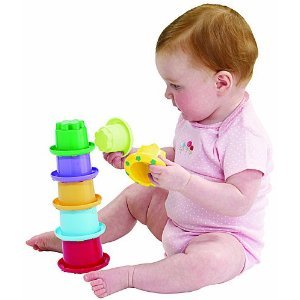
  • nesting cups (see full Glossary) (Fig. 1)
  • using scissors
  • drawing simple forms
  • tracing letters and numbers
  • buttoning buttons
  • fastening snaps
  • stringing beads
  • writing letters and numbers

Figure 1: Nesting cups

Vignette

When Maria she was 3 years old she started using her left hand often. The family was concerned. However the pediatrician assured them that being left-handed was the same as being right-handed and they should allow her to use the hand she prefers. By age 5 Maria paints and eats with her left hand and doing well in school. If her parents had forced her to use her right hand, Maria would have probably had a hard time. Luckily, her parents did research, listened to experts and gave her what she needed to grow and thrive. 

1 see References
Categories
1.3 What is Development: Motor Development

Motor Development: A Brief Overview

Motor Development: A Brief Overview1

Motor development refers to the development of a child’s bones, muscles and ability to move around and manipulate his or her environment. Motor development can be divided into two sections: gross motor development and fine motor development.

  • Gross motor development involves the development of the large muscles in the child’s body. These muscles allow us to sit, stand, walk and run, among other activities.
  • Fine motor development involves the small muscles of the body, especially in the hand.

Motor development also involves how well children’s muscles work. This is referred to as muscle tone. Children need a balanced muscle tone in order to develop their muscles and use them with ease when standing, sitting, rolling, walking, running, swimming and all other other postures and actions.

Motor development also involves the child’s vestibular and proprioceptive systems. Both of these are part of the child’s sensory system.

  • The vestibular system is located in the inner ear and allows the body to maintain balance.
  • The proprioceptive system involves the inner ear, the muscles, joints and tendons. It allows the body to understand where it’s located. Maintaining balance and posture and having coordinated movements are only possible if the proprioceptive system is functioning well.

The typical development of a child’s motor skills usually follows a predictable order or sequence.

  • Development occurs from the inner body to the outer body. This means that children usually develop or gain control over their arms before they develop or gain control over their fingers.
  • Development also starts from top to bottom. Children need to control their head first, then they will gain control over their legs and feet.

FOOD FOR THOUGHT: CONNECTING ALL THE DEVELOPMENTAL AREAS

How well a child’s motor skills are developing will influence how well they do in other developmental areas:

  • Motor skills and cognitive development: Children are more likely to explore their environment if they are able to move easily or change positions.
  • They are also more likely to draw and write if they have good control of their finger muscles.
  • Motor skills and the development of self-help skills: Solid motor control helps children learn how to finger-feed and later use utensils (e.g. forks, spoons, chopsticks), to dress and undress, brush teeth and wash hands and face, and to learn to use the bathroom.
  • Motor skills and communication development: Having control over the oral/motor area allows a child to learn to pronounce letters and sounds correctly. This is articulation.
  • Motor skills and social and emotional development: Motor skills are needed for sitting properly, for speaking, for eating and drinking. How others react to how well a child does all this may have either a positive or negative impact on that child’s development.
1 see References

Spam prevention powered by Akismet