
We are excited to announce that Mahfida Tahniat is the recipient of the 2025 EDST Research Day Blog Publication Award — for the second year in a row!
This year’s Research Day theme, “Education and the Machine“ invited participants to reflect on the intersections between education, resistance, and systems of power. Mahfida’s winning entry engages with these questions through a powerful reflection on graffiti as a form of public pedagogy during the 2024 July Uprising in Bangladesh.
Drawing from fellow EDST doctoral student Jafar Iqbal’s presentation, Mahfida explores how, in a context of state violence, media censorship, and internet blackout, graffiti became a radical educational tool — transforming public walls into spaces of protest, collective memory, and grassroots knowledge mobilization.
Her blog post is shared in full below. You can view Mahfida’s 2024 winning entry here.
Public Spaces, Powerful Lessons: Graffiti’s Role in Politics, Protest and Pedagogy
by Mahfida Tahniat

Graffiti is usually associated with terms like controversy, vandalism and illegality. Yet as highlighted in a recent presentation I attended during the EDST Research Day 2025, it holds powerful potential as a medium of public pedagogy.

Jafar Iqbal, a fellow doctoral student from Bangladesh, presented his paper titled, “Graffiti as Public Pedagogy: Let the Walls Educate for Democratic Hope and Social Transformation”. Jafar explained how he applied Gert Biesta’s conceptual framework of pedagogy “for the public, of and with the public, and for publicness,” revealing graffiti’s significance in challenging authoritarianism and promoting collective social transformation. He shared his analysis of graffiti which not only has become a medium of protest, but also has layers of meaning as dynamic educational power to engage critically and collectively.
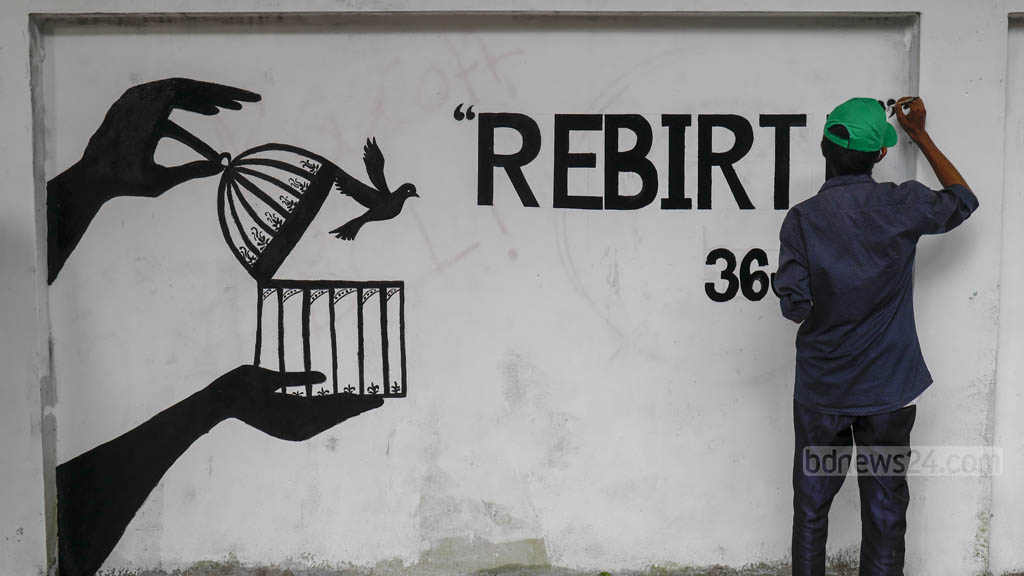
The context of Jafar’s presentation was the role that graffiti played during the historic July Uprising of 2024 in Bangladesh. What started as a legitimate demand from the university students to reduce the quota system in the public service jobs (from the existing 56% to 5%) in June 2024, the protests soon turned into a spontaneous movement against the fascist regime of the former prime minister Sheikh Hasina.
It was she who gave direct orders to kill innocent students and unarmed mass people, the youngest victim being a 3-years old child who was playing on the rooftop of his own house. In series of unprecedented events of 3 weeks, from July 15 to August 5, more than 1,500 were killed and nearly 20,000 were injured in the name of cracking down the protests.

The UN Human Rights Chief insisted how “the brutal response was a calculated and well-coordinated strategy by the former Government to hold onto power in the face of mass opposition”. After committing the crimes against humanity, Hasina fled from the country to India. As an autocrat who forcibly remained in power for more than 15 years, with arrest warrants out, she now faces charges for years of corruption, massacres, killings and human rights abuses.

During this July uprising, graffiti became a deliberate choice of weapon to challenge the fascist narrative for the students who metamorphosed the walls and public spaces into canvases across Bangladesh. Against the backdrop of total media control and complete internet black out, the collective rage of the public was broadcasted through the walls of the entire country, showcasing the powerful screams of the visuals and words which could not be silenced even with lethal weapon and threats of imminent deaths. In an age of global communication, when an entire nation was isolated from the outside world, graffiti emerged as a powerful tool for knowledge mobilization and public walls became vibrant educational platforms for every participant- children, youth and elderly alike.

While for Jafar, “these graffiti pieces represent a pedagogy of resistance, solidarity, and unity”, my key takeaway from this insightful presentation is the profound educational power inherent in graffiti which can transform ordinary public spaces into extraordinary arenas of open dialogue and critical reflection, accessible to all.
See some other images here:


Feedback for the author? Please email: mahfida@student.ubc.ca
Explore More from Research Day:
- Research Day Overview – Reflections and Summary
- Keynote Reflections: Taylor Webb on ‘ The Algorithmic Condition’
- Yotam Ronen Recognized for Outstanding Student Leadership
- Himadri Udahage Dona Recognized for Staff Excellence
- Rob VanWynsberghe Honoured with Supervisor Appreciation Award
- Podcast: Listening Between the Lines (coming soon)
Leave a Reply