Congratulations to Mahfida Tahniat for winning the 2026 EDST Research Day Blog Publication Award in the reflection writing category for the third consecutive year. We thank her for her dedication, persistence, and consistent contributions to the blog.
Toxicity in Education: A Vicious Circle
by Mahfida Tahniat
In his Research Day presentation, “Cost-Benefit Analysis of Receiving a Post-Secondary Education in Canada”,Paul Zhao used data collected through the census from Statistics Canada for a comparative study between university and trade school education. He explained how his findings suggest that attending university is a more beneficial educational option than a trade school for both domestic and international students in Canada. It is interesting how his study treated education as an investment decision, similar to an economic choice with costs and long-term returns. What I found valuable in Zhao’s presentation was his clear use of economic tools to address a question that many students and families genuinely struggle with: whether post-secondary education is financially worthwhile. However, while listening to Zhao, I couldn’t help but reflect on how the vicious circle of toxicity in education is woven into students’ everyday struggles, especially the financial ones, yet this remains largely invisible in graphs and numerical data.
My main concern was that even if post-secondary education is “worth it” over a lifetime, not everyone can access it equally because of high tuition fees, student debt, cost of living, unequal access for low-income students and additional barriers for international students, to name a few. The unequal burdens of students in exhausting living situations remain hidden behind those graphs and numbers. I believe these financial realities and structural challenges, particularly for international students, remain deeply embedded within system conditions, and demand serious attention and more action-oriented initiatives from decision-makers.

When it comes to paying tuition fees, the international undergraduate tuition is substantially higher than domestic tuition in Canada. Depending on the degree, the exact costs vary; however, international undergraduate students pay 5 times more than domestic students. For example, at UBC Vancouver, in 2026/27 Arts, domestic students pay $5,742.60, while international students pay $51,530.40 for a 30-credit year. For a Science and Commerce degree, it goes even higher, ranging from $53,082 to $66,678.30/year. Also, these are tuition-only amounts and not the total cost of attendance for international students, which includes additional expenses for student fees, books, housing, health insurance, and living costs. These figures are mind-boggling when one realises that international students are generally not eligible for major provincial and federal public student aid programs in Canada, because those systems are designed for Canadian citizens, permanent residents, or protected persons.

For the graduate students, again, the tuition fee amounts vary depending on the program, but international students pay way more than domestic students. While there are many scholarships and funding opportunities available for domestic students, international students generally have limited funding opportunities, as major Canadian student aid programs are delivered through provincial and territorial systems, and many university awards have specific citizenship, program, or eligibility restrictions. Such ongoing tension of financial pressure creates significant stress, undermines international students’ mental well-being, and negatively affects their academic performance.
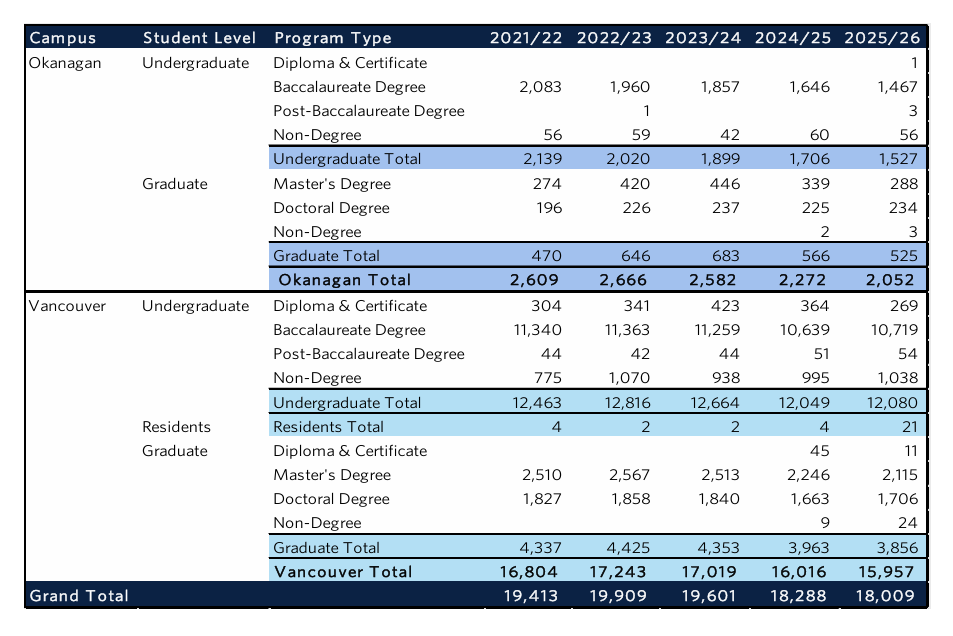
One might think that life becomes easier for the PhD students as there is the provision of guaranteed funding for all students. However, the financial challenges become far more complicated at the doctoral level. In most PhD programs at UBC, the average completion is 5 to 6 years (information available on the program website page), and the department of Educational Studies reports it as 7.8 years, whereas doctoral funding ends after 4 years at UBC. The following excerpt (along with the attached Figure 41) is taken from the most recently published UBC Annual Enrolment Report 2025/26 (pp 51-52), but one can see that the data mentioned here is from 2015/16:

“For UBC’s doctoral students, whose programs are expected to take longer than those of master’s students, the report is based on how many students graduated within nine years of program entry. For the Vancouver campus, 1,993 students began their studies between 2012/13 and 2015/16, and 1,719 (86%) completed their doctoral degrees within nine years. The 1,719 students who completed their programs are shown in Figure 41. There were 274 (14%) students who did not complete their degrees and withdrew from their programs on average after 2.7 years of study. The students who completed their degree within nine years took an average of 5.6 years to complete their studies.”
But why can’t a PhD student complete their degrees on time? This remains an obvious rhetorical question! Many UBC graduate students face financial hardship because graduate funding has historically been low in comparison to living costs in one of the most expensive cities in North America. Most graduate students juggle multiple part-time jobs to make ends meet and struggle with limited time for their studies and research, resulting in delaying their graduation. The original UBC Four-Year Fellowship (4YF) guidelines show that it was first introduced at $16,000 in 2009 (with a tuition waiver) and was increased to $18,000 in 2012. In 2018, UBC set the minimum PhD funding to $18,000 based on the current 4YF value of $18,200. Although the minimum PhD funding has increased over the years, the 4YF has remained stagnant at the same amount for the past 14 years since 2012. Importantly, UBC did acknowledge and recognise that financial commitments can be obstacles to graduate research, and they recently increased the minimum funding to $40,000, effective from September 2026. But the fact remains that graduate students are required to “earn” those minimum-funded packages in the form of working as a GTA, GAA, GRA, or in other positions.
While students struggle to survive with the minimum funding, they have no choice but to accept additional paid work, which makes it challenging to complete their PhD within the 4-year funding timeline and ultimately leads to longer degree completion years. The more the students take on additional jobs, the less time they have for their research and completing their degree, and the vicious circle continues. Once funding ends after 4 years and they are yet to graduate, the situation becomes much worse for international students, as well as for student-parents and single parents with caring responsibilities, since they face added layers of multifaceted invisible challenges and unacknowledged constraints.
Going back to Zhao’s presentation, he rightly mentions, “a university education is a more profitable investment than a trade school education”. However, my understanding is that such benefits are unevenly distributed and often come at high personal, emotional, and financial cost. In that sense, the question is not only whether going to the university is a “profitable investment”, but also for whom, under what conditions, and at whose expense. I also found myself questioning whether the value of post-secondary education should be measured primarily in financial terms at all, since education also shapes critical thinking, personal growth, social mobility, and community engagement.
Leave a Reply