
In the world of emerging DIY learning apps with a mobile-friendly design, Deepstash is one that was recommended to me by a friend for personal growth and development. This platform lets the user read shortened versions of different media types by using a form of microlearning. The description from the Google Play Store states “Learn something new in just 5 minutes, with unlimited daily access to 200,000+ powerful ideas from top books, articles, podcasts, videos and more.”

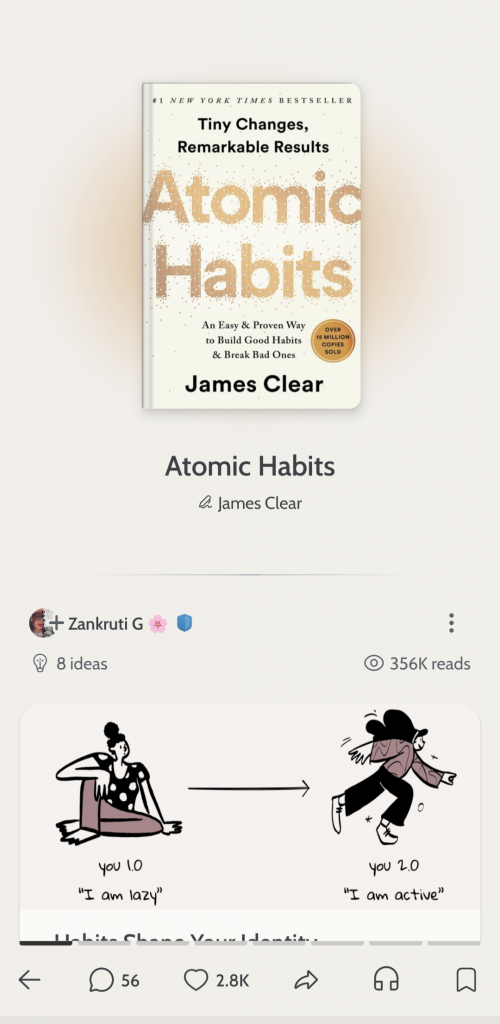
The personalization of content is a standout in this app. Deepstash will curate content by topic based on the preferences of the user. This content is then broken down into bite-sized main points and bullet points, as well as the option to listen to the content. There is also the option to participate in the comment section and like certain authors and content to further tailor the experience.
Some potential barriers in using the app include constant notifications about maintaining a “streak” within the app. Upon opening Deepstash, there is an immediate announcement of whether the user has been on a multi-day steak or if the streak is broken. Additionally, the free version of this app is limited. To access functions such as unlimited saving of content, downloading and accessing content offline, the Pro subscription costs as little as $80.99 CAD annually.
References
https://play.google.com/store/apps/dev?id=6838038566629563073&hl=en_CA&gl=US&pli=1

WOW! Thank you for sharing this. Deepstash’s microlearning model maps almost perfectly onto the realities of fast-paced retail learning, and I say that from direct experience. In my company, our beauty advisors were never going to sit through thirty-minute modules between clients—their learning happened in stolen moments: two minutes before a fragrance launch, five minutes between appointments, a quick refresher during a slow afternoon on the floor. That’s exactly the niche Deepstash fills with its five-minute, bite-sized format and audio option, which matters enormously when your hands are occupied folding stock or setting up a display.
The personalization by topic and preference is where I see real instructional value. In my work designing digital lessons, the hardest problem was relevance at scale: a skincare specialist and a fragrance advisor needed different content, framed differently, at different moments. Deepstash’s curation logic—learning from what you like and engage with—mirrors the adaptive, context-aware design I was reaching toward with LMS analytics and Tableau dashboards. The comment section and author-following features also create the peer-community dimension that made the biggest difference in my retail training programs; associates trusted tips from each other more than from corporate. That said, the streak notifications concern me from a learning-design standpoint. In retail, where shifts are unpredictable and burnout is real, guilt-driven engagement mechanics can backfire—they punish the learner for the very time scarcity that makes microlearning necessary.
Thanks for sharing this. It is definitely similar to platforms like Skillshare, but it seems that their catalogue is heavily focused on the self-help or self-improvement type books or literature. While I do find this resource useful, where I get similar advertisements that tell us to stop ‘doom-scrolling’ and focus on what Jazz mentioned, ‘micro-learning’, that I do struggle with the idea that the compactness of learning is shallow, unlike reading the full depth of a book. Something about the low bar of resiliently learning one topic when using these types of platforms, make it feel superficial, and make it difficult fo rme to buy into.
This is really cool! I keep seeing advertisements on Instagram about micro learning and I am glad that someone has tried it and has had a good experience with it.
Thanks for the suggestion, Richard.