Categories
Info Tech

Social Networking and Special Library Collections

I find it fascinating that social networking services have become synonymous with online social media platforms. I also find it particularly interesting that so many libraries have been so quick to create their own personal profile pages.

The use of social networking services for libraries, as with other Web 2.0 technologies, has been a contentious issue among librarians. The Librarian in Black offers some helpful pointers on how to leverage social media tools to increase interactivity and visibility of libraries among their communities. However, the Other Librarian states that some insist that “the culture of Libraries clashes with the culture of Facebook” and that if a librarian is going to use Facebook effectively, they will need to build a rapport with members of their community. Meredith Farkas has reminded users that social networking profiles are a two-way communication medium and that profiles can be an effective portal to library information and services. According to a survey of libraries’ uses of Web 2.0 tools in the ALA’s 2010 State of America’s Libraries Report, the greatest uses of social media include: promoting general library services, marketing specific programs/services, quick updates to users, reaching a new audience, and issuing press releases. The report concludes that the “increase in social networking suggests a set of skills that librarians should possess as social networking-literate information professionals capable of implementing library services and using information at social networking sites” and that these skills include “interacting with patrons within the sites, understanding and articulating the nature of social networking sites and their potential roles related to library services, creating presences and content, evaluating and applying information, and being able to help patrons acquire and apply these skills.”

These discussions are all well and good, but what about special collection, libraries? How are they utilizing social networking profiles, and are these profiles effective? According to Amelia Abreu’s “Creating a Community for the Cultural Record: Using Social Software in Special Collections” presentation, the archivist states that “Social software tools have the potential to document institutional knowledge and improve word of mouth referrals by establishing new channels of communication between users.”

Let’s take a look at a few Facebook library profiles pages of (yes, you guessed it) three different libraries: the New York State Library, the San Francisco History Center/Book Arts & Special Collections, and the Rare Book, Manuscript, and Special Collections Library at Duke University. Here are the corresponding Facebook pages:
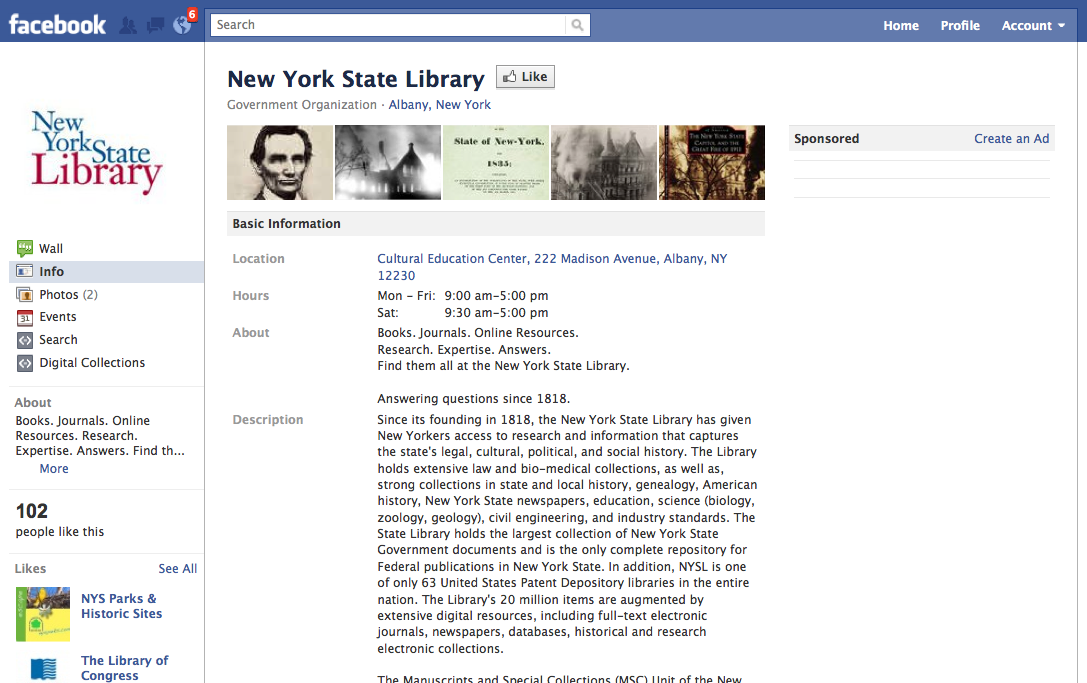
New York State Library: Special Collections
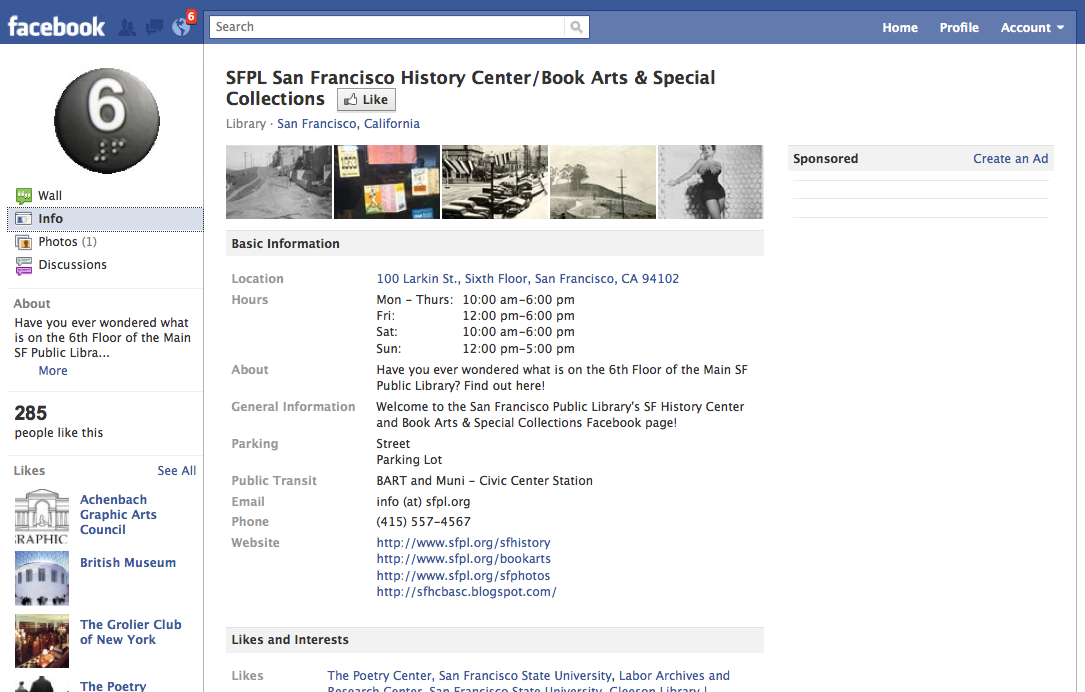
San Francisco Public Library: History Center
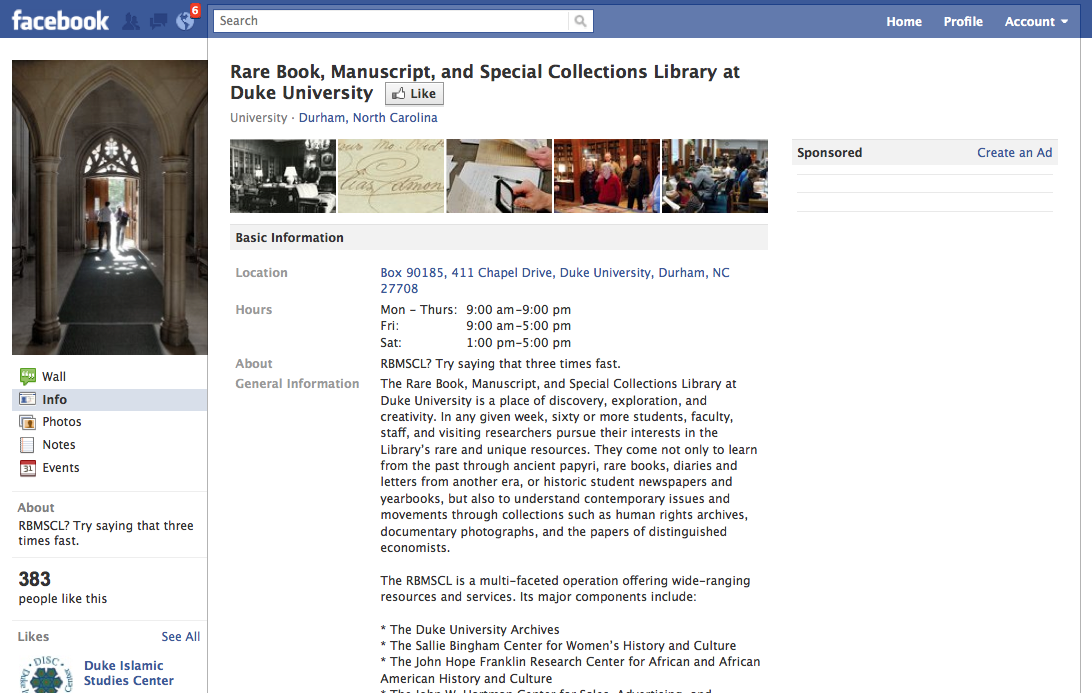
Duke University Library: Special Collections

The first thing to note is that all three libraries provide a Facebook link from their main library information page, and all three Facebook profiles appear to update regularly and have a fair amount of followers. All three profiles offer descriptions of the library in the “General Information” or “Description” area, however the SFPL History Center has considerably less descriptive content. Additionally, none of these libraries delineate the purpose of their Facebook profile.

The SFPL History Center’s profile primarily features historic photos, whereas the NYSL’s profile includes some historic ephemera photos, and some general library photos that feature what sort of information services they offer. The NYSL’s profile also features a plug-in library catalog search bar, and a plug-in sample of their digital collections. The RBMSCL at Duke University also features a some photos from the collection as well as miscellaneous general library photos. There does appear to be a bit more interactivity on the RBMSCL page, but all three seem to be using their Facebook profiles for similar purposes, mainly to market library related information on their network.

I’ll admit that I was interested in viewing Special Library Collections’ profiles to get a sense of whether or not they are effective. Regarding their overall content, I think that all three sites could better utilize the “Events” page, the SFPL History Center could include more information for users, and it’s unclear as to whether or not having a search or digital collection plug-in feature at the NYSL would be useful for users. As a patron, I would much rather go to the NYSL main page in order to better explore the libraries resources. However, all that being said, all three libraries do feature organizational updates and news of a local or historical interest. As a library professional in special collections, I could see a good deal of benefit to networking between organizational profiles, however as a patron, I don’t think that I would really consider using the social media profile service unless I was conducting regular research.

As Terra B. Jacobson concluded in her article on “Facebook as a Library Tool: Perceived vs Actual Use,” from her study it was “found that Facebook would be a better tool for ‘active libraries,’ or libraries that host a lot of events, exhibits, workshops and other activities as its top use is for announcements and marketing. Also, librarians should not get too attached to Facebook, as there is always the next tool or social networking site that people are using. Web 2.0 applications move quickly and the Internet is constantly changing, be prepared to leave your hard work behind to jump to the next tool.”
Categories
Info Tech

Tag: Using it in Library Catalogs

Folksonomies and tagging is a relatively new occurrence in library catalogs. Although the integration of tagging features seems to have caught on quite well within public and community libraries, the implementation of tagging software in academic and special library collections seems to be moving at a bit of a slower rate.

At any rate, let’s take a look at some library catalogs that are implementing folksonomies. I’ll be comparing a university/college union catalog, a city public library catalog, both of which are using tags from LibraryThing, and a law school library catalog that is implementing the rather popular Encore library search tool.

TOPCAT is a union catalog of the SWITCH Library Consortium of universities and colleges in Wisconsin. According to TOPCAT Features, the “tags are from LibraryThing, a book cataloging site that features a database of over 22 million titles. Public members of LibraryThing contribute tags describing the contents of each item. Tags are viewable within the full record of many TOPCAT titles although they are not in all records.” Additionally, according to the What are Tags? page the university library users cannot add their own tags, and tags may be “irrelevant or not quite ‘right’.” Once a user clicks on a tag to look for related resources, a Tag Browser appears.

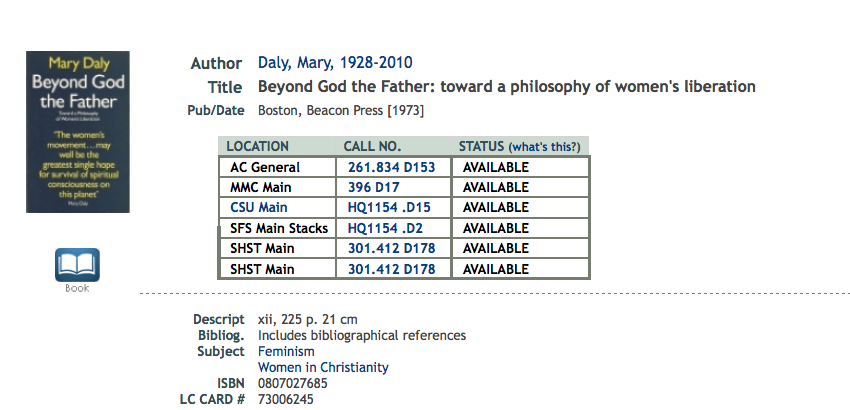
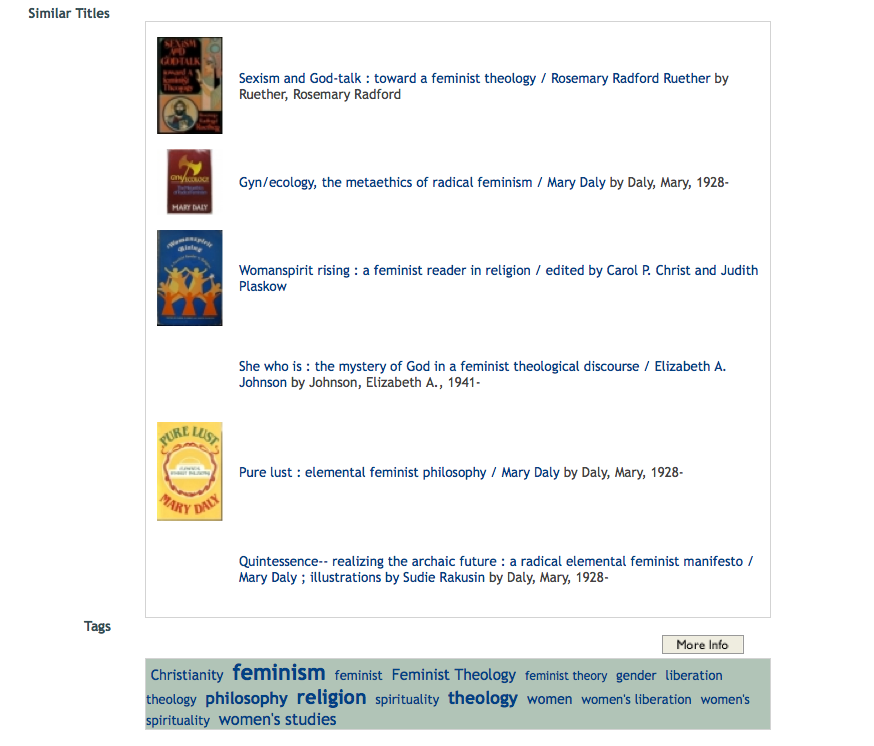
Here is an example of a library catalog description with “Tags” and LibraryThing’s “Similar Titles” feature:

Mary Daly's Beyond God the Father
Mary Daly: Similar Titles and Tags

Having read Daly’s work, and having completed a minor in Gender and Women’s Studies, I find several things to be interesting about the tags for this catalog entry. One is the absence of the term “radical feminism” which we can see referenced in the title of one of her other works. The other is that once I start to explore the Tag Browser, I find only related works on “feminist theology” or “feminist theory” that take me to other related authors, but that do not privilege Mary Daly’s other works as relevant. The relationships between terms are associative rather leading me to greater degrees of specificity.

Of course, there isn’t anything necessarily wrong or bad about this, but if I wanted to be able to browse from the broader term of “feminist theory” or “feminism” to a specific kind of theory, such as “radical feminism,” these tag features do not allow me to do so. All that being said, as an exploration and discovery tool that brings together variously associative works, the tag feature works quite well.

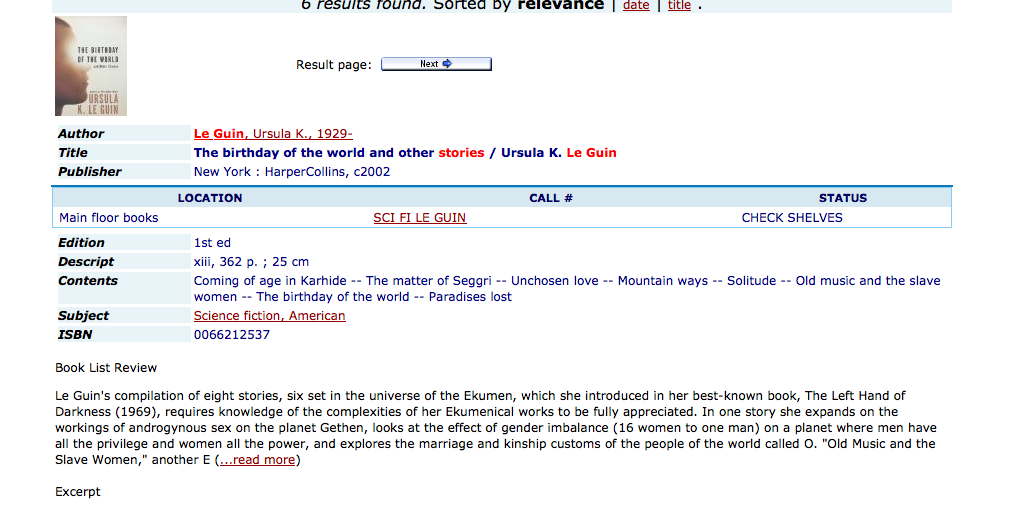
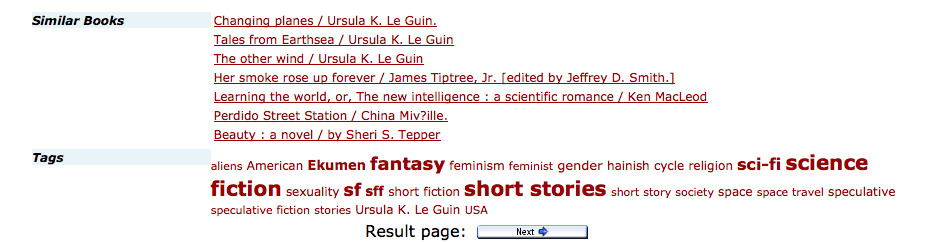
The Danbury Public Library, is the city library of Danbury, Connecticut. The Danbury Public Library Catalog also integrates some LibraryThing’s features, mainly tags and a list of similar books without thumbnail icons. Here is another example of a catalog entry and tags:

Ursula K. Le Guin: The Birthday of the World and Other Stories
Ursula K. Le Guin: Similar Books and Tags

The catalog description also features an excerpt of the works provided by Syndetic Solutions. In this case, it’s interesting to note that one of the tags includes the name of the author, and (possibly) where the work is published (i.e., USA). Also, we have terms with a much greater degree of specificity that are unique to Le Guin’s world building, namely “Ekumen” and “hainish.” As expected, broader terms like “speculative fiction” and “feminism” yield a larger variety of associative works.

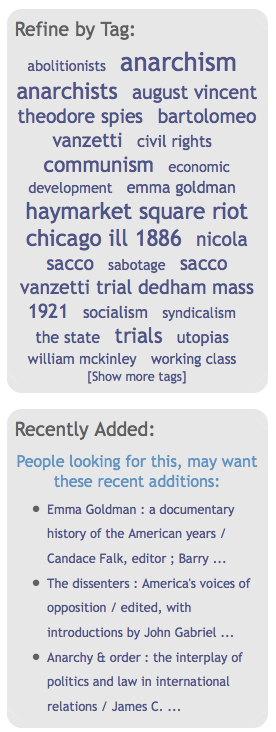
The Mendik Library, the New York Law School’s library switched to Encore library discovery search a couple years ago, according to product website. Additionally, according to the product website, both library staff and users can add tags and includes specialized terms. One noticeable difference between the tag feature in Encore, as opposed to LibraryThing, is the presence of a Refine Searches tag cloud at the bottom of a retrieved search list and a Refine by Tag cloud to the immediate right of a retrieved search list. Here are examples with a search on “anarchism”:

New York Law Library: "Anarchism" search tag cloud
New York Law Library: "Anarchism" refine tag cloud
New York Law Library: "Anarchism" refine search tag cloud
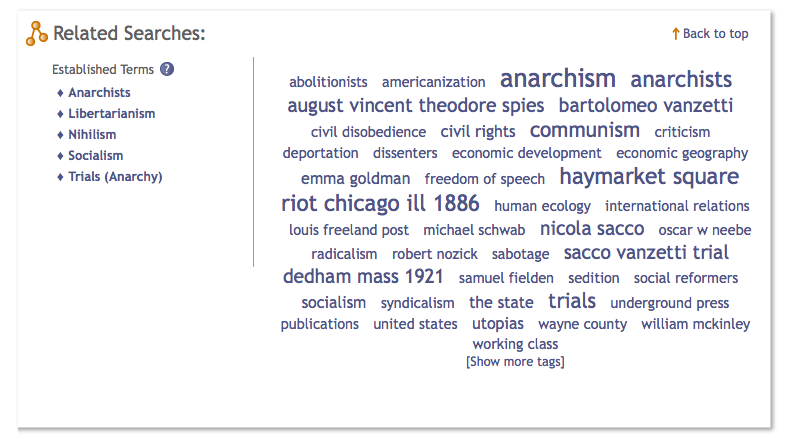
New York Law Library: "Anarchism" related search tag cloud

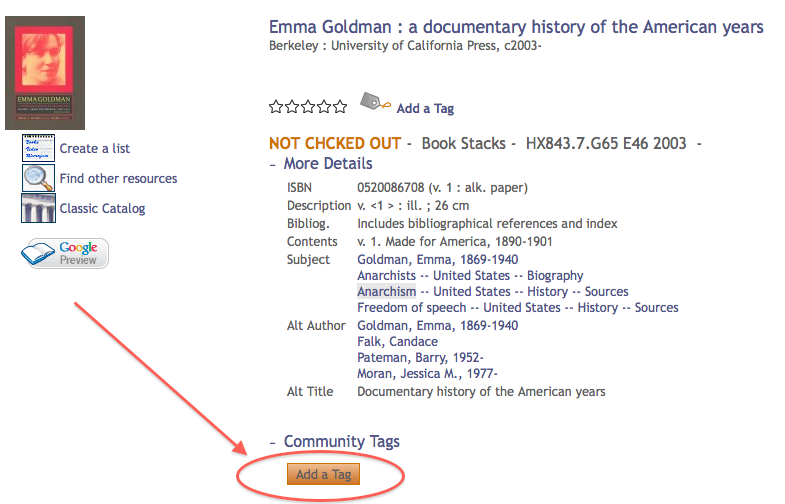
The “Established Terms” to the left of the related searches tag cloud are terms “chosen by librarians to ensure consistency in organizing library materials.” In addition to librarian-recommended search terms, the associated “anarchism” tags offer a very rich variety of associated topics, people, events, times, historical movements, and places, offering greater degrees of specificity or generality of related terms. Looking at a specific catalog entry may reveal an absence of “Community Tags,” however, the option to Add a Tag is clearly available to patrons:

Emma Goldman: Community Tag option

What’s particularly interesting about the use of tags in a special library like the Mendik Library, is that its overall usefulness seems unclear. Tag searches work quite well as a general discovery tool for those who are just beginning to familiarize themselves with the topic; however, the use of tags for highly specific and specialized research would also be useful. Additionally, the inability to add or modify tags within the systems that utilize LibraryThing, seems like a bit of a moot point.

As a public library patron, I would be much more inclined to use Encore’s tagging system for discovery, as well as utilize the option of being able to contribute my own personal tags to a work. From the perspective of an academic library patron, I would most likely view the integrated LibraryThing tags as a limited discovery tool that may become less useful once a greater familiarity with the subject and research topic is acquired. Additionally, I would view inability to add or modify links as pretty significant limitation to being able to leverage the power of tagging within a participatory academic and scholarly community. Overall, I would suggest that other libraries consider the usefulness of having tags as a discovery tool and a means of refining one’s search, and I would also suggest that other libraries do not integrate tags without the option of user participation. As others have explained, the greatest appeal of tagging, folksonomies, and social bookmarking is the ability leverage user participation and community knowledge.

Spam prevention powered by Akismet