Categories
Uncategorized

Social Media in Virtual Learning Environments

“There are no natives here…you should never feel stupid in this environment, because we are all stupid in this environment, it’s all new to all of us”

~ Michael Wesch

Michael Wesch’s video A Portal to Media Literacy and Howard Rheingold’s video on the Social Media Classroom seemed to answer many of the questions I was left with last week. Both videos introduce different learning management systems or virtual learning environments that support digital literacy, or what some call, 21st century new media skills.

Rheingold’s Social Media Classroom and Collaboratory is a kind of Drupal-based virtual learning environment that includes a variety of social media tools such as forums, blogs, commenting, wikis, chat, social bookmarking, RSS, microblogging, widgets, and video commenting all in an effort “to afford a more student-centric, constructivist, collaborative, inquiry-oriented learning.” According to the website, the SMCC helps “engage students in actively constructing knowledge together about issues that matter to them, rather than passively absorbing it from texts, lectures, and discussions.” Wesch’s Netvibes Digital Ethnography personal learning environment offers similar affordances as the SMCC but is centered much more around course content. Rheingold’s SMCC is a great all-purpose social media platform, that can offer a foundation from which instructors can build and tailor their course content.

However, what struck me about Wesch’s system was the way in he structured the course content. Rather than pointing students to resources with the expectation that they will process the material and regurgitate it in another form, Wesch structured the course around open research questions that students had to answer collaboratively. Wesch is also known for his use of game structures in his course in order to introduce students to important questions, ideas, topics, and issues that are relevant to anthropology. Granted Wesch’s courses are for undergraduate learners, however his pedagogical methods are noteworthy. According to Wesch, teachers have three important avenues with which they are able to create meaning or significance for learners:

  1. Semantic Meaning: Find a grand narrative to provide relevance and context for learning, i.e. What are the big questions? What is the epistemological context?
  2. Personal Meaning: Create a learning environment that values and leverages the learners themselves, i.e. Work together to create learning. Ask how can you unlock creativity and critical thinking?
  3. Do both in a way the realizes and leverages the existing media environment and thus allows students to realize and leverage the existing media environment, i.e. push students beyond media literacy so that students can start leverage the media for themselves

To relate this to the quote above, what I really appreciate and admire about both Wesch and Rheingold is that they don’t make assumptions about students. Rather, they recognize that young students may have engaged with social media in very superficial and non-critical ways, if they use social media tools at all. Rather, they recognize that in order to become viable participants, digital denizens, or employees in the growing knowledge economy, students need to be equipped with digital literacy skills. As creativity, collaboration, and participation are essential for new media participatory cultures, both Wesch and Rheingold offer potential aggregated platforms that can support these learning activities.
Categories
Social Media for Info Pros

Creating and the Social Web

“…we are, in a sense, interactive story tellers, trusted digital guides, interpreters of facts, and experiences,…this is the new epistemology of the social web for information professionals…”

~ Dean Giustini

I found Sir Ken Robinson’s Creative Places + Spaces video titled Collaboration in the 21st Century to be especially inspiring. Author of the books The Element: How Finding Your Passion Changes Everything and Out of Our Minds: Learning to be Creative, Robinson is a lead promotor of creativity and innovation in education and the workplace. I had such an “aha!” moment during his talk, that I found myself taking notes, and writing down nearly every word he said. This is his initial description of creativity:

“one of the reasons  so many people loose confidence in their own powers of innovation is that their imaginations have been left to wither, but they can be revived…Creativity is a step on from imagination because you can be imaginative all day long and never do anything…to be creative you have to do something. Being creative is a process of putting your imagination to work, you can think of it as applied imagination…”

He goes on to define creativity as:

  1. a process that we can understand and teach to others, “most people start with an idea and have to work on it, and the idea evolves in the process of it being formulated and often the idea you end up with is not the idea you started with”
  2. something that is original, novel, unique or different from previous ideas
  3. something that has value, because “some creative ideas are highly original but useless…and very often people misjudge the value of a new idea, because they apply the wrong values to it, they apply their present values to it rather than seeing how they might evolve. I mean, nobody would have given much for the internet 20 years ago as an idea…”

After Robinson’s initial video, I did a bit of exploring and discovered his TED Talk titled Schools Kill Creativity, and this video doubled, maybe even tripled, my initial “aha”. In this video, Robinson argues that as a society we tend to educate our people out of creativity. Here is an excerpt from the video:

“…the hierarchy [of education] is rooted on two ideas. Number one, that the most useful [school] subjects for work are at the top. So you were probably steered benignly away from things at school when you were a kid, things you liked, on the grounds that you would never get a job doing that…don’t do music, you not going to be a musician, don’t do art, you won’t be an artist, benign advice… The second is academic ability which has really come to dominate our view of intelligence, because the universities designed the system in their image. If you think about it, the whole system of public education around the world is a protracted process of university entrance. The consequence is that many highly talented -brilliant- creative people, think that they are not. Because the thing they were good at school wasn’t valued or was actually stigmatized, and I think that we can’t afford to go on that way…”

Public education values disciplines that either support the job market or the academy, thus leaving people who are unable to fulfill these values by the wayside. Admittedly, this is a rather depressing outlook, but I must say that (based on my own experiences) I have to agree with Robinson. The costs are high for students who fall prey to this system and for students who fall out of the system and, as a result, those who drop out of the system come to conclude that they aren’t valuable contributors or good at anything.

So, following that rather depressing video I found Tim Browns TED Talk on Creativity and Play and it offered a bit of hope and a breath of fresh air. Brown’s very simple and straightforward argument is that creativity and play in the workplace is valuable, generative, important, and should be consistently supported. Workplaces should encourage and support divergent play in order to generate as many initial ideas as possible and converge those initial ideas toward the aims and goals of the project. It’s creative play within a certain context and within a few paramaters that can bring about wonderful innovations.

Now, what does all of this have to do with information organizations, information professionals, and social media? I think that information organizations and information professionals can take quite a bit of inspiration from these talks when considering the potential use of social media to support creativity in learning, and innovation in the workplace.  As Henry Jenkins mentions in Confronting the Challenges of Participatory Cultures: Media Education for the 21st Century, new media skills that can be supported in participatory cultures include play, performance, simulation, and appropriation, all skills that support creativity and innovation.

Dynamic social media has the potential to support various learning types and creative engagement. What can be taken away from Brown’s talk, is that creativity and play in work environments support innovation and creative problem solving. Can information professionals adapt his process of creativity and play in order to develop project ideas or problem-solve within the organization? What sort of social media tools could be used to support innovative creativity and play? Finally, to relate these ideas back to the quote above, what role does creativity play in the new epistemology of information professionals?

I think that these are all very important questions to consider, and I think that if we are to continue to ignore the importance of creativity and play in learning and workplace environments, we run the risk of being left on the outside of the global trend toward participatory cultures.

Categories
Social Media for Info Pros

On Blogging and Being A Wannabe Blogger

“Blogging requires an embrace of hazards, a willingness to fall off the trapeze rather than fail to make the leap” ~ Andrew Sullivan

My first blogging experiences happened when I was a high school student back in the late 1990’s. This was before Facebook, MySpace, or LiveJournal, before cellphones became as commonplace as lunch pails, when AOL still ruled the web and high speed broadband was a luxury that most could not afford. I know that I’m making myself sound old and sage-like when it comes to social media, but todays online technologies are deeply steeped in generational rhetorics and, quite frankly, I believe that each of us has used and encountered social media technologies at different points in our lives, with different levels of importance, with different affects, different uses, different commitments, and different concerns.

Part of my short trek into nostalgia-land is to bring attention to some of the similarities and differences between, for example, the earlier days of blogging and blogging today. Early proto-blogging platforms like OpenDiary and LiveJournal paved the way for the commonplace blogging platforms, Blogger and WordPress. Back then blogging was much more personal and akin to maintaining a diary (as many of you may be familiar with from first hand experience). There was a greater degree of anonymity and there was less of a journalistic or magazine readership feel compared to the professional bloggers of today.

I have, as I’m sure you would imagine, grown a great deal from my early teenage years and usage of social media. I dropped the OpenDiary account by the time I graduated high school, and since then had made various half hearted attempts at blogging. I tried blogging/journaling about my personal thoughts and reflections, and quickly deleted the account. I tried blogging about food, literature, or pop culture but felt like I was trying to be too much like a journalist interested in gaining a particular niche readership. All of these attempts never really got past one or two posts.

To a certain extent, my trepidations around blogging also had to do with concerns about my own personal style and tone. I tend to write and speak in a somewhat analytic and academic tone. This might be because I spent the majority of my early twenties in philosophy and rhetoric courses, or it might be because I idolized, worshiped, and modelled myself after Janeane Garofalo in my formative years, either way I’ve worried from time-to-time that my tone can be a bit initially intimidating. In actuality, and this might come as a surprise to acquaintances, I’m a bit of an introvert and am not always as sure of my thoughts, opinions, and writing as I seem.

As a formative information professional, I feel that there is another call for blogging: to maintain professional interests, contacts with colleagues, and provide a central medium or archive of your opinions and well informed critical reflections on issues, topics, and events that are pertinent to your field. I’ve become much more interested in blogging and managing my social media networks toward these professional goals. However, balancing the management of these information productions and flows can be time consuming and difficult along side a full-time course load.

All my wannabe blogger ambitions aside, I do think that the medium of blogging has had a rather interesting relationship to both print media and other forms of social media. Andrew Sullivan‘s 2008 article, Why I Blog, offers some interesting insights on the positionality of bloggers and blogging (not to mention very quotable prose). At one point he discusses the personal origins and nature of blogging:

“What endures is a human brand…It stems, I think, from the conversational style that blogging rewards. What you want in a conversationalist is as much character as authority. And if you think of blogging as more like talk radio or cable news than opinion magazines or daily newspapers, then this personalized emphasis is less surprising. People have a voice for radio and a face for television. For blogging, they have a sensibility.”

I find it intriguing that he relates bloggers more to radio or television personalities rather than op ed writers or journalists. I agree that there is much more of a conversational tone and expectation to blogging, that is somewhat present in radio, but I feel that it is far less present in the more broadcast based medium of television. What I find most intriguing about his description of blogging, is how he relates the tone and style of writing to the medium:

“Reading at a monitor, at a desk, or on an iPhone provokes a querulous, impatient, distracted attitude, a demand for instant, usable information, that is simply not conducive to opening a novel or a favorite magazine on the couch. Reading on paper evokes a more relaxed and meditative response. The message dictates the medium. And each medium has its place—as long as one is not mistaken for the other.”

Each medium has it’s place, and the message dictates the medium. Having been repeatedly reintroduced to Marshall Mcluhan‘s ideas, primarily with The Medium is the Massage, I found this section to be particularly thought provoking. I believe that Sullivan is saying, that even though the medium affects the reader, the nature of the message dictates the appropriate medium. Blogging works best for up-to-date immediate reactions, interpretations, and opinions on an event or article, that can satiate an immediate desire for information. However, you would not look for this sort of content in a novel or academic journal.

However, despite the immediacy with which he describes blogging, I do think that blogging’s sensibility has become remolded or repositioned since the widespread use of Twitter. This blog post by Joe Manna places Twitter among terms such as instant gratification, accountability, and conversation, whereas blogging is described as verbosefulfilling, longer, and more detailed. I’ve come across this sort of comparison before, and I think it’s important to keep in mind the relationships between various social media, as well as between print and “new media.”

I’d like to end (this rather long post) with a few more quotes on blogging by Sullivan:

“[A blogger] is—more than any writer of the past—a node among other nodes, connected but unfinished without the links and the comments and the track-backs that make the blogosphere, at its best, a conversation, rather than a production.”

“To blog is therefore to let go of your writing in a way, to hold it at arm’s length, open it to scrutiny, allow it to float in the ether for a while, and to let others…pivot you toward relative truth.”

“[A blogger] can provoke discussion or take a position, even passionately, but [she] also must create an atmosphere in which others want to participate.”


Categories
Info Tech

Social Networking and Special Library Collections

I find it fascinating that social networking services have become synonymous with online social media platforms. I also find it particularly interesting that so many libraries have been so quick to create their own personal profile pages.

The use of social networking services for libraries, as with other Web 2.0 technologies, has been a contentious issue among librarians. The Librarian in Black offers some helpful pointers on how to leverage social media tools to increase interactivity and visibility of libraries among their communities. However, the Other Librarian states that some insist that “the culture of Libraries clashes with the culture of Facebook” and that if a librarian is going to use Facebook effectively, they will need to build a rapport with members of their community. Meredith Farkas has reminded users that social networking profiles are a two-way communication medium and that profiles can be an effective portal to library information and services. According to a survey of libraries’ uses of Web 2.0 tools in the ALA’s 2010 State of America’s Libraries Report, the greatest uses of social media include: promoting general library services, marketing specific programs/services, quick updates to users, reaching a new audience, and issuing press releases. The report concludes that the “increase in social networking suggests a set of skills that librarians should possess as social networking-literate information professionals capable of implementing library services and using information at social networking sites” and that these skills include “interacting with patrons within the sites, understanding and articulating the nature of social networking sites and their potential roles related to library services, creating presences and content, evaluating and applying information, and being able to help patrons acquire and apply these skills.”

These discussions are all well and good, but what about special collection, libraries? How are they utilizing social networking profiles, and are these profiles effective? According to Amelia Abreu’s “Creating a Community for the Cultural Record: Using Social Software in Special Collections” presentation, the archivist states that “Social software tools have the potential to document institutional knowledge and improve word of mouth referrals by establishing new channels of communication between users.”

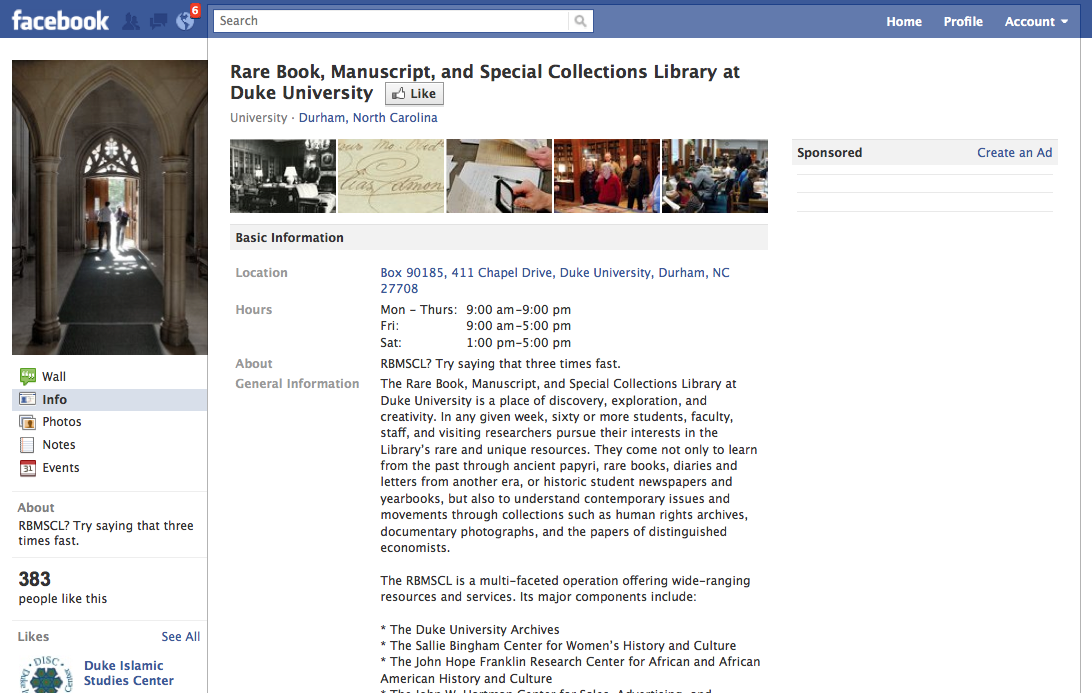
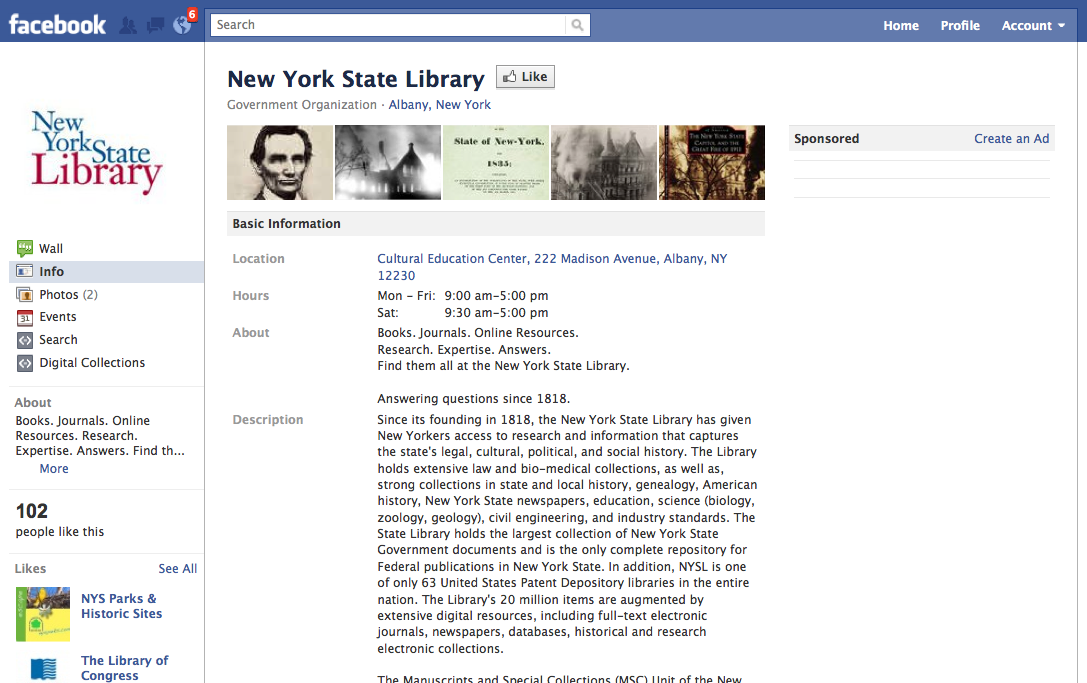
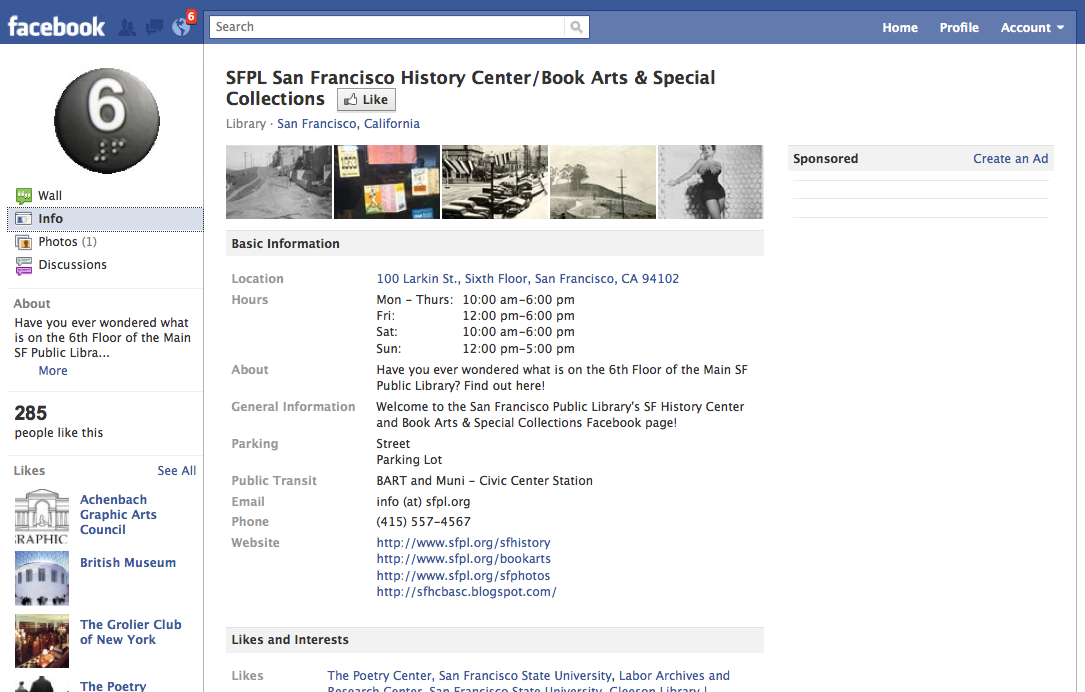
Let’s take a look at a few Facebook library profiles pages of (yes, you guessed it) three different libraries: the New York State Library, the San Francisco History Center/Book Arts & Special Collections, and the Rare Book, Manuscript, and Special Collections Library at Duke University. Here are the corresponding Facebook pages:

New York State Library: Special Collections
San Francisco Public Library: History Center
Duke University Library: Special Collections

The first thing to note is that all three libraries provide a Facebook link from their main library information page, and all three Facebook profiles appear to update regularly and have a fair amount of followers. All three profiles offer descriptions of the library in the “General Information” or “Description” area, however the SFPL History Center has considerably less descriptive content. Additionally, none of these libraries delineate the purpose of their Facebook profile.

The SFPL History Center’s profile primarily features historic photos, whereas the NYSL’s profile includes some historic ephemera photos, and some general library photos that feature what sort of information services they offer. The NYSL’s profile also features a plug-in library catalog search bar, and a plug-in sample of their digital collections. The RBMSCL at Duke University also features a some photos from the collection as well as miscellaneous general library photos. There does appear to be a bit more interactivity on the RBMSCL page, but all three seem to be using their Facebook profiles for similar purposes, mainly to market library related information on their network.

I’ll admit that I was interested in viewing Special Library Collections’ profiles to get a sense of whether or not they are effective. Regarding their overall content, I think that all three sites could better utilize the “Events” page, the SFPL History Center could include more information for users, and it’s unclear as to whether or not having a search or digital collection plug-in feature at the NYSL would be useful for users. As a patron, I would much rather go to the NYSL main page in order to better explore the libraries resources. However, all that being said, all three libraries do feature organizational updates and news of a local or historical interest. As a library professional in special collections, I could see a good deal of benefit to networking between organizational profiles, however as a patron, I don’t think that I would really consider using the social media profile service unless I was conducting regular research.

As Terra B. Jacobson concluded in her article on “Facebook as a Library Tool: Perceived vs Actual Use,” from her study it was “found that Facebook would be a better tool for ‘active libraries,’ or libraries that host a lot of events, exhibits, workshops and other activities as its top use is for announcements and marketing. Also, librarians should not get too attached to Facebook, as there is always the next tool or social networking site that people are using. Web 2.0 applications move quickly and the Internet is constantly changing, be prepared to leave your hard work behind to jump to the next tool.”

Categories
Info Tech

How Academic Libraries are Tweeting

Twitter seems to be the brand name that has become commonplace for micro-blogging in general. Now, I’ll admit that I’ve had difficulty assessing Twitter’s overall value as a technology. With a restriction to 140 characters, the technology really seems much more useful for mobile devices with data packages, for information quickies on the go, rather than an in-depth representation of services. All that being said, Phil Bradley offers some worthwhile uses of Twitter for libraries:

  • General Information Updates
  • Staff Information
  • New Resources
  • General Information
  • Countdowns for Library Events
  • Links to Images About the Library
  • News Alert Service
  • Notify Patrons About What the Library is Doing
  • Conversations About the Library or Subject Area of Interest
  • Awareness for Specific Subjects or Specific Groups of People
  • Update News RSS Feed on Library Webpage
  • Share Best Practices with Other Libraries

…and some instances when using Twitter misses the mark:

  • Tweeting without following anyone
  • Tweets aren’t open to the general public (i.e. you can’t see their Tweets until you commit to following them)
  • If you don’t see a value in it, don’t use it, and come back later to try it again

All right, but what about the academic context? How are university libraries implementing micro-blogging? Let’s take a look at three university library Twitter accounts to get a sense of how they’re using the technology: UC Berkeley Library Technology Training, Harvard Library, and Koerner Library at University of British Columbia.

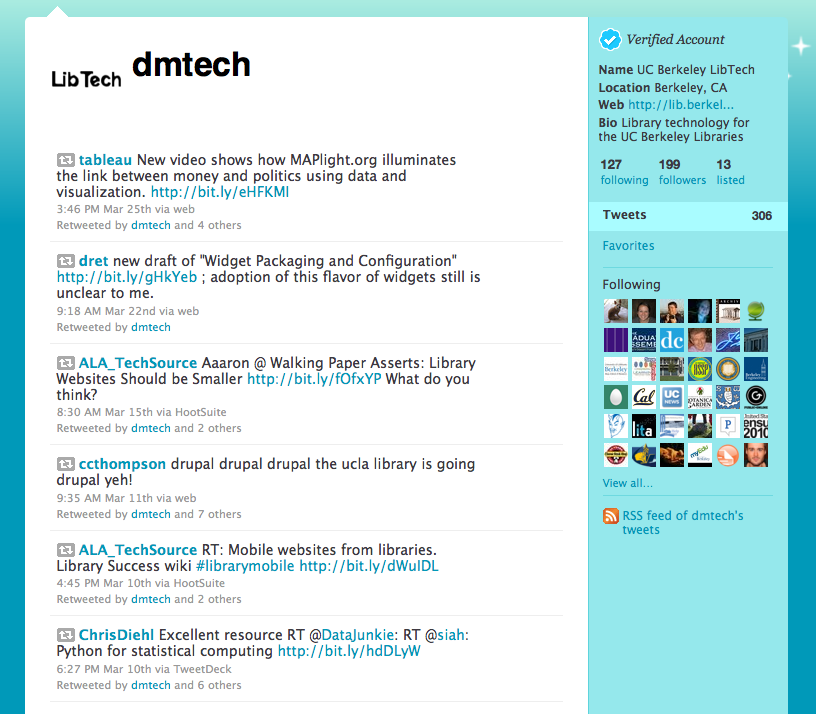
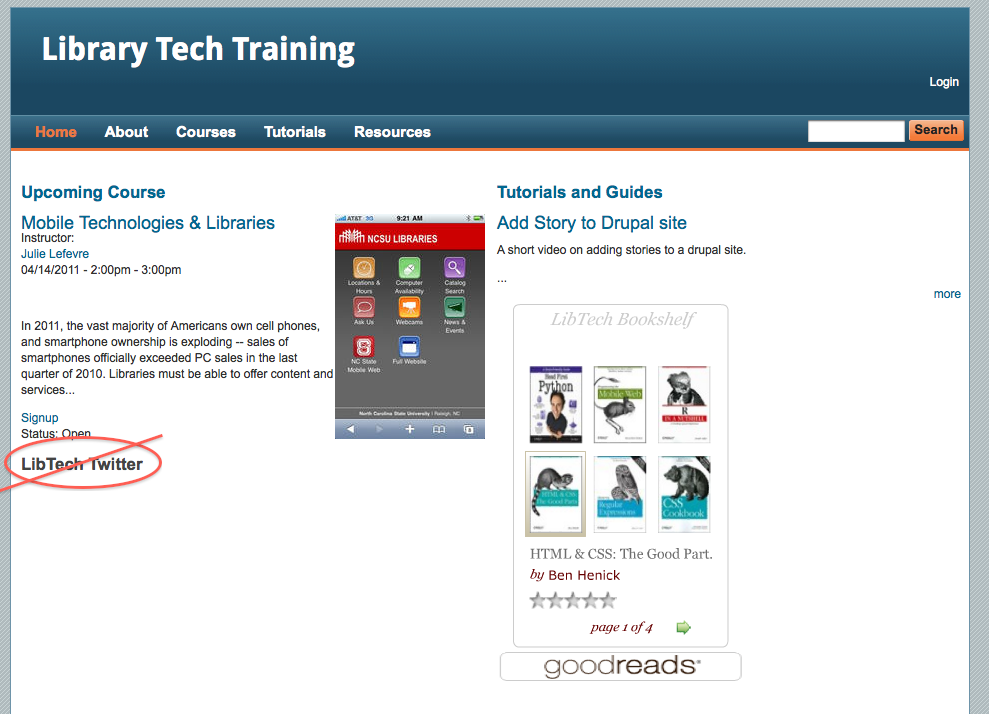
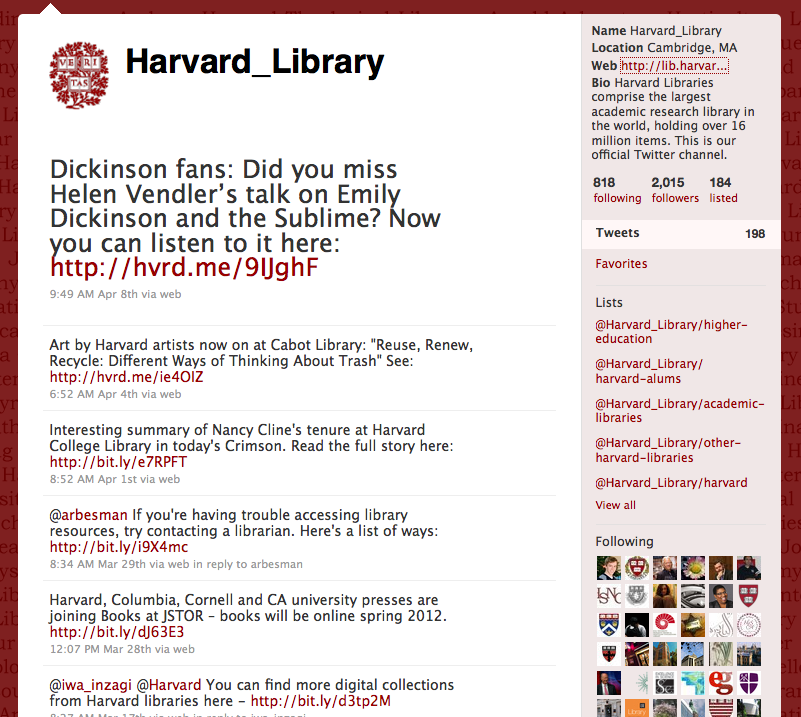
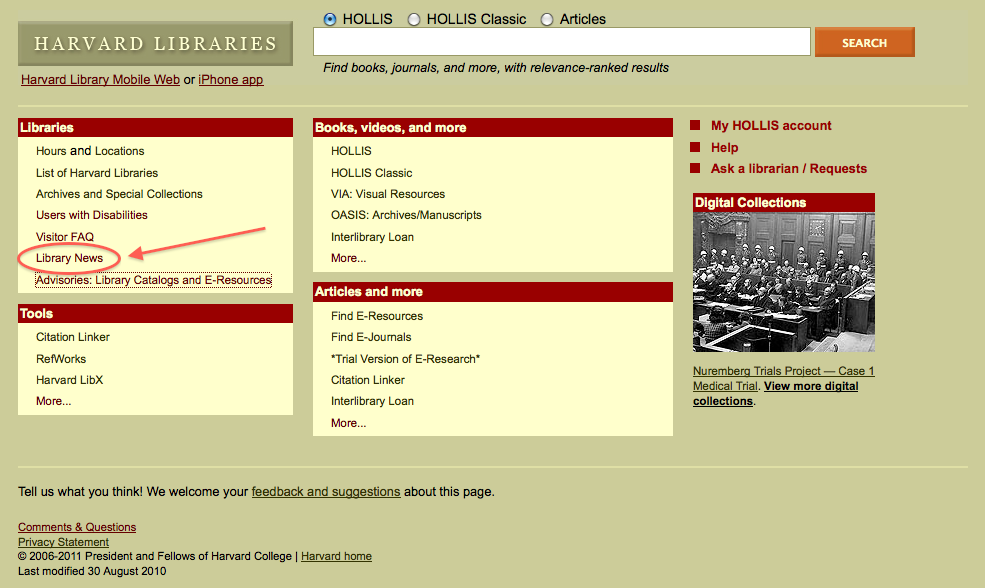
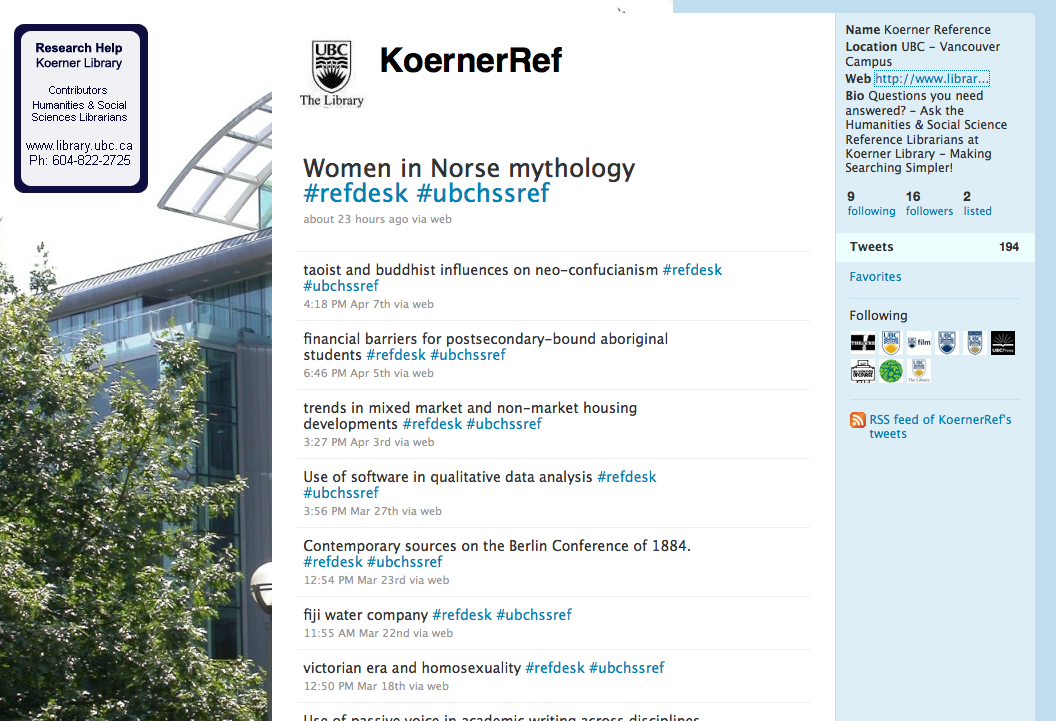
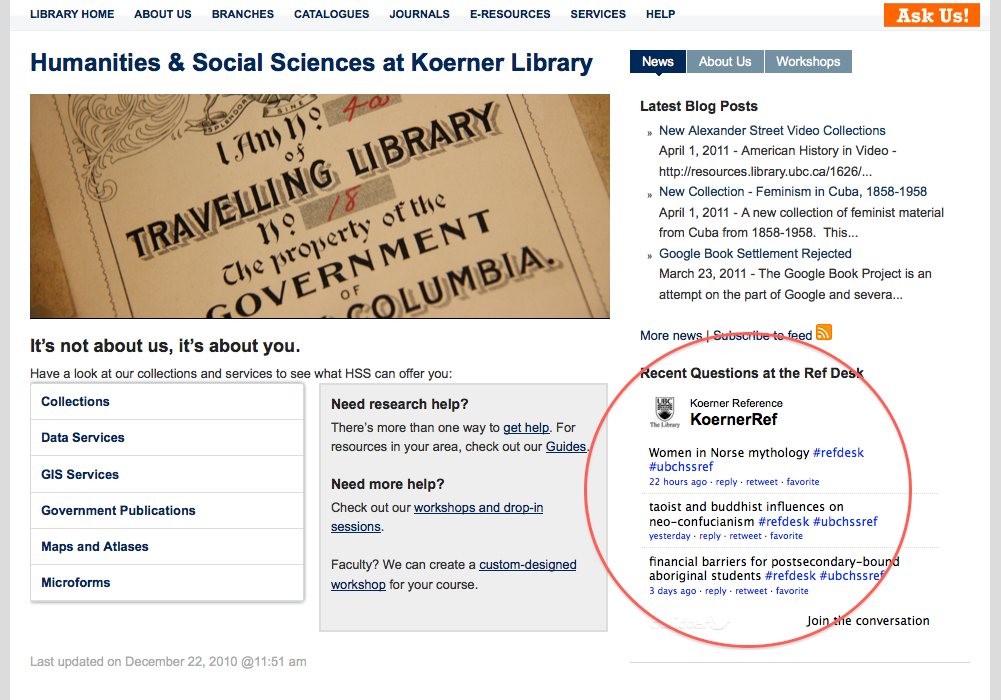
The first notable comparison is that not all three websites offer links to their corresponding Twitter accounts, but all of the Twitter accounts link to relevant pages for further information. Here are the screenshots of each Twitter account, with a corresponding screenshot of their homepage:

UC Berkeley Library Technology Traning: Twitter Account
UC Berkeley Library Technology Training: Twitter Account
UC Berkeley Library Technology Training: Homepage

Some of the UC Berkeley Libraries are utilizing Twitter, some examples include the Bancroft Library, or the Institute for Research on Labor and Employment Library. However, the UC Berkeley Libraries, the main Doe Library at UC Berkeley, and the undergraduate Moffitt Library at UC Berkeley, only have corresponding Facebook accounts. Instead, there is a Twitter account for Doe and Moffitt Library technology training (i.e. dmtech) as a resource for colleagues to remain up to speed on latest technologies. The About page states that the goal of the sessions “is to provide an environment for staff to learn technologies that have practical applications and would help them in their day-to-day jobs.” The fact that there are no links readily available to the Twitter account from the main UC Berkeley Library page, as well as the UC Berkeley Library Technology Training page, that the followers only amount to around two hundred, and that many of the Tweets are Re-Tweets, does indicate the intended purpose of the account is a communication tool between library professionals.

Harvard Library: Twitter Account
Harvard Library: Homepage

The Harvard Library Twitter account, however, seems to have more of a general patron audience in mind. The Tweets are all very clearly related to Harvard Library events, resources, and news with little to no information Re-Tweets, and the account has well over 2,000 followers. Additionally, the Library News link from the Harvard Library homepage is a direct link to the Twitter account feed, and interesting media choice for broadcasting library related news, rather than utilizing RSS feeds.

Koerner Library at UBC: Twitter Account
Koerner Library at UBC: Homepage

The Koerner Library Humanities and Social Science Library at UBC offers an interesting comparison. Despite the rather small following, the library very clearly represents their Twitter feed on the main page, with a very clear articulation of purpose: we’re here to answer your questions and here of some of the kinds of questions we get. The research help information in the background of the Twitter account can be quite helpful for students who are seeking research help; however, it might also be a good idea to include a disclaimer about Tweeting reference questions, or to possibly expand the use of the Twitter account to include news about Koerner Library in general. UBC students might not be as interested in following only random reference questions, unless they believe that it will help them with their own research or studies. For example, it might help to include one link to the relevant subject research guide or one link to a good resource with each question.

Between the three Twitter feeds, I would be more inclined to use the dmtech feed as a library professional, the Harvard_Library feed as a formal library news/update resource, and KoernerRef for general intellectual enrichment. The Doe and Moffitt Libraries at UC Berkeley could potentially benefit from a Twitter account aimed at library patrons, to promote library resources, and library events. The Harvard Library might want to consider an overall better integration of social media services, including the use of RSS feeds and an announcement page for library related news and services. Lastly, KoernerRef could expand their Twitter feed to include links to library resources, as well as include library related news and announcements. Out of the three Twitter feeds, the Koerner Library’s Homepage is the best example of a well integrated use of Twitter.

I can’t say whether or not I’ve been won over by Twitter. The medium does offer certain social networking and informative benefits. However, whenever I think about trying it out, I think about the Futurama episode “Attack of the Killer App”. The episode is basically a parody of all the hype that happens around the “EyePhone” and “Twitcher” applications. Yes, I know it’s pretty silly to base one’s trepidations on a popular cartoon comedy show, but the main moral of the episode was to think before jumping on the next new technology trend. I think that we can all agree about the importance of having clear, consistent, and strategic goals for implementing new technology tools in order to enhance library and information services.

Categories
Info Tech

Web 2.0 Technologies in California Public Libraries

The status of libraries in California has been pretty grim over the last decade. Budget cuts, the rising recession and unemployment rate have had a tremendous impact on state, county, and city libraries in California. A recent article in Education-Portal.com, “Libraries in Crisis: What Budget Cuts Mean for CA Libraries” by Meghan Driscoll summarizes that “Since the early 2000s, over 75% of funds for the programs listed above have been eliminated. This latest round of cuts will mean yet another loss of library staff, a potentially deep reduction in library hours and limited availability of books and other materials.” According to a Library Journal article by Michael Kelley the budget cuts will lead to a collapse of a 30-year-old resource-sharing network, such as interlibrary loan services. Whether or not such decisions constitute a “shock and awe” budgetary approach, the goal of which “is to inspire middle class voters to come out in June to vote for a revenue-raising ballot proposal,” as Driscoll states, is ultimately beside the point. What does matter is how California’s libraries will be able to maintain certain levels of services.

Some of you may recall an earlier 2004 California public library crisis, the closure of the Salinas public libraries. Here is an American Library article by Pamela A. Goodes and an ALA 2004 press release that presents a refresher. Lots of changes have happened to the Salinas Public Libraries since 2005. With the help from private contributions and the passage of a local tax measure, the library now features a Digital Arts Lab (as of 2007), a Bookmobile (as of 2009), as well as a new and improved web interface. Whether or not the state of California will rally to the aid of libraries, schools, and universities, is a discussion that is beyond the scope of this entry. However, as a former Californian, I find the issue of what sorts of services are available or provided through local libraries to be of particular interest.

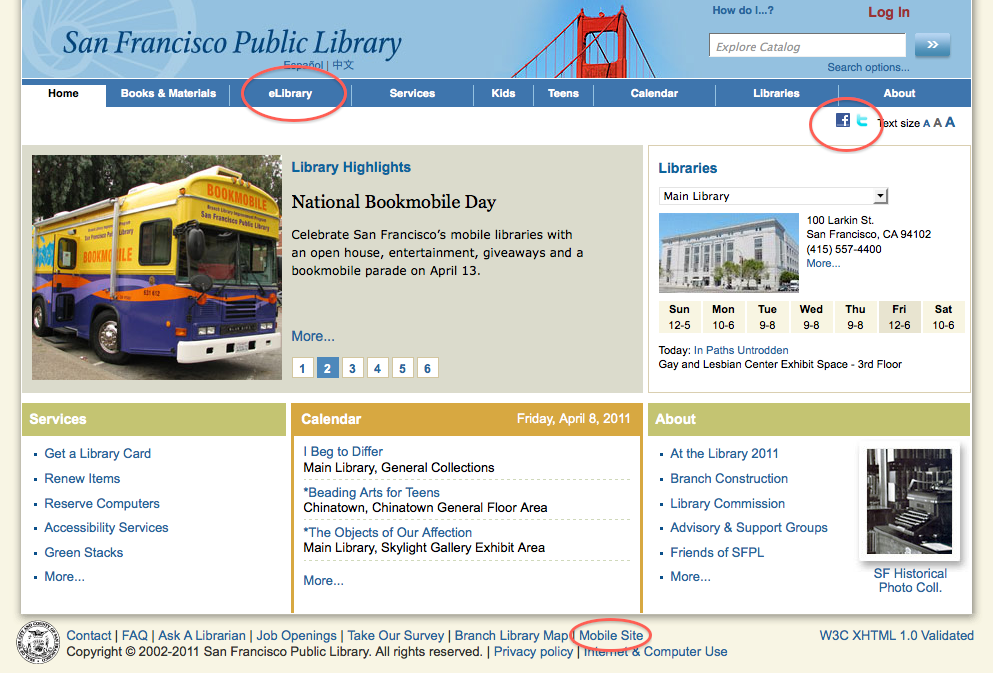
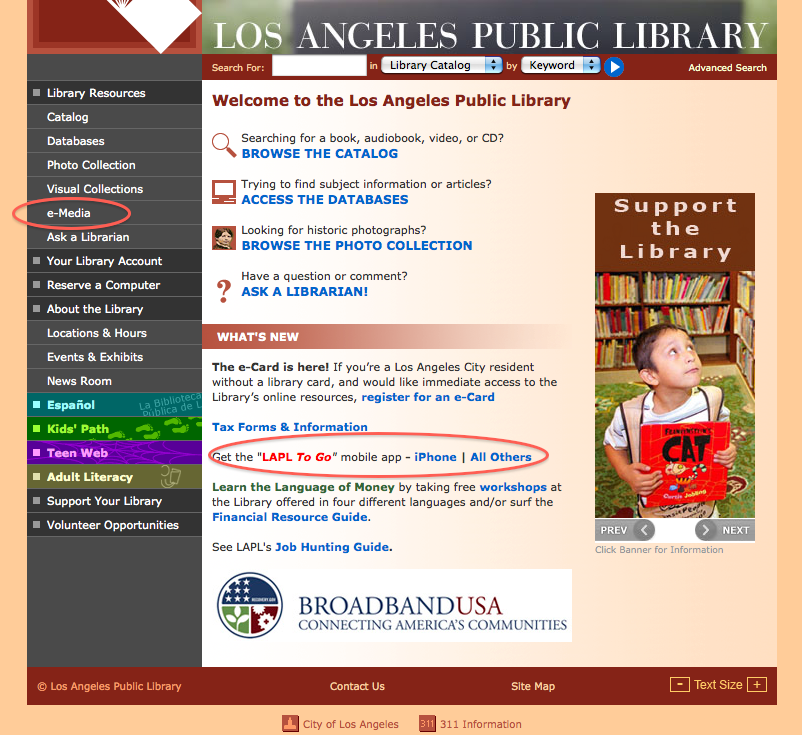
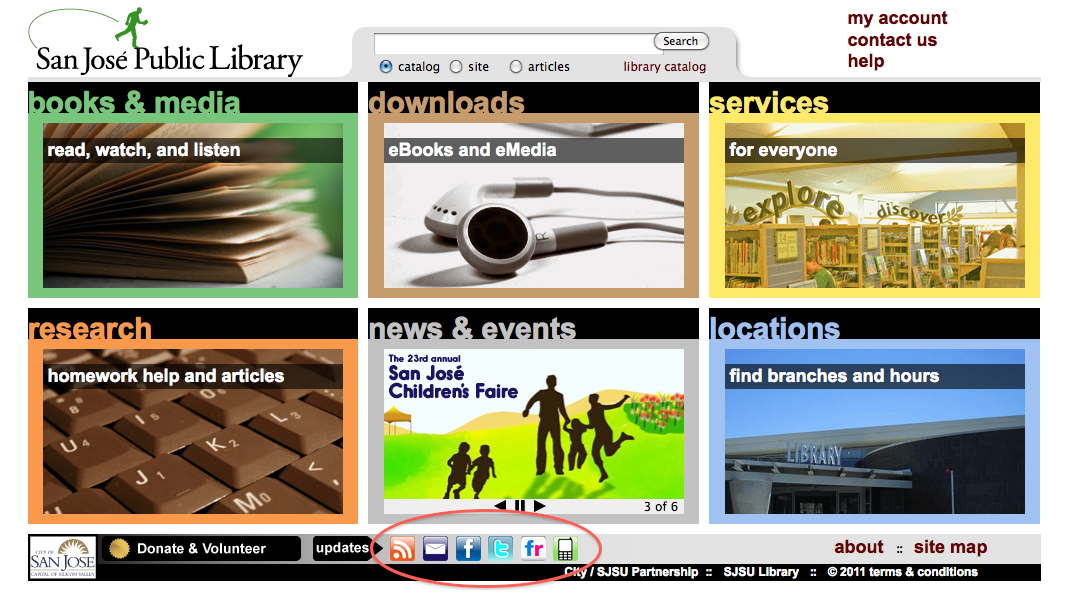
Let’s take a comparative look at a few libraries that feature Web 2.0 services: the San Francisco Public Library, the San Jose Public Library, and  the Los Angeles Public Library. Here are some screen shots of their homepages:


San Francisco Public Library : Homepage
The circles represent the dispersed access points for various Web 2.0 services: mobile services, social networking and microblogging services, and e-library services (which include podcasting, vodcasting, as well as eBooks, eAudiobooks, and eMusic).
Los Angeles Public Library : Homepage

Access points to mobile services and e-Media, such as LAPL podcasts and vodcasts. It’s interesting to note that social media applications are not accessible anywhere on the main page.

San Jose Public Library : Homepage

All Web 2.0 applications are accessible from the icons at the bottom of the page. Out of the three public libraries, this interface features the best and most straight forward access points.

Here is a comparative breakdown of the different services that each public library offers:

San Francisco Public Library Los Angeles Public Library San Jose Public Library
RSS feeds RSS feeds RSS feeds
IM service IM service IM service
Mobile interface Mobile search application Mobile search application
Podcasts Podcasts Podcasts
Vodcasts Vodcasts Vodcasts
Blogs Blogs
Facebook Facebook
Twitter Twitter
Delicious Flickr
LibraryThing
GoodReads

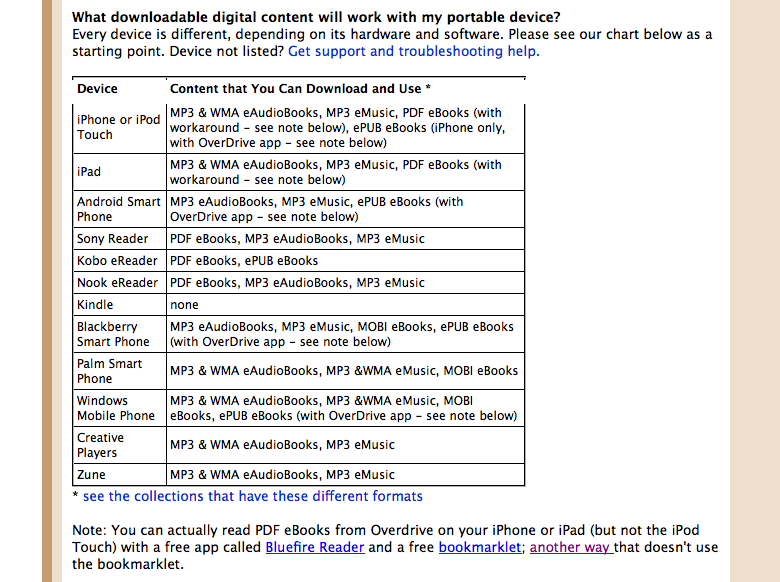
Couple of contrasting points worth mentioning. One point is the surprising lack of social media software utilized at the Los Angeles Public Library. Out of all Web 2.0 features offered, the mobile search application was the most prominent and easiest to find, with podcasts and vodcasts following second. RSS feeds could only be found after a thorough website search. The San Jose Public Library on the other hand had RSS feeds for practically everything, and nearly all Web 2.0 services are accessible from the Get Updates page. Additionally, between the three library sites, the San Francisco Public Library utilized more social bookmarking tools geared for reader advisory services. A last point of interest, is the technology service focus of the San Jose Public Library, exemplified by the device format listing on the FAQs About Digital Content page:


Device/Format Chart for Digital Content


Let’s take a closer look at podcasts and vodcasts, since all three libraries utilizes these services. The SFPL offers very limited podcasting in comparison to the SJPL and the LAPL. SFPL podcasting spans from 2007-2009, featuring local readings, spoken word, discussions, and performances. SJPL podcasts span from 2010-2011 and are mainly composed of poetry readings and staff pick recommendations. The LAPL features three different podcast programs, Children’s podcasts from 2008-2009, interviews and talks on Richard Neutra the architect, and the ALOUD at Central Library speaker series. The ALOUD series has been a part of the LAPL since 1993 and features “leading figures in the worlds of literature, the arts and ideas. These dynamic programs are designed to contribute to an informed, engaged, and democratic community and to foster life-long learning in a welcoming environment. The great majority of ALOUD programs are presented free of charge to the people of Los Angeles” (from ALOUD at Fora.tv). Between the three libraries, the LAPL offers a strong variety of podcast topics, spanning over a 10+ year period. The utilization of vodcasts also offer an interesting comparison. The SFPL, again seems to offer surprisingly little in terms of diverse topics and readings. SJPL, on the other hand, has a wide variety of vodcasts centered on community events, story times, staff picks, library tours, and overall community participation all featured on the library’s blip.tv channel. Again, the LAPL’s vodcasting exclusively features ALOUD talks, lectures, and discussions.

The use of podcasting and vodcasting offers an interesting snapshot of how each library frames their services. The lack of user-centered social media services at the LAPL and the overall top-down podcast and vodcast programing, frames the LAPL as a kind of cultural mecca. The SJPL on the other hand, utilizes vodcasting as an archival and broadcasting tool for community events and participation, offering a very clear picture of the kind of communities these libraries serve. The SFPL seems to be situated somewhere in-between, offering some forms of top-down programming but with some awareness of the importance of having some user-centered services, albeit with inconsistent application. However, it is important to keep in mind that these differences may have more to do with funding and budgetary constraints, rather than mere variations in community or user orientation.

Between these three libraries, I would probably be more inclined to use the SJPL vodcasting services if I were a new local patron wanting to get a sense of my local community, and the LAPL podcasting and vodcasting for cultural enrichment. For SFPL, I might be inclined to utilize their social media applications for reader advisory purposes, but I would be less drawn to their limited podcast and vodcast programming. I do think that the SFPL and LAPL could learn from SJPL website interface, user-centered focus, and overall usability regarding Web 2.0 applications and I think that the SFPL would benefit from re-evaluating their social media strategies, goals and purposes in support of local communities, local writers and authors, or local issues within California generally.

…and on that note, I’d like to end with a reference to a SFPL video talk with Stacy Alderich, California’s State Librarian, and her discussion of the California budget crisis and where libraries are heading. What I find particularly interesting is her focus on technology trends rather than on the overall statewide trend of slashing funding for public services and the plateaued unemployment rate. Again, it does seem as though California has been facing larger structural issues that go beyond the question of “How can we offer the same level of services for less?”

OK, I’m off of my soap box.


Spam prevention powered by Akismet