Instructions
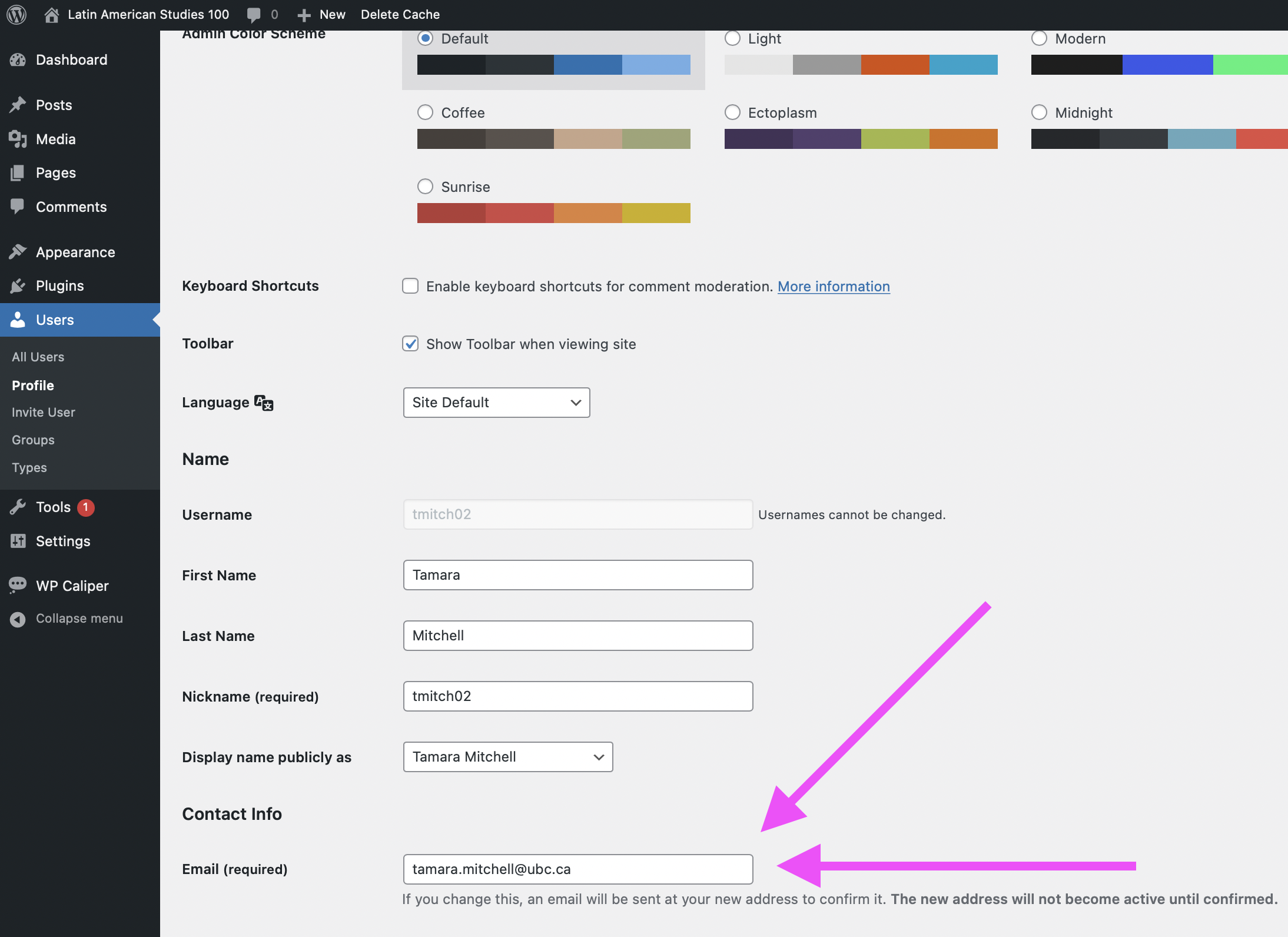
All LAST315 students are “authors” of the present blog. If you are not, write Tamara via email/Canvas Inbox with the email address that is associated with your UBC Blog account (see instructions below), and she will add you as a user.
To create a new post, make sure that you are signed in at ubc.blogs.ca. Then, from our LAST315 homepage, click on the “+New” button at the top of the blog (see yellow arrow in screenshot below), which will open a new entry page. You must be signed in to create a new blog post. If you don’t see the “+New” button, go to blogs.ubc.ca and sign in, then come back here and try again.
- All students should become authors on the blog no later than September 21 so that you can post an “I am from” poem + bio (Sept 21) and comment on 2 classmates’ poems (Sept 28).
- Beyond the “I am from” poem, each student will:
- create one assigned post where you reflect on that day’s materials before arriving to class.
- compose one unassigned post of your choosing (also submitted before class)
- Your posts should NOT comprise summary or mere observation. You should think critically about the materials for that week, which means you might: make connections across different readings; think about the text in relation to context and the history of the region; posit social norms or power structures that the readings bring to the fore; reflect on key concepts from the reading; etc.
- After you’ve written your post, create a short, descriptive title that encapsulates the entry in a few words.
- Use heading, font, bulleted lists, etc. strategically to make your post more dynamic.
- In the righthand column of your in-progress post, you’ll see an option for tags, which you should use to make your post easier to navigate. You are asked to include a tag for the appropriate unit in the following format: unit1 (no capitalization, no space, no punctuation, no quote marks). You may use other relevant tags as well, such as food item (e.g., amaranth), country, main themes, etc. See Tamara’s sample post for examples.
Tamara will create a sample blog post during Weeks 2-3 to give you some ideas on how to write a dynamic, conversation-starting post. She looks forward to reading and engaging with your posts, either in writing or during our class discussions.
General Guidelines
See blog & comment instruction doc on Canvas Files.
Posts
- 1 “I am from” poem + bio (deadline: 11:59PM, Monday, September 21)
- TWO reflection posts total, one assigned and one self-selected.
- Deadline: Noon, before class discussion on the day of the main reading you are meditating on. This will allow you to create original reflections “untainted” by class discussion, and Tamara will have time to look over posts before class.
- 250-400 words. More is not necessarily better. A thoughtful, generative post of 250 words is preferable to a rote “summary” post of 400 words.
- No late submissions. Given that there are many opportunities for blog posts, no late posts will be accepted.
Comments
- 5 comments total:
- 2 comments on 2 different classmates’ “I am from” poems (deadline: Sept 28)
- 3 comments on classmates’ blog posts reflecting on different readings (deadline: Before the following unit begins)
- ~60-100 words. Substance is more important than word length! If you thoughtfully engage with a classmate’s post in 60 words, that will earn an excellent mark; whereas comments that merely repeat what a classmate wrote in a verbose 100 words will earn a lower mark.
- No late comments. Given that there are many opportunities to comment on your classmates’ posts, no late submissions will be accepted.
- Think of comments as a chance to build on the reflections offered by a classmate. You might add details or nuance to their reflections, introduce a new angle to the observations they have offered, bring in another text or a keyword to complement their reflections, etc. If you disagree with a classmate, no problem; but please do so in a constructive, respectful way.
Content Suggestions
Take time to reflect on materials. Consider what you found challenging or thought provoking. Posts are meant to serve as initial reflections on materials in preparation for class discussions. Some useful approaches might be:
- put the reading/film in dialogue with another reading from the unit
- put a text in dialogue with one of Tamara’s lectures
- compare/contrast the assigned reading(s) with what you’ve learned in another unit
- ask questions / share queries that a reading elicits; begin to answer those questions
- put an assigned reading in dialogue with something we have touched on in class discussions
- bring to light current events (in local or national news) in relation to readings
- dive deep into a particular concept or term that is proposed
- approach a concept, term, or reading from your disciplinary training (anthropology, literary studies, philosophy, geography, land systems, etc.)
- engage in depth with a classmate’s post (link to it if you do this)
- bring in etymology
- note if your opinion has changed due to a reading and explain why
- compare something you learn about Mesoamerican foodways with your own practices
- home in on a historical fact or segment of the reading and investigate it further; investigate one of the concepts in a text more deeply
- there are many other options!
- AVOID: “like/dislike” judgments; we can learn from a text even if we did not like it!
- AVOID: summary. Blog posts should NOT provide a summary. We all read the same materials, so jump right in to reflecting critically on texts / films!
- DO: cite your sources! If you bring in an outside source, link to it and/or provide a citation.
AI policy
Among our learning outcomes are: Read critical works with attention to methodology and theoretical perspective; Read primary works and formulate original opinions and interpretations of content. Blog posts respond to these and other learning outcomes that invite your original, critical reflection on LAST315 materials.
For this reason, while you may use AI tools like Claude or ChatGPT to help you understand material, the use of artificial intelligence is not allowed for producing content or writing your blog posts.
Your classmates and I want to engage with your ideas, even if those ideas are provisional and in progress.
Troubleshooting
You may find that you are periodically are not able to create a new post, and the problem is typically that you were signed out of the blog. If, mid semester, you are suddenly unable to post, please go to https://blogs.ubc.ca and sign back in with your CWL. Then return to our LAST315 blog and try to post again. That typically fixes the issue.
If you are having more complicated issues, you can always check with me, but my knowledge is limited. UBC Blogs hosts a very helpful weekly WordPress Clinic on Thursdays (1-3PM) that you can sign up for if I am unable to solve an issue.
Becoming an author on the blog
-
log in at blogs.ubc.ca
- go to our LAST315 site
-
click on the square a the top right, beside your name (see image below)
-
Scroll halfway down the page to the contact email and send me the email address beside “Email (required)”