Volunteering for AMS Speakeasy

‘Speakeasy is like your boyfriend,’ a friend complained a few months ago. ‘Every time I want to hang out with you, you’re already doing something with Speakeasy.’

Aside from my objection that I do too(!) take care to spend regular time with friends even when I’m dating, the comparison isn’t so far off the truth. Ever since joining this AMS service in 2008, I’ve been spending more and more time every year doing whatever needs to be done to keep it running smoothly, simply because I love it so much. My friends are used to booking me at least three to four weeks in advance during the school year because I’m usually so busy with class, work and volunteering.

Before nattering on about my experiences, though, here’s a run-down of what Speakeasy is, for those of you who don’t know about it:


What is Speakeasy?

(AKA ‘Tell me about him/her!’)

AMS Speakeasy is a free, confidential, student-run peer support service for the UBC community. We provide a safe space in which students can come and discuss whatever is on their minds. Common topics include (but are not limited to): relationship concerns, academic stress, anxiety, depression, suicide, substance abuse, eating disorders, loneliness, and more. Our volunteers are trained to listen without judging and to help students work out what they need, working from the philosophy that every individual is the expert in his/her life. We provide resources and referrals to other organisations, many of them within UBC, as well as off-campus ones.

Most people know us unofficially as ‘that information desk on the north side of the SUB concourse’. During the school year, you can generally see volunteers staffing the desk from 9 to 5 on weekdays, giving directions, maps and general information to the many students, staff and tourists who come by.

Peer support is done on a drop-in basis, which means you will generally get the support you need when you ask for it. Once in a while, there will already be someone in the peer support room, in which case you can come back after an hour, but this doesn’t happen very often. To get a peer support session, all you need to do is approach one of our volunteers and say that you would like one. The room itself is tucked away in a corner to provide some privacy.

Our support sessions are offered on a one-time basis, as our volunteers are not trained or accredited to provide more than one session at a time. We can, however, offer referrals to organisations that do provide ongoing counselling if this is appropriate.

We no longer offer a crisis line (this was suspended in 2008). Our reception desk phone number is for general enquiries only; we cannot provide peer support over the phone.
 

Why I volunteer(ed) for Speakeasy

(AKA ‘Why do you like him/her?’)

As is abundantly clear by the length of this post, I can go on and on about Speakeasy once started. This is due in no small part to the community of amazing individuals we have each year, and everything I love about the service we provide.

1. First and foremost is being allowed to sit with someone and listen to their concerns.
It’s a privilege to be confided in, and to provide a measure of support. Although we get a few drop-ins each week, spaced out over 48 volunteers, that means as individual volunteers, we may only have a couple of drop-ins throughout the year. It’s quite uneven: a few unfortunately never have a drop-in, while others have a fair number. Each drop-in I have got has reaffirmed my belief in the importance of having a peer support service at all.

2. The skills and training I’ve received from Speakeasy has broadened my understanding of other people like nothing else.
I have learnt far more about being a good support person, about sexuality, mental health, depression and suicide prevention, than anywhere else — all of which I’ve needed in non-Speakeasy contexts. Ironically, I’ve given more support to the friends and acquaintances I know outside of Speakeasy than in an official peer support capacity; being here has taught me how to better be ‘there’ for the people I care about.

3. We get such a wonderful community every year.
Speakeasy was the first organisation at UBC in which I felt a real sense of community. It’s no surprise: everyone who joins is a caring, generous individual who genuinely wants to help their fellow students. If you want a warm and fuzzy feel-good place to be, this is one of the best candidates for that position. Many are the times I walked into the volunteer lounge intending to walk straight back out and ending up chatting animatedly for three hours (or more); I have met several good friends through Speakeasy and have loved the weekly bonding sessions with my shift partners over the years. Also, given the nature of what we do, it’s like having a ready-made support network when you need one!

4. I like answering questions at the desk.
Yes, that’s right: I actually like drawing places out on maps, telling people that the washrooms are down the hall on the left (then watching them go right), and trying to help someone who doesn’t speak English fluently. Part of this is because I remember how incredibly lost and foreign I felt when I first arrived in Vancouver (although I spoke perfectly good English), and I know exactly what it is to live in a place where you don’t speak the local language fluently (which was most of my life). Mostly, I like to smile and ask someone how I can help and wish them a good day. These are tiny things, but no matter what else I haven’t done in a day, it makes me feel good to know I did something for someone, however small.

So what’s up with the past tense in ‘volunteer(ed)’?

Well, having been together for three years (so to speak), and having moved from being a general volunteer to being a Team Leader for two of them, I’m happy to announce that Speakeasy and I have taken our relationship to the next level and I am now working as the Assistant Coordinator for the 2011/12 academic year. It’s all approved by the Co-op office, too, and I now have hope of finishing my co-op requirements. Hurrah!

(Actually, I started this job two months ago, but I didn’t feel like making it official back then. Ha.)
 

What does volunteering for Speakeasy entail?

(AKA ‘What do you guys do together?’)

Volunteer expectations vary year to year depending on the Coordinators of the service. This year, it’s going to be:

1. Desk shifts (2 hours every week)
The most visible part of being a Speakeasier, when you sit at the desk to answer questions, provide maps, directions and general information to everyone who comes by. This is the time in which you will do a drop-in peer support session, if anyone comes for one.

2. Team Leader (TL) meetings (1 hour every other week)
Ongoing, in-depth training in a smaller team of 7 or 8 (out of a total of 48 volunteers), headed by one of our volunteer Team Leaders, to continue practising your peer support skills and expanding your knowledge of how to handle and refer a range of issues.

3. Project meetings and project work (approximately 2.5 hours every week)
This is a slight variation on the way things were set up last year, but essentially, there will be two main divisions within the overall organisation:

  • External: Promotions, outreach & collaboration with other groups
  • Internal: Ongoing training materials, internal resources & internal social events

Once a month, there will be an hour meeting in which each division will meet to discuss, review and plan projects relevant to their portfolios. 3 Team Leaders (TLs) are assigned to each group. Once projects have been identified, it is up to volunteers and TLs to work out further meeting times to work on these projects.

(Past projects have included: booths in first-year residences, a Speakeasy Photo Booth, creating informational pamphlets on issues such as self-care, anxiety and depression, and our own twice-monthly social events.)

4. Training retreats (mandatory)
We have a major training retreat at the beginning of each term. On account of all the training volunteers need to receive in order to provide peer support, attending training in full is mandatory.

This year, our training will be:

  • September: Thursday 16th (UBC, 5-7 pm), Friday 17th (Gambier Island, whole day), Saturday 18th (Gambier Island, whole day), Sunday 19th (Gambier Island, until 4 pm), Saturday 24th (UBC, 9-6 pm)
  • January: TBA, most likely second weekend of term

We’re working on acquiring letters to excuse students from class on the Friday if you need it (sorry about that). On the other hand, we’re going to a really lovely camp on Gambier Island, and there will be free time to go kayaking, toast marshmallows and yes, do your homework if you are so inclined. But at least there will be time, which we haven’t been able to do in past years.

Note: As I write, the times for Saturday 24th September aren’t yet set in stone; we’re still working out the details of that day.


If you’re interested in volunteering for Speakeasy…

(AKA ‘If you’re interested in sharing the current love of my life… the more the merrier!’)

The 2011/12 Volunteer Application Guide and New Volunteer Application Form are currently available on our website. Round 1 application deadline is on August 19th and Round 2 is on September 8th (please read the Guide for details on the difference). Interviews are currently in progress and I am so keen on meeting our new volunteers — we’ve already hired and trained an excellent group of Team Leaders, and the year is promising to look very, very good.

If you have any questions, feel free to leave a comment, email me at speakassist@ams.ubc.ca, or the Coordinator at speak@ams.ubc.ca. (I promise never to talk quite so much about this again!)

Moon-watching

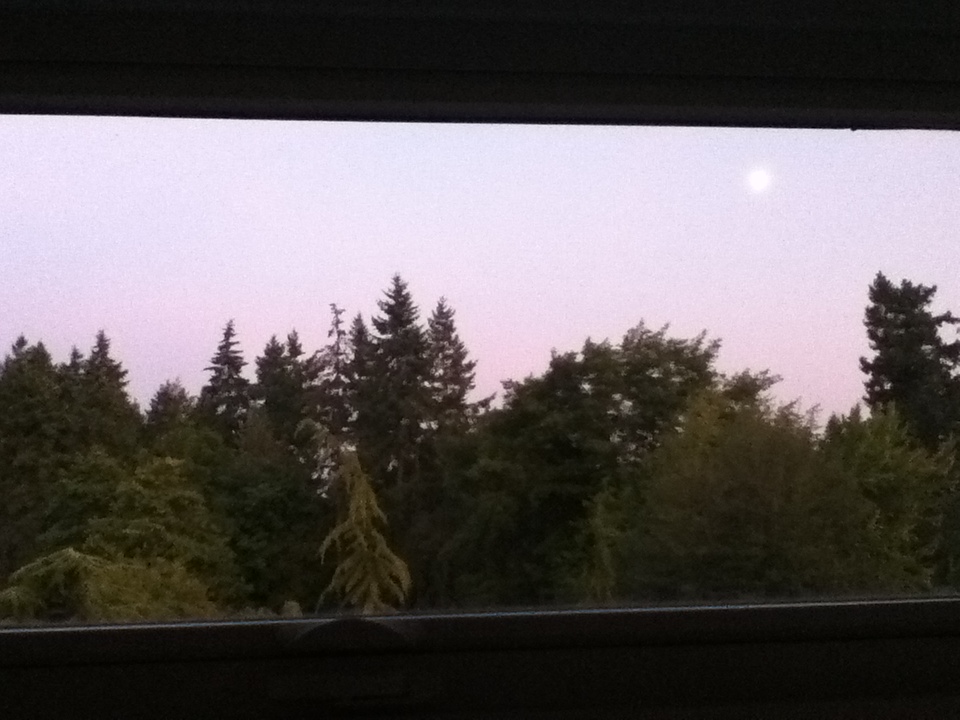
I’ve been watching the moon pass from its low vantage point, peeking through the cedar giants on the road outside my window, to rise high in the sky that is still blue, westward-bound. And it strikes me that this is the first time I’ve really watched the moon move, instead of moving myself.

Like all very young children do, I looked at everything my little eyes could take in and wondered about the world, question after question, some of which I asked aloud and others which I didn’t. One such unspoken puzzle was the mystery of the moon and why, no matter how fast I ran or the car went, and no matter how carefully I hid myself, it was always there. No one else ever seemed to talk about this strange phenomenon, let alone notice it, so I was left to conclude that there was something uncanny at work that happened only to me.

Obviously, I was being followed by the moon.

Incidentally, this may or may not explain why I believed myself to be the centre of the universe. Everyone’s universe. (Or perhaps that’s just because I was the baby of the family.)

At any rate, my brother eventually disarmed me of any solipsist notions I might have developed by explaining that the moon follows pretty much everybody. Not entirely convinced that I wasn’t special, I continued trying to cheat the moon — for even just one second — for a while, but in the end, resigned myself to watching the moon watch me.

Of course, if I’d been able to sit still for long enough, and if minutes hadn’t felt like hours (and hours, days), then I would have found that the moon moves along its trajectory in the sky whether you are there to notice or not.

Sometimes far too quickly.

(My iPod doesn't do the view the least justice and I'm too much a dunce with my actual camera to make it stop pretending it's still light out, so pixellated image it must be.)

Things I Love Thursday

Once in a while, I find myself thinking on the same theme from different angles over and over. This week, it’s all about the stars (interspersed with other things):

♥ Here’s a beautiful thought from Lawrence Krauss:

Every atom in your body came from a star that exploded. And the atoms in your left hand probably came from a different star than your right hand. It really is the most poetic thing I know about physics. You are all stardust. You couldn’t be here if stars hadn’t exploded. Because the elements, the carbon, nitrogen, oxygen, iron, all the things that matter for evolution weren’t created at the beginning of time. They were created in the nuclear furnaces of stars. And the only way they could get into your body is if the stars were kind enough to explode. So forget Jesus. The stars died so you could be here today.

♥ I was catching the shuttle bus back home last Friday night and the very nice bus driver brought me all the way to the driveway of Marine Drive residence because they shut off Agronomy Road and Southwest Marine Drive is pitch black at night, what with no lamp-posts. How kind!

♥ How the stars shine, even through all the light pollution.

♥ The fascinating Biomimicry: Innovation Inspired by Nature by Janine Benyus, on learning from nature’s designs and implementing them in human ways. It’s a little dated in parts — it was published in 1997 — but I love the philosophy, her enthusiasm, and her beautiful, clear writing.

♥ The wonderful Pride Parade on Sunday and my new collection of party beads to remember it by.

♥ Thai green curry: my latest craving. I’ve literally been eating it everyday since Sunday, yet I’ve started dreaming about it anyway.

♥ My lovely friend who visited me yesterday while I was incapacitated.

♥ This cover of Coldplay’s ‘Yellow’ by Sara Bareilles — although I love the original best when I’m in an upbeat mood, this mellows me out on tired days:

[youtube=https://www.youtube.com/watch?v=E2Pqc_hpkJc]

HealthLink BC

Did you know that BC residents can call 8-1-1 for non-emergency medical enquiries?

When you first call, you will need to give a brief summary of what you are calling about and who you would like to talk to: a registered nurse, a pharmacist, or a dietitian. Be prepared to give your BC CareCard number and other identifying information such as your name, phone and address.

I just rang them up for the first time regarding a minor injury I have that isn’t worth going to the doctor for unless it gets worse; the nurse I spoke to was very nice and gave me good advice on home treatments and symptoms to watch out for in case things do deteriorate.

HealthLink BC also has most of this information online. They have a really detailed ‘Check your symptoms’ quiz as well, that is a sight more reliable than reading people’s questions on Yahoo! Answers, for one.

Disclaimer: None of this is an actual replacement for going to a doctor. Use your common sense: if you’re in significant pain and/or are experiencing unusual symptoms, seek medical attention.

The meanings of home

you can go wherever you please but it's the insides you cannot leave

One of my best friends from secondary school has recently been blogging a lot on questions of home and what that word means. Having recently returned to Hong Kong to pursue her post-graduate studies after obtaining her BA from the University of Toronto, she is thinking about place, identity and friendship. If you’re interested in discussions on these, I highly encourage you to take a look at what she’s saying; she is an extremely articulate young woman who puts me to shame.

Having said that, I haven’t commented on her posts directly (although we’ve chatted about them) because I’ve been thinking about my own ambiguous relationship with the idea of home, an experience that is quite different, in some respects, to her current challenge of returning on a more permanent basis (for now) to a place from which she has long been absent.

Over the past four years, I have returned regularly to Hong Kong, twice a year for the winter break and for parts of the summer for the first three, and then once a year beginning in fourth year. I expect that to decrease even further in the future as I move around and make my home elsewhere, but I will always go back to Hong Kong to visit my friends and relatives. Go back: a phrase suggesting that is the place I originate from — because that is the place in which I spent all my conscious memories until I was eighteen and moved here for university. Whether I like it or not, my whole existence was in one city for the vast majority of my life, and it affected me in many fundamental ways that even now can’t be properly expressed to someone who isn’t from the same place or culture.

Regardless, I never did feel ‘at home’ in Hong Kong growing up. Not being, strictly speaking, Cantonese, I got a considerable amount of grief from some locals who were less than kind about my not being a sufficiently ‘Chinese’ person, whatever that means. Ironically, while I revel in my own difference in Vancouver, my childhood hurts from Hong Kong still stick like burrs I haven’t yet learned to shake off. If I were to be completely alone in either place, I would choose Vancouver a hundred times over, no question.

But home, for me, isn’t about being alone: it’s about belonging to a people, to a place. It means, more than anything else, having people who love me as an individual and being interwoven in the fabric of their lives. It meant that, despite not being comfortable among strangers in Hong Kong, I adored the friends and family I had in Hong Kong with every passionate atom in my body. With them, I did feel at home, and when I left, I was heartbroken and terrified that I would never again find people to rely on and trust and love that much.

I’m not sure why I thought it was a good idea to come to Vancouver without a friend in sight; I don’t think I realised how incredibly attached I was to them, or how terrible I was at change (or both). It’s always taken me a painfully long time to open up fully to other people, even as I handle small talk without a worry, so it took me three years to build up a sufficiently strong social support group to feel genuinely happy again. In those three years, I had a couple of friends I felt comfortable enough to speak freely with, but you can’t burden one or two people with your whole life all the time. So I didn’t feel ‘at home’ in Vancouver for a long time, even while I loved this place and the people in general more than I’ve ever cared about Hong Kong.

In those three years, I frequently despaired about my own ineptitude (as I saw it then) in building a new life for myself from scratch. Other people seemed to do it just fine, within months, really, so why did I still feel so out of place three years later? Every time I thought I was doing splendidly in Vancouver (and on the surface, I was doing just fine), I’d go back to Hong Kong and realise how much happier I could be, and that would throw me out of whack when I got back to Vancouver, wondering what I was still not doing right.

And then I felt increasingly out of place in Hong Kong, too.

My first few trips back to Hong Kong were wonderful: this was the place that still felt most like home to me in first and second year, and most of my friends were back there visiting at the same time I was, so we got to see and spend time with each other frequently. Of course, as time wears on, people change, make different plans, carry on with their own lives. The home I missed so much was increasingly a construct of the past, something that existed with people I loved in my memories, who aren’t necessarily the same individuals they are now.

This summer, I went back for five weeks, and my main conclusion is that I was there for too long. My parents work six days a week, I only have three friends left there at the moment, two of whom are working, and I had almost nothing to do because I accidentally left all the homework I planned on doing on a desk in Vancouver. Almost all the things I want to do and enjoy are here in Saltwater City, not Fragrant Harbour (much as I enjoy the shopping and eating there). Here, I have a job, school, many more friends, and several personal projects to work on at any given time: my life is here, now. And as relieved as I am that I’ve inverted my emotions and feel considerably more comfortable here than when I first arrived, it unsettles me that a place that was the definition of home for me for some good twenty years or so is no longer quite that, anymore.

When a best friend in Vancouver said ‘Welcome home!’ this year, I said ‘Yes’ hesitantly because it’s not yet a certain feeling with me, as much as I don’t feel at home anywhere else. It’s the ridiculously clean cut between my life in Hong Kong and my life in Vancouver, the fact that hefty chunks of my past go unrecognised because there is no one to recognise them, that leaves me feeling not quite whole. Four years don’t negate seventeen other ones, after all — but seventeen old ones can’t always continue claiming precedence over four new ones that have wrought significant changes in me.

Now I use ‘home’ in several different ways depending on the day and the situation. I call my residence my home, I call where my brother lives home home (even though neither of these feel like that). I say I’m going home when I’m preparing to fly back to Hong Kong and mean it until I get there. I excitedly tell all my friends that I’m home when I’m back in Vancouver because I want to mean it and sometimes do. There are days when this matters to me and days when it doesn’t.

Mostly, when people ask, I tell them that I’m from Hong Kong and that I now live in Vancouver. More importantly, there is nowhere else I would rather be. I count myself lucky to live in a place like this, among people who love me. One day, perhaps, I’ll call this place home without hesitation or reservation.