Chapter 3. Ethnographic Mapping

Image: “Paths through Vancouver” by Erica Fischer, via flickr, licensed under CC BY-SA 2.0
At a glance…
While maps seek to represent space, they inevitably simplify, exclude, and naturalize particular spatial narratives. Traditions of counter-mapping and critical cartography expose how mapping practices reflect and reproduce power relations, often reinforcing colonial and state imaginaries. Ethnographic mapping, by contrast, centers participants’ lived spatial experiences and relational understandings of place. In the hands of ethnographers, mapping becomes both a methodological tool and a mode of critique or activism. Participatory, community-driven approaches treat maps not as neutral data displays, but as co-produced representations shaped by context, meaning, and movement.
Learning objectives…
By the end of this chapter, you should be able to:
- Critically analyze the representational limits of conventional maps, recognizing how cartographic practices can reproduce dominant spatial narratives and naturalize power relations.
- Explain how mapping practices have historically been implicated in colonial, state, and extractive projects, and how alternative cartographic practices challenge these histories.
- Evaluate the potential of ethnographic mapping as a participatory and community-centered method, capable of capturing lived experience, relational space, and situated knowledge.
- Identify key ethical and methodological considerations in participatory mapping projects, including power dynamics, authorship, and representation.
- Apply ethnographic mapping techniques in a practical context, using tools such as building plans, transect walks, or participatory annotation to explore how people engage with and make meaning of space.
- Discuss how ethnographic mapping can function as a tool for advocacy, empowerment, and social change, particularly for marginalized communities.
In this chapter…
3.1. Introduction: The paradox of maps
3.2. Ethnographic maps: Some considerations
3.3. Learning activities
3.4. Showcase
3.5. Insight from experts: Mapping worlds
3.6. Suggested readings
3.7. Other resources
3.8. Ethnographic Mapping Tools
3.9. Creating heatmaps in Tableau
3.10. Works cited
3.1. Introduction: The paradox of maps
Argentine writer Jorge Luis Borges, in his short story On Exactitude in Science, captures the paradox at the heart of all mapping practices:
…In that Empire, the Art of Cartography attained such Perfection that the map of a single Province occupied the entirety of a City, and the map of the Empire, the entirety of a Province. In time, those Unconscionable Maps no longer satisfied, and the Cartographers Guilds struck a Map of the Empire whose size was that of the Empire, and which coincided point for point with it. The following Generations, who were not so fond of the Study of Cartography as their Forebears had been, saw that that vast Map was Useless, and not without some Pitilessness was it, that they delivered it up to the Inclemencies of Sun and Winters. In the Deserts of the West, still today, there are Tattered Ruins of that Map, inhabited by Animals and Beggars; in all the Land there is no other Relic of the Disciplines of Geography.
—Suarez Miranda,Viajes de varones prudentes, Libro IV,Cap. XLV, Lerida, 1658
This story reminds us that all maps are, by necessity, reductions. While we may strive for detail and accuracy, a map that mirrors reality too precisely becomes functionally useless. Yet the imperfections and omissions in a map are never neutral. Decisions about what to include, what to exclude, and how to represent space reflect particular histories, epistemologies, and power relations. Therefore, it is important to carefully examine maps to learn what histories have been excluded from the representation and what labels, toponyms, and borders have been portrayed as natural, static, immutable, and simply cartographical facts. We must be mindful of the consequences of these omissions and naturalizations that are used in dominant mapping practices through which “geographical knowledge continues to be produced, acquired and imposed as a fundamental technique of shoring up dominant conceptualizations of […] landscape” (Hunt and Stevenson 2017, 374).
A critical approach to mapping—often called counter-mapping—challenges the presumed neutrality of conventional cartography. Counter-mapping seeks to expose the omissions and silences in dominant spatial narratives and to assert alternative, often decolonial, geographies (Hunt and Stevenson 2017, 373). In this view, maps are not objective containers of information, but contested texts shaped by social, cultural, and political forces.
As Tucker and Rose-Redwood (2015, 197) remind us, maps and their constituent features, including place names, are “always-already power laden” and emerge through historically situated struggles over meaning and representation. Like other texts, they can be analyzed for their voices and absences, purposes and audiences, and their capacity to be reinterpreted or reclaimed (Bryan & Wood 2015).
This chapter introduces ethnographic mapping as a set of practices that foreground the spatial, social, and organizational dimensions of field sites. Unlike top-down cartographic representations, ethnographic maps are grounded in the everyday practices, relationships, and movements of participants.
3.2. Ethnographic maps: some considerations

Maps have been a part of ethnographic fieldwork since the early development of the discipline. In Argonauts of the Western Pacific, Malinowski (2014[1922], 49) emphasized “extensive maps, plans and diagrams” as among the “more fundamental documents of ethnographic research,” using them to record land ownership, hunting and fishing rights, and other territorial arrangements.
Despite this early adoption, anthropological engagement with maps remained largely uncritical for much of the twentieth century. The representational and political dimensions of cartography—especially its entanglements with colonial and state power—were often overlooked. (for an exception, look at Pulla (2016) for a brief history of “counter-mapping as an applied practice within anthropology” through the anthropological work of Frank Speck, a student of Franz Boas, on the family hunting territory in early 1900s.)
If used critically and responsibly, maps can help us in our ethnographic research, not only as a method of collecting data or representing the findings of our research, but also as an often participatory methodological tool and a means for activism.
When used critically, however, mapping can be more than a method of documenting spatial information. It can also serve as a participatory methodological tool, a medium for collaborative knowledge production, and an instrument of resistance. As Powell (2010, 553) observes, maps reveal the mutual constitution of self and place, drawing attention to how identity is shaped by physical, historical, and symbolic landscapes. Mapping, when approached reflexively, highlights how spatial relations are experienced, interpreted, and contested by those within them.
In this context, ethnographic mapping—particularly its critical and counter-mapping variants—offers a means of representing space not from a detached, top-down perspective, but through the situated experiences and knowledge of participants. It aligns with methodological commitments to collaboration, reflexivity, and accountability. As such, it invites ethnographers to attend to the following considerations:
Power and Representation
Maps are never neutral representations of space. They are shaped by the epistemologies, priorities, and positionalities of those who create them. As critical cartographers have argued, cartographic practices have historically been used to justify territorial control, support colonial expansion, and institutionalize dominant understandings of geography. The authority of the map often lies in its appearance of objectivity—even when it obscures histories of dispossession or violence.
For example, government-issued cadastral maps that delineate property lines often reflect settler-colonial frameworks that erase Indigenous land claims and spatial practices. Similarly, urban development maps may ignore or misrepresent informal settlements, rendering certain communities effectively invisible in planning processes.
In ethnographic research, counter-mapping can expose these dynamics by visualizing alternative spatial narratives. For instance, Indigenous communities in the Philippines have used counter-maps to assert ancestral domain claims in the face of mining encroachments (Peluso 1995). These maps document not only territory but also relationships to land, seasonal cycles, and spiritual geographies, challenging dominant cartographic paradigms rooted in extractive governance.
Community-Centered Knowledge
Ethnographic mapping should begin not with the researcher’s categories, but with the spatial knowledge and concerns of the communities involved. This means reorienting mapping away from extraction and toward mutual learning. It requires asking: What spatial relations matter to the community? What boundaries, flows, or territories are meaningful to them? What stories do they associate with particular places?
For example, in participatory projects with unhoused communities, researchers and advocates have co-created maps that document critical spatial knowledge—such as locations of shelter access, public washrooms, food distribution, and areas of frequent police surveillance. One such project, “Mapping the Margins” in Los Angeles, worked with unhoused individuals to identify areas of vulnerability and resilience, producing visualizations that informed local policy and supported grassroots advocacy (Cope & Elwood 2009).
By prioritizing community-centered mapping, ethnographers validate forms of expertise that are often dismissed by formal cartographic systems. This practice shifts mapping from a mode of observation to a mode of recognition and co-authorship.
Participatory Method
A participatory approach to mapping entails the active involvement of community members throughout the research process—from defining what should be mapped to deciding how it should be represented. This approach is not simply about including participants but about redistributing authority over the research process.
Participatory mapping techniques may include community-led sketch mapping, collaborative use of GIS technologies, and mapping walks (also called “transect walks”) where participants guide the researcher through spatially significant routes. For example, in participatory health research, residents of Nairobi’s informal settlements have mapped environmental hazards such as waste accumulation and open sewers—information that was then used to advocate for infrastructural change (Corburn & Karanja 2014).
These methods foster deeper engagement, ensure greater accuracy in representation, and enable the map to serve not just academic purposes but community goals.
Alternative Cartographic Forms
For example, Yolngu Aboriginal people in Australia have produced bark paintings that convey geographic knowledge, land ownership, and ancestral narratives simultaneously—maps that cannot be reduced to a Cartesian coordinate system but are rich in cosmological and relational meaning. We can also consider “emotional mapping” to visualize differently (e.g., through marks in public spaces) feelings and relationships in urban space, representing safety, discomfort, or desire alongside physical landmarks.
These approaches challenge the notion that maps must be spatially precise in a Euclidean sense and instead treat mapping as a representational and affective practice.
Mapping for Empowerment and Activism
Ethnographic maps can also function as tools of resistance, self-determination, and political mobilization. When co-created with communities, maps can help visualize marginalization, advocate for rights, and support collective action.
For instance, Bryan and Wood (2015) describe how Zapatista communities in Chiapas have created their own territorial maps that emphasize relational and community-based understandings of space, in contrast to the state’s cadastral and military cartographies. In this capacity, maps do not aim for cartographic precision; rather, they communicate political claims, relational ties, and local knowledge systems.
In settler-colonial contexts, Indigenous-led mapping have been used in legal battles to assert land rights, demonstrating that mapping can be both a cultural and legal tool for reclaiming space.
Back to Table of Contents
3.3. Learning activities
Watch and reflect
Watch this documentary about (32 minutes) about (counter-)mapping. Think about the following questions:
How does the way people featured on the video talk about maps can inform our understanding of ethnographic representation in general (beyond maps)?
- What does Denis Wood mean by ‘angry map-makers’? Can you imagine ‘angry ethnographers’? Does our discipline need them? What would they be angry about?
- When Philippe Rekacewicz discusses radical cartography, he similarly mentions that the first step is to look at the world and notice ‘unacceptable’ things with which one is rightfully ‘upset’. He, and some other people featured on the video, also mentions that maps can be used as means for activism. Does ethnographic representation (beyond maps) have the potential to affect positive change in the world and encourage activism? How can ethnographic accounts more effectively support activism?
Learning by doing
Start with the architectural plan of the building in which your department is hosted (if you don’t have access to the building’s architectural plan, you can use the fire safety plan that’s usually posted on a wall close to the entrance or create a simple spatial map of the building yourself). Take a copy of the map with you and go on a walk inside the building. How is the map different from the built environment it represents? What features are not represented in the map?
Reflect on your past and current experiences in the building and write about those experiences on the corresponding places on the map as you take the walk: “I go hide here to destress before my class presentations;” “Lily’s coach is against this wall. It is what I check first thing every time I am in the building to see if I can find my best friend, Lily;” “This is the smelliest part of the building. My pace get faster naturally whenever I approach this part of the building;” “Avoid this table in winter. The drafty window next to this table makes it impossible to sit here for long.”
Review your notes on the map and reflect on this paragraph where Martin (2022) differentiates ethnographic maps from spatial maps.
Ethnographers have long been interested in spatial maps because cultures are often better understood when the physical spaces occupied by the people of those cultures are taken into consideration. Ethnographic maps are different from traditional maps, however, in that they do not just represent the geographical features of a particular space; ethnographic maps also indicate how people interact with a space, or how particular spatial features interact with cultural practices.
Share your annotated maps with your class-colleagues (only share what you are comfortable sharing) and create a larger map showing your collective lived experiences in the building. Does the map you made change your understanding of the place mapped?
3.4. Showcase
This StoryMap has been developed by a student research group in an undergraduate ethnographic field methods course at UBC (ANTH407 W2 2024-25). The group members—Kezia Kawamura, Aidan Lee, Anita Bai, and Sarah Spicer—conducted an ethnographic study of Vancouver’s LunarFest as part of the class project theme “Pop-Up Culture.” The team investigated how this annual Lunar New Year celebration fosters identity, connection, and cultural expression within Asian Canadian communities, while navigating broader histories of systemic exclusion. Drawing on participant observation, semi-structured interviews, and site visits across multiple locations—including Vancouver’s Chinatown, Granville Island, and downtown—the group used the map (in addition to their written report) to integrate their spatially distributed observations and interview data. By situating narratives, images, and reflections within the city’s geography, the StoryMap demonstrates how mapping can serve as an analytical and communicative tool in ethnographic research, allowing researchers to connect multi-sited fieldwork into a coherent, place-based account. (click here, to view the map in fullscreen.)
3.5. Insights from Experts: Mapping Worlds
How a UBC researcher uses maps to redefine boundaries
There is a critical need for language mapping in urban areas with large migrant and immigrant communities, whether Kathmandu, New York City, or Vancouver. It is important to put marginalized language communities on the map, both literally and figuratively, using collaborative and representative approaches in ways that make their presence visible and so that they can be included in social programs and policies from which they have been excluded. From a methodological perspective, mapping is underutilized in illustrating local imaginings of space and the complexities of language practices. Language mapping is a tool that can be harnessed by marginalized communities to render themselves visible, to highlight injustices, and to create their own stories.
– Maya Daurio; In a UBC Public Scholars Initiative interview

UBC graduate student Maya Daurio cuts disciplinary boundaries, conveying linguistic, cultural, and scientific data through interactive maps. Given their power and fixity, maps have historically been used as an imperial tool but as Daurio’s work exemplifies, they can also be used to subvert established boundaries and colonial projects, unearthing and illustrating other social realities. Daurio uses mapping both as a methodology to raise new questions and inspire collaborative engagement among her informants, as well as a way of expressing her findings. Daurio’s research involvement ranges from geospatial mapping of wildfires and cultural mapping of socio-ecological knowledge among agricultural systems in Nepal to tracing linguistic diversity in New York City in collaboration with ‘The Endangered Language Alliance’. As Daurio’s work highlights, maps represent worldviews; they reflect how different people move through and understand spaces and “how mobility impacts their frame of reference.” Mapping techniques in anthropology are, as Daurio remarks, also compatible with walking and walking interviews, as movements across and relationships to place shape work to inspire different thoughts and conversations. Both the methodological techniques and final representations that mapping affords offer the potential for increased public engagement. First, in providing visual presentations that pertain to public life, and as a way of inviting and sharing individuals’ layered lived experiences in places. As a public scholar, Daurio’s research facilitates wider access to data and dialogue between fields, enabling a distribution of information that helps to address the power asymmetries inherent in conducting research. In their presentation of cultural knowledge and individuals’ experiences, maps can also serve to display existing frailties and inequalities as they graph onto material realities, whether it be through language, ecological vulnerability, or migration, mobility, and settlement. These attributes position Daurio’s interdisciplinary and multimodal anthropology as a form of translation, representation, and empowerment.
For further reading, please click on the links to other projects and papers by Maya Daurio:
- Ecologies of Harm: Mapping Contexts of Vulnerability in the Time of COVID-19 (led by Dr. Leslie Robertson and in partnership with Stephen Chignell)
- 2012. Maya Daurio. “The Fairy Language: Language Maintenance and Social-Ecological Resilience Among the Tarali of Tichurong, Nepal.” Himalaya 31 (1 & 2): 7-21.
- 2020. Daurio, Maya, Sienna R. Craig, Daniel Kaufman, Ross Perlin, and Mark Turin. “Subversive Maps: How Digital Language Mapping Can Support Biocultural Diversity—and Help Track a Pandemic.” Langscape Magazine Vol. 9, Summer/Winter 2020, “The Other Extinction Rebellion: Countering the Loss of Biocultural Diversity.”
- 2021. Perlin, Ross, Daniel Kaufman, Mark Turin, Maya Daurio, Sienna Craig, and Jason Lampel. “Mapping Urban Linguistic Diversity in New York City: Motives, Methods, Tools, and Outcomes”. Language Documentation & Conservation 15 (October): 458–90.
Discussion Question
How can Maya Daurio’s approach to mapping languages in urban areas contribute to the visibility and inclusion of marginalized communities, and what implications may this have for social programs and policies?
Back to Table of Contents
3.6. Suggested Readings
kollektiv orangotango+. 2018. This Is Not an Atlas: A Global Collection of Counter-Cartographies. Bielefeld: transcript Verlog
An open-access book, This Is Not an Atlas gathers more than 40 counter-cartographies from all over the world. This collection shows how maps are created and transformed as a part of political struggle, for critical research or in art and education: from Indigenous territories in the Amazon to the anti-eviction movement in San Francisco; from defending commons in Mexico to mapping refugee camps with balloons in Lebanon; from slums in Nairobi to squats in Berlin; from supporting communities in the Philippines to reporting sexual harassment in Cairo. This Is Not an Atlas seeks to inspire, to document the underrepresented, and to be a useful companion when becoming a counter-cartographer yourself.
Powell, Kimberly. 2016. “Multimodal Mapmaking: Working Toward an Entangled Methodology of Place” Anthropology & Education Quarterly. 47(4): 402-420
Abstract: This article addresses mapmaking as a multimodal method and lens for place-based ethnographic inquiry. I describe three contexts drawn from my research on and teaching of mapmaking. Drawing from my own sense-making of mapping as an embodied phenomenon, I discuss how the fields of sensory and materialist studies might expand the interpretive possibilities of multimodal ethnography as an epistemological and ontological lens involving the entanglement of place, body, and experience with knowing and becoming.
Brody, Hugh. 1981. “Maps and Dreams”, Douglas & McIntyre
Synopsis: The Canadian subarctic is a world of forest, prairie, and muskeg; of rainbow trout, moose, and caribou; of Indian hunters and trappers. It is also a world of boomtowns and bars, oil rigs and seismic soundings; of white energy speculators, ranchers, and sports hunters. Brody came to this dual world with the job of “mapping” the lands of northwest British Columbia as well as the way of life of a small group of Beaver Indians with a viable hunting economy living in the path of a projected oil pipeline. The result is Maps and Dreams, Brody’s account of his extraordinary eighteen-month journey through the world of a people who have no intention of vanishing into the past.
Martin, Tom. 2022. “Ethnographic Mapping”, Tyner-Mullings, Alia, Gatta, Mary, & Coughlan, Ryan (eds.). Ethnography Made Easy. New York: CUNY
This is a chapter in an open-access textbook on ethnographic research. The chapter discusses why ethnographers need to consider the role of location and surroundings in their research and how maps can contribute to filed research as a valuable tool for recording how participants interact with physical environments and other people. Ethnographic maps go beyond traditional maps by representing not only geographical features but also the interactions and cultural practices within a space. While our focus here is spatial maps, the chapter also provides the reader with information on how maps can be used to represent non-spatial phenomena such as life histories, organizational structures, and processes. These maps provide a unique perspective on participants’ lives and support the goals of the research project. The chapter also introduces resources and techniques for ethnographic map-making, including, working from pictures, using video, utilizing copyright-free resources, or collaborating with participants. These maps help capture and interpret the complexities of human action and interaction in research settings.
Hunt, Dallas & Stevenson, Shaun. 2017. “Decolonizing Geographies of Power: Indigenous Digital Counter-mapping Practices on Turtle Island”, Settler Colonial Studies, 7 (3): 372-392
Abstract: This paper addresses the decolonizing potential of Indigenous counter-mapping in the context of (what is now called) Canada. After historicizing cartography as a technique of colonial power, and situating Indigenous counter-mapping as an assertion of political and intellectual sovereignty, we examine the digital map of Amiskwaciwâskahikan (Plains Cree for Edmonton, Alberta) produced by the Pipelines Collective, which overlays Treaty 6 Indigenous maps onto ‘conventional’ maps to denaturalize and challenge colonial renderings of city space. We then discuss the expanding trend of guerrilla mapping techniques engaged in by Indigenous groups, emphasizing the Ogimaa Mikana project in Toronto, wherein Anishinaabemowin names were stickered over settler street names. Expanding the spatial theories of Michel de Certeau and Gilles Deleuze, and drawing on the research and insights of Indigenous scholars Jodi Byrd and Mishuana Goeman, our paper considers how emerging digital counter-mapping efforts offer ambivalent possibilities for Indigenous peoples to assert their presence in material ways.
Back to Table of Contents
3.7. Other Resources
- Sensory Maps is a mapping project where different places’ smells are recorded on maps. For example, look at this project recording the smellscape of a hospital.
- University of Victoria Ethnographic Mapping Lab.
- The Mapping method page at the Urban Ethnography Lab.
- WalkingLab (a SSHRC-funded international research-creation project.)
3.8. Ethnographic Mapping Tools
These tools let you create ethnographic annotations as points, paths, and areas on either an interactive world map or a floor plan, architectural drawing, or any other image. Fieldnotes are stored locally in your browser and can be filtered, searched, exported, and imported.
3.9. Creating Heat Maps in Tableau
Tableau is a powerful data visualization software that allows users to connect, visualize, and share data in an interactive and intuitive way. It enables users to create a wide variety of visualizations, including maps. Both instructors and students qualify for free licenses of the program.
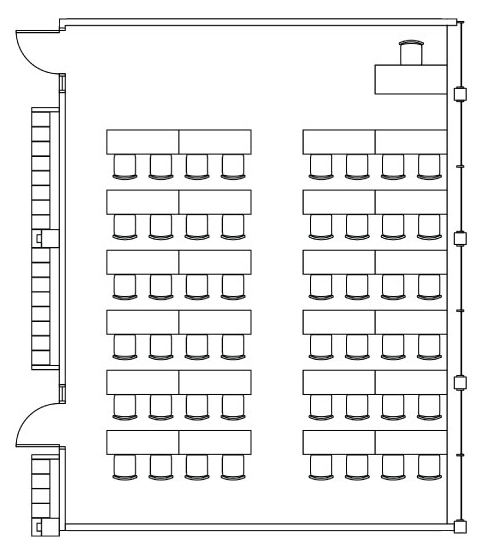
The following video is a screen recording demonstrating the creation of a heat map in Tableau. The heat map illustrates the instructor’s (Amir’s) positions in the classroom during 11 class meetings. To generate the map, you will need the spreadsheet that records the instructor’s locations in the room (e.g., podium, front left, first rows, etc.) and an image of the ‘map’ or plan of the classroom (BUCHD317).
Better quality video and step-by-step instructions are coming soon!
3.10. Works Cited
- Bryan, Joe & Wood, Denis. 2015. Weaponizing Maps: Indigenous Peoples and Counterinsurgency in the Americas. New York: Guilford Puhlications.
- Cope, Meghan, and Sarah Elwood. 2009. “Qualitative GIS: Forging Mixed Methods through Representations, Analytical Innovations, and Conceptual Engagements.” In Qualitative GIS: A Mixed Methods Approach, edited by Meghan Cope and Sarah Elwood, 1–12. London: Sage.
- Corburn, Jason, and Chantal Karanja. 2014. “Informal Settlements and a Relational View of Health in Nairobi, Kenya: Sanitation, Gender and Dignity.” Health Promotion International 31 (2): 258–69. https://doi.org/10.1093/heapro/dau100.
- HarrassMap Team. 2018. “Mapping Sexual Harrassment in Egypt”. kollektiv orangotango+ (eds.) This Is Not an Atlas: A Global Collection of Counter-Cartographies, Bielefeld: transcript Verlag. 126-129.
- Hunt, Dallas & Stevenson, Shaun. 2017. “Decolonizing Geographies of Power: Indigenous Digital Counter-mapping Practices on Turtle Island.” Settler Colonial Studies, 7 (3): 372-392
- Malinowski, Bronislaw. 2014[1922]. Argonauts of the Western Pacific: An Account of Native Enterprise and Adventure in the Archipelagoes of Melanesian New Guinea. London and New York: Routledge
- Moss, Oliver & Irving, Adele. 2018. “Imaging Homelessness in a City of Care: Participatory Mapping with Homeless People”. kollektiv orangotango+ (eds.) This Is Not an Atlas: A Global Collection of Counter-Cartographies, Bielefeld: transcript Verlag. 270-275.
- Peluso, Nancy Lee. 1995. “Whose Woods Are These? Counter-Mapping Forest Territories in Kalimantan, Indonesia.” Antipode 27 (4): 383–406. https://doi.org/10.1111/j.1467-8330.1995.tb00286.x.
- Powell, Kimberly. 2010. “Making Sense of Place: Mapping as a Multisensory Research Method.” Qualitative Inquiry, 16(7), 539–555.
- Powell, Kimberly. 2016. “Multimodal Mapmaking: Working Toward an Entangled Methodology of Place.” Anthropology & Education Quarterly. 47 (4): 402-420.
- Pulla, Siomonn. 2016. “Critical Reflections on (Post)colonial Geographies: Applied Anthropology and the Interdisciplinary Mapping of Indigenous Traditional Claims in Canada during the Early 20th Century.” Human Organization. 75 (4): 289-304.
- Tucker, Brian & Rose-Redwood, Reuben. 2015. “Decolonizing the Map? Toponymic Politics and the Rescaling of the Salish Sea.” The Canadian Geographer / Le Géographe canadien, 59 (2): 194-206.