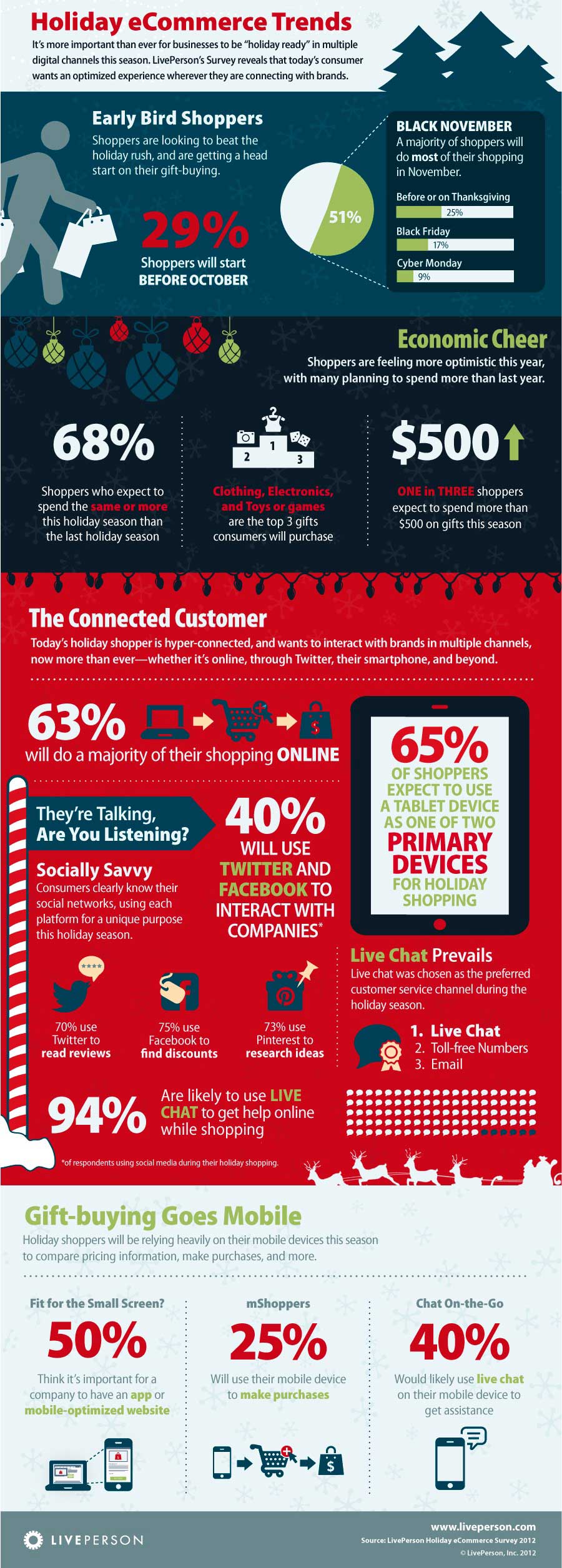
I came across this interesting article: 10 Trends for Online Marketers in 2012 on Entrepreneur.com while surfing the net for project inspirations.
The article has listed the top 10 marketing trends, with advices to help you determine if the trend is “ready for takeoff” and worthy of your time and money now, or “still boarding” and better for you to just test out.
1. Deals and Rewards
Ready for takeoff. This will be a year of bargain hunting because the economy is still recovering and consumers have more price-checking tools at their fingertips.
My thoughts: Agree, deals and discounts always appeal to customers. However, unless you are the low cost leader in the industry, you cannot rely on price competitiveness alone. On the other hand, rewarding loyal customers appropriately as part of relationship building can help you retain them and even engage them to be your brand advocates.
2. Mobile Pull Marketing
Ready for takeoff.
Mobile pull marketing means giving consumers ways to interact with your advertising over mobile devices, and pulling them closer to a purchase decision.
My thoughts: Agree. Putting too much information into an advertisement can confuse the customers. Rather, the more efficient way is to attach your product website or QC code to your advertisement so that customers can refer to them for more information and promotions.
3. Mobile Push Marketing
Still boarding.
Mobile push marketing means sending promotional messages through texts and voice calls. It’s still relatively expensive for small businesses to become bulk senders of texts and voice calls. Instead, invest in your email list. Emails are much less expensive than texts and can contain unlimited content.
My thoughts: Should be “Ready for takeoff”? Since the cost of gaining a new customer usually greatly exceeds the cost of retaining a customer (it is often stated that it costs five times as much to attract a new customer as maintaining one), marketers should invest in a database of customers’ contact list in order to send them regular updates via email or other preferred mode of communication. Already, customer mailing lists are commonplace and should be “Ready for takeoff”.
4. Three-Screen Marketing
Still boarding.
Besides the traditional advertisement on television screens, you can advertise on the portable tablet screen with emails, videos and social media, and advertise on the mobile phone screen using loyalty apps that track purchases or promotions that involve the phone at the physical point of sale.
My thoughts: Agree. This is of course assuming that your target customers use all these 3 screens. More importantly, marketers have to ensure that the messages sent across all 3 screens are consistent.
5. Local Online Marketing
Ready for takeoff.
Try some locally targeted ads in national publications in 2012 and make sure they contain locally relevant messages.
My thoughts: Agree. The struggle of Local vs. Global Marketing => Local Marketing is better. Marketing has to be tailored for the target audience in the language they understand and appropriate for the local culture.
6. Proximity Marketing
Still boarding.
Services such as ShopKick and Foursquare let people opt in to receive promotions on their mobile phones from nearby vendors.
My thoughts: Agree. Proximity-based marketing means that consumers will receive marketing information through their mobile devices when they are in the proximity. Hence, it is ideal for malls, department stores, retail outlets and locations with human traffic. Retailers can broadcast ads to mobile devices near their shops to distribute advertising digitally and efficiently. Furthermore, retailers can record all devices identified and messaged, and record which ads/messages are being accepted or rejected by shoppers. Data can be kept for review and future use, to improve advertising effectiveness. Although still uncommon, trials in proximity marketing could help prepare marketers to reach tech-savvy shoppers in the near future.
7. Social Earned Media
Ready for takeoff.
To get a positive review or referral, you have to earn it. That’s why it’s known as “social earned media.” Use a social-media monitoring tools such as Trackur or Google Alerts to find out what people are saying when they mention your company or products.
My thoughts: Agree. Customers tend to trust the content that other customers have posted on third parties websites such as TripAdvisor, Yelp and UrbanSpoon more than what marketers have posted on their company websites. Consequently, prompt management reply to negative comments posted on these sites is important for service recovery and to safeguard the company’s reputation. Research has shown that satisfaction with service recovery leads to a higher level of trust, positive word-of-mouth behavior and, to a lesser extent, the level of loyalty. Furthermore, outstanding recovery results in loyalty intentions which are more favorable than they would be had no failure occurred. This service recovery paradox means that a customer might be more satisfied with a company although they didn’t deliver on their first attempt than if they had delivered the service without errors, if the recovery action is perceived as very good. No doubt, social media is an effective platform to gather feedbacks and interact with customers. Companies should politely ask customers to rate and share opinions of their products/services and get involved in the conversation online.
8. Social CRM
Ready for takeoff.
A CRM (customer relationship management) database is usually used to track people’s purchasing behavior. But don’t forget that your customers share other information about their lives that you can monitor on social media sites.
My thoughts: Agree. With the widespread use of Internet, it is so much easier than before to “listen” to your customers and tailor your marketing plan to the latest trends in consumer behavior.
9. Globalization
Still boarding.
Language translation technology such as WordLens also is making it easier for people to read a website, email or advertisement in their own language.
My thoughts: Should be “Ready for takeoff”? One of the advantages of Internet Marketing is the ability to scale up and reach out to a global audience. People in any countries can easily search the marketing content intended for other countries anyway. The difference is that people in different countries have different needs. Hence, expansions to other countries have to be phased in progressively, starting from the local customers where you are most familiar.
10. Everywhere Commerce
Still boarding.
Paying with a plastic credit card is probably going to go away someday, but not yet. Still, 2012 will offer consumers many more payment options.
My thoughts: Agree. Although other modes of payment are available, credit cards still reign as the leading method of payment for online purchases. Your product and your customers’ buying preferences will influence which payment methods to use. In some countries where credit cards are not as pervasive, marketers may want to consider offering alternative payment methods. Offering multiple payment options is also a means to increase sales by increasing customer convenience. Whichever modes of payment, security is of paramount importance to customers and you need to ensure that transactions are encrypted and handled by a secure server.