Holiday Shopper Attitudes, Channels, Tools, and Trends

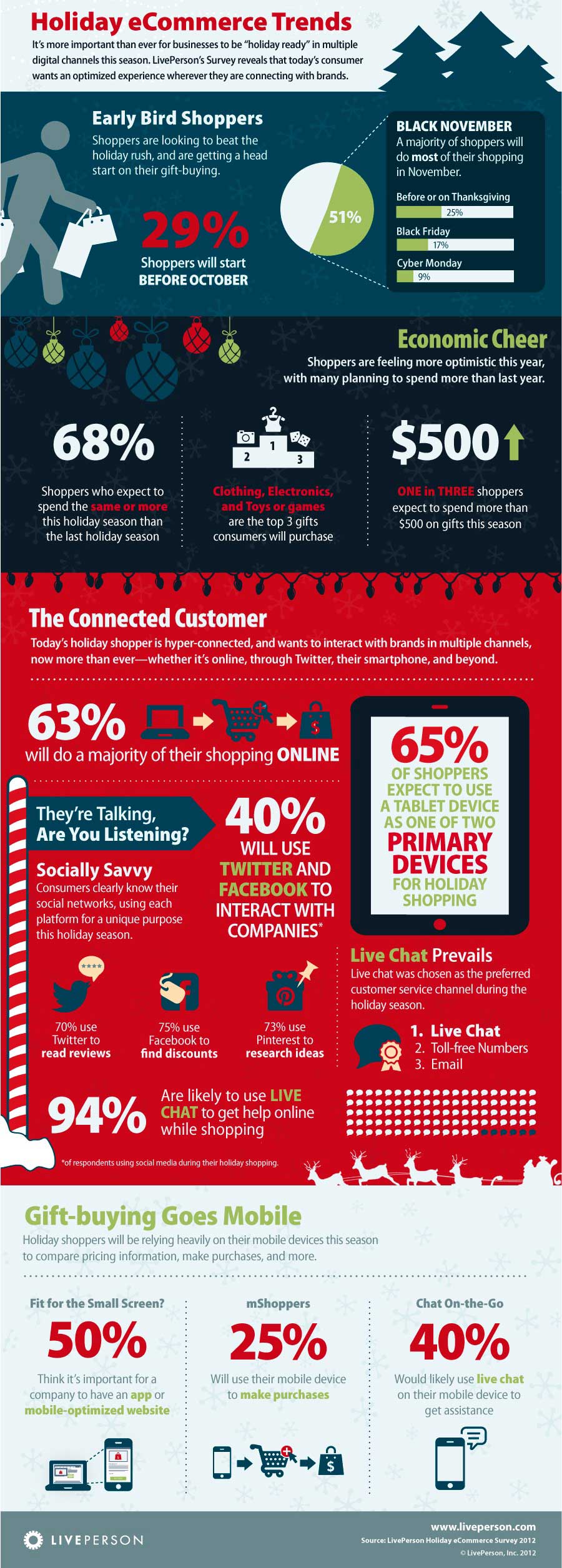
To better understand holiday shoppers and their attitudes about online tools and channels, LivePerson, a provider of real-time online intelligent engagement solutions, conducted its 2012 Holiday E-Commerce Survey.

The 500 respondents were over 18 years old and had shopped online at least twice in the previous three months.

Highlights of the findings about holiday shoppers:

  • 63% of respondents are planning to do a majority of their holiday shopping online, displaying a strong preference for using live chat over other engagement channels.
  • Consumers are showing significant use of social platforms to interact with brands, with just under half of them using such channels as Facebook and Twitter to interact.
  • Increasingly, consumers desire a better mobile experience, and they would like to use live chat via mobile devices.
  • Tablets have become a go-to shopping device, and the majority of respondents (65%) expect to use the tablet device as one of two primary devices they use for holiday shopping.

What the above means for companies is that they have to increasingly invest on social and mobile (both mobile phones and tablets) platform with live chats functionalities to better engage customers.

Below is an infographic summarizing the survey findings.

Internet Marketing & Trust

Steve Olenski, in his article “Is Your Brand Trust Worthy?” pointed out that the issue of trust or lack thereof can stem from the actions of a given brand’s CEO as it pertains to social media.

A CEO survey conducted by BRANDfog revealed that:

  • Consumers are more likely to trust a company whose CEO and leadership team openly communicate via social media about their core mission, values and purpose
  • Consumers are more likely to buy from a company whose values and leadership are clearly defined through CEO and executive leadership participation on social media

The above shown the ever-growing importance and need for the senior management to use social media as a means to engage its customers and earn their trust in the process. Think of how Barak Obama uses social media!

Another study done by MediaBrix  revealed that digital, social and mobile advertising appearing as content can be damaging to brand trust. From the survey:

  • 86% of US internet users had been misled by videos that appeared to be content but turned out to be sponsored ads
  • 57% of those who had seen them in the past 12 months found Facebook sponsored stories misleading
  • 45% of those who had seen them in the past 12 months found Twitter promoted tweets misleading

Advertising that appear to be content can misled consumers and negatively impacted their perception of the brand being advertised.  So DO NOT try to trick or mislead the consumer by hiding under the veil of content marketing.

Indeed, brands’ online content is just as important as their online presence and usually negative comments spread faster than positive word-of-mouth. Hence, marketers have to be extra cautious when navigating the Internet terrain.

Augmented Reality Is Shaping the Future of Retail

In recent years, Augmented Reality (AR) has moved beyond sci-fi movies to become an incredible marketing tool for brands and retailers. The power of AR, particularly for marketers, is its ability to overlay computer-generated content on top of the real world environment. The mix of virtual and real world means that we can access digital data about specific products or services within our physical environment. This opens the door to a highly interactive user experience!

Turns out that in the near future, customers will be able to try on clothes and products at home with no shipping required. Augmented Reality (AR) technology will allow shoppers to virtually wear garments — smelling, hearing and feeling the fabric as if it were real.

Some companies are already using AR to transform online shopping or leveraging geolocational data to augment users’ real-world retail experiences with digital data (eg. instant data on pricing, reviews or special discounts). For instance, Ikea has added augmented reality to its 2013 catalog with new features that let consumers access films, interactive experience and photo galleries with their smartphones. Although augmented reality is still an emerging technology, it will completely change retail in the near future.

This article also features how 2 companies are using AR to market their products.

Brick & Mortar Retailers to go Mobile

McKinsey iConsumer research that 50% of shoppers check their smart phones to compare prices or get product details while they’re shopping. More stunning is that 2/3 of them change their behavior based on what they learn from these checks. That means that 30+% of the retail economy is influenced by in-store price checks.While almost every retailer know that mobile shopping is a growing trend, few are attuned to how quickly this is happening. It’s clear to many of us that mobile is here to stay, and retailers need to deal with it.

More recently, I have also heard of brick & mortar retailers using mobile well. real-time geographic information enable retailers to interact with the on-the-go consumer at key decision points. For example, retailers can now send promotions or coupons to potential customers near them.

To ensure that their offers are most relevant, some retailers are even partnering with companies that have access to extensive consumer transaction data. For instance Visa, has enabled retailers such as the Gap to send messages to the mobile phones of opt-in customers when they scan a transaction near one of Gap’s stores. Gap can tailor the offer based on time of day, customer history, or other personalization methods. This capability allows it o reach their customers while they are on-the-go to stimulate a store visit and, ideally, an incremental purchase as well.

With these real time mobile interactions between customers and retailers, hardcopy flyers and coupons will soon be history.